Naturalist, artist, woodsman — all these descriptions fit John James Audubon, and each of them adds its own color to the story of his life. His personality grips the imagination — unflagging energy drove him from Pennsylvania to Texas, from Florida to Labrador in his unending search for birds; salty humor was capable of self-appraisal; unwavering devotion served Lucy, his wife. Courage and independence armed him equally against frontier dangers and the slander and flattery of civilization. His singleness of purpose never faltered from his youth to his death. Constance Rourke is an authority on the American frontier and American folk-lore. This background and her interest in the natural scene combine to make her portrait of Audubon a rich contribution to American literature.
A biography of the celebrated naturalist, with twelve colored plates from original Audubon prints, and black & white illustrations by James MacDonald.
A boy named Fougere peered through the shutters of a house in the city of Nantes. A procession was passing, gay but a little wild. Men in long red caps swaggered in crowded clusters.
The beginning seems to target children, but the audience shifts to an older target as the story progresses; this is from page 290: Hall had at least been willing to admit that Audubon was an artist. John Neal, a more persistent enemy, denied this on grounds that challenged the very structure of his art, and added personal questions which had no place in reputable journalism. Neal always delighted in controversy; his history shows him frequently in the midst of it, but the reason for so great an animus as he now displayed is difficult to discover.
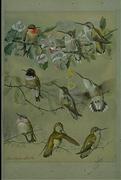
This isn't likely to hold the attention of young readers. Scenes are overly descriptive naming too many plants and birds that aren't familiar to most readers. A map would have helped with this problem, as would a tighter connection to the 12 Audubon prints that are spaced through the text. Most of the prints are not referenced nor are the images Rourke discusses included in the book.
While I did learn a lot about Audubon, I didn't enjoy this book. (It was a Newbery medal nominee, but I agree with the committee, this didn't merit the award.) It just doesn't hook the reader.
This book is too long, but not so badly written that it's length made me quit reading. I did skim many of the descriptive sections, but probably most people picking up a 300+ page biography of Audubon would be more interested in the detailed explorations for birds and plants than I am. Other than an odd comment about how Audubon as a child had the "look of race," this book largely avoided the racism of most books of its time, even included a statement decrying the treatment of the Creek. It was interesting to me to learn that his interest and study in birds did not inspire the conservationism I would expect these days, c especially his trade in bird skins, since I've read The Feather Thief and seen that practice examined on a broad scale. The author also spent what seemed an inordinate amount of time on Audubon's parentage, including quite a number of pages on the now-disproved theory that Audubon was actually the Lost Dauphin, the second son of Marie Antoinette.
I love this book. It was written in 1936 and when you pop it open it smells like a library book from my childhood-yours may be a newer edition but this was a plus for me. There is big simple print and a sensible cover with line drawings at the head of the chapters-I just love it. There are a few badly executed Audubon prints scattered through the book-printing methods at the time couldn't acurately reproduce them I'm sure but they add a little. Her writing is lush with description of people, places and things and is extraordinarily detailed. I learned a lot of interesting things and it was very cool to hear accounts of his travels, especially to places I've been- spotting the St. Augustine lighthouse after a storm, living in the Felicianas, the plantation homes he visited and tutored at. Great book.
Well, by about page 250 it got a little less boring. But it sure was hard to get that far.
This is a story about an amateur bird painter and scientist. It tells the story of how he didn't like his work, how he wasn't very bright with money, and how he tried to improve himself. Again and again and again. Finally he starts getting ready to publish and the book doesn't seem quite so bad anymore.
And the author seems to think that he is actually the lost Dauphin of France. Yeah, probably not. FYI, some DNA testing has confirmed that there actually never was a lost Dauphin of France. The kid that died in prison really was the child of Louis XVI and Marie Antoinette.
2.5-2.75 stars since there were quite a few stories/tales/descriptions that I enjoyed. It's somewhat trepidacious to begin a review with "not the worst book I've read", but the statement is true. This is a biography of the naturalist painter John James Audubon. It is also a history in microcosm of the United States expansion westward out of the colonies. Rourke takes the reader on what seems like every one of Audubon's expeditions and journeys; if she hadn't also been exploring the US expansion this would have been tiresome in the extreme. The reader gets immersed in the means of transportation available in the original colonies and across the Alleghenies, gets exposed to commerce amongst settlers, voyageurs, and First Peoples, and becomes acquainted with the wilderness and natural world of the early 1800s. All that said, I think she could have managed it in 200 fewer pages. Audubon (and his family) spent much of the time in financial straits, a situation that seemed not to bother him much; he also spent much of his married life not cohabiting with his wife Lucy and their sons - he was out tramping and wandering and pursuing various financial ventures. The final third of the book is spent on his attempts to get his birds published - so much information on how that was done! Rourke does include speculation on Audubon's birth even suggesting that he might be the missing heir (the Dauphin) to the French throne, although she admits he may just come from a Caribbean island (where he and his sister were "found"l the online bio states he's the son of the Captain and his island mistress)- he's adopted by a Capt Audubon and his French wife. I read this for my 2017 Reading Challenge "takes place over a character's lifespan" (PopSugar) and "a book about a famous historical figure" (Read World 52) and for my Newbery Challenge (Honor Book 1937).
I assumed this would be a "chore" read as I fill in gaps in my Newbery book collection, but this biography quickly surprised me. While it does not include any of Audubon's paintings or sketches (which is a shame), Rourke produced a quite readable book. John James Audubon was a very interesting person, living at a time when the pristine frontiers were starting to diminish. The story of his naturalist pursuits, artistic development, birth questions, immediate family dynamics, and sheer determination in his life work is almost fascinating. One develops a wish for a similar biographical study of his wife, Lucy Audubon - for she surely must have also been an extraordinary individual.
As an artist's book, this will disappoint. As a biography enveloping U.S. and French history, backwoodsmen, development of a renowned artist, rivalries, and life-work quests, it is a gem.
There is very recent genetic evidence showing that the young French Dauphin was killed during the Revolution; this puts the kibosh to the most tantalizing intrigue surrounding Audubon's origins, as we now know he could not be the Dauphin, spirited away to preserve his life during that upheaval. Still, that discussion from the time of this book's publishing, 1936, is entertaining, and we remain with the debate that he could have been either the son of a Caribbean mistress, or another French noble child saved from the Revolution.
Regardless of whether you like Audubon art, this biography tells much more than just the story of his art. It also tells the story of early American Life and the relationship of those individuals to nature. The abundance of wildlife and the manner in which that abundance was taken advantage of is remarkable. This was a fascinating read.
A modern child would never get through this long, overly-detailed, early Newbery honor book, and Audubon is presented too uncritically for an adult to believe. I enjoyed some passages on his explorations in nature, and the look at early frontier life in America.
This Newbery Honor book was a long slog. Minute details of travels and paintings. Long wondering about the chance that Audubon was the “lost Dauphin” son of Louis XVI of France.
If it weren't for my interest in birds and my desire to read through all the Newbery Honor books I wouldn't have gone past the first chapter. Yes, I can see its merits in that it thoroughly depicts American life in Audubon's time...a little too thoroughly, I might add, but I felt that the majority of the book was Rourke trying to find new ways to say the same thing. It's a tiresome read and I was not thrilled to see she has another Newbery honor winner, Davy Crockett. You can bet I'm going to put some distance between those two books, otherwise I might give up the goal altogether!
Disappointment aside, here is a passage I particularly enjoyed: "Slowly the storm slackened. With the first glimpse of light he heard the music of the wood thrush, a song of a few clear, mellow, flute-like notes with a trill and a final high E, falling in gentle cadences. No instrument, no song could be so sweet, he thought, so gentle in its last, almost inaudible phrases. He had heard it many times before, in the Alleghenies, on the Green, along the prairies of Illinois, but never so sweetly; this was the song he loved best, perhaps because it was closest to the mood of untroubled happiness which had so often been his, against reason."
I agree with Jill's review, I don't think I could have gotten through this book if it weren't for my goal of reading all the Newbery and honors books. I don't know if it was just me, but I couldn't focus at all, I kept zoning out, the book just couldn't capture my interest. Which isn't to say Audubon himself didn't capture my interest, as I could relate to him in many ways. I just think the writing was rather dry, and it seemed to take me way too long to finally reach the end. At one point, I thought, why am I even trying? Do I care? I know how it ends, he dies. It's a history book, everyone's dead. No one will actually know if I don't finish this one. But finish it I did, although I am now re-thinking my initial goal of reading ALL the award winning books in this category.
All one would want to know about Audubon: his life and art work. Didn't put together that he was a contemporary of Danial Boone and that he explored the wilderness too.