An in-depth profile of the noted silent-film comedian chronicles Lloyd's life and acting career from its beginnings, through the golden era of the silent screen, to his death in 1971
I don't care if Harold Lloyd's comedy is described as mechanical or not in the same lofty class as Chaplin or Keaton - he really makes me laugh, really hard - whether he is the rattled husband who takes his in-laws for a ride in his new car and comes back from the same ride in a wreck ("Hot Water"), battling with packages and a live turkey on a crowded trolley ("Hot Water" again), wanting desperately to be liked and popular by college prats in "The Freshman" - fortunately beautiful Jobyna Ralston was on hand to bring him down to earth!!, just about every minute of "Girl Shy" and of course those glorious chases in "For Heaven's Sake". It doesn't even matter to me that he was not such a wonderful person - his films were his legacy!! This book was an impulse buy - as soon as I realised that Tom Dardis was the writer, that was good enough for me. Lloyd couldn't draw on the pathos and poverty of Chaplin or the knockabout vaudeville or abusive childhood of Keaton but he could draw on his background of small town life and he did in almost every film. Although in most of his interviews he described himself as a typical American freckled faced kid (the first chapter is called "Tom Sawyer's Younger Brother") Dardis uncovers the fact that his family moved constantly from one small town to another due to his father's disastrous head for business as he plunged his capital into one hairbrain scheme after another. His mother grew to loathe his father so much that when Lloyd married Mildred Davis in the early 1920s his parents weren't invited - Lloyd said he was too scared of the consequences if they happened to find themselves in the same room together. Harold's relationship with his father (nicknamed "Foxy" and who sent beautiful letters of encouragement to Harold until he died) was very close. Lloyd started out in Hollywood as "Lonesome Luke" one of the many Chaplin imitators but he was always enterprising and wanted to create a new character and with his "glass" character he really stood out and fans of the time (1918,1919) noticed and praised him in their fan mail. What set Lloyd apart from Keaton (though they were good friends) was his business sense - he created a family trust in "The Harold Lloyd Corporation" in 1923 and gathered around him his brother, father and an uncle who didn't steer him wrong with their advice. He was also a bit of a ladies man who fell desperately in love with his first leading lady, Bebe Daniels and they almost married. Lucky for Bebe they didn't - she really had too much get up and go, Lloyd, with memories of a strident, harping mother, preferred his women soft and sweet and found the perfect combination in Mildred Davis (his leading lady in "Safety Last"). His home "Greenacres" was a monumental Italian Renaissance palace set on 16 acres in Benedict Canyon - it needed 18 gardeners to keep the grounds in order!! It was imposing and tasteless, their daughter's playhouse is the size of a small house but Dardis points out that in the mid 1920s, most stars had opulent mansions - they were almost saying "how big and popular are we - look at our houses!!". There is the downside - "Greenacres" became too costly to run and when Preston Sturges visited in the late 1940s it had a "Miss Havisham" feel, nothing had been replaced since it had been built in the late 1920s. Also because of it's size it had a very isolating effect, when Harold's fortunes down turned in the 1930s, he turned to his innumerable hobbies and Mildred, feeling alone, turned to alcohol. Lloyd was also pretty stingy and Dardis feels no doubt that he was a womaniser but everyone, even Mildred apparently, seemed to know. On a more positive note Lloyd was very supportive of his son's homosexuality - Dardis felt it was very rare for a father in the 1940s - expecially one like Lloyd who loved sport and exercise and Harold and "Dukey" (Hal Jnr's nickname) were very close - even when his son indulged in "rough trade". He and Mildred also bought up their little grand-daughter Suzanne as if she were their own as her mother spent her time travelling the world. A riveting read - probably more for "Speedy's" fans. A very concise filmography concludes this book.
Tom Dardis explores the life and career of the famous bespectacled comedian. He was not a perfect man, but he was certainly an interesting one, and this is a well-written volume, even-handed in its approach and very easy to read.
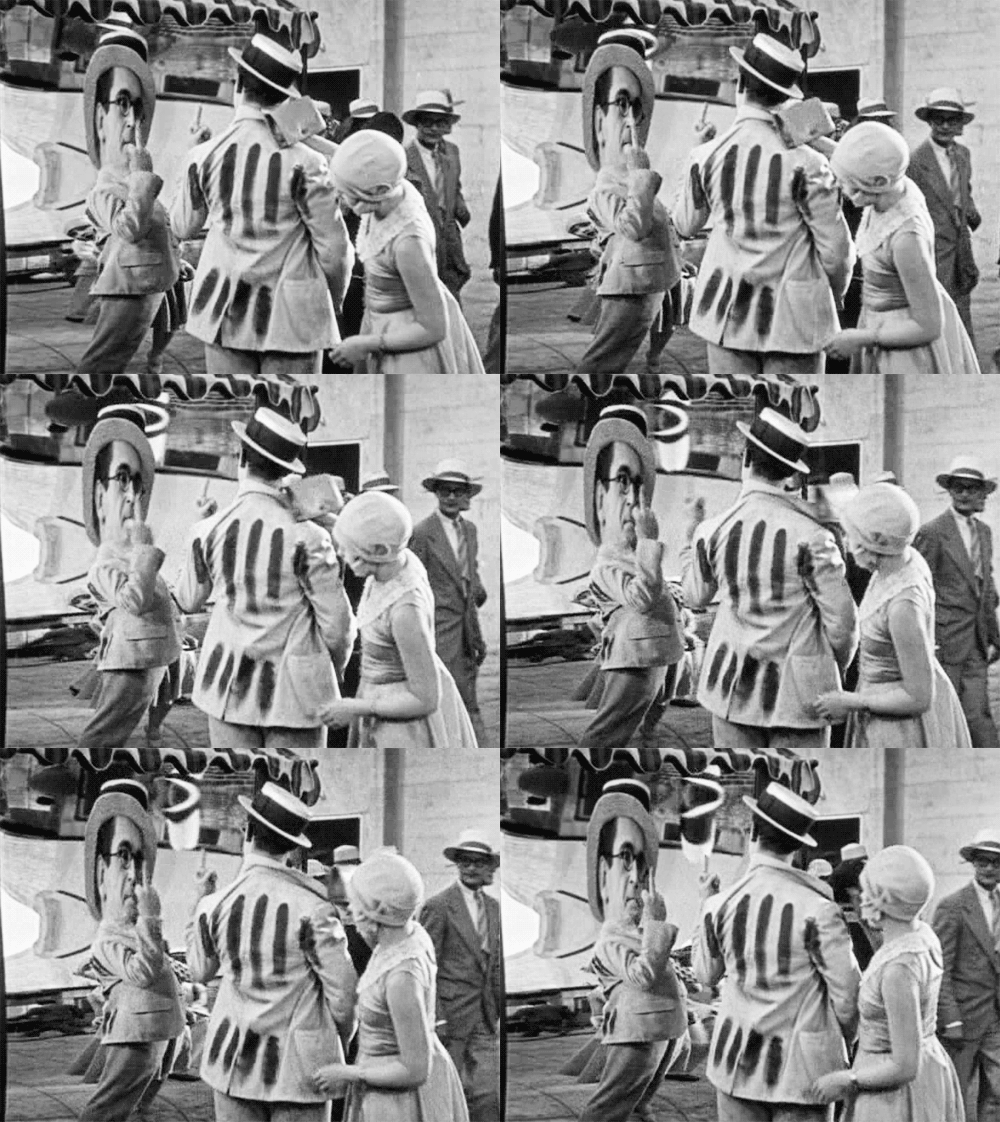
Harold Lloyd: The Man on the Clock by Tom Dardis is a fascinating biography about one of my favorite silent movie actors. Harold Lloyd isn't quite as well remembered as Charlie Chaplin and Buster Keaton, but I of the three of them he's my personal favorite. I love his glass character's can do, go get 'em attitude. This book was really well researched and the author does a great job as presenting the complex man behind the character and all of his hard work in the movie industry. If you're at all interested in film history, this is well worth picking up. By the way, I decided to rewatch The Freshman and Speedy after completing this and they are both so much fun. Did you know that Speedy features the first time when the middle finger was given in a movie? Seriously, the moment when Harold flips himself off in the funhouse mirror at Coney Island after he realizes that he's ruined his jacket by accidently leaning against a freshly painted fence is a whole mood!
A basic, but pleasant enough biography of Harold Lloyd, the third member of the great silent comedian trifecta (with Charlie Chaplin and Buster Keaton). Tom Dardis hits all the major highlights of Lloyd's life and career, but some things--like the infamous 1943 vault fire--slip through the cracks, and much of Lloyd's activities in the 50s and 60s are glossed over as well.
Dardis seems to suggest that Lloyd died without any evidence to support his belief in the quality of his work, which is a sad thought, if true. Harold Lloyd may frequently be ranked third after Chaplin and Keaton, but his films are by no means third-rate and, as Dardis does explain, he was always much more of an artist than the "daredevil" comedian that he is sometimes reduced to.
indepth story of Harold Lloyd , telling the whole story of his life and the silent movie era , all the major movie stars and directors of the time are very well documented,chaplin, Keaton, Fairbanks and hal Roach , hardly any mention of(my favorites)Laurel and Hardy ??? The one downside is the middle of the book which I found a bit of a slog detailing all his movies and plots ,which I suppose needed to be written about ,but it was interesting to see what each movie cost to make and the revenues overall a very good read !!!