A classic of northern exploration and adventure, LAST PLACES is Lawrence Millman's marvelously told account of his journey along the ancient Viking sea routes that extend from Norway to Newfoundland. Traveling through landscapes of transcendent desolation, Millman wandered by way of the Shetland Islands, the Faeroes, Iceland, Greenland, and Labrador. His way was marked by surprising human encounters--with a convicted murderer in Reykjavik, an Inuit hermit in Greenland, an Icelandic guide who leads him to a place called Hell, and a Newfoundlander who warns him about the local variant of the Abominable Snowman. By turns earthy and lyrical, LAST PLACES is an ebullient celebration of the exotic North.
I've written 16 books, including such titles as Last Places, Our Like Will Not Be There Again, A Kayak Full of Ghosts, Hero Jesse, and Fascinating Fungi of New England. I've also explored remote areas in East Greenland and the Canadian Arctic. I'm a Fellow of the prestigious Explorers Club and, in my mycological capacity, past president of the A.S.S. (American Stinkhorn Society).
And here's the most recent news: In January 2017, St. Martin's will be publishing my latest book, At the End of the World: A True Story of Murder in the Arctic. Not only does the book detail a series of murders in the name of religion in 1941 among the (surprise!) Inuit, but also it discusses how digital technology is turning our species into robots.
Lawrence Millman has written a work of travel literature, far superior in every way to most books I have read in the ‘travel writing’ genre. He sets out in the wake of the Vikings on a journey from Bergen, Norway to Foula, Shetland, to the Faroes, Iceland, Greenland, Labrador and, finally, to L’Anse aux Meadows, Newfoundland, the most likely site of the Viking settlement of Vinland.
Millman travels on foot, by boat, by plane when needs must, and camps out whenever possible. What is a last place? It’s beyond the last tollbooth on the last scrap of potholed pavement at the very end of the turnpike.... His notes are written in pencil along the way and his writing is sublime. He relates folk tales told to him by local people to explain natural and supernatural events. He meets and ‘unmeets’ people who drop their guard and tell him their stories - Then the proverbial ships part, each to its own destination, never again to brush each other’s wake.
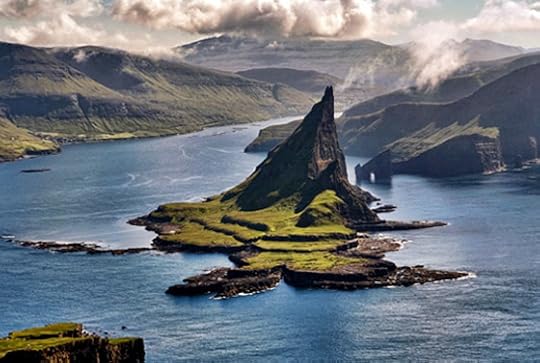
In the Faroes, he hikes over a mountain to camp a few miles outside Gasadalur - in a land that’s dead with the absolute death of the stillborn. Even movement seems to be atrophied: a waterfall hangs from Artindur like a narrow scarf of lace, its vapory dust a frozen painting.. This was indeed a ‘last place’ as, when he was writing this in the 1980s, Denmark had not yet allotted funding to build a road into Gasadalur, a road now travelled by coach loads of sightseers from cruise ships intent on seeing ‘a real Faroese village’.
Millman’s exploits often made me smile or even laugh, as did his turn of phrase. I visited a man named Gustav Olsen, who possessed a smile as calm as a sheltered inlet.
Stanley who smoked hand-rolled cigarettes....told me he’d read so much about the dangers of smoking that he’d had to give up reading altogether.
Last Places makes me think of all the travel books I’ve read in which the authors have travelled by much easier means to places that aren’t hard to find on a map. The journey is often the least important part of the story. With Millman, it’s of equal importance. He’s in no hurry to reach his next stop. One of the purposes of travel is to avoid your destination at all costs (once you’re there, you’re there, and you’ll never be permitted that long bated breath of anticipation again)...
This may be my favourite work of travel literature ever. It won’t lie on my shelf never to be read again. I look forward to reading it over and over as the writing is just sublime and the journey worth retaking many times. An easy and worthy 5 stars from me.
1) the author's own journey through [insert emotional/physical/mental struggle here] ... oh, and they happen to be eating lots of spaghetti and drinking lots of wine in Italy! / hiking up a mountain, etc. and come back "enlightened" 2) the author as narrator to the spectacular stories of a particular region; truly digging in to a culture by spending time with the people in all sorts of surroundings, realizing that the world is much bigger than the self.
You can probably tell from my descriptions which one I prefer reading. Thank goodness Millman was the latter and not the former, or I wouldn't have made it far.
Sure, we follow Millman through first-person narrative - his tent, his boat trips, etc., but it's the way he travels, and the way he mixes in with people that make his storytelling so unique. He finds the only guy who speaks the Old Norse "Norn" language on the itty-bitty island of Foula (pop. 30). He and his guide, meet the recluse who villagers swear turns into a polar bear after dark, in the fjords of Greenland. He recounts and recollects dozens of stories - some verifiable in history books, and some of the "so-so's mother's cousin said was 100% true" variety ... and you know what? It is amazing to read!
Roughly retracing Viking explorations in the North Atlantic, Millman travels to the aforementioned Foula, the most remote of the Shetland Islands, then hops over to Faroe Islands. He doesn't just stick to the pubs either - he is invited to people's tables, in their homes, meeting their families, and sharing laughs and their history... and their seal meat and fermented shark. From Faroe, over to Iceland. In Iceland he starts in Reykjavik and then treks north (and then even further north to "Hell"!), then over to Greenland (up and down and around there) and lands in North America, exploring Newfoundland, Labrador, and Baffin Island. He goes on day hikes and week trips into "the bush" with anyone who is willing to go with him, learning and sharing each story and area of interest.
Faroe Islands... just knowing a place like this exists makes me happy.
There are side-splitting funny moments, wondrous scenes and sights described, and even a few edge-of-your-seat scenes. The book was published in 1990, but I am not sure when the travel itself occurred. (Late 80s makes sense based on some of the descriptions, and mentions of the Cold War, etc.) I do wonder how much has changed in the last 25+ years in these outposts... I imagine there are some more things (cell phones), but I can also see many things staying the same as they were for the last millenium.
I hope to read more by Millman - while reading this book, I learned he has a new book coming out this month. Fortuitous timing!
This book has taken up residence on my bookshelf for 12+ years. Just sitting there looking pretty. One of my 2017 reading resolutions was finally getting to some of these books that I own. I am so glad I started with this one. A gem on my shelves for all of these years!
-- Read for my resolution of reading books on my shelves! but also because it fits well under the Book Riot 2017 Read Harder Challenge category "Travel Memoir".
Lawrence Millman's Last Places: A Journey in the North is a travel classic about traveling in the Arctic North Atlantic from Norway to the Shetlands to the Faeroes to Iceland to Greenland to Labrador and Newfoundland. I seem to have read it once before, some twenty years ago, but the book seemed like a fresh read to me except for some remote memories of the Greenland chapters.
So far, I have been to Iceland twice and would like to visit Newfoundland and Labrador if possible. Living in Southern California, I dislike the endlessly hot summer months and would love to escape to colder climes.
Millman's book was written some 30 years ago, but still comes across well. It's highly recommended for armchair (and actual) travelers.
This was a delightful, quick reading travelogue I had been wanting to read for a while and am quite glad I decided it was time to give it a go. One of my very favorite types of travelogues – a mixture of human and natural history, some humor, and not too heavy on the personal exploration – _Last Places_ chronicled the author’s four month journey from Bergen, Norway to a Viking archaeological site in Newfoundland known as L’Anse aux Meadows, along the way the traveler not only following the old Viking sea routes and making notes for the reader about Viking history and geography along the way but living as a “connoisseur of last places,” that like his “Viking trailblazers…[he] delighted in unvarnished rock and a paucity of people”….seeking out “uninhabited places, even uninhabitable places”….last places being locales that were “far-lung, old-fashioned, and without amenities,” his journey “a celebration of the North Atlantic wilderness” where he thought the more barren a locale was, “the more faithful its heart.” Not looking for popular tourist destinations by any means, the author wherever possible sought to also take the most difficult means possible to each destination (be it rickety ship or hiking on his own two feet, only flying or taking a car or a bus as a last resort) and whenever possible camping out once he reached a particular spot on his itinerary.
Though the author discussed Viking history and settlements throughout the text, the stars were clearly the far-flung exotic northern Atlantic and Arctic destinations themselves, with the Viking voyagers of long ago often just a nice framing mechanism. It is not a history book and not intended as such, but it is a great travelogue and one I am glad I read.
Not spending any time in Norway, his first real destination and one of my favorites were the Shetland Islands, the island of Foula in particular, “a pawky little piece of Old Red Sandstone so hermetically sealed off from the rest of the world that it was omitted from a good many maps,” an island “not on the road to anywhere,” a place he described as “the odd island out in a group of odd islands out.” Foula was of interest to Millman because it was the last place in the British Isles were Norn, the old language of Vikings, was spoken, the author hoping to follow a lead, as he had “heard rumors on an earlier trip to Shetland that odd snatches of the language were still being spoken in thick-walled houses by the squally sea.” The island hard to get to, its waters a “dazzling minefield” of wrecks, rocks, ledges, and obstructions, the author gave a gripping account of both Foula and also of hiking through Lerwick, Shetland’s tiny capital, and the interior of the island it was on. The author introduced me to a land I had never read about it, a land of Shetland accents (“triumphantly impenetrable”), gray sandstone cliffs, dark bogs with “bog cotton, like spent spume,” Shetland ponies, ruined, abandoned crofts “reverting to their stony essences,” bonxies (the local name for Great Skuas, a “bird with a five-foot wingspan and very nasty manners,” keen to divebomb Millman when he invaded their “self-proclaimed turf”), flanns (tornado strength-winds that occur when Atlantic gales hit the island’s cliffs and are then deflected over them), Shetland sheep (“the most primitive domesticated sheep in the world today”), and fulmars (who according to the author arrived on Foula “in 1878 on the back of a dead whale, and since then they’ve taken over nearly every rundown neighborhood, often at the expense of the usually fearless skuas”).
Next stop was the Faeroe Islands, a self-governing community “within the Danish realm,” they lie about halfway between Shetland and Iceland, “rearing themselves up from the sea like an armada of titled layer cakes.” The highlight of this particular stop on his north Atlantic tour was definitively the grindadarp or whale hunt, something the islanders call out Grind! to let their neighbors know it is occurring, often quite literally dropping everything they were doing to engage in the bloody spectacle of hunting and butchering large numbers of long-finned pilot whales all at once. In addition to witnessing a hunt an entire town engaged in, “a genuinely eerie scene – the thrashing black tails and ghostly boats emerging and then being swallowed up by the fog,” the author dined on grind and spik (whale meat and blubber) and skerpikjot (wind-dried Faeroese lamb), participated in the post whale hunt dance, visited a gannet colony numbering in the thousands, and heard a tale about a local giant that once lived there named Torur.
More time was spent on the next destination, Iceland. The reader is treated to some truly vivid scenery descriptions, lots of stories from Iceland’s past, and a good tour of much of the island. Highlights included lots of drinking, meeting a murderer who was on leave from his prison (as long as he reported his whereabouts to the police every four hours), soaking in a place variously called Thvottalaugur, Washing Springs, or Thighs Canyon, taking a rather scary bus ride through Sprengisandur (“a desert of rolling dunes at the top of a two-thousand foot plateau,” a region of black sand where he experienced an actual sandstorm, the same bus prior to this fording through torrents of glacier meltwater), visited the island of Grimsey (where he hoped to find some of the many chess players the island was once famous for, the island a “rolling, knobby slab of land, folded and then folded again with harsh masculine grace,” an island that was “treeless, windswept, rock-ribbed, hummocky, and bird-infested”), recounted the strange story of the Danish solider of fortune Jorgen Jorgensen, ate raw kittiwake eggs (complete with the unhatched and very live chick inside), visited a place called Hell (part of Iceland’s considerable volcanic legacy), and toured a lighthouse whose keeper had by his own estimate 16,000 books lining its walls.
Next stop was Greenland, with some interesting tales of the Vikings who once dwelled there. As an aside for those interested in the Norse who settled Greenland (and later died out), I highly recommend _Collapse_ by Jared Diamond. The first and really mainly only non-European cultural destination on his trip (though he did meet some Europeans), Millman spent a good deal of time with native Greenlanders, hiked the interior, had to deal with some surprisingly forceful and a bit involuntary wife swapping, saw wreckage from former Cold War-era American military bases, saw lots of seals (with the locals bestowing names not just for the different species but for the different ages, with say a one-year-old harp seal being called aataatisaq while an adult five-year-old would be called aataarsuaq), very briefly saw a polar bear, ate still more whale, noted that dandelions frequently demark former Viking farms and homesteads, discussed forced resettlement of native Greenlanders by the Danish government, and discussed the very colorful and somewhat cruel tradition of Greenlander nicknames (he himself got the nickname Allaut or Pencil, bestowed to him by one guide since he the author was always taking notes).
His final stops were Labrador and Newfoundland, where he traveled with a guide seeking black bears (the man able to tell what a bear ate by analyzing the bear’s droppings), learned to appreciate (kind of) the “hungry multitudes of black flies,” who are true conservationists” as they keep away visitors and settlers and continue to make Labrador a “last place,” saw potheads (what Newfoundlanders call pilot whales, on account of the shape of their head), hiked through mollyfudge (“Newfoundland slang for soft, spring moss”) and strolled on lonely beaches littered with “broken clam shells and whore’s eggs (Newfoundland slang for sea urchins),” and remarked how L’Anse aux Meadows is an English corruption of L’Anse aux Meduse, or Jellyfish Creek.
No real complaints about the the book aside from wanting a few photos and a map or two. I did expand my vocabulary a bit with words like sintery and couloirs. The style was easy to read and always left me wanting more. No index but I don’t think that necessary.
I liked Millman's amiable, yet aloof nature. I really liked the beginning with the Faroes and Iceland. Poor Greenland sounds utterly depressed and depressing. The ending bits in Labrador with some more Viking history and isolated, colorful characters was pretty pleasant.
I gave this book 4 stars because it started out seeming like it was gonna deserve 5, but it ended like it should only get 3. The writing in this book is excellent! I found myself jotting down several worthy and thought provoking quotes, and the author's way of describing scenes is vivid, unique, and enjoyable.
The problem was that I felt myself getting bored with his travels towards the end, especially in Canada but it started towards the end of his travels in Greenland. Maybe that's not his fault. Maybe it was the fault of the location(s).
The author would also stop describing a place every other page in order to tell a local story he was told or had remembered. Though I appreciate that stories, legends, folk tales, etc. help to color a place, I thought it happened a little too often, especially towards the end.
I would still recommend this book. If you could read this in one go, it would be best. I had to stop often due to a demanding curriculum and an eventful life. That isn't always a good way to read a slow-ish book like this one.
I did learn a lot about the Atlantic path of the Vikings, and the author did do a good job in making me want to visit most of these Last Places.
Fun and engaging reading, filled with non-generic down to the point information about the places visited. The author, yet entertaining, is a bit of a braggart and goes on some tangents to illustrate his daring courage.
A fabulously witty and beautiful look at this man's journey through the Arctic. I highlighted some of my favorite quotes for your interest:
1. “Every once in a while there would be a muffled crack, like the distant fusillade of rifle fire, and a berg would turn turtle. The soapy sheen of its underbelly would rise up to replace its former rough edges and near-right angles, soon to be whirled into a roundness themselves by the potter’s wheel of the sea. Or the explosion would mean a berg had calved, flinging out a progeny of brash and smaller bergs to embrace survival on the high seas alone.”
2. “As we sailed on, icebergs hunched in the water like a hierarchy of Chinese pagodas, Etruscan palaces, grain elevators, Boeing aircraft hangars, and alpine peaks. Some had been whipped by the wind into castellated spires, others had grottoes and natural arches, and still others looked like frozen shipwrecks of long ago, their masts petrified by whiteness. In heavy overcast they had an eerie bluish white phosphorescence, but when the sun’s slanting beams struck them they’d turn from white to blue to pink and even to black.”
3. “One of the purposes of travel is to avoid your destination at all costs (once you’re there, you’re there, and you’ll never be permitted that long bated breath of anticipation again)…”
4. “Once when I looked up, I happened to see a sea eagle poised on magesterial wings above the knurled summit of the mountain behind my tent. It was a scene of peerless tranquility, tossed out in Nautre’s devil-may-care way, which says: Just open your eyes, my friend, and I’ll astonish you every minute of your life.”
(This quote is eerily similar to one by Millman’s close colleague, Elliot Merrick, who wrote in True North: “It is a curve-tipped leaf, a tiny thing no bigger than my hand, a tiny thing no artist ever will or could draw, acres of them, made last night, melted this noon, in Nature’s devil-may-care way that says, ‘That’s nothing. If you live to be a million, I’ll take your breath away every day you keep your eyes open.’” What does this suggest? Hmm…)
6. “And so I was introduced to the Inuit custom of wife swapping in its modern incarnation. In the old days the custom satisfied bodily desires even as it kept the wolf from the door. If a man loaned out his wife, he could expect to get meat from her lover once his own cache of meat was gone; the resulting tie was as deep as a kinship tie, and lovers who didn’t share their meat often died under very mysterious circumstances.”
7. “…I walk across a series of snowfields as white as freshly laundered linen, laid out along a crinkly ridge that probably hasn’t seen the sun for years. On higher ground I enter a meadow of infinitely delicate star-shaped flowers, tufts of lady’s bedstraw and buttercups. It’s not exactly the Amazon rain forest, but it’s not a cinder-heap austerity, either.”
8. “At the turn of the century there was a man who wanted to get married but had no money, so he signed on with a Norwegian whaling vessel. After a profitable season, the man returned home and tied the knot of marriage. Three or four years later he was hard up again and signed on with another whaler. One day they took an enormous blue whale off Grytviken, South Georgia, and the man was assisting in flensing this whale when he tripped and fell onto the tongue. The tongue of a blue whale is six feet thick and extremely pulpy. The man sank into it and suffocated to death. This man was Gisli’s grandfather.
9. “On either side of the track, tortured Modigliani bodies of black lava rose up, their gaping mouths seeming to try to tell us something: Et in Arcadia ego, you complacent wheeled bipeds. Now I began to see hoary-headed Medusas and mutant reptiles and huge buzzards and malevolent gnomes crouched on battlements of broken-down rock, all waiting to pounce … Icelanders have a joke that a nuclear attack would be redundant in their country.”
10. “Within a few minutes fat flakes of snow were sifting down into the crater. The heat liquefied them before they reached us. But soon the snow came faster, and I found myself in the unlikely position of doing the sidestroke in an Arctic blizzard and being hot and cold simultaneously. Not only that, but in the midst of this blizzard the sun came out and targeted a patch of green water with one of its nocturnal beams. So many mutually exclusive things happen in Iceland that at this instant I wondered why they didn’t cancel each other out and leave the island drearily normal.”
11. “Almost all of us had been to the ends of the globe and had brought back tales to tell around the campfire. There was the German who had been bitten on the thigh by an elephant seal off Tierra del Fuego; he dropped his trousers for us and proudly displayed his rosy scar. There was the Swede who claimed he’d learned to hear the aurora borealis (“a faint rustling sound”) by camping among the sharp-eared Lapps in the far north of his homeland. There was a Dane who spoke knowledgeably about the African method of calculating distances by the number of cigarettes smoked on a journey. And then there was the other Dane who’d brought back a Gurkha Kukri knife from his travels in war-torn Afghanistan. It could cut a man’s throat so clean, he said, that the victim would think the knife had missed – until he smiled.”
MY VICARIOUS JOURNEY I enjoyed this vicarious trip to lands I have always been interested in, but will never be able to travel to. Mr Millman has taken this journey for me. He writes of his love for cold, rocky lands, for tiny, sparsely populated islands out in the middle of the Atlantic, and in out of the way places. He wants his readers to experience them also.
Lawrence Millman is very knowledgeable about the different floras and faunas in these islands and countries and also knows much about geology. He felt he needed to take the journey because of his love of these places, plus he wanted to experience what the Vikings saw and experienced on their journey to what was, in their time, unknown places. The he wrote this great book so others can take this trip without ever leaving their comfortable homes and lives.
Mr Millman is at east with the animals and the natives and interacts with both groups. At times he goes to their homes, eats their food which most of us would fear to do with people of unknown customs and ways of eating, plus types of foods these natives eat. He walks all over these rocky, barren lands, eschewing renting a car for he wants to experience all types of weather, all hard climbs. Looking out from the window of a bus is not for him.
However, toward the end of his journey, though he doesn't really want to, as he prefers to travel as the Vikings did, he takes planes and a bus to get to Labrador.
This is one great trip. I enjoyed the book and will read and reread it. Mr Millman is a man of courage, adventure and love of life. He writes about these lands just as he sees them and not through rose colored glasses. Because of this book, I was able to walk through cold lands, visit strange places and peoples, and take slow boat trips to tiny, strange villages.
This book could be called Lost Places because they are not on the tourist trips and few people know or care about them except only the indigenous peoples and those like Lawrence Millman.
I have mixed feelings about this book. On the one hand I salute Mr. Millman's stick-to-it-ness attitude in getting to these usually remote and sometimes undesirable places. The conceit of following the Viking trails merely seems an excuse to get out and into the northern back-of-beyond (as well as a reason to write a book). But it works. Primarily because he is such a good writer with a razor keen appreciation for and understanding of the low and high nuances of human behavior. Many a time I read a phrase and thought: wished I'd put that thought to paper! It also helps that I have always had a love affair with travel in the great north whether it is via armchair -- reading many of the numerous accounts of northern explorations -- or my own two feet (in Iceland and Norway). An additional enticement to read this book is that he also covers three lands I aim to visit in the near future: Greenland and the Shetland and Faroe Islands.
But -- and I don't mean this to cancel out anything else I wrote above -- sometimes his ornery, curmudgeony, essentially conservative and even reactionary (his words, BTW) traditionalist viewpoint becomes a bit tiresome. The mantra is, in essence, change is the evil that leads to the beast of modernity. There are of course, very good examples of this and Millman is excellent at pointing out the destruction we have wrought. I recognize and applaud this. However, I'm not terribly interested in turning back the clocks to when my ancestors were sticking wild boar with sharpened sticks in the (now disappeared) forests of Silesia. All things do change but it is up to us to manage that. Something admittedly that we have been quite poor at and with the current state of things, seem depressingly set on continuing that shabby record.
Back to the book...it is a good and instructive read (Greenland lesson #1: avoid Nuuk) and the writing is intelligent, human and lively. The purism of Millman's viewpoint doesn't really get in the way and in fact I found myself thinking: Millman is the cultural travel equivalent of Ed Abbey's conservation ethos. And really, that is not a bad thing at all.
Zo’n kleine dertig jaar geleden voer de Amerikaanse schrijver-avonturier Lawrence Millman in de voetsporen van de vikingen van Noorwegen naar Newfoundland. Zo veel mogelijk per boot, en langs al die eilanden onderweg. De Shetlands, de Faroer, Ijsland, Groenland…hinkelkeien op de koude zeeroute van oud naar nieuw.
En ik reisde mee! Als jonge student had ik nog nooit echt een grote reis ondernomen, behalve dan van mijn geboortedorp naar de stad (ook al heel wat!), maar wat smulde ik van de stoere anekdotes en avonturen. Samen met Theroux' Oude Patagonië Expres stond dit boek bij mij aan het aan het begin van een passie voor reizen en lezen.
Waarom nam ik het terug in handen? Omdat het nog altijd trots in mijn boekenkast staat, die krappe trofeeënkast waarin ik enkel boeken bewaar die echt iets voor me betekenen. Omdat ik– tussen al dat andere gelees door – wat vertrouwdheid op mijn nachtkastje wou. Misschien ook wel omdat ik ouder word en à la recherche du temps perdu op zoek ga naar oud genot.
Maar ik ben niet meer dezelfde. Hoewel de verafgelegen plaatsen en exotische gewoontes blijven boeien, ergerde ik me bij het herlezen aan de stoerejongensromantiek waarin dit boek baadt. Wat is die Millman soms een macho in zijn beschrijvingen. Als jonge snaak sprak dat me waarschijnlijk erg aan, maar inmiddels heeft de drang om tot het uiteinde te gaan plaats geruimd voor het inzicht dat het uiterste soms gewoon in het midden ligt.
Je kan geen twee keer hetzelfde boek lezen. Toch was dit boek ook bij de herlezing best nog intrigerend. Je kan de precieze locatie van Foula of Nuuq gewoon googelen tegenwoordig, maar de fascinatie blijft en daar draait het allemaal om, uiteindelijk.
Standing alone on arctic tundra, in some of the most quiet, desolate, barren and remote places at the very edge of the earth, in Last Places Lawrence Millman casts the synonymous relationship between extremity and ecstasy in glittering relief. Millman’s knowledgeable eye, attentiveness to the landscape and skilled descriptive writing gives the impression that the landscape itself is flowing through him, each swivel of bird and curve of moraine translating itself into words.
If not in its verbal paintings of the landscape, then the most compelling feature of this book is in its tone. Millman’s sarcasm in describing the marginal lands of his arctic journey strikes a wonderfully poised and effective pitch. His dry, humorous ridicule of the arctic people and their lands is redolent with downright reverence, casting in relief the synonymous relationship between the ridiculousness of life at such extremes and a brand of wild sainthood.
I am almost offended (at myself) for not knowing about this author until the year 2016. How could I not have heard of this peregrine, genuine, iconoclastic world traveler or was I just too busy with Ed Abbey and Carlos Castaneda?
This book was one of many in my neighborhood 'library on a post' and of course, being a field rat myself, an eschew-er of main highways, it caught my eye. What's funny (finny? vinny?) is I just finished the whole Ancestry dot com thing and found out my ancestry on my mother's side leads all the way back to the Saxons that sacked Rome. Since Millman is obsessed with all things Viking in this book, I figured perhaps I was reading about my relatives...then again, God, I hope not. Oh, I think my Earl Grey tea is ready.
First published in 1990, the book rose out of the journal Millman kept while seeking the northernmost Viking hinterlands on the edge (literally and figuratively) of civilization. About this time, I was living in Alaska and experiencing much of the same kind of culture--the guiltless killing of a lot of animals, though at that time, 70% of it was for subsistence still it was weird watching the villages change as electronic devices invaded--the Inupiat family goes out to get a seal, or grabs a few eiders, then comes in afterwards and watches Jeopardy, taking a break only to use the "honey pot" outside. One summer "night" in Kotzebue, I couldn't sleep because a couple of boys, maybe 10 and 12 years old, kept driving a backhoe up and down the dirt street. You want it to be a certain way when you're in the hinterlands but it just won't be and you spend a lot of time struggling with this. Are you a spoiled elitist who wants views straight out of a Norwegian cruise commercial who wants the natives only on sled dogs as they write poetry about whales, or is it ok that they just went by on snow-machines with high powered rifles and a few of them are stinken drunk? I remember walking into a bar in Nome Alaska only to hear someone yelling "thar she blows" regarding two very large and drunk (or is that two very drunk and large...?) native women dancing (?) with one another. One of them was bending down to visit the zipper of a man's pants while the other one wobbled a second then splattered herself on to the floor.
Millman gets to all of the wild life, both human and non-human. His encounters with seabirds is very entertaining. He covers the northern latitudes of Iceland, Greenland, Newfoundland, Labrador and many places in between--teeny tiny remote places in between he seeks out--"remote" being what trips him up the most--it may be remote but it's still covered in local garbage and dead marine mammals not to mention the girls that ask him if he has a good penis.
The book reads in almost its own language and jargon, and it's gritty with detail. Also, Millman has a rather exasperating writing style where he will be explaining something then finish the sentence with a metaphor or simile and you are left with little idea of what just happened. This was frustrating. Also, sometimes they just don't work. Be ready for words like Bergthorshovall, Mucklegrind, grindadrap, qivagtoq, piniartorssuaq, ilimanarsertivaligajikkalivarimmit; I mean, after all, it is Viking country, bludgeoning club optional.
One suggestion, read it sipping (sipping) a little brennivin, sans the vodka, that is if you want to stay on track with the story.
I loved this book and can't recommend it highly enough. This one of those books I pick up to read and re-read; my copy is getting quite beaten-up and dog-eared. I lose myself in the world of Millman's storytelling. His words vividly bring to life the sights, sounds, and even smells of some of the most remote far North and Arctic communities, along with the people who live there. Although the book can be read as a series of separate anectotes/adventures, it is held together with the loose structure of Millman following the path the Vikings took when they came to the New World, with more than a dash of history spread throughout. I like that he doesn't romanticize the Inuit and other indigenous people of these sparsely populated regions; he shows them for who they are, flaws and all, and yet somehow, as the reader, you still wind up loving them. His voice is non-judgmental as he tells their stories, and although he's clearly an environmentalist, he doesn't beat you over the head with his views as some travel writers do. Millman combines an observant eye with a dry wit, and his cultural adventures and misadventures are often amusing, sometimes sobering, and have given me a new respect for the dangers of modern society encroaching on traditional and native societies. Ever since I read this book I've yearned to visit Greenland, the Faeroe Islands and Iceland, among others. I'd love to have a drink with Millman himself, as well.
The best travel writing reveals new layers of a place, and inspires us to pick up an atlas — not just to find out where these strange settings are, but to start planning a trip of one's own.
Millman's travels take him through some fascinating bits of both physical and human geography: from the Shetland islands to the Faroes, through the Iceland's uninhabited centre, deep into Greenland, and finally to Labrador and Newfoundland, as he loosely follows the route of the Vikings and immerses himself in myth, landscape, solitude and questionable meals.
I first encountered Millman's work many years ago in Best American Travel Writing 2001, the one edited by Paul Theroux, and his story of Pantelleria stuck in my head ever since, hovering at the back of my mind long after I'd transposed the location to Lampedusa.
I found a copy of An Evening Among Headhunters some years after that, and several of those stories left a similar mark. I grew up in a small St Lawrence River town in Ontario, and became temporarily obsessed with Anticosti Island after reading his book — an island I'd never heard of and still have yet to visit.
And I found Last Places while researching an upcoming journey to Iceland. Halfway through the book, I found myself ordering copies for friends, and sending away for Millman's other northern books.
This is an inspiring journey, wonderfully written, funny, honest, and true. Highly recommended.
Lawrence Millman, a lone traveler, explores the path of the Vikings in last places and generally tries to find the most out of reach spots in the Northern Passage. He succeeds and meets innumerable unusual inhabitants of these places, although, it seems they are quite normal in their own culture. Millman has an eye for description and depicts these places few will ever go with interest and never with judgment. While I thought all these random islands and remote people and places were interesting, the book lacked a few things.
1. The writing was not consistent. Millman moves from journal entry to general storytelling without much more than a space. The writing also got a little boring at times without any real solid movement.
2. No maps or pictures. I had no clue where he was most of the time and was not always able to look it up. Also, the people and places could have been conveyed even more beautifully with a little help from the camera.
3. More personal details. Aside from the assumption that Millman has a case of wanderlust and likes to live in a tent, his personality remains somewhat shrouded in mystery. How in the world could he afford to take 4 months traveling around? and How in the world can he speak to all these people in their own language?
All in all an interesting travel narrative from a less than normal traveler.
I enjoyed this book a lot. Ever since I read The Greenlanders by Jane Smiley, I've had an interest in the inhabitants, past and present, of regions in the north. I loved that Millman takes the reader to some of the remotest places in the North Atlantic and provides a comparison between the place's history and its present day circumstance. I thought he was a little lax in the first several locales about tracing the trail of the Vikings--the reason giving shape to his journey--not really getting down to discussing it at any length until he reached Greenland and Labrador, his final destinations. The first 2/3 of the book seemed to focus more on establishing himself as a rugged individualist.
For an excellent historic/present-day travelogue, read Blue Latitudes:Boldly Going Where Captain Cook Has Gone Before by Tony Horwitz. His book is much more balanced in its discussion of the past and the present, and between focusing on the inhabitants and focussing on himself and his travel companion. Still, Last Places is a fascinating book, giving us a feel for places most of us will never travel to.
I have read and reread this book a dozen times. I came early totravel writing, especially of northern regions. Rasmussen and George Kennan, not to mention theclassics from the warmer parts of this flying mudball: Rebecca West, Robert Byron and many more. Yet, Icame late to Millman. His journey from Norway to the Shetlands, Faeroes, Iceland, Greenland and Labrador brought the smell of sweet Arctic air to my nostrils, I felt deliciouslycold while reading this book. His journey is adventure, pure poetry, lived poetry. Think of this as Snorri reborn, delirious from sleep deprivation and last nights fun. While not merely whimsical or irreverent, the tone of the book shows Millmans love for his subject matter. And what exactly is his subject matter? Always the human at the edge , the beautiful last edge, far far away from the comfort of our warm bed. I'd recommend all of his books, Kayak Full of Ghosts, Northern Latitudes, Innu Tales. In fact , I use them to teach English as a Second Language in Russia.
This book belonged to my mother, and I ended up with it when my father was culling bookshelves. I finally read it now, after a brief trip to Iceland last month. In this book the author visits out-of-the-way or "last" places in the far north, including the Shetland Islands, the Faeroes, Iceland, Greenland, and Labrador, preferring to walk or to take a slow boat, rather than driving or flying. There is at least destination (in Greenland) that he doesn't reach... the only boat captain wiling to take him there has to turn around before they reach the destination. The author tells stories of landscapes and ways of life that few of us get to see... inspiring me to visit or re-visit some of these places, and inspiring me to travel and live my life with this attention to detail and attention to my surroundings, on foot whenever possible. I will read more of Millman's books. and thanks to my mother for introducing me to this author. My mother is no longer here, but one of the things we shared was a love for the vast spaces and way of life of the far north.
A little disappointing although my own prejudices are the problem rather than the writing. Definitely a "cold" book. Hillman follows a Viking route from Norway to Newfoundland visiting the Faroe Islands (oh how I want to go there!), Iceland (where I've been but only to Reykjavik and I'd love to see more), Greenland, Labrador and Newfoundland. He camps, makes friends with all sorts of people, takes boat rides that make you feel seasick just reading it etc. But I did struggle with the endless alcoholism that displaced natives ended up with and the slaughter. Now I know that whale hunting is something that Faroese do and Inuit eat seal and so forth and that it's important culturally and what else would they eat but that whale slaughter in the Faroe Islands did give me pause in my desperate wish to go there (but I still do but I'll avoid whatever time of year that takes place).
(newer) I'm having trouble burning through this one like I've done with so many other travel/adventure books. I'm not sure what the problem is. It's a humorous book, so perhaps the style of writing is not engaging me fully. I'll keep going with it. Therefore I lowered it to 2 stars. I'm probably a 3rd through. (older) Liking it so far. If Annie Dillard can give it such high praise, I figured it must be something special. Humorous writing about some of the most un-Godly spots on the face of the earth. Very quirky local characters make constant appearances. Millman makes even the most desolate places seem alive. I hope it keeps up the pace! testing out code right now
An account of a journey following Viking routes from Norway to Newfoundland. The sections on Iceland and on the Faroe Islands were among the highlights. Frankly it became redundant and too "cute" as it moved on. Not a bad modern book on the northern countries. I would recommend for the traveler.
Like many books of this type --- Why don't they put maps in them for the readers?! You should definitely read this while having a map or globe at the ready.
What a wonderful read. I honestly enjoyed every single word. So much so, that I slowed down my reading pace considerably to generate as much prolonged joy as I could possibly muster along the way.
If you long to travel and to do so where few have been, then this book will embrace you. If you enjoy wonderful writing, whatever the circumstance or theme, then you should immediately get your mitts on this book too. Reading it was an absolute joy and privilege.
Lawrence Millman goes where I surely never will -- by slow boat along the route of the Vikings, from the Shetland and Faeroe Islands to Iceland, Greenland, and Labrador. He meets and describes in poetic and often hilarious detail a crazy cast of characters and lands lonely and remote. He reminds me that the world is a very big and wild place. A great writer and a great journey!
An apt companion on a trip to Iceland. Each chapter is a mini story of it's own. Creating a feeling of the space and the people. Greenland and the Canada did prove disappointing more in how these spaces have become, than in the stories Millman tells. I'm left wanting to read more of his writings and reading more about these lands, so all in all, an excellent travelogue.
I found this book at a garage sale for a buck. What the heck. Then discovered I had stumbled on a fascinating & eccentric travel writer. I've now read most of what he has written. He wears pretty well and his view on some of the odd corners of the planet is really fascinating.
I know this is an egotistical thing to say, but Millman's writing style reminds me somewhat of my own, or at least, in a style that I greatly admire. This was an enjoyable read - not as Greenpeace-y as I had feared, but still conveying the writer's love of the natural world.
A book that writers will appreciate. Beautiful descriptions of the lands and seas of the north. I would guess that Bill Bryson was influenced by the author. Many different ways of life in these isolated last places.
I loved this book so much I'm encouraged to go north and eat seal blubber with the author. The allure of northern ice and snow and arctic hares has never been so eloquently expressed. Read this book: it's a wonder.