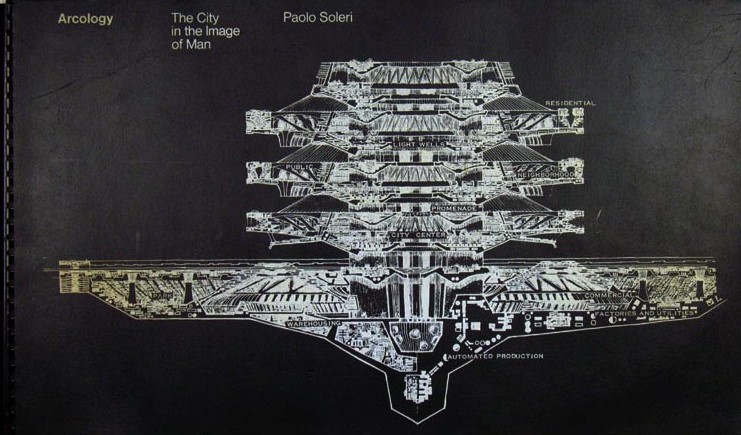
Paolo Soleri was an Italian architect. He established Arcosanti and the educational Cosanti Foundation. Soleri was a lecturer in the College of Architecture at Arizona State University and a National Design Award recipient in 2006.
Soleri authored six books, including The Omega Seed, and numerous essays and monographs.
That is the first line of Arcology and it's given two pages all to itself, emphasizing the difference in scale between the large-format book and the small text.
Soleri's vision of arcology is usually relegated to the back corners of science fiction and the odd comment in newspaper reviews of architecture, usually indicating how far outside of the mainstream Soleri is considered to be. More attention is given to the culture at Arcosanti, where 20-somethings go to live, make bells, and work on his "urban laboratory."
As with most things, going back to the source reveals a different world than the third-hand repetitions found even in excellent reproductions. Reading Arcology for yourself, you find several interesting things.
First, the writing is enjoyable. Soleri makes comments about his "lazy Italian tongue" and his poor grammar, but he learned English at Taliesin West, serving tables and waiting on Frank Lloyd Wright. The people he learned the language from were some of the best--and most idiosyncratic--minds of the time. He never shies from complex sentences and making up words seems to be a hobby. If you only like the more modern style of short and declarative prose, you may find him tiresome, but if you are willing to dive into some nuanced language that focuses down to what it means, then he's a hoot to read.
Second, the book isn't at all about making big buildings or dehumanizing people. He starts with history--social, technological, and civil--and extrapolates to what he believes is an unavoidable step in human society.
The central argument is that all things evolve towards miniaturization, towards complexity, and towards increased duration, although the measurement of duration may be complicated. In general, he reduces these to increased interconnections between parts: cities from towns, computers from radios, and so forth. He considers this descriptive rather than prescriptive.
Given an assumption of this direction in growth, he asks how humans can increase interconnection between one another and with nature. To this he adds some values he would like to see evolve; these values are prescriptive: no poverty, live with access to and in harmony with nature, increased sense of community (although the perception of community size may change), separation of industry from living and socializing areas. The well-known arcologies come from this.
Throughout, the book is incredibly illustrated. The top half of most pages is given to illustrations and diagrams that relate to the text plus some full-page diagrams and pictures for complex topics. At the end of the book he presents 21 sample arcologies of varying size, each suited to one natural environment. These are concept diagrams, not blueprints, and lovely to look at. You can see how these captured the science fiction community's attention.
So if you - have any interest at all in arcologies, Soleri, architecture, urban design, big-system models of evolution, or an early view of how ecology can be integrated into life, - can enjoy reading some complex (but still somehow breezy and humorous) writing - want to look at pretty pictures and diagrams of (non-biological) evolutionary process and big buildings
then check it out. It's back in print and it's a fun read. Very quotable, too.
You may disagree with his urban design or his model of miniaturization, complexification, and duration; you may find some of his presentation very late-60s/early-70s (he's a bit woo-woo at times); and you may find he requires a few more leaps of faith than you're willing to take, but the book is interesting whether or not you agree with the conclusion.
030518: this is actually Not an extra-long book: but i wanted to give readers a warning on exactly how Large this book is- finally decided to put it flat on the dining table and look down at it. there is also something endearing as annoying, that the book selects only a few readers willing to read snippets, read often incoherent writing, read a sense of the western world 1969 that seems ultimately utopian with no sense of how we mere humans can advance on this plan...
utopia by design? i remember rather more dystopian narratives set in SF futures of really big buildings, in the books read i guess around late 70s or early 80s, but these works did not really frighten me, i was a suburban-acreage kid and urban life i saw only in tv and movies. but i did buy a paperback mostly because it had this cover image of a tower rising and rising from fields by waterfront (i also liked it because i had read a short story in it, and it had had sex) and then when i was a youth and we were building the new house, i was interested in architecture, i read several big-building SF novels that did not necessarily have sex but it was one ongoing concern...
this was the age i heard of Arcosanti but only by summary, by now i finally see it, i have a wider life history, i am a bit more skeptical about our lived environment as something we could shape to shape us, either for good or for ill, and some problems in effective, practical concerns- the cities i have lived in, even if only around for the past hundred years, seem far too organized and present for anything other than complete decimation of urban warfare, to make it possible to radically change the pattern... but then, are any of the similar 'super malls' of Korea or Japan, actually advanced beta tests for renewed urbanism? i worry rather that with computer automatic driving we, in North America at least, will simply extend the suburbs and suburbs and suburbs... already i know one friend's husband in carpool goes about a hundred kilometres every morning- but as he is only one of the five he only has to drive once a week and sleep or work other days... and of course housing is much cheaper in the mountains, safer, smaller community, recreation year-round just a snowshoe out the back door...
Sure, the text is mostly autistic gibberish, but the illustrations are incredible! I found a copy in a bookstore for 20 bucks, because I am an extremely savvy book buyer.
A beautiful book. I don't know what it says-- the letters are too small for me to read, it's something about cities as organisms and the outgrowth of human creativity-- but the illustrations are everything you could hope for. Arcologies are futuristic, biologically inspired cities inside of buildings, designed in detail by the author. And by detail I mean so many details you can't possible percieve them all, even with a magnifying glass, overflowing the two-foot-long pages. Recommended especially for fans of SimCity 2000.
I'm really curious to read this book. Even the concept fascinates me. Soleri introduces the idea of ''acrology'', a fusion of architecture and ecology, imagining cities designed to be self-contained, efficient and harmonious with the environment. The book explores visionary concepts for urban living, addressing population growth, resource use, and sustainability, all while challenging conventional ideas of how cities should be built. Just thinking about his designs and philosophies makes me excited to dive in and see how he envisioned the future of urban life.
despite being very far outside the mainstream is probably responsible for inspiring so much sci-fi and real life architecture the writing is fun/kinda wordy at times but I enjoyed it. the illustrations are glorious, You can get lost in them for ages!!