Robert Hans van Gulik was a Dutch diplomat best known for his Judge Dee stories. His first published book, The Celebrated Cases of Judge Dee, was a translation of an eighteenth-century Chinese murder mystery by an unknown author; he went on to write new mysteries for Judge Dee, a character based on a historical figure from the seventh century. He also wrote academic books, mostly on Chinese history.
All too frequently historians, even cultural historians, ignore music, even though every living person knows how important music is to his or her own personal culture. This is due perhaps, at least in part, to the transient nature of music, but I fear it is also due to scholarly prejudices concerning the triviality of music. But in some cultures, such as the Greek and Chinese, music was a central supporting pillar of the entire religious/political/social edifice of the High Culture.
The Dutch diplomat, orientalist and author Robert van Gulik (1910-1967), previously known to me for his translation of 18th century Chinese texts relating the exploits of an investigating magistrate (Dee Goong An (Celebrated Cases of Judge Dee)) and the subsequent composition of his own detective stories based on the original T'ang dynasty character, also wrote Lore of the Chinese Lute: An Essay in the Ideology of the Ch'in (1940), a one-of-a-kind (at least in English) examination of all aspects of the ch'in (qin), a Chinese zither or lute, from its origins sometime in the second millennium BCE, through the techniques of play and the repertoire of the instrument, to its deep significance for Chinese High Culture.
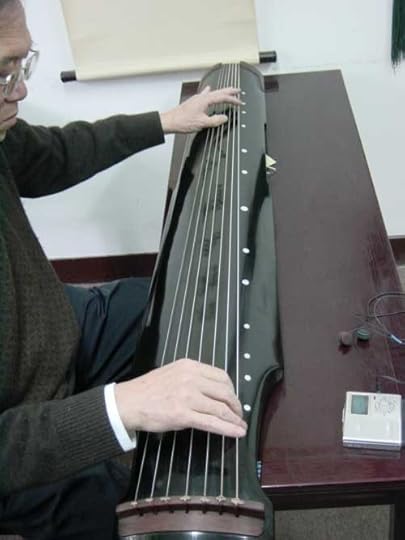
As one can hear via the links I provide below, the ch'in is not really used to play tunes, though it can be used to accompany singing or the chanting of poetry. Instead, the focus of the play and audition of the ch'in is on each individual note, its unique pitch, tone and timbre, richly supported by the percussive capabilities of the instrument. For this reason the notation used for recording the repertoire of the ch'in indicates not just the pitch of the note, but also with which string and with which fingers of which hand, and with which technique the note is plucked and stopped.
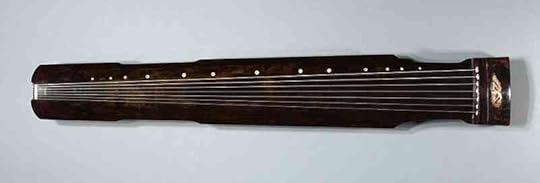
Top view of a ch'in
The ch'in is large and requires special woods and construction techniques, so it was always expensive, "an exquisite treasure jealously guarded by the literati." To play it properly requires much training and practice, so the ch'in found in the library of many literati was more likely to be a family heirloom than to be competently played, much like the grand piano found in the drawing room of a certain class of Western elites. Nonetheless, the ch'in occupied a special place in the ideology of the Chinese elite, and the explication of this ideology and the significance it had for Chinese culture is the primary focus of van Gulik's book.
In the Chinese tradition music was a direct expression of the harmony of the universe, its laws and structure, and was to be used (along with certain rites) to awaken people from the distractions of the trivial to harken to the eternal. In the words of the Li-chi (the Book of Rites), "Music has a profound influence on man, it can improve customs and ameliorate morals." Indeed: The kings of olden times instituted rites and music, not to satisfy the mouths and stomachs, the ears and eyes, but in order to teach the people to balance their likes and dislikes, and to bring them back to the Right Way.(*)
Van Gulik reviews the literature particular to the ch'in, which dates back to the beginning of our era, to show that the playing and the audition of the ch'in became a way to enlightenment and that the associated ideology became so elaborate and complete that each note of the ch'in had its own special associations and evoked a specific emotion. The ch'in and its repertoire became the sole official counterweight - apart from the ancient music accompanying state rites, which were witnessed only by a select handful of persons in any case - to the increasingly foreign songs of Cheng and Wei. The samurai had their bushido, but the Chinese literati had their ch'in-tao, the Way of the Lute, and Lore of the Chinese Lute makes this neglected corner of Chinese culture available to the Western reader. Personally, though I have listened with pleasure to the ten or so discs (LP and CD) of ch'in music I have in my collection, I had no idea of its deeper significance, aside from the in-the-moment, pure-minded transcendence of the "10,000 things" obvious to anyone familiar with Buddhism.(**)
(*) Of course, this was the official line. Van Gulik shows that even among the elite conformity to that line was far from perfect. Consider, for example, a quote from Prince Wen of Wei (426-387 BCE): When in full ceremonial dress I must listen to the Ancient Music, I think I shall fall asleep, but when I listen to the songs of Cheng and Wei [code for popular music], I never get tired.
In Sui and T'ang times the Chinese adapted much from Indian and Central Asian musics into their own "songs of Cheng and Wei" which were then played even at the imperial court, as van Gulik mentions and as is developed in depth in the very interesting Music from the Tang Court: Volume 7: Some Ancient Connections Explored, which connects Japanese court music, gagaku, with T'ang dynasty music, which in turn is connected with musics as far away as Mesopotamia and Greece.
(**) In this book van Gulik also touches upon the influences of Buddhism and Taoism on the ch'in-tao.
R. H. van Gulik combined a guqin player's love and appreciation of his instrument with a Sinologist's gift of objective, historically-informed research to write this groundbreaking study of the Chinese 7-string guqin (古琴) and its ideology, a book that stands unique and (still) unparalleled amongst the literature on the qin for its thorough, linguistically masterful and historically contextualized treatment of the subject. van Gulik chose to use the word "lute" instead of the usual term "zither" for the guqin, since "lute" is the word which "since olden times in the West has been associated with all that is artistic and refined, and sung by poets." With this unusual yet perceptive choice of name-in-translation, van Gulik set the tone for his book as one that would reveal the palimpsest of ideological meanings - accumulated through 3000 years of history - that have made the guqin the highest symbol and expression of Chinese literary culture.
van Gulik's impressive grasp of Chinese language, literary culture, history and philosophy, and his own abilities as a scholar-official (he was a high-ranking diplomat in the Dutch foreign service, a gifted linguist and Sinologist, a successful fiction writer and a player of the qin) eminently equipped him to write as an insider on this hoary subject. At the same time, he brought Western rational perspectives of objective, socio-historical scholarship to bear on a topic which had heretofore been steeped in 3 millenia of mysticism and lyricism. Not only are the subjective and objective, lyrical and socio-historical aspects of his study well-balanced, the author displays the mark of genuine humility as well as wit and good humor. With such harmony between intellect and heart, character and learning, the result cannot be anything but gratifying. Indeed the treatise is a feast of the intellect that satisfies poetical, musical, artistic, historical, ideological and philosophical tastes.
As a student of the qin, I had been puzzling over the various strands of ideological influence apparent in qin music and ideology, wondering how I can begin to tease out the interactions of Confucianist, Taoist and Buddhist influences in qin music and their impact upon it through time. In this book, van Gulik addressed those questions that had piqued my curiosity, with a thoroughness and vision that exceeded what I had dared imagine was possible. The sources for such a study are so scattered and so rare, and the field so untouched, van Gulik had to collect the original materials one by one, "sometimes more than a year passing by before a rare item was at last found in the dim corner of some Chinese or Japanese bookstore." van Gulik humbly calls his study an "essay", but it is as much a treatise as it is an essay. He presents a copious amount of original sources in Chinese, along with his own English translations. He discusses these materials in their relevant musical, literary, socio-historical, philosophical and religious contexts. He traces the evolution of qin music and ideology, correlating them with larger trends and changes, through the different dynastic periods. His commentary sparkles with original insight, and the thesis he advances about the history and formation of qin ideology is based on sound analysis.
van Gulik found that qin ideology had early roots in ceremonial orchestral music, its earliest appearance being in the Book of Odes in the Western Chou period (1122-770 B.C.), where it was associated with another instrument the "Se" with which it was played. The magical connotations of this ancient, ceremonial music continued to be associated with the qin even as it evolved primarily into a solo instrument. During the later Han dynasty, the powerful Confucian literati made the qin their special instrument, even as it became the sole surviving repository of the ancient magical notions associated with ceremonial music, which now blended with Taoist beliefs on life-preservation and immortality. During the Sui and Tang periods, qin music reflected the increased influence of foreign ideas and customs within Chinese society, as the qin was used to produce tunes with Central-Asiatic flavours as well as tunes inspired by Buddhist ideals of emptiness and restraint. At the same time, conservative scholars began to reactively define qin ideology as a province of pure Chinese culture. These various, originally conflicting ideas blended more and more during the Sung dynasty, and in the Ming dynasty the various eclectic elements became unified as one single qin ideology, which gave expression to the highest ideals of literary life and elegant refinement. Amidst the Ming efflorescence of Chinese art and culture, qin music reached its acme and qin ideology was elaborated upon and given definite shape. It was during the Ch'ing dynasty that decline set in. Although the scholarly culture that surrounded the lute now belongs to the past, the future of the qin, van Gulik concluded, is bright, for he believes that "what is really good and beautiful will last forever." The resurgence of the qin in recent years bears out van Gulik's optimism.
This book will delight not only the scholars but also the musicians among the readers. Qin students will benefit especially from the sections on the symbolism of the tones and the finger techniques. As van Gulik points out, sections that touch on the deeper ideological meanings of qin musical tones and fingering were left out of qin handbooks printed in the Ch'ing Dynasty - I note that they are also left out of handbooks being printed today. Hence, such excerpts from Ming dynasty handbooks that van Gulik presents are most instructive and helps to re-connect the qin player to a long musical tradition rich in profound meaning, subtly expressed. The many stories told of qins and qin players - alternatively amusing, eccentric, magical, strange, eerie, awesome and lofty - will delight and inspire readers. Lovers of Chinese literary culture will enjoy the erudite descriptions of literate life and its refined pursuits, and gain much knowledge on the symbols and associations of the qin as well as practical pointers on creating the ideal environment for playing. Studious readers will appreciate the copious references and bibliographic lists given of primary sources. All in all, this is a marvelous book on a wondrous subject, and I thoroughly recommend it to all those with a personal or professional interest in Chinese culture and music.
For contemporary qin players, heirs of this hoary tradition who will carry it forward, this book is a beacon shedding light on the past, illuminating the shape of future possibilities. I would like to end this review with these haunting words of the author, given in the preface: "As the Sung scholar Su Tung-P'o says in his celebrated poetical essay on the Red Wall: 'There remains only the clear breeze over the river, and the moon shining over the mountains. The ear catches the wind, and it is sound. The eye sees the moon, and it becomes colour. These things no one can forbid us to take in: they shall be forever with us, for they are part of the never exhausted fullness of the creation.' It was such considerations that influenced the author to publish this study, feeble though be the effort it represents; for when his bones and these pages will be mouldering, the wind will rustle in the pines, and the rivulet murmur among the moss-grown stones. And ultimately it may be said that perhaps the sole design of this essay was to show that lute music in its simplest essence is the echo of these undying voices of living nature." ....And so, as we play the qin reflecting on these wise words of the author, which have since come to pass, we too, in our turn, shall continue "the old approved principle of 'treading in the footsteps of the ancients'", remembering the transient nature of individual lives and consciousness borne upon the inexorable tides of time and change, yet marveling at Life's imperturbable continuity.
PS: The painting on the cover is of Yeh Shih-Meng, the author's first teacher of the lute, to whom this book is dedicated.
old world colonist feel - wry comments in Latin - really a fantastic place to begin to understand music within Chinese cultural and philosophical life... well written in the Dr. Johnson sense
Robert van Gulik is an amazing person. Check this: http://en.wikipedia.org/wiki/Robert_v... This is the book on Guqin, which is a musical instrument played in China and Japan from ancient time. And I also play Guqin every morning before my brain becomes fully digital.