Jump to ratings and reviews
Rate this book

Disaster Was My God

Rate this book
The author of the critically acclaimed novel The World as I Found It brilliantly reimagines the scandalous life of the pioneering, proto-punk poet Arthur Rimbaud. Arthur Rimbaud, the enfant terrible of French letters, more than holds his own with Lord Byron and Oscar Wilde in terms of bold writing and salacious interest. In the space of one year—1871—with a handful of startling poems he transformed himself from a teenaged bumpkin into the literary sensation of Paris. He was taken up, then taken in, by the older and married poet Paul Verlaine in a passionate affair. When Rimbaud sought to end it, Verlaine, in a jeal­ous rage, shot him. Shortly thereafter, Rimbaud—just shy of his twentieth birthday—declared himself finished with literature. His resignation notice was his immortal prose poem A Season in Hell. In time, Rimbaud wound up a pros­perous trader and arms dealer in Ethiopia. But a cancerous leg forced him to return to France, to the family farm, with his sister and loving but overbearing mother. He died at thirty-seven. Bruce Duffy takes the bare facts of Rimbaud’s fascinating existence and brings them vividly to life in a story rich with people, places, and paradox. In this unprecedented work of fictional biography, Duffy conveys, as few ever have, the inner turmoil of this calculating genius of outrage, whose work and untidy life essentially anticipated and created the twentieth century’s culture of rebellion. It helps us see why such protean rock figures as Bob Dylan, Jim Morrison, and Patti Smith adopted Rimbaud as their idol.From the Hardcover edition.

384 pages, Kindle Edition

First published January 1, 2010

37 people are currently reading
435 people want to read

About the author

Bruce Duffy

6 books21 followers
Bruce Duffy is the author of the autobiographical novel Last Comes the Egg (1997), and the 2011 novel, Disaster Was My God, based on the life and work of the poet Arthur Rimbaud. An only child raised in a Catholic middle-class family in suburban Maryland, Duffy sees the 1962 death of his mother—essentially by medical malpractice— as what pushed him to be a writer. Duffy graduated from the University of Maryland in 1973, and has hitchhiked twice across the United States, worked construction, washed dishes, hopped freight trains with hoboes, and reported stories that have taken him to Haiti, Bosnia, and Taliban Afghanistan. Today he lives just outside Washington, D.C., works as a speechwriter, is married to a psychotherapist, and has two grown daughters and a stepson. Writing in Salon, Joyce Carol Oates named The World As I Found It as one of “five great nonfiction novels,” calling it “one of the most ambitious first novels ever published.” A former Guggenheim fellow, Duffy has won the Whiting Writers’ Award and a Lila Wallace–Reader’s Digest Award

Ratings & Reviews

What do you think?
Rate this book

Friends & Following

Create a free account to discover what your friends think of this book!

Community Reviews

5 stars
59 (26%)
4 stars
66 (30%)
3 stars
66 (30%)
2 stars
18 (8%)
1 star
10 (4%)
Displaying 1 - 30 of 40 reviews
Profile Image for Ted.
515 reviews736 followers
January 18, 2017
Mama’s boys together … their two-year rampage through Paris, London, and Brussels. Leaving just four people, all women, of course to pick up the pieces. Mme. Rimbaud, Mme. Verlaine, and Mathilde Maute’ Verlaine – dewey-eyed no more. And of course their leader and strategist, the ever resourceful Mme. Maute’.


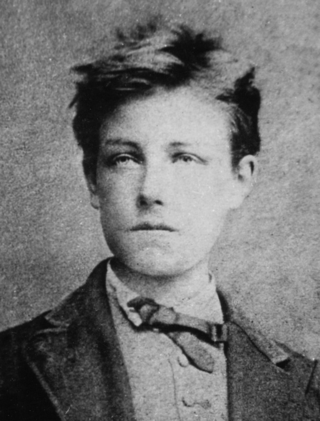
Arthur Rimbaud, age 17.


Fictional biography? What??

Why would anyone want to read a “fictional biography”?

Well, if you enjoy reading biographies, then you might not want to! If you care about the details of a person’s life as “actually” lived, in this universe, then not for you – maybe.

I have enjoyed some biographies. But the problem I have with many bios, especially contemporary ones, is that they’re so damn long. The biographer assumes that the reader’s appetite for what’s being served is insatiable. That every detail counts. That this bio must contain everything ever known or believed about the person.

Well, Duffy’s novel certainly doesn’t contain all that stuff. Which isn’t to say that he doesn’t know all that stuff. I suspect he does.

I suspect he knows quite a vast amount about Rimbaud. What he’s done is condense all this information, keeping what he finds most exemplary of Arthur Rimbaud, emphasizing the relations between Rimbaud and others that he finds most interesting, and, yes, making up thoughts and words (there’s a lot of dialogue) and details that have happened in the life of ”Arthur Rimbaud” – in some other universe.

So – might you enjoy this book? Yes, if you’re not a stickler for facts about a famous poet; and if you like great novels, “historical” novels if you will.


A tale - the fictional life of Arthur Rimbaud

Here’s what Duffy emphasizes in Rimbaud’s “fictional” life.

His mother. Marie Catherine Vitalie Cuif. Lord, what a woman. They fought and grasped at one another, hated one another.

Paul Verlaine. The renegade symbolist poet (1844-1896) who, compared to the boy Arthur Rimbaud (1854-1891), was more like a comfortable pillow. The ten-years younger Arthur, who Verlaine took into his home (complements of his new wife’s family) in Paris in 1871, the boy Rimbaud 17, the still-boy Verlaine 27.


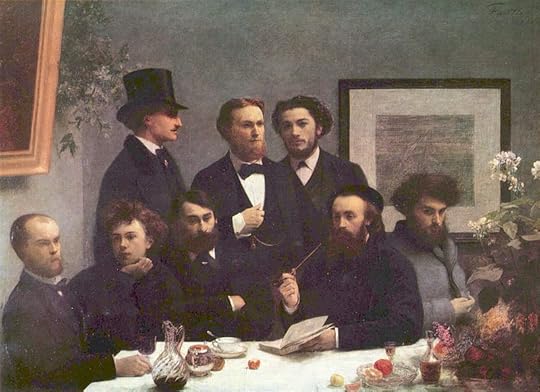
Verlaine (far left) and Rimbaud (second to left) in an 1872 painting by Henri Fantin-Latour (Wiki)

Still-boy immediately seeing that boy was a poet writing poetry that was not good. Not because it was bad, but because it could not be judged by any existing or prior standards. As our narrator puts it, by the time boy was sixteen - “not that anyone then knew it, of course” – Rimbaud
had anticipated, and exceeded, Dada and Surrealism, had checkmated and rewritten fifty or sixty years of future poetry, had barged headlong into the twentieth century, and then with the recklessness and bravado practiced, in France at least, only by painter provocateurs like Honore Daumier or Paul Gauguin.
Yes, Verlaine sensed – more than sensed, knew - that boy left still-boy in the dust. So Verlaine naturally fell in love, and the two of them, sponging off the parents of still-boy’s wife, and the raging mother of boy, debauched their way through Paris, London, elsewhere, still-boy leaving his wife and child, they drinking and whoring and pederasting their way into the scandal sheets of the 1870s. What a time!

A spot on the map – Harar, Ethiopia, representing the years Rimbaud spent in Africa, and the Great Mystery of the poet. His “taking” of a beautiful young Ethiopian Muslim woman, then his dithering as to when they will wed, his eventual decision to not wed her at all, paying off her family for having taken her virginity; his arms selling to African slavers (admittedly out of date arms, but still …); the wealth accumulated, the source of “outlaw” in the legend of Rimbaud coming down to us from those long past years.

His siblings: Frederick (b. 1853); Victorine-Pauline-Vitalie (b. 1857, died a few weeks after), Jeanne-Rosalie-Vitalie ("Vitalie", b. 1858) and Isabelle (b. 1860). Most particularly Isabelle, thrown into the wicked stew with Rimbaud and their mother, Isabelle ground into the mud by mother, deemed unmarriageable, only good for working on the Madam’s farm, who at the almost-too-late age of thirty discovers … that the brother she always loved was a writer! Is known in Paris! Partakes of fame (in some avant-garde circles). Isabelle, who unbelievably becomes the wife of her brother’s first (not very good) biographer.

And The Great Mystery itself, the almost unprecedented mystery of an iconoclastic poet throwing it all away at the age of 21, never writing again, never interested in poetry or fiction or drama, reading nothing but engineering manuals, only what could help him earn money, leaving Europe for half his life. This hulking shadow of Mystery, permeating with hardly any emphasis by the narrator, this fictional life.


A tale’s teller - the narrative voice

This is Bruce Duffy’s third and most recent novel. His first, The World As I Found It, was a fictional treatment of three well-known philosophers (!) – Bertrand Russell, G.E. Moore, and the main protagonist, Ludwig Wittgenstein.

His novel of Rimbaud again has a third person narrator who knows all, except when he poses questions within the story, and can only guess at answers. But the narrative voice in this book is, at times, courser, sometimes almost sneering – a voice that I took to be a (rather successful) attempt to point the reader down paths which Rimbaud’s poetry might reveal.

Here’s a passage from fairly early in the book, a chapter called Heaven-Sent Turd, in which Duffy is not just telling the story, but quoting and commenting on some of the early poetry. Rimbaud is thinking of some of the poetry he has read by others.
But what about the counterargument, thinks the boy, plain nasty unfeeling, without all the phony, putrid, arty language? In a flash, he can see it, a new poem entitled “First Communions”, one of the first productions of what might charitably be called his angry, bratty, scatological stage. And yet a strong, clear light shines through with an unfussy style and a sense of reality that only a country boy would have.

Really, it’s stupid, these village churches
Where fifteen ugly brats dirtying the pillars
Listen to a grotesque priest whose shoes stink
As he mouths the divine babble:
But the sun awakens, through the leaves,
The old colors of irregular stained-glass.

The stone still smells of the maternal earth.
You can see piles of those earth-clotted pebbles
In the aroused countryside which solemnly trembles,
Bearing near the heavy wheat, in the ochreous paths,
The burned trees where the plum turns blue,
Tangles of black mulberry and rosebushes covered with cow droppings.


Blasphemy! All in the voice of a young girl, a feminine alter-ego who, extending her tongue in Communion, feels an overpowering nausea – nausea at the putrid kiss of Jesus.

And it’s all written, thinks the boy, written across the sky. Written before it even is written.

Look up, poets! From the ass of heaven, down it falls, a heavy brown mass of pure feeling. Thump.
Like that.


A tale’s imprint on a reader

One of Rimbaud’s writings that is quoted often is A Season in Hell. This perhaps the only book that he ever wanted to publish, written at 18. He got his mother to promise to finance the printing. But she never paid up, our narrator comments, “A Season in Hell, another Rimbaud mummy. There it was, lying forgotten in a printer’s warehouse under dust, dead wasps, and mouse droppings.”So A Season in Hell now resides on my maybe shelf, from where it will move to “to-read” once I have it.

Duffy’s novel has made me fascinated with Rimbaud. Much more than a bio likely would have, though I do have a well-regarded one, Arthur Rimbaud: Presence of an Enigma, which I might read sometime.

Duffy recommends the 1966 English translation of Rimbaud’s poems by Wallace Fowlie.

One last hook will be set for the reader-fish of this review. In a Final Note, Duffy writes
Jim Morrison of the Doors … was another Fowlie fan, so much so that he wrote Professor Fowlie a number of searching letters before his death at the age of twenty-seven. No doubt Bob Dylan, Patti Smith, and now younger artists have pored through the same translation, still undiminished in its power to thrill and incite, perplex and disturb.

Please, read the poems. In any language they are ageless.
One senses Duffy may have had this project in mind a long time.
Profile Image for George Ilsley.
Author 12 books321 followers
September 18, 2022
Perhaps I would have liked this more if I knew less about Rimbaud's life. I wanted to like this novel. Certainly Rimbaud was a complex and contradictory personality and there is plenty of room for an inventive treatment of his life.

However, this novel annoyed me, particularly the extended sequence when Arthur Rimbaud makes the trip on the litter to the coast in Africa. This trip lasted only about two weeks, yet takes up a large chunk of this novel during which he is accompanied by an invented family, the MacDonald's, mostly it seems as an excuse to explore issues of Christian piety. Bah, humbug. It all rang false to me.

Other large segments of AR's life, like his months in London, are skipped over in a few paragraphs. Why invent an English family for the African trip, and ignore AR's time in London?

I wanted to like this novel, and where it stuck to the facts, I did. But when it wanders off into pure invention, it did not pull this reader along. It also seems quite apparent that Duffy is much more comfortable in exploring AR's heterosexual aspects, rather than considering the totality of AR's multifaceted sexuality.
Profile Image for I. Merey.
Author 3 books117 followers
December 20, 2012
'Disaster Was My God' ....Rimbaud is one of mine! [Undead husband, to be most precise.]

I picked this book up with excitement, and just the slightest trepidation.


Right off the bat, the author wishes to be clear, unapologetic: This is not a biography, he says, it is a fiction using facts and pieces of the poet's life. The result is an unbelievably rich eight course meal providing possible (neither definitive nor necessarily comprehensive) answers to the big Rimbaud questions, namely, why, upon turning twenty, did he start writing himself a just as passionately unpoetic life as it was once poetic?

His early childhood, his early genius, his mother, Verlaine, Africa, the leg--the agony and the ecstasy--it's all in there. ...Excellent psychological insights, characterizations... This is a smelly, joyous, visceral, passionate novel--

I fell in love with my reckless old man all over again.

Profile Image for Jeanne.
53 reviews2 followers
September 19, 2011
Bruce Duffy tells the story of Arthur Rimbaud, a french poet who was a 14-year-old prodigy. Blurring the line between fact and fiction, Duffy attempts to answer the question many literary historians ask. Why did Rimbaud write his entire life’s work in 5 years and then turn his back to creative writing forever?

This was an amazing novel for fan of the "drunken boat & a season in hell".. Disaster was My God is “an audaciously constructed, powerfully composed work that manages to create for the reader not simply the facts of Rimbaud’s life, but rather, the driving, almost insensate force that made those fact so alarming, so alluring.” Duffy “brilliantly reimagines the scandalous life of the pioneering, proto-punk poet Arthur Rimbaud.”
Profile Image for Danny.
901 reviews15 followers
August 27, 2011
Chosen for a book group to groans of "a fictional biography? What does that even MEAN?" this book turned out to be interesting. It tells the story of Arthur Rimbaud, someone about whom I have no prior information. (I even had to ask someone how to pronounce his name.)

Rimbaud, in case you don't know, had a brief but intense career as a poet in Europe before giving it all up and eventually landing in northern Africa as a tradesman making a fortune. During all that he had an affair with another poet, Paul Verlaine, who famously shot Rimbaud as the younger poet was leaving him. (At least that's what happened in this book.) When he became ill he went back to France and died shortly thereafter, leaving a mystery surrounding the abrupt advent of his talent and his equally abrupt exit from the word of letters.

This book is like a fever dream, floating back and forth from his present, in which a dying Rimbaud is traveling across the African desert towards home, and his past, ranging from his difficult childhood on a French farm to his days as a hard-living poet in the capitals of Europe. Much of it has to do with the relationship with his mother, who might charitably be called a believer in tough love.

VISCERAL is the word for many of the passages, like little snapshots of seedy underbelly among passages of poetic language.

It's the sort of book made easier by occasionally letting your eyes glaze over and scan the text. Which sounds like a criticism, but isn't in this case.
Profile Image for Frederic.
316 reviews42 followers
August 8, 2011
Very disappointing...the writer tries a number of narrative strategies but never comes close to seeing Rimbaud except through a glass(very)darkly...
Profile Image for Edward Sullivan.
Author 6 books225 followers
September 7, 2014
An interesting but ultimately disappointing fictional portrait of Rimbaud. Reading a straightforward biography and the poet's own works would be more satisfying.
Profile Image for Julie.
459 reviews
December 18, 2012
Read last summer & forgot to record. Memorable and vivid and interesting.
Profile Image for Denise.
7,548 reviews138 followers
December 13, 2017
I first learned about Arthur Rimbaud, the ultimate enfant terrible among French poets, when we were tasked with introducing a French poem and its creator to our class back in high school - and obviously, being a bit of a rebel, I picked the most incomprehensible (with high school French, anyway) thing by the mostly intriguingly scandalous poet I could find. His short, extreme in so many ways, and quite fascinating life should make for great material for a captivating novel - this one, however, was not quite it. The prose is a mesmerizing tour de force propelling along a plot which jumps wildly back and forth in time - now if only not so very much of the book were spent on that interminable and terribly tedious trek through the desert or Rimbaud's mother being extremely vile to his sister while he's off elsewhere and instead focused on the parts of his life that are vastly more interesting, that would make the whole thing a far more intriguing read.
Profile Image for Eric Scotch.
16 reviews
September 1, 2021
It was pretty good in parts. The writer has a great turn of phrase that is lyrical and poetic in places. I don’t think you learn anything from these kind of imagined biographies written as novels. It’s like someone writing speculatively about someone elusive - a novel of Lennon’s final Dakota years or something. Bit weird. Imagined fanboy stuff, but this subject is as elusive as they come so it’s quite good fun. Parts of it were really great, well conceived and researched and illustrated in detail as if he we were there.
36 reviews1 follower
July 27, 2025
Loved it!

As much as I loved "The Worlds As I Found It," Rimbaud, his terrible mother, and his lachrymose lover Paul Verlaine are just so much more fun to read about. Incredible imagining of a poet so unimaginable in terms of his creation. How the hell did a 17 year old world weary adolescent come to write like this, and why did he stop?
209 reviews1 follower
April 11, 2024
Exquisitely written. I can't quite give it 5 stars though. The three lead characters (Rimbaud, his mother and Paul Verlaine) are all, while interesting, are all monsters. Plus there is a long trek across Africa that takes up so much of the book. But overall, it's a fascinating read.
Profile Image for Julio The Fox.
1,745 reviews121 followers
February 11, 2021
The life of Rimbaud told in bio-fiction, through a post-punk lens. Duffy only half-succeeds, though, for his novel is often disjointed and lacks the luster of madness that defined his anti-hero.
Profile Image for Sidney.
141 reviews7 followers
Read
May 11, 2023
I’m not going to rate this but I will say that I found the style off putting.
Profile Image for Cee Martinez.
Author 10 books9 followers
November 17, 2011
The tumultous relationship between the legendary French poets Arthur Rimbaud and Paul Verlaine takes a surprising backset in this biographical novel that is ultimately the fictionalized portait of the embittered battlefield that is the bond between mother and son. The Rimbaud/Verlaine relationship would seem like the obvious centerpiece for this novel, and indeed it does crackle the pages with chilling power when it is covered. It is not to Rimbaud and Verlaine we are first introduced to in this novel; it is to Rimbaud's mother as she supervises the exhumation of two of her dead children--her daughter Vitalie, and the famous Arthur Rimbaud. When preference is given to Arthur's corpse over that of Vitalie's, Madame Rimbaud is horrified.

From here we see the history of Madame Rimbaud's life, motherless, sexually abused by her father, abandoned by her drunken brothers, and abandoned by her drunken husband. All of these factors form to create an ascerbic, controlling woman who relies only on her own cunning business intelligence, and the obedience of her bullied children to get by in life. When the teenaged Arthur breaks from her stifling grip, she cuts herself emotionally from him, forevermore seeing him as the failed, useless male, that her father and brothers represented to her.

From there we learn of Paul Verlaine's naive, pregnant, teenaged wife, and of Verlaine's eccentric and forgiving mother who also keeps the preserved fetuses of his miscarried siblings in glass jars. The inner lives, and social plight of these women, trapped in a world where a good beating from a husband is considered commendable is starkly portrayed. By the time Rimbaud's and Verlaine's romance is portrayed, all of their destructive lusting seems like so much selfish pining on the part of two talented momma's boys from opposite ends of the spectrum. This fuels the novel's main flaw, creating a tedious read for anyone not sympathetic to two talented men who seem to have no shortage of self pity even as they scorn and phsyically harm the women in their lives.

The novel's prose is intoxicating at times, however, with scenes taking us through the pathetic horror of a veal calf goring its tongue on a nail out of boredom, to blisteing high adventure, and passionate eroticism on the African desert. The first sexual encounter between Rimbaud and Verlaine punctures the page with florid passion, wrestling, and finishing with the breathless abandon even seasoned romance writers strive for. The unflinching departure from romance that this novel takes forces one to examine further the works of Rimbaud and Verlaine, and the lives, and relationships formed and destroyed to fuel the creation of their poetic masterpieces. It forces one to look at the faces of the women scarred by the creation of these works, and then one is left to wonder at the human price of high art.
Profile Image for Ken.
311 reviews9 followers
October 22, 2011
This is a well-written and engaging biography of Arthur Rimbaud(1854-1891). It sticks very close to the details of his life, yet the scenes and dialog would have to be fictional.

The book begins with his mother attempting to bury his body, and finally wraps up with this same scene. I liked that the book did not recount a linear examination of his life, and jumped between his adventures in Ethiopia, to his Parisian encounter with Paul Verlaine, scenes of his childhood with his mother, and his flight from Africa. And, it did not dwell on the particularly lurid accounts of his debauchery with Paul Verlaine in Paris which I was kind of expecting in a book about Rimbaud.

Basically, Rimbaud was a man who wrote poetry for a few years as a teenager, was discovered by Parisian literary society, and completely changed the entire art form. I don't think that anything similar was written for another half century. The spirit of Arthur Rimbaud can clearly be seen in the Punk Rock genre of the late 1970's, and that was nearly a century after Rimbaud had ceased to write. When it seemed that he was at the zenith of his powers, he suddenly stopped writing. He no longer even considered himself an artist, and turned to the business field. Where he decided to engage in probably the lowest form of commerce-Gun Running. A very strange individual indeed! Tremendously talented, yet clearly slightly unhinged.

Bruce Duffy writes with a maximum of style and verve, and really moved the story along.
Profile Image for Scott Adelson.
69 reviews8 followers
January 16, 2012
A fictionalized biography of the much-romanticized Arthur Rimbaud, the poet and enigma who ushered in new forms of poetry and thought that served no-less than to predict and unleash modernism just prior to dawn of the 20th century. Well known today as the muse of the likes of rock-auteurs Patti Smith and Jim Morrison, the bratty, explosive, prodigy/savant began his legendary work during his mid-teens only to cease writing before he turned 20, disappearing from the literary world and ending up in shady and shocking African trade, never to write another syllable again. Even as Bruce Duffy (who gave philosopher Ludwig Wittgenstein a similar treatment in The World as I Found It) demystifies the myth, the literary legend is as no other.
Profile Image for Amy.
119 reviews
September 2, 2011
I'm not quite sure how I feel about historical fiction generally, but I heard about this on NPR and it sounded interesting, so I added it to my queue at the library. Other than knowing that some rock bands were into his work (the Clash, the Doors, etc.) I wasn't familiar with the story of Rimbaud. This book doesn't tell a very flattering story about the man or his companions, but it did hold my interest. As with other historical fiction books, however, it left me wanting to know which parts of the story were real and which were invented. In all, not a bad read, but I guess I would've liked a little more.
Profile Image for Sophia Roberts.
93 reviews
May 20, 2012
The book is a tour de force! Duffy has, with considerable flair, incorporated many of the known facts of Rimbaud's life with imaginative fiction. The result is a compelling novel (not an attempt at a biography) that - in the author's own words - bends his subject’s life, "in order to see it, much as a prism bends light to release its hidden colours." It is to the author’s credit that he has achieved this – and how!
Profile Image for James.
31 reviews
December 18, 2011
Meh. I was hoping for more insight into Rimbaud's mindset and motivations and less clever prose and skipping around in time ala Slaughterhouse Five. Or maybe Rimbaud really was just a jerk, there's no 'big secret' about why the child genius gave up poetry to run guns, and this sort of 'fictional biography' is the only way to tell his otherwise uninteresting life story.
Profile Image for Jean.
105 reviews
March 17, 2012
Although I found the organization of the novel interesting with various flashbacks, I really didn't feel that I gained an understanding of Arthur Rimbaud. His mother stands out (in this fictionalized account) as a real meany! I'm not sorry that I read the book and will now tackle some of Rimbaud's poetry.
Profile Image for Tara.
Author 9 books19 followers
October 12, 2012
This is a fictional reconstruction of Rimbaud’s life, with poetry interspersed, that is especially intriguing (I think) to those who have read an actual bio of Rimbaud, as well as some of his works. Not sure what it would be like to pick up this book while knowing nothing.
Profile Image for Dale.
25 reviews15 followers
January 19, 2013
I actually didn't finish this book,which is very unusual for me. It's beautifully written, I mean I enjoyed the author's style very much, but I just couldn't get interested in the narrative--and I'm very much interested in Arthur Rimbaud.
Profile Image for Allison.
76 reviews
September 10, 2016
Ugh--the writing style was all over the place, the story equally so. Tedious . Couldn't finish it.
Profile Image for Linda.
71 reviews1 follower
August 26, 2011
If I had not seen the movie I could not have gotten though this book - not because of the writing, which was outstanding - but because of the content.
Displaying 1 - 30 of 40 reviews

Can't find what you're looking for?

Get help and learn more about the design.