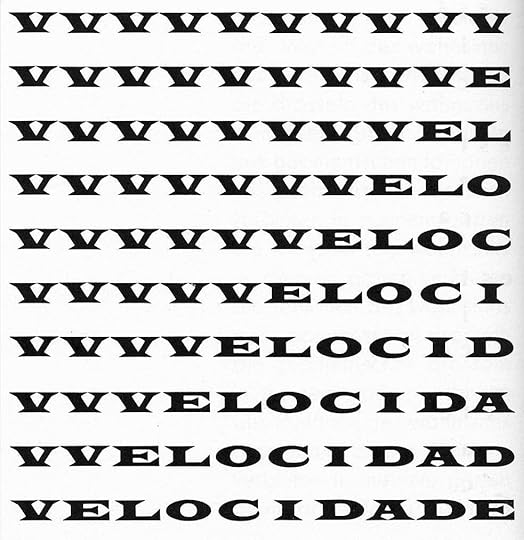
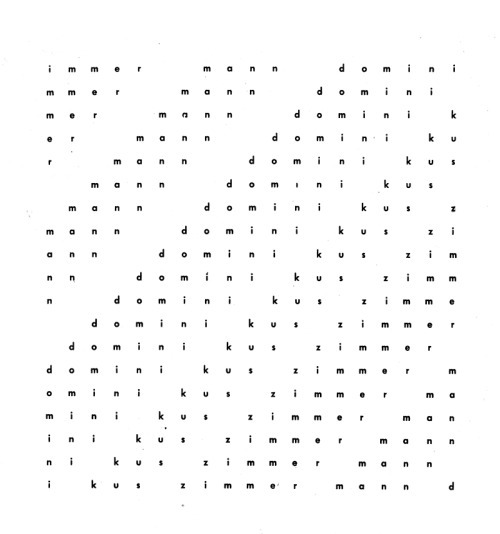
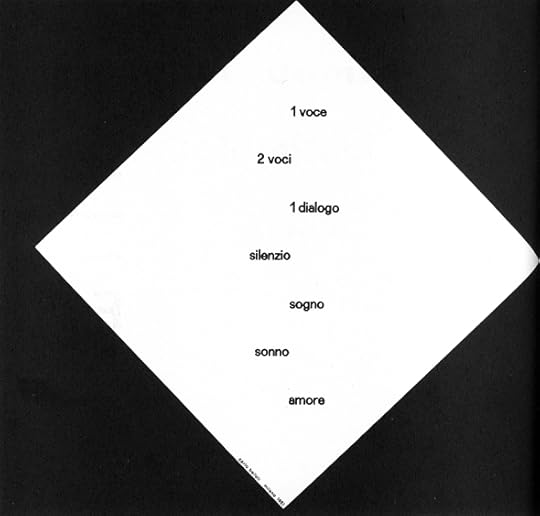
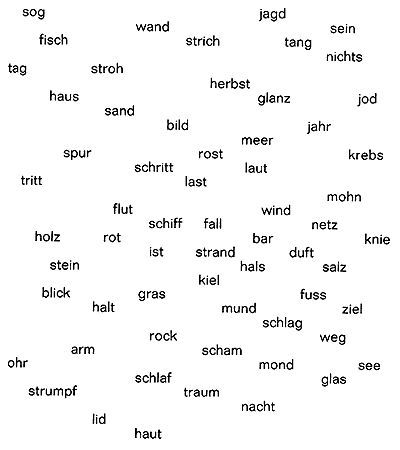
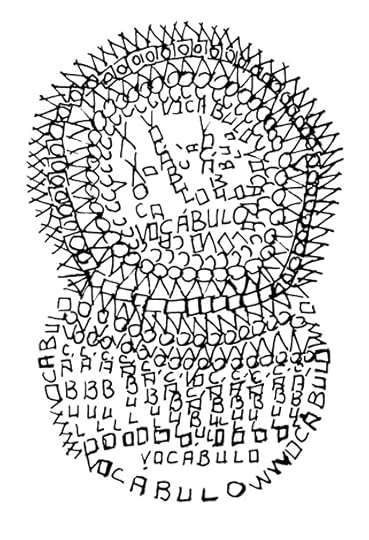
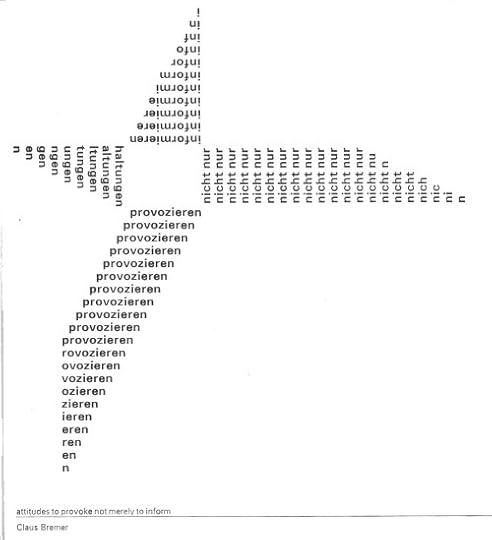
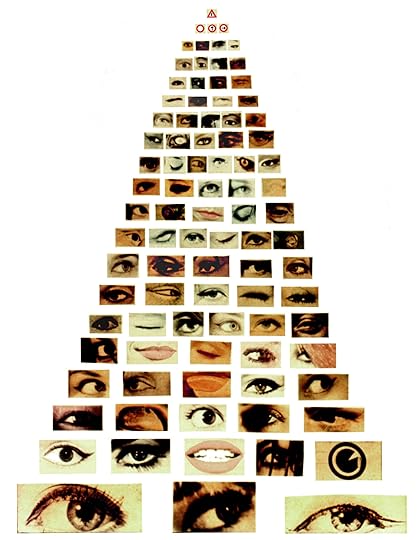
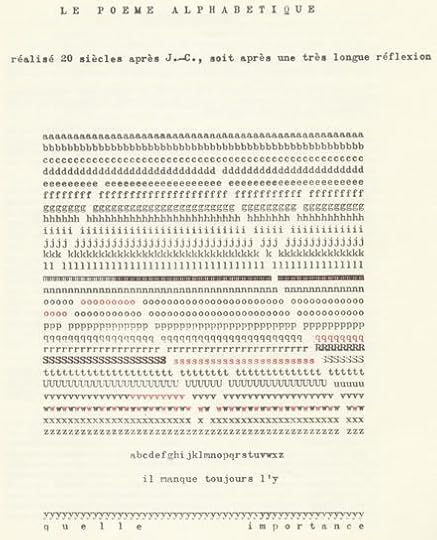
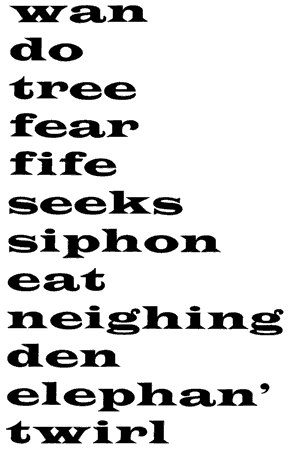
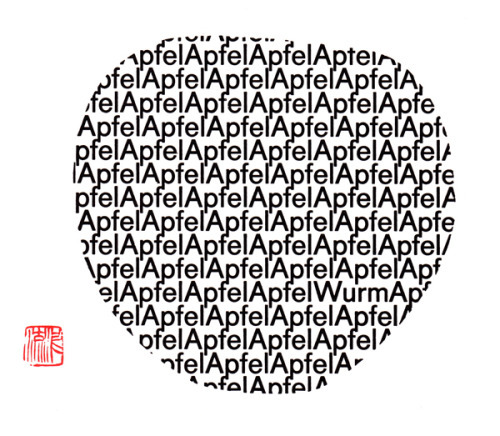
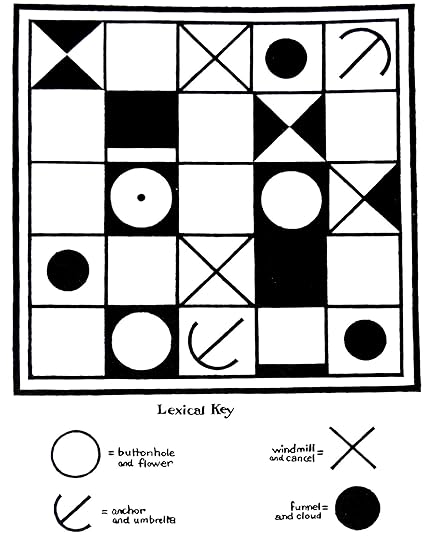
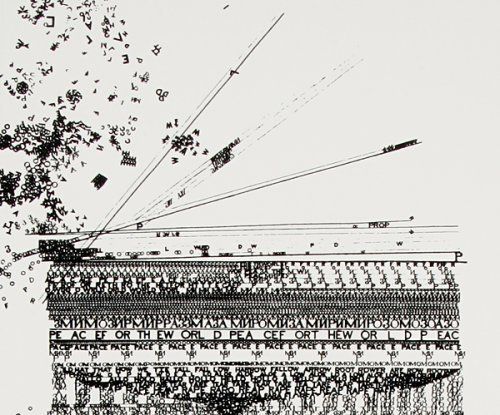
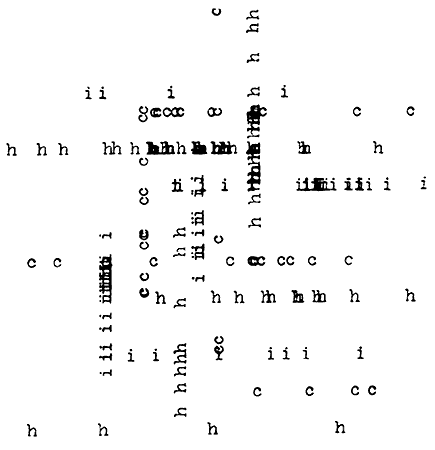
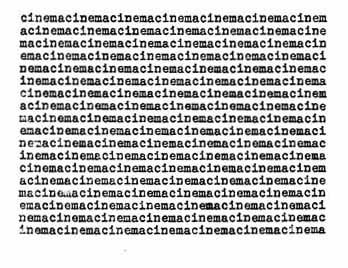
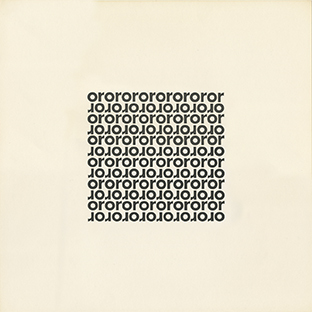
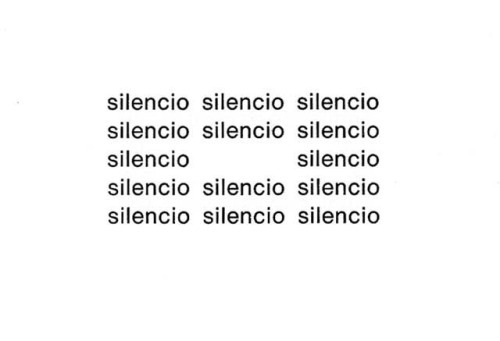
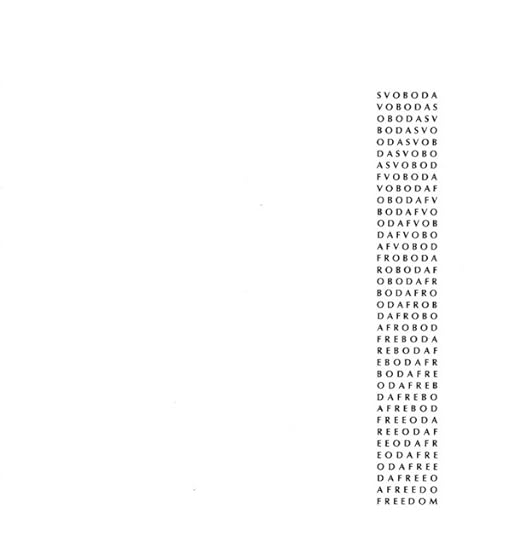
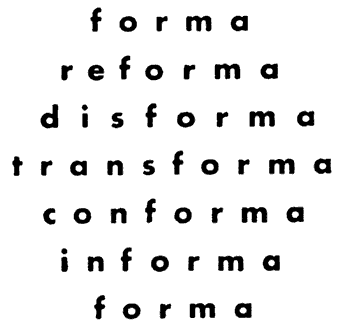
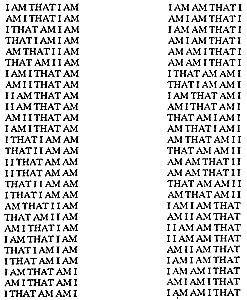
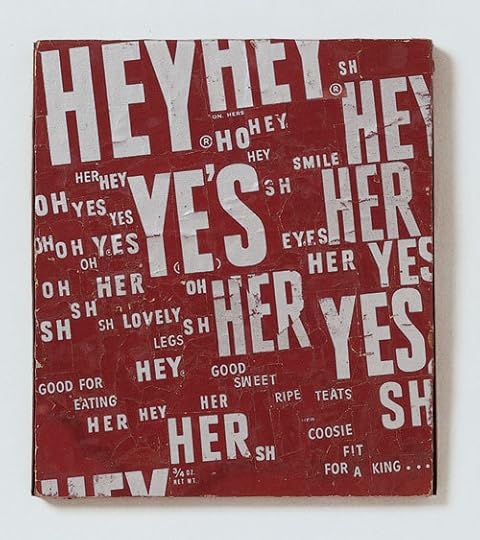
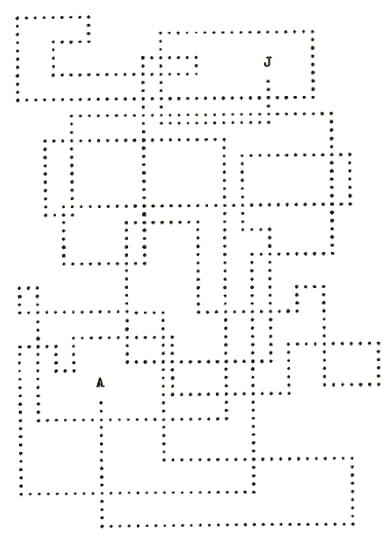
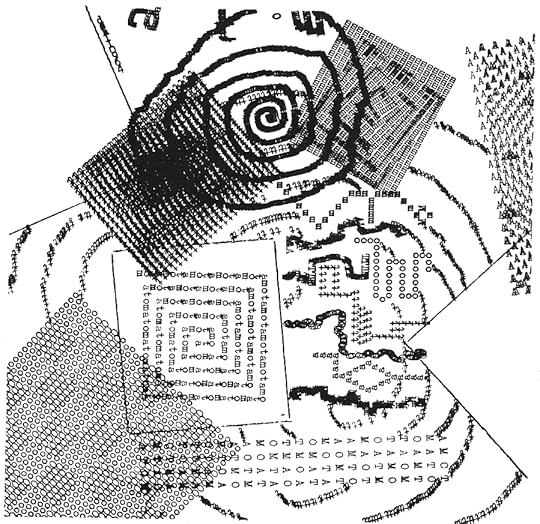
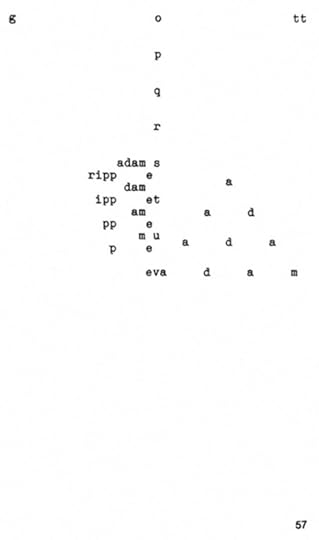
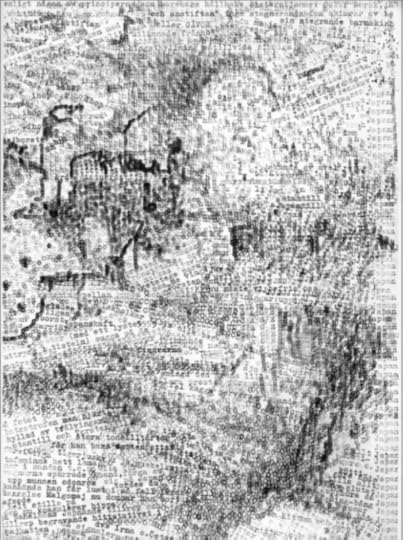
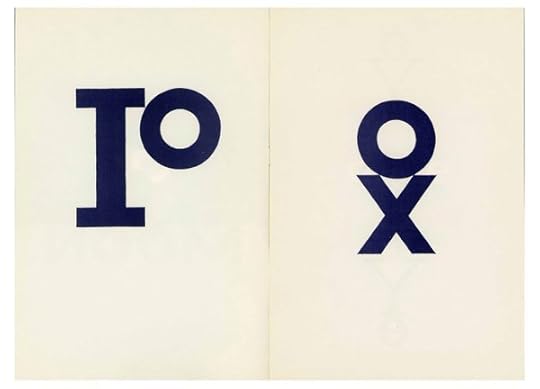
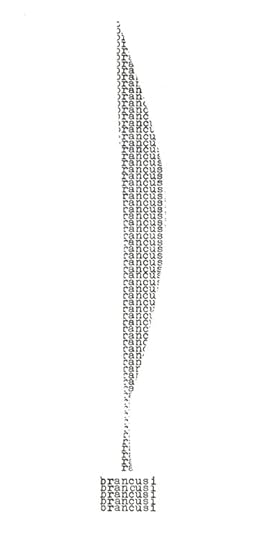
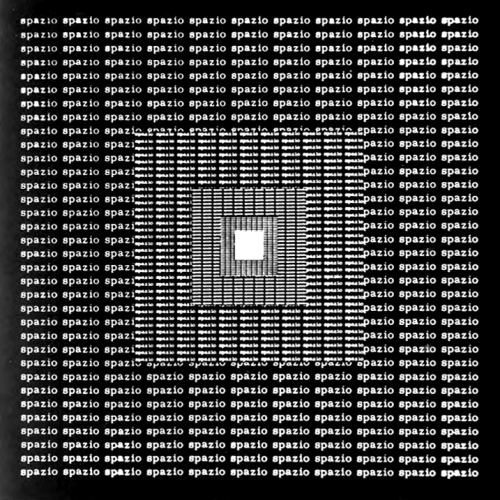
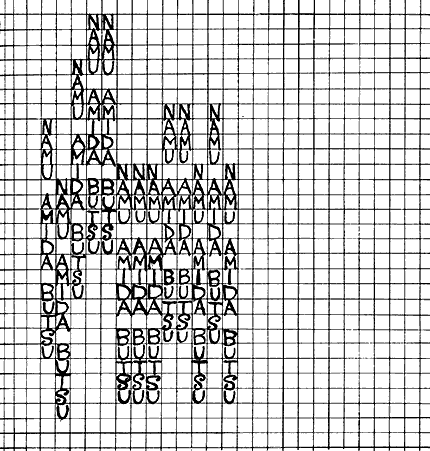
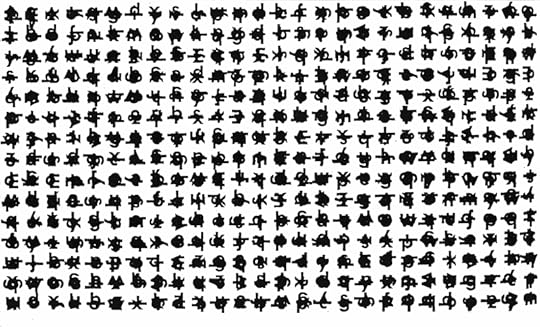
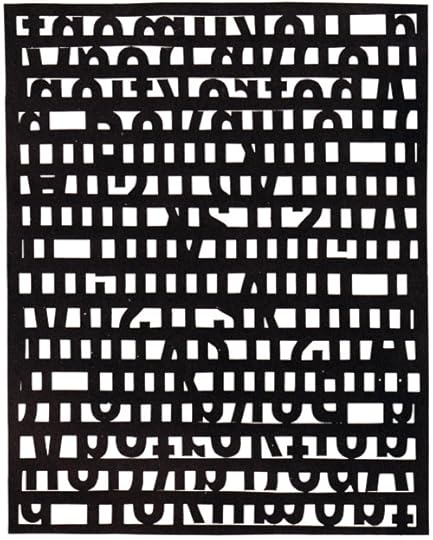
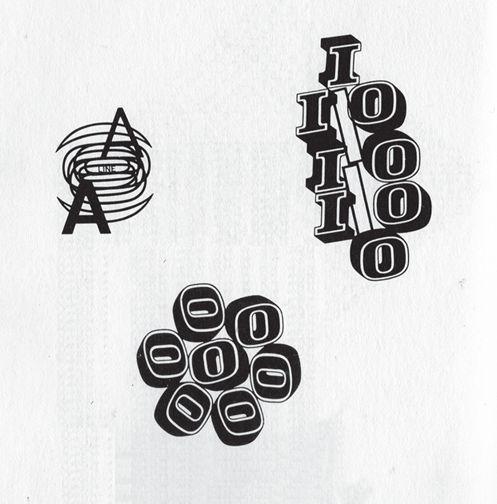
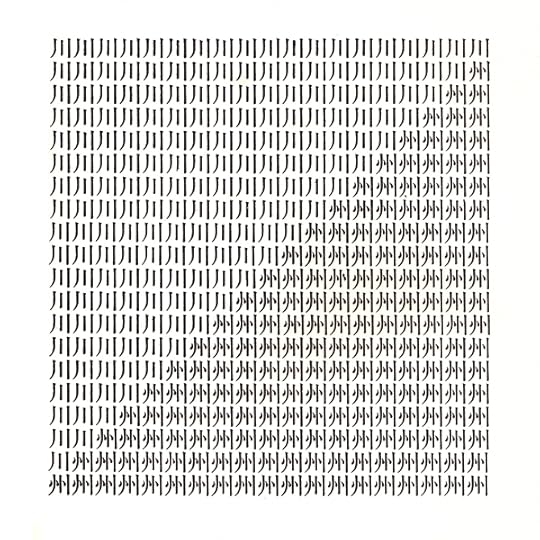
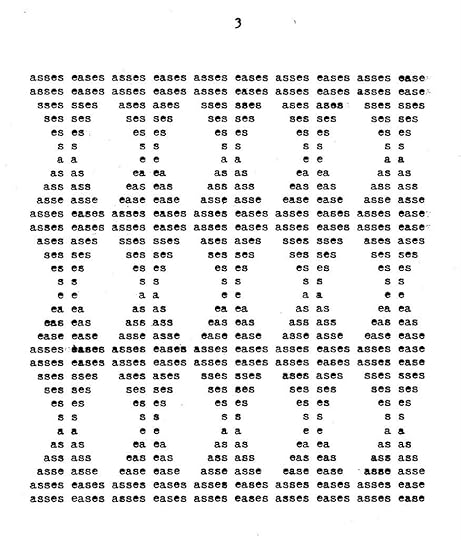
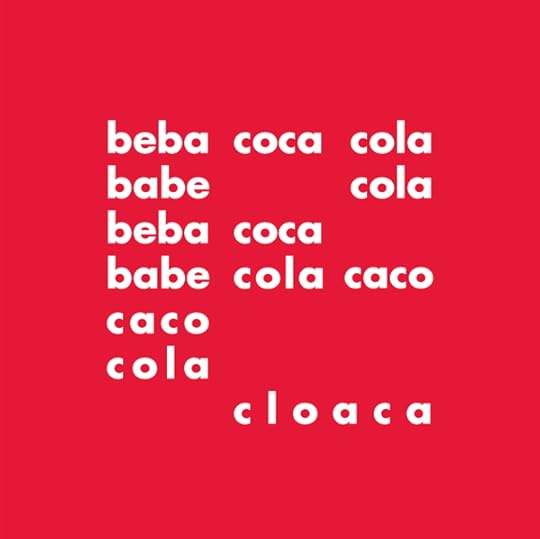
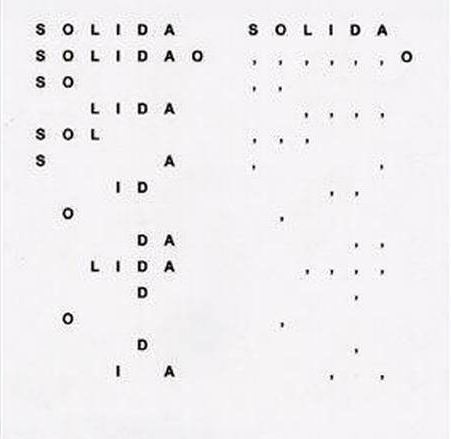
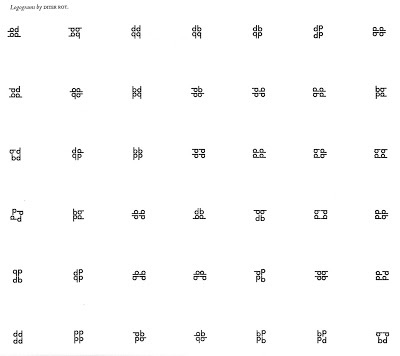
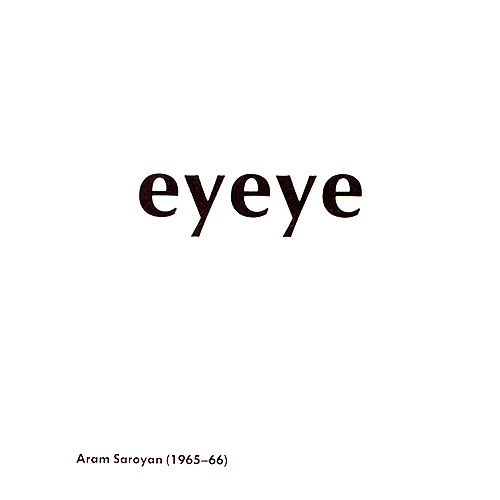
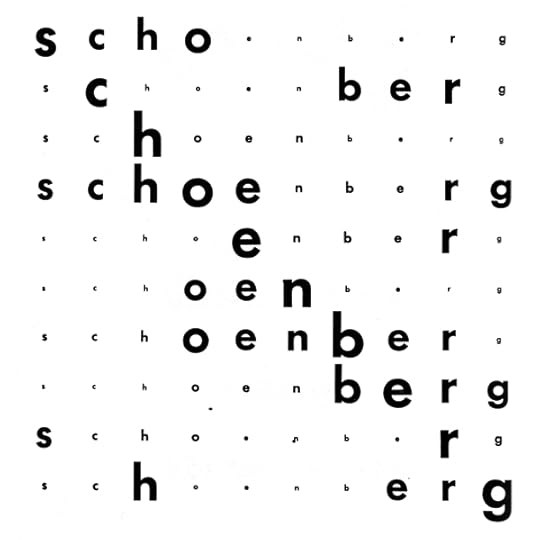
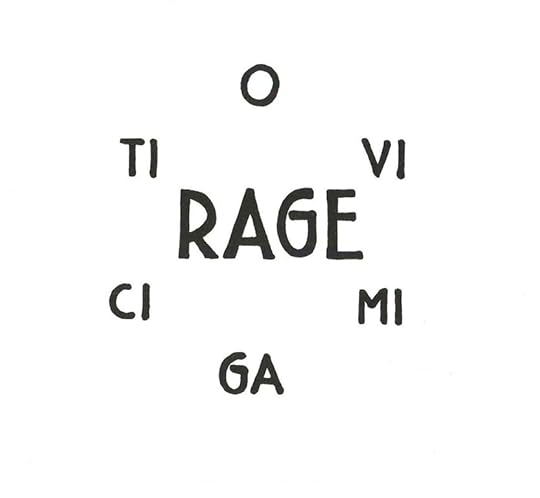
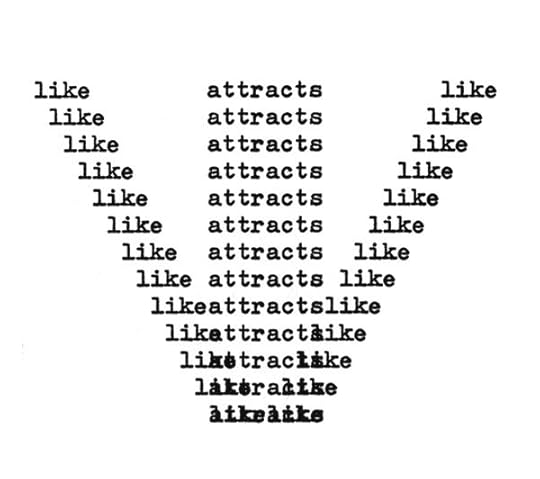
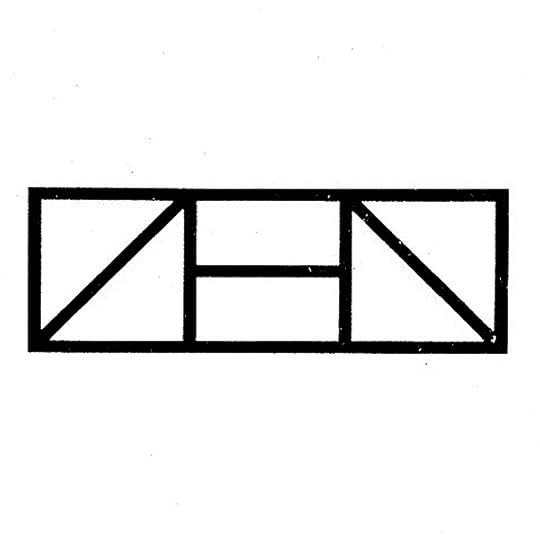
I've already made my love of Concrete Poetry & of Something Else Press abundantly clear elsewhere but I'll repeat myself anyway: one of my favorite forms of poetry, one of my favorite presses. An incredible body of work edited by one of its main practioners. Works in languages other than English presented in their original language & in translation (when 'possible') or otherwise explained. Just referring to the pieces here w/o showing examples is like describing the 'Mona Lisa' as "some woman" (or whatever).
Sadly, I rarely meet anyone anymore who even knows what concrete poetry is. How time flies, shit stinks, & people forget. Concrete Poetry is writing in wch the form of the text is as communicative as the words & letters of the text itself - if not more so. & this anthology was, according to the front cover, "the largest Anthology of Concrete Poetry to appear to date, and the first major one to be published in the United States."
If you like yr visual & textual stimulation intertwined cleverly into one gloriously compacted form, this is for you. If you have to watch "The X-Files" on tv 1st, uh, forget I mentioned it. There're over 300 selections in this monster from many people in many countries. This is one of the most international poetry comps you'll ever se.
All the worst crimes of poetry (except perhaps the confessional) are on display in this volume, so you'll understand that it's saying something when I assert that the most embarrassing part by far is watching poets provide artistic statements, as though they were (shudder) art students. It's especially embarrassing when the poem receiving the statement is a single word, perhaps repeated several times.
If you are Margaret Dumont, or the ghost of straw-man Philip Larkin, this anthology will blow your mind and force to to reevaluate your preconceptions of language etc. If you are anyone else, the deadening effect of page after page of disposable and pretentious word games will reveal what an artistic dead end concrete poetry is.
"What is a poem?" is the sort of question these poets, and the introduction to this work, are interested in. Well, I'm not saying I know what a poem is, but I'm pretty sure a poem isn't something you can compose 90 of in an hour.
More a cross-section in time than a selection of [more narrowly defined] "concrete" (if such a thing exists)--by which I mean there are inmixed what I would be tempted to call "sound" or "visual" poems. Huge, and fun, and easy to read, but in my opinion kind of dead.
I'm going to go against the broad love-it-or-hate-it style which seems to have dominated goodreads reviews of this book and say that most of these are actually quite mid. These poems' overriding concern with the unity of content and "look", combined with the orthodox-concrete idea (or at least broad consensus) that the "look" ought to be dictated by the imprint, arrangement, and orientation of the latin characters on the page, combined with just how vague the associations of the simple printed latin character are--no matter what font you pick--mean that most of the poems themselves are usually vague, or just vaguely associative, or worse "suggestive." Worst of all so many of these poems are so horribly safe. Today if you see a poem like this "in the wild" it's on the sides of city-council approved buildings, or, even worse in airports. What they provoke is almost always, at least for me, an intellectual appreciation--"ah, the content and the form are nicely unified;" "what an interesting play of sounds and meanings." Or, if they provoke, it's by crude appeal to the body: a poem shaped like a vulva; a poem which contains the word semen. But this kind of provocation is cold too.
That's the rule. The exception is stuff like Artmann's "in meinem garten"; Belloni's "sole solo"; Campo's uma vez; Ian Finlay's "XM poem"; Grunewald's poem on petroleum; Jandl's poem on umlauts; Morgan's "Seven Headlines"; or any of Niikuni's beautiful poems in Japanese. What makes these different? Frankly I'm not sure. But (except Jandl's poem, which I like because it's funny), these feel like they risk something. Their play seems more serious. And they move away from the horrible "mechanics of constellation" stuff which the poem-descriptions are full of, and which range from mildly interesting to hermeticist to fully enciphered babble.
But at least all but the worst of these are intellectually stimulating, and fun to read. And the Japanese ones especially are in a class of their own. It made me really want to put together a project to read/perform some of these aloud (but again, because it's interesting to think about how it could be done, not because it's moving). Anyway,
You don't really read concrete poetry so much as look at it and think about it. It straddles the line between the language and visual arts: opaque and silly to some, bottomless and sublime to others. Count me in the latter category.
"An Anthology of Concrete Poetry" was originally published in 1967 and was edited by Emmett Williams, one of the finest practitioners of the form. It's a comprehensive, international survey of poets working in a variety of unusual expressions of semantic creativity.
Jackson Mac Low is represented here, whose poems were created through purely chance operations. Brion Gysin's cut-up method is included. Works from Mary Ellen Solt, bpNichol and Václav Havel are also here. What all the contributors have in common is that language has been broken down, manipulated and re-constructed to convey ideas and themes outside the range of traditional poetry, perhaps outside the range of traditional semiotics.
The book is back in print thanks to Primary Information, an NYC publisher of art books. I'd reccomend this one for anybody interested in the convergence of poetry and the visual arts.
The uncanny number of multilingual concrete poetry collections published over the years suggests, among other things, that despite the lofty assertions of its practitioners, the form is more visual than verbal. Some of the translations included here are atrocious, leaving one to wonder if monolingual readers would not be better off with the visual element alone. That said, the hit/mid/miss ratio is quite good, making this collection a pleasurable 'read'.
cool (i like the mary ellen solt anthology better tho, a lot of these poems were a little tiring to get through but there are some that are really good)
For me a lot of this is quaint and very dated. Neat collection of a common cause but only a few of these poems stick the landing, or else stick the landing is all they do but miss the landing part. It's a lot of fun to go through, though.
THE compendium of concrete poetry up to the late 60s. Wow. I cherish SELECTED SHORTER POEMS, a collection of works by Williams (who edited this and contributes), just as much.