Amy Ehrlich is the author of more than thirty books for young readers and is also a winner of The Dorothy Canfield Fisher Award for her novel Joyride, which was also chosen Booklist Choice Best Book of the Decade. She lives on a farm in Northern Vermont with her husband and a great many domestic and agricultural animals.
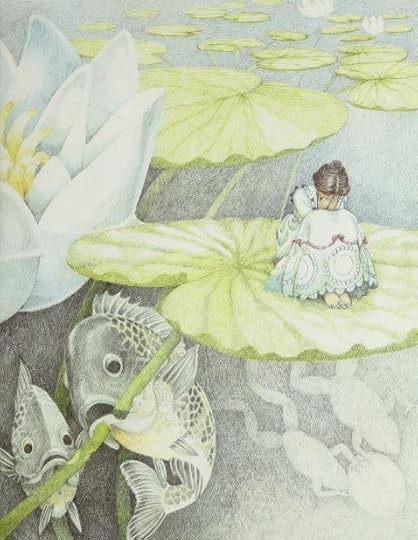
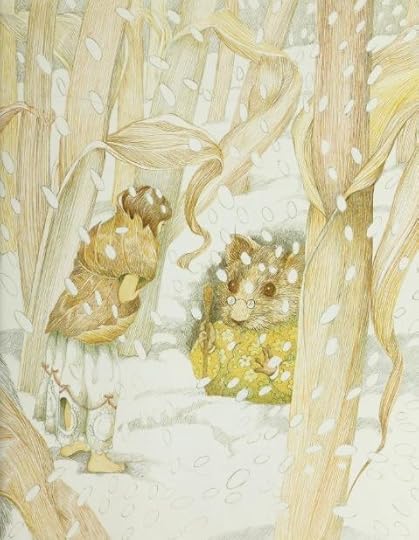
SUSAN JEFFERS ILLUSTRATIONS: I thought this was lovely, but then I'm a Jeffers fan. The story of Thumbelina has always proved oddly intriguing--alternately delightful and disturbing--for me (aided, no doubt, by the very odd experience of seeing human actors dressed as Mole and Bluebird in the Faerie Tale Theater production, ahem!) I must say this version (text) did nothing to clear up the problematic elements although I am still enchanted with the idea of the wee girl living amongst birds, butterflies and flowers. Here, we have a very sudden "happy ending" as Thumbelina's dear friend (whose apparent love for her remains unrequited) drops her off amongst her own kind and the prince falls for her instantly because she is "so lovely"--the translation tries to make it out that Thumbelina sees right through to his good heart given the kind set of his lips and his nice eyes, but it really seems a bit too "you're beautiful, I'm handsome and a king and I want you so let's get married" for my taste--oh, and I guess Thumbelina never gave her poor mom another thought??? But, anyway, the illustrations are lovely and cater to all the elements of the tale that I actually like--Thumbelina sleeps in a nutshell with flower petal blankets, she has exquisite dresses (lots of them--apparently the fieldmouse she stays with likes to keep her dressed well!), gets pulled along on a lillypad harnessed to a butterfly, she befriends a bird and soars through the sky on his back, and in the end she gets her own sweet pair of wings so she can fly, too.
Originally published in 1979, this abridgement of Hans Christian Andersen's Thumbelina - in which a tiny girl must escape from a number of would-be bridegrooms - was recently reprinted, in 2005. Adapted by Amy Ehrlich and illustrated by Susan Jeffers - who also collaborated on The Wild Swans, The Snow Queen, and Cinderella - it is pleasant enough, but also problematic, from both a narrative and illustrative standpoint.
Ehrlich's retelling omits a few key episodes, from Thumbelina's kidnapping by an amorous beetle, and resultant grief at her knowledge that the butterfly she tied to her lily pad will probably starve to death, to the sparrow's final flight north, where he relates his tale to a man (Andersen, clearly) who understands him. The result is a story that feels flattened: robbed of much of its emotional power, and sense of danger. Ehrlich attempts to compensate for this by making the character of the Mole even more unlikeable - going so far as to have him behave in an abusive way to Thumbelina, forcing her to sing until she is hoarse - but the effect is melodramatic, rather than sinister.
Unfortunately, Susan Jeffers' pen and ink illustrations are just as uneven, lovely in some places, and out of place in others. Why does Thumbelina change dresses in every scene, after coming to live with the Mouse, always looking like a Victorian lady? The two-page spreads are quite beautiful, but the overall impression is of a project that doesn't hang together as it should. This is an edition I would recommend only to Susan Jeffers fans - everyone else should probably look further, perhaps to the Lauren Mills edition, or to the recent retelling by Sylvia Long.
I never liked Thumblina. I always saw her as a weak character. She doesn't do anything, and nothing really happens to her other than getting abducted or imprisoned which require others to help or rescue her.
I read this for the illustrations. They are really beautiful.
داستان نهم از همخوانی داستانهای اندرسن بار اولی که در سالهای گذشته ورژن فارسی مخصوص کودکان این رو خونده بودم دوستش نداشتم ولی این سری بهش حس بدی نداشتم. شاید چون این بار اون احساس عدم تعلق و تلاشش برای زندگی رو بگم بیشتر درک میکردم. البته این احتمال هم هست که اون ورژن فارسی شده، چیز مناسبی نبوده؛ باید میگشتم پیداش میکردم اما وقت و حوصلهاش نبود. به نظرم کاراکتر تو تمام داستان دنبال جاییه که بهش تعلق داشته باشه؛ این حس گمشدگی چیزیه که شاید الان یکم بیشتر از اون موقعها درکش میکنم. و باقی داستان که اسپویل نمیکنم. نقاشیهای وسط ورژن تاتار هم ازش جالب بود. بهمن ۱۴۰۳
Thumbelina is in the genre of folklore and is intended for children ages 2-5 years of age. Thumbelina is about a a tiny girl named Thumbelina. Thumbelina was a beautful girl and all of the animals loved her. One day after a toad wanted to marry her and Thumbelina did not care for him, she decided to escape. Some of the animals helped her escape but she was soon captured by a May bug. However, the May bug decided to let Thumblina go and she was left with nowhere to go. When winter came, she stumbled upon the house of a mouse. She loved living with the mouse but she really wanted to go off with the sparrow that she had found and nursed back to health. One day she decided to go away with the sparrow and he took her to a beautiful place. There she met her future husband and became the queen of the flowers.I gave this book 4 stars because the pictures are full of details to capture the imagination and attention of young readers. The illustrations are enhanced by small pieces of silver in the paper that show a teardrop, beetle wings, flower pedals and a walnut shell. Children will want to read this story again and again, because of the principles of kindness, friendship, love, and belonging that this story teaches them. This book can be incorporated in the class room by having the children think about some of the things they could do if they were as small as Thumbelina.
Thumbelina is about a family who wanted a daughter. They wished for a daughter and were given a seed to plant, that would grow a child. The next day, a flower had bloomed and inside, there was a little girl who was not even as big as your thumb, inside of the flower. One night, a toad came up and stole the little girl while she was sleeping on her flower. The toad took her to be his son's wife but Thumbelina escaped and found a mouse who invited her to live in his den with him since winter was coming. Inside the den, the mouse has Thumbelina clean the den because Mole was coming. Mole ended up falling in love with Thumbelina but the feelings were not mutual. Mole was rude, greedy, and selfish. One night, there was a sparrow that Mole thought was dead, but really it was just cold. Thumbelina nursed it back to health and allowed him to fly away. The sparrow takes Thumbelina away from the Mole and to a new place where the sparrow and Thumbelina can be together. The sparrow does not want Thumbelina to fall out of the nest, so he places her in a flower, below the nest. Inside the flower is a prince who is the same size as Thumbelina. The thumb-sized prince and Thumbelina fell in love and got married.
Thumbelina by Hans Christian Andersen is a book about a girl who is given to parents who could not have children. The unique thing about her was that she was no bigger than the size of their thumb. IN the spring, a toad noticed her and thought that she could marry her son. So she kidnapped her. This is where the adventure really begins. She meets many creatures like the Maybugs and the mole. In the end she meets the diamond prince and she marries him and they live happily ever after. In this book that is good for young children with active imaginations. It is a great book because it introduces a lot of characters.
"Thumbelina" is often a forgotten fairytale. It is the story a girl the size of a thumb who is stolen from her home by a frog searching for a wife for her sun. Thumbelina has many adventures including working for a mouse, almost being forced to marry a mole, and riding a sparrow. Thumbelina eventually is able to find a fairy prince that is the same size as her and gets a pair of wings of her own. Thumbelina is a good story, however it has some dark sides to it. This is one fairytale that is interesting but may lead to questions from children. For instance, you may be asked why would she marry a toad?
Ehrlich does edit this story, and some of her deletions are confusing, especially for a picturebook. The image of Thumbelina rowing her tulip petal boat is pretty iconic, yet the scene is missing here, as is the mayfly abduction and the framing device with Andersen. As the illustrations are quite pretty, I would have liked to see what the artist would have done with them. While it's a shorter tale, it's not as edited as some versions, so it makes for a good story with some of Andersen's charm and is a bit easier than the original for a modern child audience.
This is one of my favourite fairytales, the story of Thumbelina was first brought to my attention from the disney film which never really took off. However I loved it and couldn't wait to be able to read the book. The way that Thumbelina has to cope with all the woodland creatures and it is a whole new town.
This is a sweet story. I love it because the animals in the book save the little girl from the ugly toad's mother. Just to find her way back to home.
We could recreate the animals and retell our story. Make pretty flowers from where she was born. Help the children express how they would get back home.
Once upon a time there was a women who planted a seed and grew a beautiful flower. Out of that flower came Thumbelina a small dainty women. Thumbelina lived a wonderful life with this women until one night she was kidnapped by a toad. She escaped and came across many scary journeys until she finds her prince. This was a cute fairytale, with great pictures.
Thumbelina was taken from her home and was put under the wing of a field mouse. The field mouse set up a wedding with a mole but Thumbelina wanted to be free. The sparrow flew Thumbelina to his house and landed her in a flower. She became the Queen and got her own set of wings.
Thumbelina (Hardcover) by Amy Ehrlich (Adaptation) this book has beautiful pictures a short retelling of the story of the original hans christian anderson