Jump to ratings and reviews
Rate this book

The Roving Party

Rate this book
1829, Tasmania.

John Batman, ruthless, singleminded; four convicts, the youngest still only a stripling; Gould, a downtrodden farmhand; two free black trackers; and powerful, educated Black Bill, brought up from childhood as a white man. This is the roving party and their purpose is massacre. With promises of freedom, land grants and money, each is willing to risk his life for the prize. Passing over many miles of tortured country, the roving party searches for Aborigines, taking few prisoners and killing freely, Batman never abandoning the visceral intensity of his hunt. And all the while, Black Bill pursues his personal quarry, the much-feared warrior, Manalargena.

A surprisingly beautiful evocation of horror and brutality, The Roving Party is a meditation on the intricacies of human nature at its most raw.

296 pages, Paperback

First published April 28, 2011

18 people are currently reading
999 people want to read

About the author

Rohan Wilson

7 books38 followers
Rohan Wilson lived a long, mostly lonely, life until a lucky turn of events led him to take up a teaching position in Japan where he met his wife. They have a son who loves books, as all children should. They live in Launceston but don't know why.

Rohan holds degrees and diplomas from the universities of Tasmania, Southern Queensland and Melbourne. The Roving Party is his first book. He can be found on Twitter: @rohan_wilson.

Ratings & Reviews

What do you think?
Rate this book

Friends & Following

Create a free account to discover what your friends think of this book!

Community Reviews

5 stars
88 (19%)
4 stars
177 (39%)
3 stars
133 (30%)
2 stars
31 (6%)
1 star
14 (3%)
Displaying 1 - 30 of 88 reviews
Profile Image for zed .
605 reviews157 followers
June 26, 2020
Author Rohan Wilson has written an impressive historical novel that has left me considering it as good a debut that I have ever read.

The main character is a Vandemonian born indigenous man called Black Bill. Bill is beholden to John Batman to assist in the hunting down of plangermaireener clansmen and women as part of the Black Wars that were part of the sad history of Van Diemen’s Land. Along with a crew of convicts looking for their pass’s to freedom and Aboriginal trackers from the mainland Wilson writes a tale of both brutality and beauty about this Roving Party intent on genocide and the rewards that would go with the capture of some of the clans people.

The book is many themed. Man’s inhumanity to his fellow man looms large. Also covered is the deep spiritual aspect of knowing the value of the land that one is part of be that as an individual or through a clan. Black Bill for example never says what is on his mind in being part of the Roving Party with its murderous intents but as the reader I always got the impression he was torn between the old world and the new. The brutality of some of the events is written in such a way as to leave nothing to the imagination. This is countered with beautiful descriptions of the starkness of the country side and the extremely inclement weather that the protagonist’s encounter on their journey. The seamlessness of the telling of the story and the description of the land was fantastic.

I was immersed from page one to the very end and recommend The Roving Party to anyone with any interest in the subject of Van Diemen’s Land be that fact or fiction.
Profile Image for Blair.
Author 23 books226 followers
December 19, 2017
Dark, visceral and confronting, The Roving Party is a hard read. Not only in terms of the brutal, raw material of the subject matter, but also in its structure. Non-standard punctuation (or lack thereof) makes it rather disjointed and a difficult reading experience in one sense, but at the same time this challenge is worth it. Mainly because of the beauty of Wilson's prose. Powerful and punishing with a lower-than-average count of adverbs and adjectives for a work of this length, the style has been compared (favorably) to that of Cormac McCarthy. Brilliant characterisation, for me, is one of the keys this novel's greatness.
The author won the 2011 Vogel Award and was shortlisted for others. I'm not surprised.
Highly recommend.
Profile Image for Mel Campbell.
Author 8 books74 followers
June 15, 2014
I normally steer well clear of any self-consciously 'Australian' award-winners set in the colonial bush (this won Wilson the Vogel Prize), but when I flicked through the first few pages of this in the shop, the writing immediately intrigued me. It feels urgent and modern in a way that belies its 1829 setting: terse dialogue with an ear for colloquial rhythms, and descriptions that are viscerally poetic – sometimes, literally so.

But there's also a mystical quality to this that reminded me of Cormac McCarthy. Perhaps it's all the laconic men with their guns and merciless killing, but it's also the weird, unresolved tone of the ending and the role of stories and allusive imagery. One of the most McCarthyesque scenes occurs when the roving party meet a stranded toff with a mysterious fancy case, who pitifully begs to be escorted to safety. John Batman looks inside the case, but never tells the party what it contains… and we never find out either.

The clan chief Manalargena, an ambiguous antagonist who seems to have magical powers, tells Black Bill – an equally ambiguous protagonist – a story about two brothers eating crayfish by a river, pursued by a hunter who wants the crayfish for himself, until all three are transformed into wallabies (or, in the version Black Bill remembers, snakes) and graze together peacefully, forgetting who is friend and who is foe.

This story seems to be an allegory of the frontier war that was then being fought between black and white people in what's now Tasmania. Manalargena wants Black Bill to join him in fighting off the whitefellas, who only want what someone else already possesses. And he implies that, like the wallabies, Black Bill has spent so long around the colonists that he has forgotten whose side he's on.

But the story could equally be utopian: a vision of a Tasmania shared peacefully by black and white people. Wilson explores the arbitrary lines of belonging and not-belonging in Van Diemen's Land: the clashing allegiances one could find oneself wrongsided by. It's telling that Manalargena is described as a Plindermairhemener man, but Black Bill is a Vandemonian: he belongs to this place, but having been raised from childhood by a white settler, he's native in a 'white' way.

We see this cycle being repeated as John Batman – another ambiguous antagonist, who'd go on to claim what's now Melbourne for the white men – steals a Plindermairhemener boy to raise in his household, calling him Ben. And when Eliza Batman enlists the help of Black Bill's wife, Katherine, in finding out the name of a black girl Batman has kidnapped – and whom Eliza is now trying to 'civilise' by bathing her and dressing her in European clothing – Katherine's mouth goes hard and she says, "Whites got no need of our names."

Also unwillingly becoming Vandemonian are the four convicts who are loaned out on assignment to Batman (an officially condoned use of convicts as slave labour for free landowners). Three are English, one is Welsh, but as Batman informs them, they're all Vandemonian now. And joining Batman, his servant Gould, Black Bill and the convicts in the titular roving party are two Dharug men from Parramatta, Pigeon and Crook. By virtue of their skin colour and their bushcraft skills they're lumped in with the local blackfellas, but this isn't their language or their country.

So much of the book is the oppressive suffering of this oddball group as they set out to earn money, land or their freedom by murdering and enslaving the local clanspeople. The cold, rain and snow, the hunger and thirst, the leeches and rocks and branches, the brutality and lack of compassion, are all described vividly. Theirs isn't a journey with a clear trajectory – they do rove, searching and never quite finding their quarry, and erupting into vicious, deadly skirmishes here and there.

Black Bill's urgent desire to find and kill Manalargena is what really drives the book. Like so much here, the nature of their feud is unspoken – although Bill's collusion with Batman to exterminate his own people is viewed with justifiable disgust by the clansmen. In a way, it seems that Manalargena represents Bill's shame over what he's done, and his alienation from his language and traditions. He's an opaque, stoic character who nonetheless feels deeply. Bill seems dispassionate, even callous, in his work, yet he displays a compassion that seems innate. He repeatedly rescues Horsehead, one of the convicts, a disagreeable man who could easily have been left to die.

Later, he rescues a black girl from the clutches of two escaped convicts, and feeds and shelters her. Children seem to act here as both as emblems of what has been lost, and hope for the future. The white urchins the party encounter in the towns are crueller and more horrible than the adults. Manalargena constantly surrounds himself with children. And Bill's unborn son is his only source of solace.

I was reading about John Batman on Wikipedia just now and learned that his direct descendant Daniel Batman, an athlete who died in a 2012 car crash, was married to athlete-turned-politician Nova Peris and fathered two children with her. Jack Batman, whose ancestor murdered black people, is Aboriginal.
Profile Image for The Shayne-Train.
440 reviews103 followers
November 19, 2020
So recently I've been super-interested in novels dealing with the colonization of Australia. I've always enjoyed "frontier slice-of-life" stories about early America, but those of Australia adds something more provocative and interesting. I've been trying to figure out exactly what that is, and I think I've come up with:

A DIFFERENT FLAVOR OF RACISM

In the Americas, the Native population got their share first, along with attempted genocide. After THAT the Blacks were kidnapped and brought over, and thus started the racist-in-a-different-way suppression/enslavement/exploitation. But in Australia, the Natives WERE the black people, and all the different strains got to pour out all at once, and it makes for terrifying, unsettling, morbidly fascinating goulash of hate and prejudice.

And this novel is written so clinically, just presenting the circumstances of all this terrible treatment, it really is jarringly good at showing you the evils of the past.
Profile Image for Jennifer (JC-S).
3,550 reviews289 followers
June 18, 2011
‘The Governor is payin us to instil a lesson in the obtuse skulls of these dark skins.’

Van Diemen’s Land (now Tasmania)’s Black War was fought between 1804 and 1830 when the new and old inhabitants of the island clashed violently over occupation and use of the land and its resources. The end result of the Black War was the dispossession and near annihilation of the indigenous inhabitants. In this novel, researched over a number of years, Rohan Wilson focuses on one roving party: sanctioned by Lieutenant-Governor George Arthur, and was led by John Batman in 1829. While the precise demarcation between fiction and fact is unclear, the story has its own momentum and its own raw impact.

In 1829, Van Diemen’s Land had been a British penal colony for 26 years. John Batman was then a grazier (he went on to found Melbourne), and this roving party was to consist of nine men: Batman himself, his farmhand William Gould, four convicts (Baxter, Clarke, Gumm and Toosey), two black trackers from New South Wales (Pigeon and Crook) and Black Bill.

John Batman tells the roving party: ‘There is among them a chief. A warrior. Some say witch. He is called Manalargena.’ ‘You must bring him down before all others.’

Black Bill, referred to as the Vandemonian, is an indigenous man who has been educated and raised by Europeans. (There is an historical ‘Black Bill’ – William Ponsonby about whom I would like to know more.) He belongs to both cultures, and to neither. As the novel opens, Black Bill is approached by Manalargena to fight with his indigenous clansmen:

‘Who is brother. Who is hunter. They forget this thing.’

Black Bill refuses: he has already agreed to accompany Batman. It may be a pragmatic choice: the members of the roving party have been offered freedom, land grants and money; but it is not to be an easy one.

‘It was through old country they went, a thousand generations black.’

The events, relationships and confrontations depict the brutal world of early colonial Van Diemen’s Land. While many of the acts depicted are violent and cruel, each has a reason and its place in the narrative. The descriptions of the natural world contrast its beauty: ‘the white cotton crown of Ben Lomond’ and hostility: ‘They scanned the weave of alpine scrub along their sights. To follow him into that realm was a near thing to suicide.’, and add to the tension of the story.

Black Bill is the central character in this novel, and it is Black Bill’s relationships with his wife Katherine, with John Batman, with Manalargena and with others that brings this novel to life.

A very haunting life, based on troubling historical events.

Jennifer Cameron-Smith
Profile Image for James Whitmore.
Author 1 book7 followers
September 5, 2014
It's now been a couple of weeks since I finished The Roving Party, which is a good thing for a review because now I know whether it sticks with me or not. It does. The thing that sticks with me most is this: mina. nina. narapa. Googling tells me they are palawa kani words for 'me', 'you', and 'to know' or 'to understand'. palawa kani is the pieced-together language of indigenous Tasmanians. But in the book, they words arrive without explanation. They are a locked door, and a reminder of our failure to understand each other.

The Tasmanian characters are similarly opaque. Sometimes it works; often I wanted to know more. Why are these characters doing what they do? What do they feel? Perhaps there can't be an answer. As a theory for the atrocities committed during Tasmania's Black War, it feels compelling.

For a bleak, brutal and often cold book The Roving Party is surprisingly beautiful. There's a lovely rhythm and repetition in the book's landscape, and even moments of humour. There's a possibly supernatural subplot running underneath, which is cool but feels a bit odd in an otherwise relentlessly realistic novel.
Profile Image for Steve lovell.
335 reviews18 followers
October 2, 2011
As is frequently necessitated by my bi-coastal existence, the driving up and down through the Midlands of my island is a constant. I recently made the journey yet again after reading Wilson’s award winning book. As is always the case, part of said journey is flanked by the slopes of Ben Lomond, rising bull-like from its range, this time on a sparklingly crisp spring morning. Unusually for the time of year, there was no circumference of frosting to temper its blue-green stance. It is a majestic mountain within Tasmania’s context, but I’d always figured it to be benign.
In this author’s mind though it is an even more substantial presence and is the fulcrum around which his story plays out. On one side we have Batman, the dour, hard organiser of the hunting party. On the other is his quarry, members of the gloriously named Plindermairhemener clan, ably led by its headman Manalargena. Here we have a resistance leader to rank with Mosquito of earlier decades, or even Pemulwuy on the Hawkesbury Plain as well as Kimberley warrior Jandamarra. We know from history that his courage will be no match for the fowling pieces of the government sponsored bounty hunters. This is the time of the Black Wars, Tasmania’s ultimate stain, leading to the demise of a people in their traditional form. This is a dark, dank cruel book, but one stunningly written. A new and capable member has, with this tome, introduced himself to the excellent coterie of this southern state’s eminent writers, and will soon press for their mantle if this standard of product continues to be repeated.
The novel evokes frontier Tasmania, a time of no quarter given by either side and of harsh practices that are, even by today’s desensitized standards, stark and horrible. Wilson does not shy away from this, but the book also includes black humour and some nuances of hope. The character of Black Bill is the most fascinating creation, and the ultimate hero may surprise some.
The novel has led me to read some internet on Batman and there is some interesting stuff out in the ether, some laudatory, but some as well backing up Wilson’s view of Melbourne’s founder. It has also in part led me to purchase James Boyce’s ‘1835’, dealing with his time after these events. This also promises to throw some light on the icon’s darker side.
As a Vogel winner one would expect this to be a novel of quality written by an author with potential. Some former winners have fallen by the wayside, but Wilson, I suspect, has the chops to make a go of it in these difficult times for our literary people. My island truly punches above its size in quality output for discerning readers. But with the place I’m privileged to live, there’s plenty of fodder in its sour, tainted past.
2 reviews
August 13, 2014
My Book Club found itself back in Tasmania, this last month, with The Roving Party by Rohan Wilson. This time it was a different Tasmania - a brutal and savage place with a confronting story told with surprising beauty.

Rohan Wilson's poetic prose is as raw as the landscape it describes. Somehow, this spare and pared back language, with its visceral verbs and minimal adjectives, captures the harsh splendour of the Tassie wilderness. Who knew there were so many fascinating ways to describe the bush?

At first, I stumbled on words and checked for definitions (often). Some were archaic and little used. I wondered how the author had discovered them.

At first, I was unsettled by the lack of formal punctuation and formatting. There were no quotation marks used to define dialogue and no chapter numbers or names.

At first, I was puzzled by the occasional use of indigenous language in the dialogue. I had no easy way of translating it.

Then I stopped stumbling and stopping. I settled in to the flow (instead of resisting it), let the rhythm tell me the story. Like quality poetry, the meanings are more instilled in the surrounding envelope of words and feelings than they are in any single word, or set of quotation marks. It's all there, if the reader just relaxes into the cadence. And so I did.

The characters are drawn in vivid, contrary detail and it is many chapters before I let myself feel any empathy for them. These men are barbaric and unlikable. Yet, they interact according to a bizarre code of conduct. They're survivors, skilled bushman ... and killers.

The action is played out, sometimes at a plodding pace, against the backdrop of wilderness and the mystery of the hunted, the aboriginals. We're challenged to understand how Black Bill can hunt his own people, how he can survive in the "no man's land" between his people and the newcomers. I looked for the answer everywhere - in his relationships with Batman, with his wife and with Manalargena, the fearful tribal warrior. The storyline seems simple, but the motives and intentions of the characters are as complex as any epic narrative.

And therein is the true beauty of The Roving Party ... amongst the poetic language, the seemingly barbaric characters and the splendidly drawn Tassie wilderness, there are intricate themes of humanity and inhumanity to explore and ponder. I'm left wondering well past the final page.

There are more questions than answers in this amazingly atmospheric read.
Profile Image for Wando Wande.
5 reviews1 follower
February 12, 2014
NetGalley offered The Roving Party in exchange for a review. This book is a literary western with magic realism elements. The story is simple enough. Set in the 1820′s Tasmania or Van Diemen’s Land, a roving party headed by John Batman set out to track and apprehend an aboriginal clan. Central to the story is an aborigine, Black Bill, who aids John in hunting those of his kind.

There isn’t much of a plot or page-turning action or dramatic character development. Instead we’re immersed in the dreary day to day of thugs tracking the “blacks”. Despite the slowness of the plot, the book does engage, mainly because Black Bill is such a mystery. Why would he hunt his own kind? How can he be stoic in the midst of such agressive racism? He is a difficult man to understand, but out of the merry band of thugs, he’s the most compassionate, amazingly enough.

Needless to say, if you’re looking for an easy story to read, this isn’t it. Racism is vicious and ugly and pervasive. Animals are killed without hesitation. Women and children aren’t spared from the cruel calculus of conquest. I didn’t know much about Tasmanian or Australian history before reading this. Oh dear, I know now. Black Bill’s a historical figure, as much as John Batman. They really did go out into the wild looking for aboriginal men to kill, sort of like white men in the American West hunting down Native Americans to kill and scalp–A bit like Blood Meridian, you say?

You’ll find a lot of a reviews that compare this book to Blood Meridian, and the comparison is apt. The prose shares a lot of Cormac McCarthy’s style in cadence, spareness, and emphasis on stark descriptions of the landscape. Dialogue is without punctuation, and the narrative voice exudes poetic omnipotence. However Rowan’s style does leave out McCarthy’s overbearing forcefulness of million-dollar words, paragraph long sentences strung together with ‘and’s, and the unrelenting nihilism of violence. I’m happy to report that Rowan Wilson doesn’t imitate McCarthy’s penchant of taking climatic showdowns off camera.

Ordinarily, this book would earn three stars because I had to make myself read through too many sections of men being inhumane. But the ending surprised me. I think it would surprise you too. The ending only bumps the book from three stars to four stars.

Unflinching and haunting sums it all: The Roving Party.
Profile Image for Lisa.
3,795 reviews492 followers
December 15, 2015
Rohan Wilson’s debut novel has revealed the Plindermairhemener as one of the peoples who inhabited Tasmania from time out of mind, and he gives voice to these people by using their language in this book. It gives the work authenticity and power. For while the sordid tale of human brutality in 1829 is fiction, it is based on extensive scholarship - and such is the power of Wilson’s prose that I believe in the novel’s truth. I know, at an emotional level, that if not these, then some other people now lost, engaged in these events. It is our history.

To read my review please visit http://anzlitlovers.com/2011/08/30/th...
Profile Image for Poppy Gee.
Author 2 books125 followers
April 25, 2023
This is possibly my favourite book ever. Reasons why:
The lyrical, poetic descriptions of the Tasmanian bush are evocative and miserable at the same time. As a Tasmanian born person, the descriptions are as accurate as they are captivating.
The way First Nations people are represented, as warriors and heroes and complex individuals, all fully imagined characters. Even in 2013 when this novel was published, most novels were depicting indigenous Australians in stereotypical ways. Black Bill is caught between two cultures; one of the first First Nations people to find himself in this way. He is smart and kind, vindictive and violent and mysterious - there are more questions than answers, and this is considerably satisfying.
I love the use of Language and the way the author's research of First Nations people is effortlessly woven into the story.
This is a dark, tragic and pivotal chapter in Tasmanian history. The Black War was a significant era when one way of life ended, and another was beginning. Manalargena's warriors have their ambitions and desires; as do the convicts in Batman's roving party.
The plot is riveting. It's a fictionalised account of real history - every event in the novel actually happened. The hunting party becomes the hunted; this brutal chase culminated in a last stand, not unlike an Amercian western.
Most of all, what I admire in this novel is the originality. It's utterly unique.
Profile Image for Heidi Burkhart.
2,781 reviews61 followers
July 5, 2019
I heard about this title in an Australian blog that I follow.

This was a very violent and cruel story, although beautifully written. Wilson really impressed me with the story and his style. I audiobooked this and the reader's voice was perfect.

Describing a tragic time in Austrian history I can't imagine a book who could have told the story better. If you can make it through the violence I recommend it highly.
Profile Image for Ville-Markus Nevalainen.
429 reviews34 followers
December 11, 2019
Around 3,5 stars at this point. I read this while I should be reading for my master's thesis, which might have not been the smartest decision on quite a few levels, most obvious being that I have a lot of other stuff to read. The other one being that this isn't the lightest read there is.

I found and picked this novel as a massive fan of Cormac McCarthy. Actually, the first I heard it mentioned was when I found out that someone had done their Master's Thesis on how The Roving Party is heavily inspired by McCarthy's works, especially Blood Meridian. (Haven't read that analysis, though.)

And the influence is apparent, at times in a good sense, at others not that much - largely because it is just inferior to his works. And that isn't bad thing by itself, it's a high bar to reach. But the comparison is easy to make, it's almost like the Australian version of Blood Meridian in some sense, men are sent to kill natives, there's blood and gore, and its written in a beautiful, poetic way.

So in that sense, there is lot to love and perhaps part of the reason why the novel failed on my part, was that I couldn't focus on it that well. Australian as a setting was both intriguing and challenging, as I had a trouble figuring out some of the descriptions at first (as a non-native speaker). The plot felt like it was missing that punch, perhaps because I was waiting something Judge Holden-like from Batman.

So yes, it's not McCarthy, but it does scartch some of that itch and I will need to return back to it at some point with more time and energy.
Profile Image for Trish.
1,424 reviews2,715 followers
September 2, 2016
This haunting debut by Rohan Wilson is a grim but beautifully written and evocative retelling of the clearing of Van Diemen’s Land for white settlers. Darkly imagined and unblinkingly told, Wilson features a black man raised white as one of two central characters. He is called Black Bill, or The Vandemonian. Vandemonian is a term white settlers of Van Dieman’s Land called themselves. Bill travels with and aids the ‘roving party’ as they seek to kill or capture aborigines in the area that came to be called Tasmania.

The other is major character is Batman, John Batman, a historical figure born in Sydney of British parents and who settled in Tasmania’s northeast. Batman led roving parties over a period of years during the ‘Black Wars’ that is the subject of this novel. The roving party has two more black scouts, both from Parramatta near Sydney, who join for payment. Much of the rest of the group are poor damned men, recently released white convicts who seek government pardons for their efforts.

Wilson balances on a knife’s edge in re-creating the real life that fills this story, rounding out his two main characters by instilling in them a steely-eyed savagery, an ability to coldly reason and plot their advantages, and a blessed and unexpected charity. Rich language and complex characterizations makes this tragedy the marvel it is, and Wilson is positively Shakespearean in adding comic relief with the occasional buffoonery of some of the rovers.

The raid depicted in this novel is a recorded event that took place in September 1829. Batman led an attack on a large group of Plindermairhemener clan aborigines who were headed by the witch Manalargena.
"Foremost among that singular horde was Manalargena who carried across his shoulder a waddy shaped from blackwood and stained with the filth of war…his wife had ochred his hair into long ringlets as precise as woven rope…the beard on his chin was matted, and the lank twists as red as a rooster’s wattle jiggled as he walked about…"
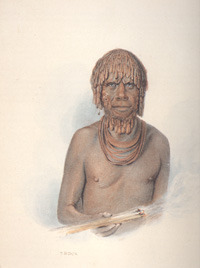
Mannalargena


On this raid, Batman takes hostage a young mother and her child. He sends the mother off to the penal colony down south while he keeping the child in his own household. But it is Black Bill we watch with such terrible intensity throughout the novel, praying that his motivation becomes, if not acceptable, at least understandable. He knows Manalargena, and hosted his band at his home.

There is very little modern-day sensibility here and we feel transported to a different time. Whatever dislocation non-Australians might feel with the language, the weapons, the plants and animals unique to the continent ‘down under’, one knows in one’s heart and gut the bald truth of the white man’s sense of ‘manifest destiny’: What’s yours is mine and what’s mine is mine. That each of our continents experienced it makes this terrible tale no less potent.

Originally published by Allen & Unwin in Australia in 2011, this book won the Vogel Literary Award there in that year. It has also won the 2013 Tasmania Literary Award Margaret Scott Prize, and the 2012 New South Wales Premier’s Literary Award. It was shortlisted for the numerous other awards. It deserves all this attention for as a debut this is an extraordinary achievement. For more history of the time and place recorded in this fiction, see this Wikipedia entry for Ben Lomond Mountain in northeast Tasmania.

It turns out that Black Bill was real, too. His name was William Ponsonby. Rohan Wilson shares with us the experience of writing his first novel and winning the Vogel Prize. His writing schedule and methods are revealed here in an interview.

This book is being released in the United States in February 2014 by Soho Publishing and is available for pre-order. I was given a copy for review.
Profile Image for Brenda.
Author 3 books49 followers
October 31, 2013
Rohan Wilson’s The Roving Party is a harrowing account of the hunting of aboriginal peoples by men employed by the Australian government. Although John Batman is a historical figure, the closest representative of a moral center in this novel is the made-up character known as Black Bill.

One of the most trusted members of Batman’s party, Black Bill is torn between his upbringing among whites and his lingering native sympathies and superstitions. Unlike most of Batman’s convict crew, who have been promised a release ticket for their role in capturing and killing Tasmanian natives, Black Bill is motivated partially by a sense of indebtedness to Batman, but also by his growing abhorrence for the aboriginal headman, Manalargena.

Manalargena is described as a mix of witch and warrior. Seemingly impervious to white man’s weaponry, Manalargena comes to represent a personal threat to Black Bill’s family as the novel progresses.

In some respects, Wilson’s novel veers into the realm of magical realism as Black Bill is haunted by another liminal figure, his as-yet unborn child. Early in the novel, Manalargena places unsettling attention on the burgeoning belly of Black Bill’s wife, Katherine. By claiming that his “demon” has informed him of the fetus’ sex, the headman hints at his powers' ability to infiltrate even the protective womb.

Black Bill has refused to participate in an insurgency against the colonialists. From this point on, the hunter seems himself to be stalked by impending malevolence. Is it only his own guilt that leads him to suspect Manalargena's henchman of plotting to murder his wife and son? Or will the witch-man’s demon-arm tear out the perceived race-traitor’s soul as if it were no more than entrails of sheep?

The Roving Party would likely appeal to fans of Cormac McCarthy. Though I’m willing to enter their worlds for a span, I wouldn’t want to live there. Their characters traverse unforgiving landscapes.

Thanks to First Reads for providing my advanced reader’s edition.
Profile Image for Miffy.
400 reviews27 followers
August 7, 2011
While the history behind this story is really interesting, and the characters very well-drawn, this book was incredibly frustrating to read. The choice by the publlisher/ author to dispense with dialogue punctuation menat that, for me, the story became disjointed and difficult to read, as I was continually having to reread paragraphs for meaning. It was so disappointing, as the story of Black Bill, an aboriginal man who has chosen to support John Batman in his relentless and bloody pursuit of aborigines for their bounty value, is really interesting. John Batman is portrayed in history as 'the guy who settled Melbourne', but there is obviously much more to him than that, and the side stories of the convicts, the aboriginal chieftan Manalargena, Bill's wife, and Batman's family, are tasty morsels that you want to learn more about. I'm a fast reader, but this took me days longer than a book of this size would normally take. I recommend it to you for the story, but be prepared to find the reading jerky and disjointed.
Profile Image for Rex McCulloch.
84 reviews
March 30, 2014
I haven't read much Australian literature, but Wake In Fright is one of my favorite novels, and The Roving Party sits now at the same grim, esteemed table, though not quite at the head of it.

Nor am I overly familiar with the history of that land, but I know it is in large part the bloody history shared by many such places that were swept and shaped by colonialism. Telling the somewhat fictionalized tale of one chapter in the history of Tasmania, the The Roving Party heavily borrows the style and structure of Cormac McCarthy's Blood Meridian, another epic, quasi-historical novel of colonial violence and its philosophical questions.

But while McCarthy's style is too singular and well-known for most authors to brandish without shame, Rohan Wilson does better by it than anyone I've read, turning the perspective on its head to illuminate the plight and the mind of the aboriginal people.
Profile Image for Galen Johnson.
404 reviews4 followers
October 29, 2013
In stark and unapologetic language, Wilson tells a fictionalized version of John Batman's hunting of native Tasmanians. The tone is quite similar to Cormac McCarthy's The Road, not just for the absence of quotation marks to set off dialogue, but for the spare but evocative language and the both tedious and frightening aspect of the travel in the book. I found the story interesting (although the book doesn't provide much context, so you need to research Batman elsewhere to really understand the history), but the book was disturbing enough that I could rarely read it when I wanted to relax so it took me a while to complete. If you can't handle brutality, definitely leave this one alone, although the violence is integral to the story and never gratuitous. (Note: I received this book for free through a giveaway on Goodreads.)
Profile Image for MTD.
151 reviews
October 8, 2013
This book was published in Australia in 2011, and will be published by Soho Press in the US in 2014. I read an advance copy of the US edition from NetGalley.

The book is based on Tasmanian historical events of which I was unaware until after I'd read the book, so I didn't bring anything to the table except curiosity. The writing mirrored the events of the book .. harsh, unyielding, austere. Dialogue is not differentiated by quotation marks. The menu of events occurring in the book are limited -- rove, make camp, eat, sleep, massacre, take prisoners -- and the pacing and tone reflect this. There is a lot of brutality in this book, and I find that difficult to take when reading for pleasure, but I kept reading because the prose was so evocative and visual. It built a mind-world for me that I am finding difficult to shake. I'll be thinking about these characters for a while.
Profile Image for Calzean.
2,770 reviews1 follower
March 24, 2016
A haunting novel set in Van Diemen's Land around the late 1820s. A party of men, a mix of convicts and black trackers, hunt down aborigines for bounty. The party is led by John Batman but the main character is Black Bill, one of the trackers.

This is a brutal story with vivid descriptions of the desolation, weather, hunger and fear all combining to paint a bleak and desolate picture of the life and times.

But nothing is more brutal than the callous and cruel actions of the party lead by Batman and their treatment of the local aborigines.

The characters are all interesting, the ending is a beauty and the overall book has tremendous interest in both the history it tells and also how it reminds us of man's never ending ability to inflict pain on others.
Profile Image for David.
340 reviews5 followers
October 23, 2011
A brutal story about the tragic plight of the indigenous Tasmanians. A courageous book about cowardly acts that have long been glossed over in Australian history.
Profile Image for Geoff Wooldridge.
918 reviews1 follower
June 26, 2021
The Roving Party, which won the Australian/Vogel's Literary Award in 2011, is a stunning, haunting, visceral debut by Rohan Wilson.

The novel is set in wild Tasmania (Van Dieman's Land) in 1829, and a 'roving party', essentially a band of armed thugs, each desperate and driven in his own way, and led by the infamous John Batman, is roaming the countryside seeking to kill or capture as many of the local Aboriginal population as possible.

In particular, they are seeking out Maralargena, the fearsome, powerful and wily leader of the local native tribes.

The roving party, under the command of Batman, comprises a total of 9 men, including Black Bill, an Aboriginal who now works with white men and has a personal vendetta against Maralargena. The others consist of a couple of black trackers from the mainland, Gould, a rugged farmhand seeking reward of land grants, and some desperately violent convicts seeking ticket-of-leave freedom for their service in hunting blacks. For the roving party is a government sponsored enterprise.

These man have murder and massacre on their minds, are are prepared to endure the extreme hardships involved in trekking across the cold and harsh landscape of the Tasmanian wilderness in search of their prey, and they don't care whether it is men, women or children that they kill or capture.

Wilson's prose is gritty, powerful, visceral, and hard to stomach at times, not just for the vivid depictions of acts of brutality, but also for his resonant descriptions of the powerful stench of unwashed and poorly nourished men, as well as his insights into the evil prejudices that fester in the minds of the uneducated and desperate men.

But it's not just the roving party that harbors these evil ideas, because the racial hatred and systemic degradation of the local black population is almost ubiquitous, right down to the attitudes of the white children who spit and jeer at black captives.

There is nothing much pretty or gentle in this story. It is a series of horrors, intensely and movingly written, that invokes feelings of shame and sadness as well as disgust.

Wilson has researched his subject thoroughly and has managed to convey something of the customs and language of the Tasmanian Aboriginal population with a degree of respect and empathy, which I found quite fascinating.

The characters are powerfully and graphically presented, and some, especially John Batman, Black Bill and his wife, and especially Manalargena, are hard to forget.

I was tempted to give this 5 stars, but it fell just short, so we'll call it a very solid 4.5 stars.
Profile Image for Lisa.
952 reviews81 followers
February 8, 2017
In 1829, a roving party enters the Tasmanian wilderness with aim of massacring any of the indigenous population they find. Led by John Batman, it is made up for four convicts seeking their freedom, two black trackers from New South Wales, a downtrodden farmhand and Black Bill. Black Bill has been brought up by white settlers, his loyalty given to Batman, but his heritage as an indigenous Tasmanian cannot be forgotten, even as he hunts down Manalargena, the much-feared warrior, witch and headsman.

The Roving Party is an exquisitely told but brutal story. There is something incredibly lyrical and fluid about Rohan Wilson's writing, that no matter how brutal, how ugly The Roving Party gets – it is quite a dark tale – there is still some beauty to be found in the words.

For me, this didn't quite reach the heights of Wilson's To Name Those Lost. I felt a bit muddled at times – which was possibly caused by the use of heavy colloquial speech and the decision not to use quotation marks to indicate speech. However, for me, To Name Those Lost was such a powerful, towering read that it feels unfair to expect any read to live up to that – and The Roving Party is, on its own, extremely powerful.

4.5 stars.
Profile Image for Giles Field.
56 reviews2 followers
March 8, 2021
Gee I was impressed by this. The mind boggles at the research and work that would’ve gone into it. I can’t really speak to how authentic it is but it certainly feels right, an account an Indigenous man who was part of John Batman’s party hunting other First Nation’s People in the very early days of colonial Van Diemen’s Land.
The writing was beautiful, kind of lyrical with a particular ear for dialogue. I had to adjust to the narrative style though which, at least to my eye, didn’t appear to be crafted tightly but was more to paint a mood.
Highly recommended. 📚📚📚
101 reviews1 follower
August 28, 2024
Searching for ‘The Great Australian Novel’ and for a first up effort, I found this one moved me and angered me.
The plight and treatment of the Tasmanian indigenous peoples was sad, sorrowful and just plain wrong.
The author tackles this story by creating strong characters and describing harsh realities in gritty detail. His descriptions of the native landscapes are vivid and haunting.
It’s an important story well told. It moved me.
Number 14 on my list of Australian novels
Profile Image for Tammy Reardon.
2 reviews1 follower
January 4, 2021
Ugh. Yes I expected this book to be a difficult read due to the subject but it was just a difficult read. I like the fact the author used Indigenous language but a glossary would have been helpful. As the author was Tasmanian born he should know breadfruit does not grow there!! Its the little details that count. And the ending...just wandered off with no conclusion.
1,333 reviews
May 13, 2017
After reading To Name Those Lost I wanted to read anything else Wilson had written. This, his first novel, is a brutal story of Australian whites trying to eradicate the Aborigines. In spite of the horrors portrayed the writing is compelling.
1,182 reviews15 followers
December 14, 2019
I had thought the writing in this book might be brilliant enough to overcome my distaste for the graphic violence towards defenceless people. It wasn't. This was the first I'd read of the dark side of John Batman. Obviously my education has been neglected.
Displaying 1 - 30 of 88 reviews

Can't find what you're looking for?

Get help and learn more about the design.