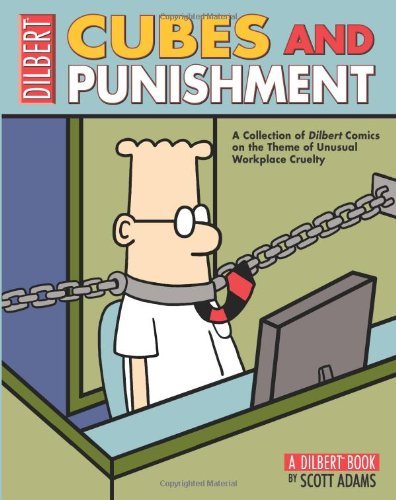
"My cube is sucking the life force out of me." - Dilbert
In Cubes and Punishment Dilbert sardonically skewers the Dostoevskian sense of despair and anxiety that corporate life breeds. And nowhere is this sense more alive than in the desolation of the cubicle. In Dilbert's world, cubicle dwellers are relegated to everything from the half-size intern cubicle to the patented head cubicle and are even sentenced to adopt and decorate empty cubicles.
Dilbert continues to be the voice for the embattled cubicle-dwelling everyman. With best-friend Dogbert, and a veritable who's who in accompanying office characters ranging from the Boss and Wally to Alice and Catbert, Dilbert offers a welcome dose of laughter in response to the inanity of corporate culture and middle-management mores.
Scott Adams was a defining voice of the American white-collar experience who transitioned from a prominent cartoonist into a polarizing political commentator. After earning an MBA from UC Berkeley and spending years in management at Pacific Bell, Adams launched the comic strip Dilbert in 1989. The strip’s sharp satire of corporate bureaucracy and the "Dilbert Principle"—the idea that incompetent employees are promoted to management to minimize their damage—resonated globally, eventually appearing in 2,000 newspapers and winning the prestigious Reuben Award. Beyond the funny pages, Adams explored philosophy and persuasion in works like God's Debris and Win Bigly, the latter of which analyzed Donald Trump’s rhetorical strategies during the 2016 election. His career took a dramatic turn during the mid-2010s as he shifted focus to his daily "Real Coffee" livestream, where he combined his background in hypnosis and corporate strategy to comment on the "culture wars." This period of independent commentary culminated in 2023 when he reacted to a poll regarding racial tensions with a series of inflammatory remarks. Labeling Black Americans a "hate group" and advocating for racial segregation, Adams faced immediate and widespread repercussions; hundreds of newspapers dropped his strip, and his publisher canceled his upcoming projects. Undeterred, he moved his work to the subscription-based platform Locals, rebranding his comic as Dilbert Reborn. In his final years, he faced severe health challenges, including stage IV prostate cancer and vocal cord issues, yet he remained a prolific presence on social media. He eventually announced the end of his hand-drawn work due to focal dystonia but continued to direct the strip's vision. Adams’s legacy remains a complex study in the power of branding, the evolution of digital influence, and the volatile intersection of creative genius and political provocation in the modern era.
We all might have started out like Calvin with a great view of life. But after hitting the workforce we all somewhat become Dilbert. Everyone knows someone like one of the characters in the strips. Highly recommended
Cubes and Punishment is organized in an unusual way for a collection of cartoons, by protagonist. Although the material is at least 15 years old (the book was originally published in 2007), it’s big enough to contain surprises for all but those with photographic memories and a long-standing OCD-like Dilbert jones. Anyway, for real fans an old favorite can be as entertaining as a new discovery. My only complaint about the e-book is the choice to use about 20% of the page to display 8- panel Sunday strips, leaving the all the rest blank. The other pages contain three 3-panel daily cartoons displayed so that most of the space is unused. Might pose a real vision problem for phone users - I can’t imagine their being intelligible on so small a screen … but probably that’s just another way of saying that while I wasn’t looking l became what is politely known as geriatric. That said, if you like Dilbert and have good eyesight you’ll enjoy using the latter to read about the former in Scott Adams’ Cubes and Punishment.
This sadistic view of 1980’s corporate life (1990’s also if you want to push the envelope) is a laugh to anyone that has worked for incompetent bosses or huge organizations bloated with regulations and internal politics. Dilbert the everyman is the dumb victim, the classic exploited genius, suffering the craziness. A distracted read only good during a bad storm.
Interesting way of organizing this particular Dilbert collection. It was a little different, and mostly I liked it. My only criticism is that in the Catbert section, some of the strips had Dogbert in them with no sign of Catbert. I love both Dogbert and Catbert and I think a good editor should have realized that they are not interchangeable.
You may have heard that Scott Adams added being insufferable to his talent stack recently. The good news is that Dilbert remains a universal way to enjoy the many benefits of experiencing other people in places of work.
P.S. There’s one strip in this collection that might reveal his bigotry. Also several strips in the Catbert section actually feature Dogbert.
Dilbert remains as one of only about three comics that I even bother to read in the paper anymore. I think this is the first Dilbert collection I've read. It's heavily focused on cubicle humor, and although I must admit I've never had a cubicle of my own, there is a lot of true-to-life content here. I always especially enjoy the random characters that show up in Dilbert's world, such as Hammerhead Bob, Stubborn Dumb Guy with a V-neck Sweater, and Scapegoat. Scapegoat actually didn't appear in this book but I wish he would have.
I do believe this is the best Dilbert book I've read in the series. Focusing on individual characters per chapter, the author does a great job of showcasing the best of the best when it concerns that character. I caught myself laughing out loud so many times. If you enjoy work related humor, this book is perfect for you.
Office party "White Elephant" gift, following some furious trading.
Very funny. Not as funny as some other Dilbert books, because you don't get the series of strips with one topic leading into bigger punchlines. Certainly this is the "meanest" Dilbert book I've read.
Best line, "Try giving up hope. It turns the bad feelings into emptiness."
Another Dilbert collection. This one collects strips related to working in a cube farm. As a 23 year veteran of the cube farms at a large electronics company, a lot of these strips hit close to home. Very little exaggeration is necessary, given all the absurdities of cube life.
As usual there were some really good comics and a few that left me shaking my head. One in particular (on the back cover and inside) says "If you can't quantify it, then it must not be necessary" and I thought how very true the business world sees this.
Haven't read Dilbert in a while, so this came as a real pleasure. I honestly don't know how Scott Adams gets it so damn right all the time! Just amazing funny stuff.