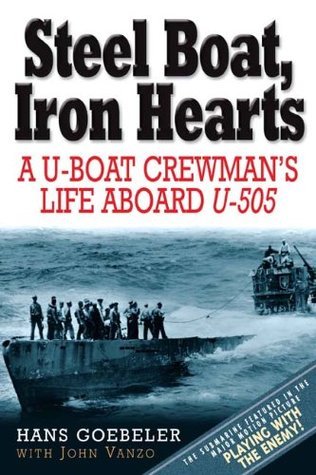
As the subtitle says, this was a memoir of a German U-boat crewman who served during WWII. U-boat service was dangerous. During WWII, about 37,000 Germans served on U-boats. Only 6,000 of them survived the war. Despite the danger, the U-boat service attracted some of the German Navy’s best recruits.
Hans Goebeler admits that his family initially supported Hitler, because the Weimar Republic wasn’t doing much for them economically, and his father, who had been a POW in Russia and then the Soviet Union during WWI, was very much set against the Communists. Add in a Grandfather filling young Hans with stories of the glory of the Franco-Prussian War, and you have a young man eager to join his country’s armed forces.
Despite the fact that Goebeler’s U-boat was on the wrong side of the war, it was easy to identify with the men on board. They were, after all, just serving their country. They acted like professional sailors, regardless of their political beliefs. True, they sank a few Allied merchant ships, but they usually surfaced afterward to aid any survivors. It was war, yes, but with a touch of chivalry, at least under Goebeler’s first skipper. Under his second skipper, the unlikeable, unreasonable ship captain became part of the crew’s enemy. They also had to deal with extensive sabotage by the dock workers in the French port of Lorient. During most of 1943, U-505 was being repaired. Just when they thought everything was fixed, they would do a test dive and discover a leak, or find a small hole leaking oil, or some other problem that would force them to return to port before they’d really started their patrol. This happened multiple times. Reading this, I’d think “well done, saboteurs, you’ve kept that boat out of the war for months” but I could also understand the crew’s frustration at having to turn around again and again and again.
Life aboard a WWII sub or U-boat wasn’t pleasant. Water dripped everywhere, there was no privacy (the toilet was a bucket by the diesel engines), and no baths. Fresh food quickly spoiled, and what they ate when it was gone lacked balanced nutrients. Equipment wasn’t dependable even in the best of times. Torpedoes didn’t always work, even if aimed correctly, and reloading them was heavy, backbreaking labor. And that was before you were attacked by an airplane or had depth charges rolled on top of you. I was impressed by how much a U-boat could take and still not sink. In some ways, it reminded me of stories about B-17s taking lots of hits and still limping home. Though they didn’t know it at the time, the German Navy also operated under the disadvantage of having their codes broken by the British.
The memoir had its light moments. For example, while the crew was in port, they’d often take naps when they were supposed to be working on the bilge. Someone would be sure to tap a pipe every few minutes so the officers wouldn’t know the men were sleeping off their hangovers. Or when U-505 picked up some German sailors after their surface ship was sunk and had them on board for a few days, “they couldn’t understand why we enjoyed serving on a vessel that sank several times a day. We couldn’t understand why they enjoyed serving on a boat that couldn’t dive to escape the enemy.”
In the summer of 1944, U-505 was captured by the US Navy (the first enemy vessel captured by the US Navy intact on the high seas since the War of 1812). The Americans didn’t want word to leak out that they’d captured the ship—and its secrets, and its codes—so the crew weren’t allowed to write to their families to tell them they’d survived, and they were isolated while in POW camps.
Considering the fact that the book was written by a sailor, the language was fairly clean. I’d still recommend it only for older readers though, as there is plenty of information about how sailors entertain themselves while in port. Goebeler was never detailed about his time with the “mademoiselles,” especially during the first half of the book, but during the second half I got the impression he was bragging a bit about his prowess with the ladies. Since he was paying most of the women for their company, I wasn’t impressed. (Not that I would have been impressed anyway. I’m of the opinion that such activities should be saved for married couples, though I’ve also read enough to know many people don’t agree with me, especially during wartime.)
Overall, I’d recommend the book for anyone wondering what life was like aboard a WWII U-boat. The book was informative, interesting, and a good glimpse at the other side of the war.