Jump to ratings and reviews
Rate this book

Cuckold

Rate this book
The time is early 16th century. The Rajput kingdom of Mewar is at the height of its power. It is locked in war with the Sultanates of Delhi, Gujarat and Malwa. But there is another deadly battle being waged within Mewar itself. who will inherit the throne after the death of the Maharana? The course of history, not just of Mewar but of the whole of India, is about to be changed forever. At the centre of Cuckold is the narrator, heir apparent of Mewar, who questions the codes, conventions and underlying assumptions of the feudal world of which he is a part, a world in which political and personal conduct are dictated by values of courage, valour and courtesy; and death is preferable to dishonour. A quintessentially Indian story, Cuckold has an immediacy and appeal that are truely universal.

609 pages, Hardcover

First published October 1, 1999

300 people are currently reading
5208 people want to read

About the author

Kiran Nagarkar

27 books147 followers
Kiran Nagarkar was born in Bombay in 1942. In addition to plays and screenplays, he has written four novels, establishing his reputation as an outstanding representative of contemporary Indian literature. His books are a target of ideological critique due to the hybrid nature of his version of postcolonialism, involving irreverence alongside seriousness.

Nagarkar studied at the Ferguson College in Bombay and then worked as an assistant professor at some colleges, as a journalist and screenplay writer, and, notably, in the advertising industry. He wrote his first book Saat Sakkam Trechalis (1974; Eng. Seven Sixes are Forty Three, 1980) in his mother tongue, Marathi. His bitter and burlesque description of the young Bombayite Kunshank – achieved by means of a fragmented form and rendered in innovative language – is considered to be a milestone in Marathi literature. In his first play Bedtime Story (1978), Nagarkar takes on the subject of modern responsibility by broaching the topic of political crises of the day (for instance the Cuban Crisis, the Vietnam War, and the State of Emergency called for by Indira Gandhi). Due to problems with state censorship as well as religiously motivated restrictions that prevailed over the cultural scene, the play was not staged until 1995. His second book Ravan and Eddie (1994) also met with a hostile response. The story of the childhood of two young boys, one Hindu, the other Christian, from families who live next door to each other yet live in completely different worlds, was criticized both as anti-Hindu and anti-Christian. The fact that Nagarakar chose to write this book and other subsequent writings in English, the language of his education, also encountered objections from his fellow countrymen.

In his subsequent novels, Nagarkar contrasts bigotry and extremism with a tolerance that feeds on doubt and is open to diversity. In Cuckold (1997), this mentality is embodied in a character who looms in Indian historiography. This is the unknown spouse of the famous princess Meera from the 16th century, whose love songs to the God Krishna have passed into popular Indian culture. In God’s Little Soldier (2006), the protagonist, who switches faiths without ever abandoning extremism, stands opposed to his questioning brother. Consistent with the underlying idea of this book as a parable without a message Nagarkar affirms in an interview that we can never stop questioning ourselves, we must bring our convictions out into the light and prove them. Nothing is more dangerous than being too much oneself, being completely sure of oneself, since such a belief will soon develop into an intolerance of others.

Nagarkar was distinguished with the H.N. Apte Award for the best first novel, the renowned Sahitya Award and the Dalmia Award for the furtherance of communicative harmony through literature. He received a Rockefeller grant and was awarded a scholarship by the city of Munich. He lives in Bombay.

Ratings & Reviews

What do you think?
Rate this book

Friends & Following

Create a free account to discover what your friends think of this book!

Community Reviews

5 stars
820 (45%)
4 stars
641 (35%)
3 stars
246 (13%)
2 stars
74 (4%)
1 star
27 (1%)
Displaying 1 - 30 of 233 reviews
Profile Image for Warwick.
Author 1 book15.4k followers
December 6, 2014
We were that rarest of couples. Even after years of marriage we were madly in love. I with her and she with somebody else.

Cuckold is set in early sixteenth-century Mewar, one of the many smallish kingdoms occupying the area of what's now Rajasthan state, in northwest India. Frankly you could tell me anything about sixteenth-century Mewar and I would have no reason to disbelieve you; my complete ignorance of the period and place is one of the things that made reading this book such a fascinating experience for me. Nevertheless, within India the story being told here is familiar – it fictionalises the circumstances of Meerabai, a princess-bhakta who, after marrying into the royal family, ignored her husband and claimed to be married to Krishna; she is still much-loved and her devotional songs and poetry much enjoyed today.

So you can think of Cuckold as a kind of Indian Wolf Hall, which is, from a narrative point of view, its contemporary. (Hey, HarperCollins, feel free to use that if you ever deign to publish the thing outside India.)


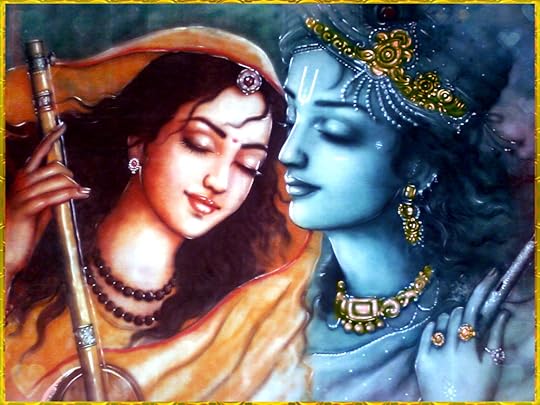
Shri Krishna Meerabai by Vishnu108 Meera playing the ektara (I think) and preparing to snog ‘The Flautist’ or ‘The Blue One’ (just two of Krishna's innumerable epithets)

Our narrator is Meera's earthly husband, the Maharaj Kumar (i.e. crown prince). He is intelligent and witty, amused, thoughtful, more sinned against than sinning – overall a very charming person to spend time with, which is of no small importance in a book of more than six hundred pages.

He is also tearing his hair out with desire for his wife, who refused him marital relations on their wedding night and has continued to do so ever since. Despite our narrative point of view, Nagarkar allows us to sympathise with The Princess, who after all has been dragged from her home and married off to someone she's never met. The final visit she makes to her maika, or maternal village, before leaving forever, is described very movingly (something that also struck me, in a completely different context, when I read The Kalevala – someone should do an anthology of this stuff):

…ŧhe sound of the school bell and the sound of a sandstorm and of rain hissing into the sand, her aunt beating the water out of her hair with a thin towel, the bucket at the well hitting the water some hundred feet below. And the smell of the sun burning the sand, of dry kachra frying in oil and spices, the powdery, bleached smell of her father's armpit when he came back from a long day of surveying their lands, the fierce smell of the kevda leaves in their garden. All these she must etch on her memory.


Still, it's hard not to feel for our poor narrator, too, who is placed at the centre of a series of studies in sexual desire and sexual frustration running throughout the book. The passages later in the novel, where he dyes his body blue with indigo and sidles into her room playing the flute in an attempt to seduce her, manage to be sexy, funny, and unsettling all at the same time.

Cuckold interleaves these sultry scenes of palace intrigue with a parallel political narrative. Mewar is a kingdom of Rajputs – that is, Hindus, with a few Jains – but they are surrounded by Muslim states, namely the kingdoms of Gujarat and Malwa and the sultanate of Delhi. Political tensions become identified with interfaith tensions, in a process that has clear parallels with later Indian history down to the present. The Maharaj Kumar worries about this a lot, and puzzles over the links between violence and religion:

Why did Mahavir, who founded Jainism, and Buddha find Hinduism inadequate and look to other ways for moksha or nirvana as Buddha would call it? Why did they reject violence so totally? Did it not amount to denying one of our deepest human impulses? Was that one of the reasons why Hinduism has reasserted itself in our land and squeezed Buddhism till there's only one drop of it left in Sri Lanka? Jainism, it is true, survives but only in a marginal way…


I compared this earlier to Wolf Hall, but it's worth saying that the approach is very different. I happen to dislike Hilary Mantel's slavish adherence to historical fact, and so I was happy to see that Nagarkar is more concerned with his novel as fiction than as history. ‘The last thing I wanted to do was write a book of historical veracity,’ he says in his Afterword. ‘I was willing to invent geography and climate, rework the pedigrees and origins of gods and goddesses, start revolts and epidemics, improvise anecdotes and economic conditions and fiddle with dates.’ Hear, hear! Similarly, he does not try to reproduce sixteenth-century language, and happily adopts a modern idiom for the novel, which I can see has annoyed some other reviewers. Personally I thought it worked well (though one reference to ‘the time-space continuum’ did jump out).

Of more interest to me was how very Indian the narrative voice felt. It was not just the different usages I was already familiar with, like ‘quantum’ for ‘quantity’, which is so common in the papers here but hasn't been current in English English since the days of Fielding and Sterne. It was also the general garrulousness of the sentence structure, a willingness to mix metaphors, to choose exuberance over concision, to take the first half of a phrase from one source and the second half from another. (Nagarkar talks, for instance, of ‘advantages and demerits’.) This sense of changing horses in midstream extends even to tenses, sometimes with jarring effect: ‘We are face to face finally. He embraced me…’.

But most of all, my sense of pleasant dépaysement came from the huge – really huge – number of words that were completely new to me. This is something that doesn't happen to me much any more and I loved it. On page 44 alone, I had to look up ‘bajot’, ‘mandap’, ‘saat phere’, ‘odhani’, ‘siropa’ and ‘mogra’, only one of which was in the OED; and these terms are not italicised as foreign borrowings but unmarked and natural elements of Nagarkar's Indian English. To me (and I realise this is a naïve response) it was fantastically exhilarating.

This sense that there's a shared pool of insider references is also reflected in the plot. Meera herself is never referred to by name in the book, so without prior knowledge or some research you have no chance. Similarly Babur, who emerges as a major antagonist towards the end of the novel, was unknown to me, but if you have a better grasp of subcontinental history you will recognise this very famous figure as the founder of the whole Mughal dynasty. A lot of foreshadowing and dramatic irony sailed over my head.

The result was that this felt more Indian than any other Indian novel I've ever read; it seemed not to be aimed at me, and this is a feeling I enjoy and respect. Perhaps that's why it hasn't, as far as I can tell, been published outside India yet, despite how popular it was in its home market. It's a shame, because it really deserves a wider audience; everyone can enjoy the skewed love story, the politics is desperately relevant, and although Nagarkar is relating a tragedy he does it with such admirable wit and humour that it's impossible not to get behind his narrator's central, world-weary philosophical conclusion:

Pain may be the only reality but if mankind had any sense it would pursue the delusion called happiness. All the philosophers and poets who tell us that pain and suffering have a place and purpose in the cosmic order of things are welcome to them. They are frauds. We justify pain because we do not know what to make of it, nor do we have any choice but to bear it. Happiness alone can make us momentarily larger than ourselves.
Profile Image for Sonia Gomes.
341 reviews133 followers
September 11, 2022
How strange it must have been for the Crown Prince of Mewar, or to any man for that matter, when your beautiful bride, the one with those green eyes, refuses to sleep with you on your wedding night. He is confused, sad and lonely...

Things have never easy for the Rajkumar. The Rajput Kingdom of Mewar is locked in battles with the Sultanates of Mewar, Malwa and Gujerat.
Then there are the scheming wives of the Maharana, his Father, who want to oust the Rajkumar from power so that their own sons can be the future Maharana.
Add to this, the beautiful wife now has a lover, he finds poems, sonnets couplets dedicated to this 'lover' hidden under the low altar where she keeps her idol of the Lord Krishna.

Strangely, the beautiful wife with green eyes is the much cherished daughter in law of the old Maharana. She beats him at chess, sulks when she loses, arranges parties at the palace, picnics for the benefit of the Royal House of Mewar but draws the line at conjugal relations with her husband.

In fact the Rajkumar and his wife get on beautifully….but for the conjugal relations.
In this book, the sadness, the loneliness and the bewilderment of the Rajkumar is palpable, he does realise that she is in love with the Lord Krishna, but cannot reconcile to the fact...
He hates Lord Krishna for he is his rival for the affections of his wife, the Rajkumar does try to take Lord Krishna's place but who can compete with a God !

This is the story of Mirabhai a saint, a devotee of Lord Krishna, she has composed great many devotional songs called 'bhajans' to be played on a one stringed instrument called the 'ekthara.'

Cuckold is one of the most beautiful books I have read, the beauty of the language, the Rajkumar's total sense of loneliness and of bewilderment is so palpable...
I loved the relationship that the Princess or Mirabhai had with everyone, she loved them, she adored her husband but she was so much in love with Lord Krishna, and that to her, was all that mattered... reminded me of nuns and saints who consecrate their love to Christ.
Profile Image for Ahtims.
1,673 reviews124 followers
June 26, 2020
It was an epic experience . Totally revelled in this magnum opus tale of Maharaj Kumar. Am seeing Mirabai through quite another viewpoint . I can't reconcile the green eyed princess of this book with the sedate Mirabai of Amar chitra Katha and various Hindu calenders .

Will revisit this story after a few years 🧡
Profile Image for Maura Finkelstein.
27 reviews44 followers
July 19, 2009
This book is incredible. At times I found the extensive descriptions of medieval Rajput warfare a bit obtuse and exhausting, but that is most likely because I was eager to get back to the sex and scandal. Go figure...
Nagarkar created magic out of legend and folklore and brought to life some of the most well know historical figures in Indian history...I have always enjoyed the story of Meerabai for the obvious reasons (tough 16th century feminist and all that), but found my affections completely manipulated by Nagarkar's alternative narrative. I was sad to leave his world and return to mine...
Profile Image for Gorab.
842 reviews153 followers
May 11, 2017
4.5/5
This review is slightly biased for I'm very much in love with the vibrant and colorful Mewar, and the premise for this book is the story of Rajput clans of Mewar around 15th century.
Brilliant composition and a compulsive page turner. Told as an autobiography of Maharaj Kumar, the eldest son of Maharana Sangram Sinha (more popularly known as Rana Sanga), this book unfolds the state of mind of the king, his way of leading and the formulation of unorthodox war strategies.
While fending off the enemy forces of neighboring kingdoms of Gujarat, Malwa and Delhi, he also has to be cautious of the enemies inside having an eye on the throne.
Pivoted around the fort of Chittore, there are other monumental references like Kumbhal Garh, Ranakpurji and Eklingji, and I immensely enjoyed traversing through them along the story.
Touches upon the shrewd financial tactics of the Mewari Jains and Mehtas, the nature of which holds true till date. (Being a Mewari Jain, I can vouch for that!)
Profile Image for E.T..
1,031 reviews295 followers
June 25, 2016
4.5/5 This book is a wonderful mix of 'Bambaiyaa' smartness, historical fiction, nihilism and philosophies, and some brilliant set-pieces. And i guess the mix is distinctly Nagarkar.
The author has been bold in the manner in which he has written such a long book. There is a single thread of narration that follows the Maharaj Kumar and I could have easily been bored in the long 600+ pages, but I was not. . Secondly, The language was modern but it somehow didnt feel awkward. The lucidity meant that once it held your interest it was a pacy read.
God's Little Soldier, another 600+ pages, was the first book I read by Nagarkar, and thought it had great potential but it became painfully dreary after the first 200 pages or so. Even in this book I was apprehensive that it would go the same way, but Cuckold ended up being good enough to compensate the money/time I paid for both the books. Following up Ravan & Eddie
Profile Image for Moushumi Ghosh.
433 reviews10 followers
October 16, 2012
Nagarkar stuns with this historical novel. For a long time, I did not read it being overwhelmed by the sheer size of the volume but I had been depriving myself. It is definitely Nagarkar's masterpiece. In spite of the novel being narrated from a man's perspective, the voice is still of the marginalized, something that Nagarkar excels in. The story of a man who tries to win the heart of a woman who is obsessed with a god. How does one compete with a god? While the focus may appear romantic, the novel's forays into court intrigue, statesmanship, government, and war makes the novel read partly like a thriller and partly a thesis on 15th century Rajasthan. Must read. Must read. Must read.
Profile Image for Naeem.
531 reviews295 followers
May 30, 2008
While Ravan and Eddie and God's Little Soldier have a frenetic energy -- the former's dominant tone being humor, the latter's serious urgency, but both having both -- the prose and tone in Cuckold is sustained, tempered, and reflective.

Form follows function, or in writing one might say that form follows content. The setting is 16th century India. The book are the memoir of a young first born prince of Mewar. The Portuguese are in the background, but the book focuses on the inner workings of the palace and on the wars with neighboring states. Babur, originator of the Mughal dynasty, and his memoir, Baburnama are central to the consciousness of the young prince and to the book itself.

Its too early for me to formulate a deeper impression of this book. I will come back later in the summer for that. But it is not too early to give a few impressions.

First, and foremost, the book captured me. I was there with Maharaj Kumar: in Mewar, in the palaces, in his family life, in his head, and worried for him. The book transported me to a different time and place -- indeed a crucial time in the history of India. I have never not been interested in the history of South Asia (its "home" after all), but sometimes home is the last thing you want to study. For the first time, I thought: "MUST study this history."

Second, you cannot escape Nagarkar's philosophizing (not that I want to), since I think one of the challenges he sets up for himself in each of his books is the following: how to get at the knottiest problems of life while using simple prose, beautiful language, all contextualized in a deep narrative ("deep groove", I would say if this were music). The reader is invited to think hard with Nagarkar and his characters. The invitation is easy to accept, as is the hard thinking.

Third, three books, three different styles. That I find rather astounding. And all taking risks.

Finally (for the moment), I want to say that this is truly an important book. I want to spell out the 17 reasons why I think this is so. But I cannot at the moment. Later perhaps. I think this one will stand the test of time as a "great" work. It changes things -- not just about what it means for something to be a novel, or a historical novel. I think it changes things about how we view the significance of Indian history itself. It is one thing to work against what some of us call Eurocentricism. Another to produce the work that makes both Eurocentricism and fighting Eurocentricism seem irrelevant. I think I want to say that this book is a congealed act -- an act of great relevance.

If you want to read a interview with Kiran Nagarkar, you can do so here: http://www.anothersubcontinent.com/kn...
Profile Image for Ashish Iyer.
870 reviews633 followers
March 3, 2018
This is the first historical fiction book I have read on Rajasthan. A fictionalised biography of Maharaj Kumar of whom little is known except that he was the son of the famous Rana Sangha of Mewar and the husband of Meerabai . Nagarkar has carried out a lot of research into Rajput history of those times and he sets his story against the backdrop of real events. The descriptions bring you to India in 1600. The writing is smart, fun and captivating. The author has chosen such a topic for his novel that is not very common in the history of fiction. To know the historical characters we do have to rely upon the history books or documents preserved in the libraries. That too sometimes seems boring. But Nagarkar has taken the boring and tough job and made his way to that bygone era. The novel is a work of fiction but sometimes he has taken literal liberties but that are too to suit his purpose of writing.

The story revolves around Maharaj Kumar. Married to a wife who loves someone else, he struggles to rescue Chittor from hostile elements - both internal and external. Maharaj Kumar is a brave warrior and a forward thinker who plans many grand and innovative schemes like a water and sewage system for the fort, a brilliant tactician who prefers to watch his enemy in action and then plan an attack as opposed to the straight on confrontation preferred by Rajputs of those times, who ultimately becomes a victim of his circumstances. Politics, scheming, spies, romance, affairs, eunuchs, concubines, cheating wives – everything is there in this novel. I felt transported to Kumbhalgarh and Chittorgarh and it was as if I had been there, the colours of Chittorgarh all coming alive in front of my eyes. It is an absolute page turner and is a must for people who are in love with Rajasthan and its splendour. There is a lot of research that has gone into this book and it is evident in the manner in which he describes the war strategies and the mechanism of gathering intelligence about enemy position etc. of those times. There is ample attention to detail and one feels as if one has known the characters personally for a long time.

I wish we could have more of such books which talk about the grandeur as well as the history of Rajasthan. To be honest I was looking for more of Ranga Sanga and Meera bai. And i felt drag in parts.

Interesting Read.
Profile Image for Manny.
255 reviews
September 9, 2012
I generally judge Indian authors differently from Western authors and give them more leeway. This book shook my perceptions on Indian writing and my biggest joy was that this was written by an Indian with literary flair.

This is one of the best books I have read in the recent past and like some earlier reviewers mentioned, I found it sad towards the end as I didn't want it to end.

The book was an extremely well-written historical novel portraying the memoirs of the Prince of Chittor and the husband of one of India's most favourite saints, Meera Bai. I had visited all the places mentioned 2 years ago and could literally feel as walking through the times and turmoils of the prince as he described the story.

The plot shifts from his internal issues with Meera as well as very vividly portrays the scheming political situation of the Mewar Kingdom. Historically accurate about the cultures at that time, what blew my mind was the writing. I had read other Indian novels about our history including the Moghuls one but everyone else concentrated only on a few aspects and the language structure was very modern like reading a Chetan Bhagat book.However this book felt like a modern translation of the prince's memoirs.

The book also had many symbollic moments and many philosophical discussions which represented the Prince's thoughts. These parts also made for very interesting reading since they provided a context and then hit you with very hard ideas so that it was easier to relate to them.

Do yourself a favour and read this book as soon as you can grab your hands on it.
Profile Image for Prabhat Singh.
25 reviews8 followers
May 19, 2018
At the risk of jumping to conclusions – this being my first Nagarkar novel – I will say that the author is already one of my favourites alongside Manu Joseph, on whose recommendation I read him. Can’t say I’ve been disappointed at all.

Let me also confess that I was biased towards this book even before reading it because it deals with the story of my ancestors, who have traditionally been neglected by the genre of historical fiction. One of the reasons I picked up this book – other than its catchy title – was to learn more about the Rajput kings of Rajasthan.

This book isn’t classic historical fiction, since the language is contemporary and the author doesn’t necessarily strive for pinpoint accuracy in depicting social customs of the 16th century, in which era the book is set. Having said that, it is loaded with invaluable information about the statesmanship and philosophy of Rajput kings, methods of warfare, internal and external power struggles of Mewar and surrounding kingdoms, and Babur’s conquest of India.

I disagree with those who think this book is primarily a love story, or that its central theme is the protagonist’s failed attempts to win over his wife, Meerabai (not once referred to by this name in the book). Agreed, this is indeed a leitmotif of the book, and has a profound impact on her husband, Maharaj Kumar, but this isn’t what the book is about. The quote below should put an end to this debate:

"My wife, Kausalya, Leelawati, my friends matter to me, but the meaning of my life doesn’t revolve around them."

Which brings us to what this book is actually about – a deep dive into the meaning of Maharaj Kumar’s life. I have hardly read something that explores a character’s heart, mind and soul in such excruciating detail. Often through deeply revealing mental dialogue, Cuckold unveils the different roles he plays in life – that of a husband to two different women, a lover to several others, a son to a father who suspects his son will unseat him someday, a brother to those who incessantly plot to have him killed, a visionary warrior who considers peace and commerce to be more important, and an ambitious statesman. In the end, the book reveals an endearing man who’s tough on the outside but deeply conflicted inside, constantly questioning his actions and decisions.

I suspect, though, that this is a book written by a man, based on a man, and for men. Depiction of female characters solely from a male perspective, physical and sexual violence, and excessive details of battle strategies (which I thoroughly enjoyed, including the bit about jihad’s importance to war) give me the impression that it would put off most female readers, but then I could be wrong.

And oh, keep a dictionary handy while reading Cuckold. Hardly have I come across a book which had so many unheard of words.
1 review
March 7, 2010
I felt depressed when (only) the last few pages in the book were left to read.I wanted the book to go on forever. I found the construction of the Maharaj kumar's personality, character and thought processes fascinating.

Similar to the Princess of Maerta, I have come across Saints who are self absorbed, create enormous disturbances in other peoples lives, are possessive and jealous, and yet leave behind an everlasting message for those whose hearts and minds are open to understanding our oneness with Nature and and the significance of the Divine in our lives.

My one question to the author is - what was the significance of the Bhootani Mata episode in this book?

This book is a masterpiece but the reader must understand the context - History of the period, Indian Spirituality, Psychology, Warfare at its best and worst, Human relationships both giving and unforgiving and their complexities as prevalent in 16th century Rajasthan.
Profile Image for Prajakta Shikarkhane.
71 reviews49 followers
May 23, 2017
What this book is not... 'A refined Mills and boon story'!
Nagarkar beautifully weaves the historical context of 16th century Hindustan. Power, war, love, betrayal, morality and nuggets of philosophical debates - all make for a heady read!
Profile Image for Madhulika Liddle.
Author 22 books543 followers
June 6, 2018
In the early 16th century, the powerful Rajput kingdom of Mewar was ruled from Chittor, its sovereign lord the one-eyed, one-armed, battle-scarred Rana Sanga. His heir apparent, the Maharaj Kumar, was a man history has pretty much forgotten: Bhoj Raj. But Bhoj Raj’s wife was a legend, a woman who even today is celebrated in Indian literature, in popular culture and music and religious tradition: the Bhakti poetess, Meera Bai. Meera Bai, so deeply devoted to the deity Krishna, that she considered herself part of him�� thus making of her husband a cuckold. To be cuckolded by a god is poor consolation.

Kiran Nagarkar’s engrossing Cuckold, winner of the Sahitya Akademi Award for Best Novel in English in 2000, is the story of Bhoj Raj. It is also, of course, the story—to some extent—of Meera Bai, of Rana Sanga, even of Babar, who arrived in India in 1526 and changed the politics of the land forever. But all of these are peripheral characters in Nagarkar’s book; its central character is the Maharaj Kumar, a man pulled in many directions, torn apart by love, frustration, lust, loneliness, and more.

Through chapters that alternate between a first person narrative (from the Maharaj Kumar’s point of view) and a third person narrative, Nagarkar builds up layers of relationships. Between father and sons, one favoured and spoiled, the other trying to help but constantly pushed away because of a manipulative stepmother who has an inexorable hold on the father. Between a man and the wife who tells him, on their wedding night, that she is betrothed to another. Between a man and a woman who has been both his wet nurse as well as the woman to whom he lost his virginity.

Relationships, too, between King and ministers, between rulers of different states. Between Gods and their worshippers. Between a man and his own self.

This is a very impressive book, gripping at different levels. Whether it's political intrigue, personal politics, or a man’s mad desire to somehow make his wife love him, Nagarkar weaves an intricate tale that draws you in. Unforgettable.

If there’s anything that detracts from the experience, it’s the occasional use of jarringly modern language in places. Words like TB or bloke, or idioms like Get him on the double and giving someone the third degree just don't fit in with what is otherwise mostly a rich, somewhat old-fashioned style that’s very suited to the subject. And there are the (admittedly obscure, but still) anachronisms: the frequent mentions of everything from custard apples to red chillies to corn, none of which were known in India at the time.

Despite that, however, a memorable book. Khushwant Singh regarded Cuckold as the best novel written by an Indian. I wouldn't go so far as to label it that, but it's certainly one of the most impressive novels written by an Indian in English that I've read.
Profile Image for Vaidya.
258 reviews80 followers
June 21, 2014
At some points I just wanted to throw the book out, I wanted to rail, rant and scream! Although Nagarkar excuses himself right at the beginning for the language - "an easy colloquial currency of language will make the concerns, dilemmas and predicaments of the Maharaj Kumar, Rana Sanga, and the others as real as anything we ourselves caught in", it seems too forced. It seems at many places that he's talking down to you using that most abominable of phrases "..if you will".

And then after some time, you start noticing less and less of it, not that it's not there - there is even a cricketing metaphor thrown in - just the tale he weaves is so enticing and sucks you in completely. There are points when he forgets his language and loses himself and so do you.

There is something about the way Nagarkar talks about music, about how it moves him. The seeming effortlessness of the alaap while also propounding on the difficulty of finding the soul of the Raaga, after all how difficult can it be to create your own music within a set of rules? Ah, the deceit of language. I wanted to pull out my neglected flute and play, and he almost had me convinced that it would produce only the truest melody. One of these days, that long-neglected instrument might find its deliverance after all.

There's something about the love the Prince feels for his wife, who can only love the Blue God and the hatred he feels for the God - an all-consuming hatred, that eventually claims him completely. The more you read, the more you realise how he's one with the Blue God himself, the way they think, the way they want to conduct warfare in an era where bravery is placed at a higher premium than victory and war is sought over peace. And most importantly, the way they love one woman whom neither 'gets'.

There is something about the way he describes war, which eschews the main event, reducing it to a mere inevitability which leaves you with no illusions as to the eventual winner. It is almost like watching the Rocky movies - when the boxing comes, you know what's at stake and who's going to win. And it is in the setting up that he scores. The dilemmas, the codes, the things at stake - the things that matter, the loss of lives is always inconsequential, no?


Profile Image for Abhyudaya Shrivastava.
Author 10 books27 followers
November 2, 2016
cuckold
It is a 608 pages long book of historical fiction but it reads like a fast thriller. Kiran Nagarkar has no qualms about the fact that he has fictionalized the life of Bhoj Raj Singh. A guy who is very little known to history. History remembers him as the poor husband of Meera bai- the Little Saint. His marital life is far from a bliss. He falls in love with multiple women including his own wet nurse. Yes, there is incest in the history of Mewar but that is the least scandalous scandal of the book.

The cuckold is helpless only because his adversary is The Blue God- Lord Krishna himself. Then there is the war side of the novel. There are moats being dug and cannons being fired. It is all very gripping. The Battle of Khanua is the climax of the book. But in no way is it the highest peak of the novel. The battles fought at Idar, Mandu and Panipat were equally gripping.

The book is coloured in the colours of Mewar. Chittor is the center of all action for the most part. The vamps like Karmawati, the politicians like Lakshman Simhaji, the warriors like Rana Sanga complete the motley crew. The characters do seem to be a bit cardboard with Vikramaditya taking the cake as the monotonously evil guy but that is because the canvas of the novel is too vast to focus on individual voices.

One criticism I read about the book was that it has a language that does not suit a period drama. Admittedly, it is written in simple, postmodernist prose but, I do not why that would be a problem. The purists who want to read the book in classical language might as well insist on reading it in Mewari- the language prevalent in Rajasthan.

Yes, the prose in modern English is impossible to fathom as the expressions are also anglicized but it is an interesting take. I would prefer it over a book written in English yet carrying the load of Mewari, using the local idioms and then explaining them in English. This was a much easier approach.

The book is also a political treatise. How Babur made his wars in Jihads while the secular Mewaris tried to resist the temptation of colouring the war with religion-- forms an interesting reading.


5 stars all the way.
Profile Image for Poornima.
30 reviews23 followers
November 9, 2017
It took me about 10 days to finish a 607 pages book,which is an inordinately long time for me.
I have always liked historical fiction and this book is no exception. The historical figures of Rana Sangha,Maharaj Kumar(the protagonist),Princess or Little saint more popularly known to us as Mirabai,Queen Karmavati,Babur and more are brought alive and close to us.
One knows it is going to end in tragedy and that might have been one reason why I was prolonging the agony. The lives of royalty and courtiers who are forever engaged in machinations,statecraft,wars,plotting murders/poisonings makes you thankful for a normal life.
This is one book which will be with me for a long,long time.
Profile Image for Arunesh.
7 reviews
April 2, 2019
This book came with a high recommendation. I am a slow reader and I am intimidated by big books. I have picked this up a few times and dropped it. This time, once I got through the first few pages, the story kept rolling. This is easily one of the best contemporary accounts of history. And easily one of the best Indian authors I have read.
Profile Image for Varun.
36 reviews1 follower
January 8, 2019
I picked up this book 4 years ago at a used books' store in Bangalore. I cringed at the title and the cover illustration but bagged it anyway since it came with a strong recommendation from Mr. Khushwant Singh. Over the years I never felt the urge to read this tome that lay in a corner of my bookshelf. The only times I did pick it up were to wipe it clean. Nonetheless, after my recent conquest of Woolf's "To the Lighthouse" I felt particularly smug about myself. Sensing that it was an unhealthy attitude, I decided to act against my familiar instincts and picked up a book that did not really appeal to me. Although I had no expectation from 'Cuckold', it turned out to be a vile and distasteful experience.

In his acknowledgement, Mr. Nagarkar speaks of how he had made a conscious effort to write historical fiction in colloquial parlance. This however, does not seem to be the case. Rather than a conscious decision, it seemed to be flimsy gimmick to get the reader to pardon (or turn a blind eye even) Nagarkar's unimaginative use of language.

The malaise of an uninspired imagination reflects in the lacklustre and lazy prose that reveals itself on the very first page and little else improves as you plod further. It becomes very clear that Mr Nagarkar is driven by a singular ambition to write a verbose and loquacious novel. Characters and characterisation be damned. He is primarily concerned with creating enough opportunity to flaunt his knowledge of fancy words. This is a common trait amongst Indian authors who write in English. (I reject the entire practice of creating a special category of authors called "Indian English Authors". If you write in English, you subscribe to the same standard of authors who have written in the language in the past. No special concessions, allowances or recognition will be given to you for being an Indian who writes in English) Words are used to capture attention, than to create an impression by Indian authors who write in English today.

However, coming back to Nagarkar, a very basic research on the man told me that he had made his mark on the literary scene through a collection of short stories written in Marathi. A language which Nagarkar apparently had to learn before he wrote the stories. I don't buy into this narrative entirely as it seems a marketing ploy than anything else. Nagarkar is essentially from the state of Maharashtra and it's quite likely that he had a fair knowledge of the language when writing that collection. That coupled with the fact that the quality of his writing in the English language as exhibited in this scandalously titled novel is consistently cringesome, I call hogwash on the whole thing.

Cuckold is the work of a Marathi writer trying to make his mark as a writer in English. The language does not fire up his imagination as he hoped it would. He tries to overcome his shortfalls through the use of exorbitant language that obscures meaning and emotion than effectively transporting the reader to an era of Mewar Royalty in the 16th Century where the story is set. Crippled in its inception the insipid story collapses 25 pages into the novel.

Cuckold is probably a good lesson to anyone who wants to learn why the authors job is to be a medium that allows a story to be effectively narrated. Even more importantly, it is a lesson on what happens when the author dictates to the story the shapes and forms it ought to take. It also is a reminder that the greatest geniuses found a way to keep control and while allowing themselves to be led by the characters they wrote about. 'Cuckold' in the final analysis, cannot disappoint a seasoned reader, as he would know 13 pages into the story, that this is not a novel worth his time.
Profile Image for Akshay Dasgupta.
91 reviews13 followers
July 9, 2017
Okay, this was like the Indian version of 'Game of Thrones' only much shorter and cleaner. I knew from the beginning that I was going to like this book because, firstly, it is a historical fiction and secondly because it is a story of my all time favorite holiday destination - Rajasthan. There is something about Rajasthan (perhaps the rich history and heritage - as reflected in this book) that attracts me towards the place.

This book is good recollection of the splendor and might of the Mewar kingdom. Like most historical fiction books, it has information regarding wars lost and won, kings slain and kingdoms lost and annexed. However, what I most liked about this book is the bitter sweet / love hate relations between the Maharaja Kumar, The Little Saint and the Flautist. The writer has described these relationships in such a delicate and humorous manner, I could re-read the chapters over and over again.

Highly recommended for any historical fiction lover !
Profile Image for Vihag Gupta.
2 reviews2 followers
March 9, 2013
This is perhaps the best English novel by an Indian author I have ever read.
The protagonist, the maharaj kumar, the heir apparent effortlessly intertwines history, the people, the mindset of mewar. but central to it all is his internal strife to become a better statesman, a better lover. his antics of posing as the blue god , his wife's lover is beautifully elucidated and his transformation (maybe realization ) of himself as the blue one is intensely thought provoking.
Profile Image for Shinde.
Author 3 books107 followers
January 19, 2019
Memoirs of Meerabai's husband. Yes, it is apt not to name him anything else, since history would rather focus on Meera's devoted passion for Krishn than her marital life.
Crackling with palace politics, gender games and unrequited love between God & woman, this one still leaves plenty of scope for Meerabai's husband to carve his identity.
Recommended for aficionados of literature, history, mythology and fiction.
Profile Image for Meera Srikant.
160 reviews30 followers
February 7, 2013
Couldn't put this down. In fact, almost didn't feel like reading the last few pages as that would mean the end of the story... Wonderful story, language, intrigue, perspective...
Profile Image for Priya.
2,151 reviews79 followers
April 19, 2022
This was a fascinating read!
More so because though historical fiction is one of my favourite genres I haven't read much Indian historical fiction except those set in British India. This time period, the politics, music, culture and traditions was wonderful to read about and the book really took me on a journey to that time and place.

Mewar in the 16th century was the most powerful Rajput kingdom ruled by Rana Sanga. This story is set around historical characters and events preceding the invasion by Babar and the beginning of the Mughal Empire. It is also a very interesting perspective about one of the most famous devotees of Lord Krishna, the poet saint, the royal princess Meerabai.

The author has chosen Maharaj Kumar, the eldest son and heir apparent of Mewar to narrate this tale. As he says in the historical note, not much is known of this son who was married to Meerabai so this is her story imagined through his eyes. Though married off in a political move and as per the tradition of the time, the princess held steadfast to her assertion that she was the bride of Lord Krishna. Her rumoured 'affair' with another because of which her husband was much maligned and laughed at does not bother her and she continues to sing, dance write poems and worship her Blue lord, the Flautist.

From the greeneyed one who is called all sorts of names, she becomes the Rana's favourite daughter in law and displays an intelligence and knowledge of royal matters that serves the court well. However, the relationship of husband and wife is never really the conventional one though the Maharaj Kumar cannot stay away from her or establish a household with another despite the pressure on him to produce an heir. The dynamics of their bond are juxtaposed with the threats posed by the Sultans of Gujarat,Delhi and Malwa as well as the most dangerous of all, Babar.

It's a very well woven story that portrays the period it is set in quite authentically including the unsavoury parts of it. The war planning and strategies, succession wars, jealousy, palace intrigues are all a part of it.
The Maharaj Kumar is a very human, flawed character who recognises his own faults, knows what his father and the court think about him, is tortured by the violence he unleashes as a part of war and is completely bewildered and unsure what to make of his wife. His attempts to not woo her maybe but to become a more significant part of her life are heartbreaking even as he knows his efforts are in vain.
It's quite sweeping in scope because of this and very well written. At 600+ pages, it still retained my interest throughout. I definitely want to read more in this specific genre.
Profile Image for Anusha Jayaram.
181 reviews61 followers
May 24, 2019
4.5 stars - Long review alert (and also a fair bit of gushing!)

This book is quite the tome, and not the kind I could breeze through either. It took me quite some time to read it, probably because I found I could digest it only in bite sized portions.
The seemingly slow pace of the book is because of the fact that it is so richly packed with nuance; there are several, intricate layers to each character (even the minor ones) and to each sub-plot. I realized that, if I wanted to absorb all of this, breathe in the atmosphere that the author had created (and he’d done a great job of that, too), I could not read more than 50 pages or so at a stretch – I had to assimilate the book slowly and steadily.

The writing is lucid enough and not overly archaic, and this seems to have been a conscious decision by Nagarkar - to keep the language light and flowing, using modern spoken English.
Once I got used to it, this didn’t seem to interfere with my processing of the narration, rather, it made the characters more relatable in the immediacy of their thoughts or words.
Perhaps there were a handful of times when I cringed at the excessively modern turn of phrase, but overall this worked well as a narrative device, helping to move the story along without weighing it down with old world English.


Like most other Indians, I too grew up hearing a lot about Meera bai right from my childhood – hearing stories of her devotion to lord Krishna, listening to and learning Meera bhajans – the songs she penned down addressed to lord Krishna.
I find Kiran Nagarkar’s choice to create a story narrated entirely by the husband of the beloved Meera bai, from his perspective, thoroughly original.
Once the perspective is flipped, all those stories about Meera’s persecution by her in-laws, and the initial resistance to Meera’s worship of lord Krishna (lord Shiva was the prime deity of the Rajputs of Chittor, the house into which Meera was married), become more understandable as seen through the lens of 16th century Mewar and its mores.
Nagarkar succeeds in making the reader empathize with Meera’s husband – the Maharaj Kumar, crown prince of Mewar and narrator of 'Cuckold'. This is quite a feat, since the Maharaj Kumar does not really filter out events or actions which depict him in poor light – there are plenty of those!
But as a reader, you begin to understand at some level, the forces that guide him in his actions and you begin to root for him in spite of yourself. At several points, I realized that Nagarkar had so convincingly flipped the narrative that it painted Meera in a completely unflattering light –self-absorbed, selfish, and utterly inconsiderate to those around her.


A few things that really stand out about this book are: the amount of energy devoted to elucidating strategy and thought processes; the fact that the entire story is set within the frameworks of major historical events of the time; and the fact that it turns a very honest eye on some of the events in India’s history which we conveniently avoid mentioning.

First - Strategy and Plans:
I was amazed at the level of detail with which various characters' strategies and schemes were presented - whether regarding war with enemies and dubious allies, political maneuvering to tweak the line of succession, or the many manipulations wrought in the personal lives of central characters.
The insight into the Maharaja Kumar’s own detailed thought process at various points was a delight to read: the way he combines long term strategy and vision for the kingdom and its allies with short term tactics of war and winning; the way he dares to question time-honoured Rajput values of courage and valour even in the face of defeat, positing that it could be better to retreat, and live to fight another day. Fascinating.

Second - Historical Facts:
It is apparent that Nagarkar has invested considerable time and effort into gathering facts and researching 16th century period Rajasthan. The genius of this story (which is likely to escape a reader who either does not already have a background or does not cross check historical events of this time period) lies in the fact that Nagarkar works within the framework established by documented historical milestones of the time. The fact that the resulting story is so rich and complex is an indication of the author’s imagination and creativity.

Third - Brutal Honesty:
Nagarkar tells the tale of Mughals invasion into India without any sugar-coating. Most of our modern literature on the subject attempts to downplay the violence of the advent of Mughals into India, (starting with Babur’s many campaigns), preferring to focus rather, on the more tolerant ruler of Delhi, Akbar - Babur’s grandson.
Cuckold’s narrative is replete with many of the facts that our history textbooks have systematically been airbrushing out of existence for so many decades now. This includes the fact that the Mughals initially entered into India only to loot, pillage and plunder - they had no intention of staying.
By the time they did settle in Delhi, they had systematically destroyed all symbols of the ‘infidels’ of the Hindu religion, and razed all Hindu temples, building mosques in their place.
There is no side-stepping of facts such as these, as well as the fact that all of those initial conquests were motivated by a will to vanquish the unbelievers, catalyzed by a call to jihad (along with a beautiful analysis by Nagarkar, via his narrator, of what makes this such a powerful rallying cry).


Having said all of this though, this book is not without any drawbacks at all.
It is extremely long, and I do sympathize with the editor. But that doesn’t excuse the few egregious spelling errors I stumbled upon.
More importantly, the book could certainly have done with some trimming. There were some parts which I felt did not really add much value, and just increased the page count. One specific instance is the whole side story of Bhootani Mata – I do not see how this added any value to the story, except for introducing a slice of the macabre into the book.


Cuckold is definitely not a light read, neither does it have a taut plot with a clear beginning, middle and end. Also, it would probably require some background reading for an initiated reader to get a grip on things in 16th Century Rajasthan to truly appreciate the beauty of this book.
But as far as I am concerned, all that extra work would be completely worth it.
Profile Image for Sonal.
80 reviews6 followers
February 22, 2022
Interesting title I would say. When I picked up this book I had no idea one of the protagonists was Meera Bai, nor did the blurb mentioned so. And what a pleasant surprise it turned out to be. Cuckold here is Meera Bai's husband Maharaj Kumar, the heir apparent of Mewar and who she is cheating him with, the great lord Krishna himself. I have read/ heard stories of Saint Meera Bai since childhood, of her devotion & love but never ever gave a thought to her husband. Lost to history I would say. Thanks to the author for bringing him back to life so beautifully. The character of Maharaj Kumar in this book is nothing short of a perfect hero. A warrior prince with sharp political acumen, winning almost lost wars, an advocate to justice & peace, admirer of art, music and a true romantic at heart. In spite of the betrayal from his wife, and the public humiliation because of her singing & dancing in the temple, he loved her. His dilemma, fears and his thoughts are so well put.

This novel is huge and a history lesson in itself. It covers the life and times of Rana Sanga, Ibrahim Lodhi and Babar's conquest of Delhi. Chittor is depicted in all its glory and we also had a virtual tour of Kumbhalgarh & Ranakpur. I can only imagine the research that went into making it. As for the writing, mostly it is beautiful & lyrical; but drags at some places, usually during Maharaj kumar's musings. Also, in certain places, the voice suddenly becomes modernistic, confusing me, if we were still in the 16th century or back to the present.

In real life, little is known of Maharaj Kumar aka Bhoj Raj and so the story that the author weaved was a treat. There are very few historical fiction works for Rajasthan and this is the best I have read so far. Definitely recommended.
Profile Image for Alan DSouza.
16 reviews2 followers
September 22, 2021
Such depth of character in writing. Every thing in this book gives you such a deep insight into history. Nagarkar's research is Beautiful and he's goes above and beyond to get this book together.
Profile Image for Shreya.
49 reviews
May 10, 2021
I did not think I would be giving the book 5 stars. For the first 100 pages, I was dreading I'd DNF this book but I kept on reading albeit my disagreement with the writing method. Half way through the book and I was ready to stay up all night to finish the rest half. Perhaps it was only the writing style that I eventually adjusted to and, at the end of the novel, I like it. I was reading the book faster now, picking it up even when I had only 5 minutes of break, eventually extending the break to an hour.
Kiran Nagarkar has done an amazing job. This is one of the best mythological fiction I have ever picked. He hasn't missed even a slight detail in weaving the story. At the end of the story, he presents us the known facts which is when you know he has been an amazing storyteller throughout the book. The book has a lasting effect on you. You wouldn't forget the thoughts and quotes and they'll probably keep swirling in your head for days.
Irony is, at first I would give anything for this book to finish ASAP but when I was about to reach the end, merely 20 pages away, I hated the thought that it's going to end.
11 reviews5 followers
June 15, 2008
There are two things that troubled me when I read this book:

1) Why does Nagarkar's ability to demonstrate music's ability to transport us into an 'interstitial' space leave me cold? Let me clarify: Music transports me as well, but it is usually to a foot-stomping place (a la, pop music); I am left cold because though I yearn for the experience, I only understand it as theory. Try as I may, Indian classical music puts me to sleep - something I am ashamed of. Nagarkar's gift to me, despite my earlier denunciation of his work, is to needle me with this absence in my life - the absence of music that can move. Not with the peg of lyrics (that is how, I think, he describes lyrics - a peg to hang music on), but through itself.

2) Why is my own inner life not as voluble as that of the characters in nearly all his novels? Is it that I move through the motions of life without thinking? In my earlier reviews, I noted that Nagarkar invades the space of his own novel in a very ungainly fashion. That may still hold true (even though the forays of his own voice in this novel were a lot more structured - and consequently, mellifluous). Nevertheless, in denouncing his anti-aesthetics perhaps I was subverting my own accusations against myself; what I took to be ungainly forays might have been evidence that others think a lot more deeply than I ever can.

In any event, I do not get a sense of everyday life in his novels. The depth of thought is so great that I feel that the philosophical ground covered by his characters might have taken a few minutes or a few days at most. The reason I think so is because no one can sustain such an engagement with life over a life-time, let alone remember its lessons. For which reason time seems to remain a problem for me when I read his novels. That is not say that he fails - instead, like his needling on music, it is a call to deeper reflection.

I suppose my reaction to "Cuckold" is structured by two anti-theses, which I explain shortly. But before I do, I need to provide a short background. Whenever I come across a new book (academic or not), I make it a point to find a picture of the author (this technique, as you will see, does not work well with those whose portraits are all we have). So the anti-theses:

1) Thesis: The picture reminds me that this person, whoever s/he is, shits, pisses, loves, hates, cries, fears, etc as everyone else. For which reason, nothing this person says is inviolable - I should not be seduced into thinking that because this is a book ("and since it is in a book it must be true") it has truth embedded in its very structure

2)Anti-thesis: Precisely because this is written by a person, whoever s/he is, who shits, pisses, loves, hates, cries, fears, etc as everyone else, I must pay heed to what is being said. It would be not the sanctity of the book that would encourage my consideration of it; the sanctity of life itself demands my engagement with it.

The problem I have with "Cuckold" - or to put it more directly, the book's greatest strength - is that it makes me acutely aware of these anti-theses.

(Neither "God's Little Solder", nor "Ravan and Eddie" manage to do this in a sustained manner... less so the latter than the former).
Profile Image for Payal Sachdeva.
173 reviews22 followers
January 19, 2023
This is one of the most exquisite and heart rending books I have read recently . It culminates in a gripping climax, leaving the reader with a poignant yearning for more ..
Set in the 16th century , the book is about Mewar kings and their kingship . The story is narrated in the first person by Maharaj Kumar ( the heir of Mewar kingdom , Raja Bhoj) ... how the kingdom is locked in the wars with Delhi , Gujarat and Malwa ... the narrative is excellent and delves deeply into the each war tactic , how at times they are in face to face combat with each other and at times retreating , winning the wars unscrupulously which brings defamation to Maharaj Kumar ...one gets a glimpse about the citadels , temples and lives of Mewar people ..
The core of this book revolves around the love between Maharaj Kumar and his wife ( Meerabai ), who he dearly calls Princess or green eyes . It’s the journey about this couple , a voyage from hatred to abysmal love . We all have known about Meerabai , but hitherto , none described the feelings of her husband , a man forgotten for good in the history of Rajputana ..
How he hates his wife who says she is already betrothed to someone else on the night of their wedding , denies him of conjugal rights and when questioned , who is the one , she just smiles , causing relentless anger and frustration in him .. yet he is in madly love with her ...a tale of unbridled passion and love ; Meerabai’s for her Krishna and Maharaj’s for his green eyes ...the unrequited love leaves one in excruciating pain yet love should be free of all expectations and should be given and received at free will and its warmth can only be appreciated when it’s altruistic ...though reciprocation has its own charm ...
He finally accepts the truth , which he had been wrestling with , that his adversary is none other than God himself , whom he had loved like anything and still hates the most ...the loneliness of a man , the Cuckold , can be felt and it leaves one tearful, but who has the power to compete with a competitor , who is none but Madhusudhan !
Out of desperation and love for his wife , how he paints his body blue each night and dresses up like Krishna just to spend some moments with her and who is oblivious of everything , as she sees Krishna in each human being ...
The poignant feelings of love of Meerabai for her wedded husband is also described beautifully as how she loves Maharaj and is guilty of denying him all the rights he deserves yet their love defy any explanation ...
A story well written with beautiful language and this book would stay with a reader forever!
Highly recommended !
I would rate it as 5/5 ( it’s a hefty tome , 630 pages and one needs patience to read it , it can’t be rushed and plowed through )

Everything about this book is awesome but I loved the most what this couple had to say :

Meerabai pleading ‘ They call me tart, harlot , whore , slut ,strumpet , fornicator. Tell them , I beg you , I beseech you , tell them .Save my honour , beloved , save my honour . Tell them who I am , A God’s wife , nothing less ‘

Maharaj Kumar’s :- “ We were that rarest of couples . Even after years of marriage we were madly in love . I with her and she with somebody else “
Displaying 1 - 30 of 233 reviews

Can't find what you're looking for?

Get help and learn more about the design.