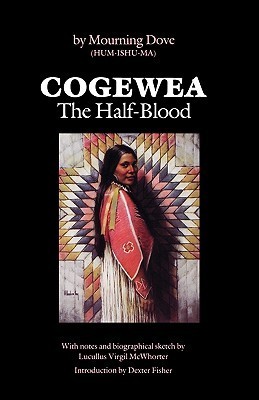
One of the first known novels by a Native American woman, Cogewea (1927) is the story of a half-blood girl caught between the worlds of Anglo ranchers and full-blood reservation Indians; between the craven and false-hearted easterner Alfred Densmore and James LaGrinder, a half-blood cowboy and the best rider on the Flathead; between book learning and the folk wisdom of her full-blood grandmother. The book combines authentic Indian lore with the circumstance and dialogue of a popular romance; in its language, it shows a self-taught writer attempting to come to terms with the rift between formal written style and the comfort-able rhythms and slang of familiar speech.
This is a fun vintage book full of cowboys, indians, romance, and action. Written in 1927 by Mourning Dove, it was the first novel published by a Native American woman, and she did it as a migrant farm worker typing on her rickety old typewriter at night. It is definitely pulp fiction, but there is also some depth if you read closely.
At page 76 I choose not to finish reading this book. I was eager to read the first novel published by a native American woman but found the narrative voice hard to consistently identify as hers for the many insertions and edits and influence of her collaborator, Lulus Virgil McWhorter.
Fiction can shine light on dark times and places, reveal human circumstances otherwise opaque and hidden but in this story the characters often disappear to make room for scolding didactic arguments that would be better delivered either by one clear narrative voice or the characters themselves.
Still, the book exists and probably would not have without these two helping each other. I will pop it on my bookshelf and see if I revisit it in another season.
Cogewea is a "breed" or "half-blood," a young woman stuck in the liminal world between two cultures. Her grandmother gave her the tales of her Native American heritage, but she lives on her white bother-in-law's ranch on the Flathead Indian Reservation. The book a romantic pulp fiction, yet the narrator offers some unique observations from the author's own first-hand experiences, highlighting the emotional and psychological pressures of finding a comfortable place in an ever-changing world. Cogewea is one of the first novels to be written by a First Nations female author. Mourning Dove (Hum-Ishu-Ma) toiled for ten hours each day out in the fields, then typed her manuscript at night in her tent. It was later edited by Lucullus Virgil McWhorter. And although there are few surprises for the modern reader, it is hard not to admire the writer's drive and dedication. Mourning Dove had a limited education, no role models, and the hardships of poverty to overcome. The language she uses is flowery and antiquated yet her insights into a vanished era are invaluable. This is an important book from a historical perspective. I would, however, only recommend it to readers with an academic interest in women writers or Native American literature.
I would give a three for the parts I could tell were hers, and I would give very little to the parts I know the editor meddled with. I'm incredibly offended by his presence in the novel, which is egregious and obvious. Why can't we simply have our own voices? Why can't we write whatever stories we feel? Why did he feel the need to assert his knowledge of a different nation as she tried to tell a fictional story about someone from her own?
From a historical perspective I find this valuable, but also depressing. It shows similar problems that still exist. It shows a startling similarity even to today.
Also, as a complaint, I know the book is very dated, but also the way the dialogue functioned was hard to follow because it too often tried to show accents in a manner that was distracting.
This novel mesmerized me with multiple layers of history and cultural identity. Cogewea is a character of dual identity, which readers may find a connection with.
I guess I don’t care for century-old Western romances with a whole bunch of confusing narrative voices (other reviews explain this so I won’t repeat all that). However! I will say it is surprisingly accurate for even 100+ years later regarding everything it says about Indian-white relations on the Flathead Reservation. As in, nothing much has changed except there’s a lot more white people now…Which is a disturbing continuation of racism and everything else that’s shitty. So it got 3 stars for being disgustingly prescient.
I enjoyed reading this novel. I felt Mourning Dove's writing shone through even if some of the editing was a bit verbose. Not a very complex romance. Worth a read. I finished it in about a week.
i preferred the parts that talked about Cogewea’s struggles with identity more than the romantic parts. i read it for class and the version we read was edited, which, i think, took a lot away from the original meaning, it felt very westernized.
I loved the dialogue that included various slang/ everyday language and the authors ability to write the different characters. I loved the combination western/romance/tragedy/legend/folk tale aspects of the book. Very definitely a book of it's time but also with insight beyond it.
The narration was messy and hard to follow. The book should’ve been written in first person. I have never read something so repetitive and meaningless. Another novel that is only valued because of its historical impact. I have nothing else to say.
It's a romance with a western setting. Instead of focusing on lovers separated by class or family strife, it focuses on lovers separated by race--and then lovers brought together by race.
It's pretty predictable in its plot and in its criticisms of white people and of the emphasis on pure blood (the protagonist being half white and half Indian), but it is notable for its place as the first novel written by a Native American woman, even if there is some question as to what role Lucullus McWhorter, her collaborator, played in shaping the narrative.
This book is kind of hard to follow, even with a background in Native history and a love of Harliquin Romances. You know her 'mentor' helped Cogewea "write" her book, and even she acknowledges that she needed him to get it published. However, either a third grade education was a lot more political then or he editorialized a lit, especially the first third of the book. I read this as a favor to my spouse, who also has read it as part of her grad school class. Could Cogewea be as naive as she comes across? There is a reason the author had to guarentee publishing costs, this book might be history,but enjoyable.....not so much
Surprised I enjoyed this as Romance novels aren't typically my thing. First, this novel, written by an Indigenous woman, is maddeningly steeped in noble savagism and the myth of the vanishing race. At the same time, it's really fascinating to see this pre-Renaissance critique of settler colonialism and white supremacy. Also a good source for Indigenous liminality, though the differences between white, Indigenous, and "breeds," are almost entirely defined by blood quantum and not cultural identity. Could pair well with pre-Chicano/a lot novels like CABALLERO and SQUATTER AND THE DON, too, for how they navigate a place of women of color, white men, marriage, and progress.
I thoroughly enjoyed this book. This is a love story and, yes, it is predictable but it is still a great read. I respect and admire Mourning Dove and the fact that she is the first Native American woman to have published a novel. Her writing style is fun and free-spirited and it was a great adventure to read this book. One of my favorites.
apparently the book was the first published book of a native american woman author. it's compelling in parts, but not worth wading through unless you're seriously interested in it as a historical examination.
Humm not exacly sure what to say, one I read for school. It's pritty much a typical western just dose a better job of dealing with Indian characters. I'm just not a big western fan.
I read this book for a Native American Literature class. While I found the way that it was written to be kind of boring, the story was interesting and the ending, although rushed and cliche, was extremely satisfying!
It’s hard to tell what’s Mourning Dove and what’s McWhorter, but the latter definitely did more harm than good. See my highlighted quote for an example of his prose stylings.