A novel centered around the Temple Stage School and its matriarch, Freddie Wentworth, focuses on the lives of child actors trained and represented by the school, in a novel appearing for the first time in a U.S. paperback edition. Reprint.
Penelope Mary Fitzgerald was a Booker Prize-winning novelist, poet, essayist and biographer from Lincoln, England. In 2008 The Times listed her among "the 50 greatest British writers since 1945". The Observer in 2012 placed her final novel, The Blue Flower, among "the ten best historical novels". A.S. Byatt called her, "Jane Austen’s nearest heir for precision and invention."
I loved The Bookshop and so I was eager to read another Penelope Fitzgerald book. But after weeks of trying I cannot get past page 50 and I cannot care about it either.
The story is of a very fat old woman who was once well-known in theatre circles and now runs a decrepit stage school and her efforts to save it from financial ruin. So far she has hardly moved from her chair and doesn't seem to have made much of an effort. The other action is between two new Irish teachers neither of whom interested me, and a couple of kids. One of the kids is rich and precocious, the other is poor and uninteresting to all except the rich and precocious kid.
It's an over-written study in uninteresting details - every little eyebrow lift is described, every creak of the rotten floorboads is detailed and the result is ennui and exasperation. All I want is to be able to put the book aside and forget about it and not feel guilt for not finishing it. This book can go to the Animal Shelter. I don't know if they'll sell it or rip it up for hamster bedding. I couldn't care less either.
Where to begin. Perhaps with the Freddie of the title. She doesn't have as many speaking parts as some of the other characters but she takes up a lot of room on the stage of this narrative, and when she does speak, her voice carries right to the back of the theatre. And the stage set where we first meet her, and which she hardly ever stirs from, is so full of interesting detail that it is worth the price of admission for itself alone: Everyone who knew the Temple [Shakespearian Theatre School] will remember the distinctive smell of Freddie’s office. Not precisely disagreeable, it suggested a church vestry where old clothes hang and flowers moulder in the sink, but respect is called for just the same. It was not a place for seeing clearly. Light, in the morning, entered at an angle, through a quantity of dust. When the desk lamp was switched on at length, the circle of light, although it repelled outsiders, was weak. Freddie herself, to anyone who was summoned into the room, appeared in the shadow of her armchair as a more solid piece of darkness. Only a chance glint struck from her spectacles and the rim of great semi-precious brooches, pinned on at random. Even her extent was uncertain, since the material of her skirts and the chair seemed much the same...Opposite was another, much smaller, armchair, which, though Freddie kept no pets, gave the impression that a dog had just been sitting in it. Placed there, the caller had to meet Freddie’s eyes, which, though not at all bright–they were of a pale boiled blue–expressed an interest so keen as to approach disbelief. The face, like the ample skirt, was creased with lines, as though both had been crumpled together at the same time...
Although Freddie almost never moves out of her chair, and rarely reveals her true bulk in the light of day, we get her measure very quickly as we watch character after character, especially those who might wish to make changes to the running of the school, get Freddied one after the other. The only character who can out Freddie Freddie is one of the youngest pupils of the theatre school, Jonathan, a ten-year old acting prodigy who was born to be one of those actors who work from the outside inwards. To them, the surface is not superficial. He didn’t want to know what it felt like to be desperate enough to jump from a wall; he wanted to know what someone looked like when they did. Jonathan and Freddie are an interesting contrast, he, tiny and trying for the ultimate transparence, she huge, and adept at keeping everything hidden. Together they sum up my experience with Penelope Fitzgerald's writing: the absolute clarity of some of her pen portraits combined with the often obscure underlying themes. I'm still peering hard at this one...
"Everyone who knew the Temple School will remember the distinctive smell of Freddie's office. Not precisely disagreeable, it suggested a church vestry where old clothes hang and flowers moulder in the sink, but respect is called for just the same." Another clever and labyrinthine and charming novel from Fitzgerald about an eccentric stage school for children. As is always the case with Fitzgerald the children are all compellingly precocious. And as is always the case there's a lot of initial misdirection in the plotting so you're not sure which of the characters will occupy centrestage. An interesting feature of this book is that it repeats but develops a one night stand that also appeared in Offshore. The man involved is a wonderful character in both books, a man utterly bereft of vanity and incapable of dishonesty. He's the only untheatrical character in the book, the only character incapable of acting, the only character who doesn't possess a backstage area. With him, what you see is what you get. Everyone else gets into costume before appearing on life's stage. In fact, the entire novel is poised metaphysically in that explosive hinterland between the changing room and the stage. 4+ stars.
My whole life I have lived in pleasant thought, As if life's business were a summer mood; As if all needful things would come unsought To genial faith, still rich in genial good; But how can He expect that others should Build for him, sow for him, and at his call Love him, who for himself will take no heed at all?
I read steadily, with the odd laugh and occasional smile until I had about fifty pages left when I noticed that my pace quickened, my eyes slipped faster over words, my fingers worked the pages onwards until with a sprinter's last burst I finished the book. Pff! You will say, but that's normal as the assassin gets closer to General de Gaulle, or the old woman pauses in her knitting to address the six possible suspects gathered in the drawing room to tell them who killed the vicar and why, everyone reads faster then. That of course is true, but the thing is that in this novel virtually nothing happens and yet it still works up to a final crescendo. Well that's not true, lots of things happen, but if even taken together they amount to a plot, I wouldn't say.
It is a chess puzzle novel. The characters stand just so in certain relation to each other, they might be pretty unremarkable, even so they are deftly brought to life and set in motion for our amusement, black to win in 230 pages.
This is a novel about a theatre school the 'Freddies' of the title. It was written in the early 80s but set back in the early 1960s. Covent Garden was still London's wholesale fruit, vegetable and Flower market (now replaced by the imaginatively named New Covent Garden) while Original Covent Garden has been successfully remodelled as a tourist trap. The national theatre on the South bank was then still a building site, but by the time Fitzgerald was writing it was a faded and problematic brutalist concrete pile - later to be dealt with by painting it white, although this hasn't improved the accessibility much. The bright future which threatens the much decayed theatre school - the children have been advised to walk round the edges of the corridors where the floor is sagging, while in a rehearsal room a piano has sunk half way up its legs through the floor boards, that bright future by the time Fitzgerald wrote has itself become tarnished and down at heel.
Mend and make do might be a motto of the novel, we see the two teachers; Pierce Carroll putting up shelves, and Hannah repairing her coat and having her shoes reheeled so she can better pound the pavements in search of somewhere to live. This is not an affluent London - the theatre school children at lunchtime wander the market bargaining for the cut price rejects of the fruit and vegetable worlds.
At the same time it is explicitly a book about power, a vicious case study. Power which plainly isn't based on wealth but on the ability to manipulate people and without conventional or explicit bullying either. There is no shouting or swearing, waving of fists or wooden legs but the power and dominance is complete none the less. Of the eponymous Freddie: It was from Lilian Baylis that she had studied the craft of idealism, that is to say. how to defeat material by getting getting people to work for almost nothing (p.8). She has an unfailing eye for the characteristic of a person that she can take advantage of and make it seem to her victim that she is doing them a favour.
However despite the lack of money associated with Freddie's - when debt collectors are sent round she manages to persuade one of them to donate his waistcoat and jacket to the school's costume collection - a couple of men smell the opportunity to make some money - the father of one of the pupils: At the very idea of profits going to waste, even if they didn't concern him directly, he felt a mixture of wistfulness and anger, like a poet conscious of all the roses that fall (p62) this man puts his old mucker Joey Blatt on the case, and one storyline is Blatt moving round the chessboard attempting to mate Freddie and to turn the school into a money making machine .
Another storyline running through the book is that of the two new (and only) teachers at the school, both fresh from Northern Ireland, Hannah and Carroll. Hannah's weakness is the theatre, she loves it and will endure apparently anything to be even marginally connected with it. Carroll on the other hand is talentless, but in a brilliant touch understands and accepts that completely, he tells Freddie the wages she offers are exploitation, at the same time as admitting that low as they are, they are about as good as he'll ever get He had no ability to make himself seem better or other than he was. He could only be himself, and that not very successfully (p.22). Well as you no doubt know there is a class of stories in which A loves B and B loves A and they are cruelly divided perhaps by demons, or pirates, or demonical pirates, or piratical demons, or some other variation, the two have fantastical adventures and face terrible obstacles until they are reunited at the close of the book, there is also a class of stories in which A loves B while B doesn't love A. In this book we are toldHe was absorbed, in fact, as well he might be, by the strange venture he had undertaken, unprecedented in his family, as far as his own knowledge went. His forebears were middling farmers who married when their financial position justified it, advertising at that time in the Castlehen Eagle for a well-educated young woman aged between 28 and 35, Protestant, and able to play the piano. And these practical arrangements, which had worked so well in their time, had finally produced this Pierce Carroll, who could fall in love (pp54-55). In passing one of the poignancies of the text is that Hannah is Catholic and Pierce Protestant, while she protests that this isn't important as readers we know that in 1982 when the novel was published this was again in Northern Ireland a very live issue. But again as with Blatt, Pierce attempts to move about the chessboard to call out checkmate to Hannah - her eyes though, are locked only on the theatre.
The brilliance for me of Carroll's It's very low...but as much as I can expect (p.22) is that at a certain point I felt that all the male characters were as ridiculously hopeless and talentless as he was, but that he alone knew and accepted what he was.
For all the multiple power games taking place, the absence of stakes and the determined hopelessness of many of the characters I found it a funny and compelling little novel. Fitzgerald has for me a wayward yet appealing genius.
Outside is unbearable so I hide indoors, drink water, and read. Fitzgerald is just perfect to cool the blood. Refreshing. You can almost see drops of condensation on the cover.
She holds my interest, for hours. No skimming or skipping: there's too much just under the surface, there's often no indication of who's speaking, minor characters return with major roles to play. An enigma looms large at the centre: the monstrous Freddie herself, voracious spider to everyone else's fly. But how old she is, her family background, how she came to set up a stage school is a mystery.
The only people who underestimate Freddie are the ones who have never met her.
In The Bookshop Florence Green tries hard not to see the world divided into exterminators and exterminatees. Here, the recurrent motif of the mirror seems rather to divide the world into those who are conscious of themselves and their effect on others, and those who are not.
Fitzgerald can be gentle, subtle, but ruthless. Look at this scene where Hannah, young and pretty, is sent to the theatre where Mattie is rehearsing as the Greater London Council insists that Mattie's education should not be neglected. There she meets An Actor.
With the shadow of a bow he passed her and began to negotiate the stairs down. It was the first time Hannah had ever talked to an actor, as you might to an ordinary fellow, and she was not disappointed. He had never yet given - though Hannah could not know this - a disappointing performance.
A performance as an ordinary fellow?
And Fitzgerald is just so wryly humorous:
Protests were only effective in this country when they were made by people who knew as little as possible about the subject. Nobody trusted an expert. Through the columns of The Times bishops complained about motorways, merchant bankers appealed for thatched cottages and politicians for free speech, while industrialists took up the cause of single-track railways.
This is an absolutely brilliant book. You really have to read it twice through, because the voice is so cagy, and the story so subtle that, first time through, you (or I, at any rate) missed what appears to be on the margins, but in fact is at the book's moral center. The story is about Freddie's, a school for children in theater; it's also about the profound but often invisible distinction between genuine art and commercialism. The sacrificial figure of the book is a small child who is a true artist, and whose experience hovers at the novel's edges. A powerful and wholly human indictment.
Set in a London stage school in the early 1960s, At Freddie’s is another of Penelope Fitzgerald’s marvellous tragicomedies, reasonably similar in style to her earlier works, Human Voices and Offshore. Many of the familiar elements from the author’s early novels are here – isolated women; hopeless, befuddled men; precocious children – all caught up in a somewhat eccentric, idiosyncratic community. Once again Fitzgerald has drawn on some of her own experiences in writing this book – in this instance, her time spent as a teacher at the Italia Conti drama school during the decade in question. It’s an excellent novel, both darkly comic and poignant, shot through with a deep understanding of the foibles of human nature both positive and negative.
At Freddie's is a brilliant, witty book. A group of people caught up in an institution, the foundering Temple Stage School, try to transcend the constraints of a squalid physical environment to attempt great things. Also, there's Freddie: a formidable, selfish, calculating, ruthless woman who is the school's headmistress. Of course, there are children. And children in Fitzgerald's books are always in danger, they always need adult protection. Like most of her novels, this one is about beauty and loss, about courage and the resilience of the human spirit in its search for some kind of freedom on hostile grounds. Fitzgerald's pared writing relies on indirection and surmise so this novel probably requires to be read twice. A knowledge of Shakespeare's King John would be most useful as well.
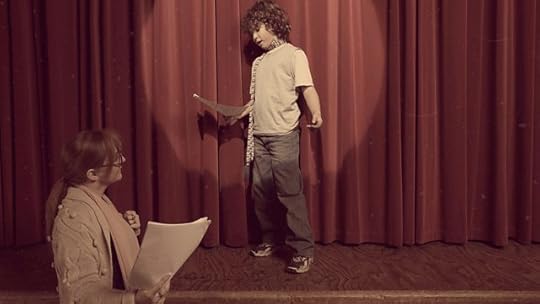
From BBC Radio 4: 1960s: Freddie Wentworth is the eccentric head of the haphazard Temple Stage School, training children for everything from Shakespeare to panto.
Penelope Fitzgerald's comic novel is a love story for anyone who has ever acted a little or pretended to be what they are not. Dramatised by Michael Butt.
Freddie Wentworth ... Margaret Tyzack Miss Blewett .... Dinah Stabb Hannah Graves.... Laura Doddington Pierce Carroll.... LLoyd Hutchinson Oliver Blatt.....Philip Jackson Boney Lewis..... Nick Boulton Mattie .... Rory Copus Jonathan.... Alex Green Joybelle...... Candice Davies
“I’m afraid you’ll have to speak a little more clearly, dear. It comes with training … you can’t have rung me up to complain about a joke, an actor’s joke, nothing like them to bring a little good luck, why do you think Mr O’Toole put ice in the dressing-room showers at the Vic? That was for his Hamlet, dear, to bring good luck for his Hamlet. I’m not sure how old O’Toole would be, Mattie will be twelve at the end of November, if you want to record his voice, by the way, you’d better do it at once, I can detect just a little roughening, just the kind of thing that frightens choirmasters, scares them out of the organ-lofts, you know. I expect the child thought it would be fun to see someone fall over … two of them detained in Casualties, which of them would that be, John Wilkinson and Ronald Tate, yes, they were both of them here, dear, I’ll send Miss Blewett round to see them if they’re laid up, she can take them a few sweets, they’re fond of those … I suppose they’d be getting on for thirty now … well, dear, I’ve enjoyed our chat within its limits, but you must get the casting director for me now, or wait, I’ll speak to the senior house manager first … tell him that Freddie wants a word with him.’
The senior house manager came almost at once. Having intended to say, and for some reason not said, that all this had absolutely nothing to do with him, he summoned indignation in place of self-respect and spoke of what had come to his ears and not knowing what might happen next, also of possible damage to the recovered seats, and the new carpeting which had recently been laid down in every part of the house.
‘What became of the old chair covers?’ Freddie interrupted. ‘What of the old carpets?’
The manager said that this was a matter for his staff. It seemed, however, that the Temple School, with its forty years of Shakespearean training, was carrying on the old traditions in a state not far from destitution, with crippled furniture, undraped windows, and floors bare to the point of indecency, and it was not to be believed that a prosperous theatre like the Alexandra would stand by and watch such things happen without giving a helping hand. The manager knew what was happening to him, even though it was for the first time, for he had heard it described by others. He was being Freddied, or, alternatively, Shakespeare would have been pleased, dear-ed, although the phrase had not passed between them. Thirty-seven minutes later he had agreed to send the old covers and carpeting round to the Temple, on indefinite loan. He felt unwell. Weakmindedness makes one feel as poorly as any other over-indulgence.”
Tras leer por primera vez a Penelope Fitzgerald y quedar totalmente enamorada de “La librería”, tuve un súbito antojo de seguir con su obra. La editorial Impedimenta se puso en contacto conmigo para hacerme llegar el último libro que publicó la autora en 1982, La escuela de Freddie.
En esta historia conoceremos a Freddie, una mujer que en el Londres de la década de los sesenta dirigió una escuela de teatro para niños. Esta última, situada en un escenario algo sórdido es el eje central de la novela donde diversos personajes aparecerán y formarán parte de un cambio revelador. Una instantánea tomada tras el paso de la Segunda Guerra Mundial, en la que también viviremos en segundo plano una historia de amor.
Con su característico ingenio, Fitzgerald nos muestra de nuevo un pasaje en la vida de unos personajes realistas, una cotidianidad basada en su propia experiencia como profesora de teatro en una escuela. Nos muestra las decepciones, el amor y las oportunidades de un grupo de niños, las esperanzas que no logran romperse a pesar del peso constante de la pobreza.
Pero, para mi triste frustración debo declarar que este relato ha creado cierta desilusión en mí. En pocas palabras, creo que esperaba algo que nunca llegó, porque a pesar de disfrutar una vez más del pulcro y descriptivo estilo narrativo de la autora, he caído en un profundo aburrimiento sobre todo una vez superada la mitad. ¿Mi gran problema? La ausencia de trama, el poco desarrollo en los personajes y quizá la extrema monotonía de los acontecimientos narrados.
En conclusión, debo decir que este segundo encuentro literario no me ha quitado las ganas de seguir descubriendo las obras de Penelope, al contrario, quizá esta sea una manera de recordarme que “La librería” es uno de esos libros irrepetibles y que seguramente no pueda superar ningún otro de la autora. Lo que sí quiero deciros es que si buscáis una novela no demasiado extensa, costumbrista, con cierto toque de humor y que es sumamente ligera de leer, le deis una oportunidad.
Here is a comic novel which satisfies, which owes its depth to marvellous characterisation, feelings that linger beneath what is expressed, to a wonderful sense of atmosphere – of the theatrical milieu in the West End of the 1960s. It is also achingly sad.
It was a time before encroaching commercialism overtook postwar austerity, a time when Covent Garden was still a fruit and vegetable market. It is evoked without sentimentality, but with tenderness. Freddie has been running her Temple Stage School for a long time; she lives on past glories, she has known actors, directors and impressarios. Time has taken a toll on herself and her school. It is down-at-heel, insolvent, but she is unfazed by any of it. She knows her own mind. She carries off everything with the stubbornness of eccentricity, bolstered by her firm belief in the magic of the theatre.
We find her musing:
At this very moment they (the people) were hurrying off from work, boltng their macaroni cheese (Freddie’s heart was always with the cheaper seats) and braving the struggle back into the city, to concentrate on what as said and done in a lighted frame, which, when it went dark, would make them cry to dream again. They were creators in their own right, each performance coming to life, if it ever did, between the actors and the audience, and after that lost for eternity. The extravagance of that loss was its charm.
The charm hides a mxture of anguish and shabbiness. It is real enough, but it can be more in the mind than actual. We get a picture of the school full of little geniuses with their own idiosyncracies. The atmosphere is desultory yet it is a world into which we can immerse ourselves. Hannah, the new teacher, appears to be the most level headed or rational person present, apart from Miss Blewitt, (Bluebell) who looks after the practical side of things. In this unconventional set up, she finds her own equilibrium. The other new teacher, Pierce Carroll, has an unusual way of existing in the world, a way that is described with empathy and subtle mastery. He is a believable character for all his strangeness. If one sentence captures Pierce Carroll best, it must be this one:
He created around him his own atmosphere of sad acceptance.
His interview with Freddie is disconcertingly funny and sad. He does not pretend to be other than he is. Freddie gives him the job out of sheer curiosity – and to save money
I’m doing you down, dear. That’s right, Miss Wentworth.
His first day is probably as he expects it:.
It might have been anticipated that among these unruly children of artifice and real and contrived emotion, Carroll woud be unable to keep order, and he couldn’t; but neither in the end, did he create disorder.
He is greeted by silence and disbelief at his attire. Then…
When he laid out his books and announced a course on the history of the British Commonswealth, uproar was poised, then broke in waves from the back row to the front, where the desk lids slammed and clashed like the teeth of trolls. After about five minutes, which seemed much longer, the noise died down, seeming to circle, more and more gently, round the unperturbed Carroll. He said nothing and did nothing.
When Freddie asks him what happened in class, he does not dissimulate, he tells her:
They were talking, Miss Wentworth, he explained, just talking. Well, what about?
He tells her exactly what they were discussing, in his own matter of fact way.
Why weren’t you giving them a lesson? They’re not disposed to listen to me, Miss Wentworth. They find these other subjects more absorbing. And there’s another point at issue here. It seems to me that these children don’t care about formal education because they intend going on the stage. Now, if I tell them they must work hard at their books in order to earn a living, won’t that be showing them clearly that I don’t expect them to succeed in the theatre. Am I right now?
His logic can't be faulted, and yet......
Even Hannah is not the rational creature that she seems.
Penelope Fitzgerald said: I am drawn to people who seem to hve been defeatd and even profoundly lost. She sees their weaknesses and vanities with great clarity, with an eye for the absurd. There are many funny moments
Touches of comedy come amidst scenes of tension and sadness, illuminating inner thoughts:
Pierce Carroll has intercepted Hannah in the street, to talk to her about his feelings.
Could there have been a worse place to talk things over? The Italian grocer’s had formerly been a hairdresser’s, and just inside the entrance where they were standing, there remained a full length mirror with the words A CUT ABOVE THE REST in gilded letters. The streets were filling up now and very few of the passers by had the strength of mind to ignore it entirely, some snatched a sideways glance at their reflection, some straightened and patted themselves and all of them in doing so had to look past Hannah in a disconcerting manner, so that behind poor Pierce, standing there with his suitcase at a serious crisis in his life, she could see a procession of figures slowing down, glancing and hurrying on.
It is a dramatic moment, made visually vivid in all its absurdity by acute observation. Unlike the members of an orchestra, or unlike actors in a play, people in real life danse to a choreography of incomprehension. Each character, even the child actors, carries within himself or herself a world that can only merge with another for a fleeting moment.
A note about the background: Penelope Fitzgerald taught at a stage school. Her books carry her experiences and research lightly. The subtle can often be disregarded or overlooked with a shrug of the shoulders.
A very quick read for me - yet it didn't ultimately make the impression I'd anticipated, even though I remained easily engaged. ~ no doubt, that's largely due to being a theatre person myself. Fitzgerald is quite adept at capturing the milieu and the (shall we say) delicate personalities of certain types of actors (not to mention the sprite-like qualities often found in young actors).
I was most taken with the main character of 'Freddie': stage school owner Frieda Wentworth, a formidable force that has been training children for the stage for 40 years. Fitzgerald shows sharp observation in her vivid portrait of the woman. She's not the blustery, 'theatrical' type one might expect in a stage mother-hen. She's more of the 'speak softly and carry a big stick' variety. She knows how to arrange just what she needs (and where to pull from) in order to do her work. She knows how to budget without giving way to 'extras' - and she knows the value of influence (she calls it 'fluence'); she calls on it in a particularly impressive sequence involving an indirect 'threat' to her business.
'Freddie' hires two less-than-ideal individuals as tutors, to take care of what she probably considers the nuisance of general education. These two eventually wind up in an awkward emotional situation; one that I found less interesting than what was going on elsewhere.
Fitzgerald's writing generally remains strong - yet it can slip into being more oblique than I ever noticed in either 'The Bookshop' or 'The Gate of Angels' (which I particularly enjoyed).
There's a plus factor in the occasional humor that comes through in detailing some of the more capricious aspects of stage productions. I could easily relate, and could have done with more of those captures here.
Those who hold a love of theatre may be those who will best appreciate 'At Freddie's'. Overall, its merits outshine its drawbacks.
Penelope Fitzgerald tenía la capacidad de crear historias con encanto. Es una novela que no te cambiará la vida, pero que al menos te entretendrá y te hará meterte de lleno en la historia de estos personajes perdidos en la vida.
Si en "La librería" la autora nos hacía empatizar con esa librera que intentaba sacar adelante su negocio en un mundo retrógrado, en esta novela nos encontramos con Freddie Wentworth, una antigua estrella de teatro reconvertida en directora de una escuela de Artes Escénicas. En este caso, nos encontramos con una anciana ambiciosa, manipuladora y con una capacidad asombrosa para sumergirse en el interior de quienes la rodean para así hacer uso de esa información a su favor. Aunque con esta descripción pudiera parecer una villana de manual, el talento de Fitzgerald hace que sintamos simpatía por esta profesora a la que cuesta asumir que los tiempos cambian.
No diré mucho más para que la podáis descubrir-a Freddie y a su historia-por vosotros mismos.
Penelope Fitzgerald's slender novels are so very brilliant that it is almost possible to miss their perfection. A subtle writer with a true understanding of human foibles and so full of compassion, she rarely misses her mark. At Freddie's, is true to her rare form. Centered around a children's acting school in London during the early 1960s, one meets characters as varied as the incompetent teacher hired to make sure the professional child actors have their state mandated hours of academics to a hard headed business man who is determined to save the school which is perennially broke, though some of his methods are, uh...unorthodox. Take the case of how he attempts to have the school's most gifted child wow the visiting Noel Coward. At the center of this theatric microcosm is Freddie, the aging director of the Temple Stage School. Freddie has been adept at cajoling and charming resources from everyone, but times are changing, and the school seems in peril. Besides the question of the school the reader has a love story and the antics of the small stars with their overweening egos and a sham maturity to amuse and worry her. Plus, there is the fate of the gifted Johnathon to be determined.
Fitzgerald actually spent time at such a school as a teacher in the '60s so she knows her stuff. In fact, one of the amazing things about the writer is the volumes of stuff she does know and her ability to weave it artlessly into her stories. Compare to the bookish, heavily researched novels of A. S. Byatt. Byatt will wow one with the mass of information she imports to her work and obvious meticulous research she pours into the crafting of her novels. But as a reader, one feels the burn. With Fitzgerald, the wow comes later. One never feels overwhelmed by the sheer volume of information, instead later one realizes one knows all sorts so things about turn of the century dining halls at Cambridge, bourgeoisie housekeeping in 17th century Germany, BBC regulations in WWII and educational laws as they pertain to little shits like Matty of At Freddie's.
A true treasure of 20th century English literature.
Based on Penelope Fitzgerald's own time teaching English at the Italia Conti Stage School, At Freddie's is a pitch perfect affectionate skewering (if you can skewer affectionately) of thespians young and old.
It boasts lots of Fitzgerald's dry wit, and her usual cast of underdogs and the downtrodden.
The most memorable of that cast is Freddie, the longstanding doyenne of her own stage school. She produces brilliant students, but barely seems to leave her couch. Her money troubles are legendary - and yet somehow everyone is in her thrall.
Then there are the two teachers she takes on, some odious pupils and a pretentious director and his flaky cast.
First and foremost this book is very funny. There may be affection, but also a satirical edge. And beneath the humour, Fitzgerald is I think trying to say something about talent, authenticity and commerciality.
The novel is set at a time when traditional theatre is under threat - both from the avant garde but also crucially from television.
At Freddie's may not reac the peaks of Fitzgerald's later masterpieces, but it's still an entertaining and involving triumph.
I vacillate between love and boredom for this book, as with most of the Fitzgerald I've read. She undoubtedly displays a mastery of the craft of lean writing, with sometimes breathtakingly beautiful descriptive phrases and emotionally charged scenes. But on the whole, the absence of any deep and resonant plot, conflict, and story in these humorous, sad little novels turns me back to bigger books filled with larger ideas about life, the universe, and the impossibly complex interactions of human beings. There are three scenes I found worthy of time and additional study as a student of the novel. Perhaps it's just my vision of what makes a novel differs so much from that of PF and her fans, but tawdry people living meaningless lives of pretended worth where the biggest concerns are the basic human needs don't, in my opinion, lead to an expansion of human consciousness and spirit. I'll read the news or hang out at a local coffee shop for seeing real life and its emptiness. In a novel, I want a grand adventure with a strong cast throwing the net wide and catching something that makes me sit up covered in gooseflesh and go "That was incredible."
This felt like a ‘day in the life’ type read, centred around a theatre school in the West End and its inhabitants. I started off thinking Fitzgerald would delve deeper into ‘the life’, expanding on the hints of grotesquerie that she dropped here and there. But midway through the novel, the narrative started to loosen up a bit with the characters seeming to unravel. What I’m left with is a sad cast of characters inhabiting sad little lives - on the verge of the ludicrous - in a decrepit institution. Considering the emphasis on the old, the established, the institution itself - and the play that goes on the background, Shakespeare’s King John<\i> - I wonder if it was all just a nod towards the blurred lines between tragedy and farce.
Slice-of-life short novel about the happenings at a Childrens' Theatre School in England in 1963. The novel's humor, when it exists, is overshadowed by a sense of melancholy. The funniest part, in my opinion, concerned the description of a production of Shakespeare's King John. But Beryl Bainbridge described theatre better and funnier in An Awfully Big Adventure (about a Regional theatre company). I found the pace of At Freddie's to be leisurely at first, but picked up in the last third. However, I found the ending abrupt and ambiguous. I would consider a lower rating, but the author does not overstay her welcome--the book is only about 175 pages long.
More a collection of character studies than a novel, I felt; but none the worse for being so. Freddie's is an intriguing look at another world in a bygone era seen in relation to a bizarre and fascinating group of characters. For me, sadly, the book was let down by it's ending which left me unsettled and wondering (over the possible fate of a character). I'm sure this was intentional but to me it felt wrong in the sense of being out of character with the overall tone of the book. Still, a very good read.
Very funny and unexpected. A story about a crumbling children's theater school in London in the 1960's. Witty, witty writing. I will seek more of Fitzgerald's works. Four stars for making me laugh 20 times.
Another of Fitzgerald’s semi-autobiographical masterpieces: small and beautifully-carved, its melancholia and humour in effortless balance, and every sentence perfectly weighted. Its story of devotion, artistry and compromise plays out in a shrewdly-drawn hinterland at the fringes of the West End, where the glorious, quasi-monstrous Freddie runs her rundown stage school for precocious kids.
Fitzgerald’s work is so uncommonly atmospheric – the Blitz glass crunched under feet in Human Voices or the rainfall on fat green leaves in The Beginning of Spring – and her evocation of this greasepaint-streaked world is unstintingly remarkable, while shot through with an irony that’s neither good-natured joshing nor naïve luvviedom, but something heightened and touching and true.
The only time her unerring gift threatens to fail her is during an extended diversion into the love life of two teachers, and yet their climactic meeting in a Lyons’ tearoom is one of the great set-pieces of her career, possessed of a piercing specificity in terms of era and national character that renders it at once a passage of deep and backwards-looking longing, and a work of brutal anti-nostalgia.
At Freddie’s is sad and subtle – its characters’ triumphs fleeting, their disasters enduring – and yet she writes with such empathy about human bungling, self-delusion and mediocrity, qualities she herself seemed to have in such short supply. The climactic sequence, of snow falling into shadows, and a boy falling too – a presage to a tragedy, and the boy a genius – is heartstopping.
Description: 1960s: Freddie Wentworth is the eccentric head of the haphazard Temple Stage School, training children for everything from Shakespeare to panto. Penelope Fitzgerald's comic novel is a love story for anyone who has ever acted a little or pretended to be what they are not. Dramatised by Michael Butt.
Freddie Wentworth ... Margaret Tyzack Miss Blewett .... Dinah Stabb Hannah Graves.... Laura Doddington Pierce Carroll.... LLoyd Hutchinson Oliver Blatt.....Philip Jackson Boney Lewis..... Nick Boulton Mattie .... Rory Copus Jonathan.... Alex Green Joybelle...... Candice Davies
Fitzgerald is such a unique and quirky writer. The creation of character through apparently inconsequential conversation and the boldness of her characterisations never fail to enchant me. Her treatment of children is also a tonic - she is utterly unsentimental, and makes them the repositories of delightfully absurd levels of wisdom and cynicism. At Freddie's didn't hold me as much as (what I consider her best novel) Offshore, but its dark lonely ending made me reflect on the art of theatre and the nature of creativity. It is also a very funny book - Freddie herself a grotesque comic creation, who I am sure must have sown some seeds in the creation of Joey's agent Estelle in Friends!
This one of those literary novels that are Joycian in how there is no plot, rather it’s one long character study with a tableau of characters. Nothing really happens, yet there is an urgency that something might. And it takes ever so long to realize it doesn’t. Brilliantly written, of course.
NOTE: since the library doesn’t own The Bookshop, which I hope to read before watching the movie, I grabbed this instead. If this were made into a movie I would envision Bette Davies as Freddie.
This is a terrible book by a great writer. Terrible because there is NO STORY, just character sketches, albeit interesting ones, after each of which I was waiting for the story to start, but it never came. Novel fail.
I read this novel because links with Beryl Bainbridge's An awfully big adventure was pointed out. The setting of Freddie's theatre school was fascinating, as were the characters, their pragmatic interactions and the view of humanity in its attempts at staying meaningfully alive.
After reading Fitzgerald’s Booker-winning Offshore, I jumped into this other ensemble gem—full of lovable misfits and outsiders who made me laugh and feel open-hearted. And for the record, Freddie, in my mind, was the formidable Miriam Margolyes.




 https://www.bbc.co.uk/programmes/b007...