“A new and assured talent….Nicola Upson is to be congratulated.” —P.D. James
Author Nicola Upson brings legendary mystery writer Josephine Tey back for a third investigation in Two for Sorrow, the spellbinding follow-up to An Expert in Murder and Angel with Two Faces. Fans of P.D. James, Agatha Christie, and Jacqueline Winspear will relish this ingenious literary creation, as one of the most beloved mystery writers of the twentieth century, while doing research for a new novel based on a horrific case of multiple child murder in 1903 London, is drawn into a chillingly related hunt for a sadistic, present-day killer.
Nicola Upson was born in Bury St. Edmunds, Suffolk, and read English at Downing College, Cambridge. She has worked in theatre and as a freelance journalist, and is the author of two non-fiction works, and the recipient of an Escalator Award from Arts Council England. She lives with her partner and splits her time between Cambridge and Cornwall.
Nicola is currently writing the sixth book in the 'Josephine Tey' series, and a standalone novel set in the 1920s.
I just wish I could warm to Josephine Tey a little more. It is difficult to really enjoy a series when you do not like the main character.
However I do like her offsider, Archie Penrose, and since he does all the work in investigating and solving the mystery in Two for Sorrow I still enjoyed the book. The topic of baby farming was interesting and the book ended with an intriguing twist which I was not expecting. Josephine meanwhile waffled around, undecided about which of her various love interests to pursue, whether to continue writing the book she had started and generally being irritating.
I actually considered stopping this series right now but I see future books earning over four stars average in their ratings. Things must improve as we go along! Or maybe Archie continues to play a more prominent role than the erstwhile main character. Perhaps I will continue and find out.
I decided to give this author another chance as the series sounds just up my alley. But, sadly, this was far worse than the first of her books that I read. I am very accustomed to reading murder mysteries and seldom find myself horrified when murders are described in novels, but in this case, all I can say is ....YUCK! I don't like the visual image I have now remembering it. Also, the book included characters from previous novels and kept referencing one of them, but even having read the book I had difficulty understanding the references - I can't imagine what nonsense it would be to someone who hadn't read the first novel. Some of the personal relationships made very little sense to me and the actions of the characters seemed to come very much out of the blue. I have forced myself to read the whole thing, but am thinking of tossing it in the trash when done as it doesn't deserve passing on to anyone else. How does stuff like this get published???? If I could give it a zero I would.
Here I am again grousing about a book I thought I was going to be giving five stars. This third mystery in which the amateur detective is Josephine Tey has a clever and complicated plot. But the book, which is nearly 500 pages long, should have been closer to 300. The author couldn't resist throwing the kitchen sink in there: a plea for prison reform, a description of women's prisons at the turn of the 20th century, a history of "baby farming," and a lengthy and boring subplot in which a character from a previous book tells Josephine that she loves her and Josephine anguishes over how she feels about this woman.
I think the subplot is a failed attempt to round out the character of Tey, which is flat and one dimentional. That is not a complaint. I don't expect my fictional detectives to be real people. Miss Marple is perfect the way she is. The detectives in the Deborah Crombie and Susan Hill mysteries are a surprising exception. There was no need for the boring and ultimately ineffectual lesbian relationship, which slowed down the action annoyingly.
The book begins with Tey starting a new detective novel in which she takes an historical situation and plans to fictionalize it. Two women in 1902 are running a scheme where one of them, a nurse and midwife, runs a home for unwed mothers. When the babies are born she takes money from the young mothers to place the children in homes where they will be welcomed and loved. Unfortunately, instead of adoption it is death that awaits these children. A second woman takes the babies away, kills them, and disposes of the bodies.
Grim as this is the plot is based on a real case and reference is made to another woman who did much the same thing only abandoned the babies rather than killing them. It was called baby farming. As the fictional Tey researches this practice she becomes embroiled in a murder that takes place in the book's present, 1936. The motive seems to be an attempt to keep the murdered woman from telling what she knows about the baby farming case of 30 years before.
Archie Penrose's cousins are busy making sets and costumes and evening dresses for a gala fund-raiser for a nursing school and attached women's club, a club to which the real life Tey belonged. The scramble to get everything done on time, the internal politics of the nursing vs the club factions, the ongoing murder investigation in the middle of this chaos - these are excellently well done and I was engrossed in the story.
But the author kept stopping dead in the water to talk about how a particular woman prison manager allowed female prisoners to have mirrors and photographs in their cells at Holloway Prison. Or to lecture us on how uncivilized hanging was. (It was, actually, but the middle of a fast-moving mystery plot is not the place to discuss it.) The lesbian sub-plot dragged very slowly. I read it carefully because I assumed there was some carefully placed clue there that would lead to the identify of the killer. There wasn't.
So instead of the 5 stars that this book would have earned if a tough editor had forced the author to control herself and focus on the story - the book gets only 2 stars. I am exceedingly disappointed because there is so much potential for this series to become really first rate. I'm putting my hopes on the next volume of Tey/Penrose adventures.
2012 No 15
This entire review has been hidden because of spoilers.
If you are a reader who enjoys intricate plotting, brutal murders, baby farming, turn of the century English women’s prisons, death by suicide and execution by hanging not to mention a little lesbian action thrown in for good measure, then you are sure to embrace the latest in the Josephine Tey mystery series, TWO FOR SORROW. Nicola Upson has managed to capture the readers attention as she artfully leads them through all of the above referenced experiences in this whodunit of intertwined stories whose twists and turns lead to several surprising discoveries, not the least of which is the who, what, where, when and why of the culprits identity.
Relying on the 1903 executions of Amelia Sachs and Annie Walters as her foundation, Ms. Upson has created, via her protagonist Josephine, a fascinating back story for these two women and has cleverly blended their story with two other events in Josephine’s life to provide the reader with a satisfying reading experience.
While I enjoyed Ms. Upson’s intricately plotted narrative and the attention paid to the historically accurate aspects of this chronicle, I will admit I was a bit put off by the detour the story took with the insertion of the Josephine/Marta lesbian encounter. Its unnatural placement in the story really seems to have nothing to do with the mystery other than to possibly tap into the reader’s prurient curiosity or possibly to establish Josephine as a person less self possessed than she appears to be and in reality just a staid woman unwilling or unable to deviate from the entrenched routines that constitute her life.
Overall, this was an enjoyable read. I would recommend that in order to better understand the relationships between many of the characters in this story, it would definitely be beneficial to read Upson’s AN EXPERT IN MURDER before embarking on TWO FOR SORROW.
Josephine Tey atvyksta į Londoną, rinkdama medžiagą savo naujai knygai apie 1903 metais nuteistas dvi kūdikių žudikes - Amelia Sachs ir Annie Walters. Rašytoją šįsyk labiau domina ne pats nusikaltimas, o tai, kaip su jo pasekmėmis tenka toliau gyventi tiems, kas vienaip ar kitaip su ta istorija susiję. Kai nutinka ypatingai žiauri dviguba žmogžudystė, Tey ir bylą tiriančiam jos pažįstamam detektyvui inspektoriui Archie Penrose ne iš karto kyla įtarimas, kad nusikaltimas susijęs su 1903 metų įvykiais, kurių paslaptyse rašytoja ir knisasi. Kaip ir pirmajame serijos romane, visą tyrimą velka Archie, Tey gi blaškosi šiaip, pakeliui bandydama susigaudyti savo jausmuose ir orientacijoje. Kaip ir pirmojoje serijos knygoje, vėl visi su visais kažkaip susiję ir, žinoma, po penkiskart pasikėtę pavardę, kad skaitytojas įtartų dar mažiau, nei Tey ar Penrose. Detektyvas, kuris šįsyk tikrai šiek tiek daugiau, nei vien detektyvas. Nepaisant visko, patiko labiau, nei primoji serijos knyga. Tad ir gauna savo keturis iš penkių.
This book was the most incredible surprise. I'd grabbed it from readitswapit.co.uk simply because it reminded me a little of The Hatpin, and I was more interested in getting rid of my books than finding new ones so I was often swapping for just any old thing. When I saw how large this was I figured I'd never get onto reading it before going home... until I was looking at what to bring to Vienna with me and figured it was the perfect opportunity.
I began it on my first day, thinking that I'd probably either be finished it or finished with it before the day's traveling was out. However, I wasn't too far in when I realised that this was NOT a book to simply read and leave behind in the hostel... this was one to bring home to Beth so she could read it too because OMG WIN. So I put it back in my bag and read everything else, and by the time I was finished with my other books I was at Gatwick again and on my way home and this was, perfectly, the sole book left standing.
I'm astounded that my initial poke around, when I saw this on readitswapit, did not give me any indication that there was even a sliver of gay in this book. Seriously, wtf?! This is up there with the Kate Delafield series or something. Not just a few slashy lines - but SO MUCH GAY. And it was just so artfully, beautifully, and naturally done... not a big deal, but just always there in the background and I loved that. Unlike with the KD series, there was no huge mention of it, it was no big deal, just... implied. And then outright stated - at last, on page 191. I love that it took almost 200 pages before the issue needed to even be addressed! Especially when you start off with such cheeky innuendo on page 19 - when Josephine receives some flowers at her room at the women's club, and Geraldine teases her that perhaps she has an "admirer on the inside" - "just think - it could be any one of us. Who would you like it to be from?"
Geraldine is so wonderfully flirtatious, and in the 1930s setting of a London women's club this is just even more awesome. I love how there are just so many casual little hints dropped and then she finally says, "oh, you know - a collection of pretty young women in uniform. It's easy to get distracted." I love how there's no hiding or anything, also how the author didn't make a big deal of it. It's really refreshing. This isn't a romance novel either, although there is the smaller storyline of the Marta/Lydia/Josephine love triangle in the background... again, I loved that. It's not the focus, it's just... there. And they're all women. And that's not at all an issue for anyone. Why are there not more books like this? Well actually I found out that this is the third in a series, so maybe I should check out the other two. It didn't read like part of a series much though, the only part that lost me at all was Marta's background (wait, what, she was in jail, and she was an accessory to murder, and the victim was her own child, WHAT?!) - everything else made perfect sense when reading this book on its own.
I was also all gleeful over the many Noel and Gertie mentions (crowned by an actual appearance!), especially the line, "I suppose it's more interesting than just waiting to see what plum role Noel's written for himself this time." XD I was also happy at being able to recognise the vague pop-culture references to The 39 Steps and Coward's Still Life - brief descriptions that you don't need to be able to pin a name to, but it's fun when you can! I adore the time period and the atmosphere and the setting and the writing and the EVERYTHING.
Although it was [Pembrose's] private opinion that the temptation to slap Celia Bannerman might prove hard to overdome whether you were drunk or sober. -- loved that line!
Okay and now for the actual story ;) Basically, Josephine's writing a fictional novel about the Finchley baby farmers, who were hanged for killing babies at the turn of the century. If you know The Hatpin, you can guess why I was drawn to this!
We get to read a few chapters from her manuscript, which was loads of fun, but the majority of the story occurs in present day: ie. 1930s London. Marjorie Baker, a young ex-convict working now as a seamstress, is brutally murdered... and as the investigation goes on, the crime has more to do with the one Josephine is writing about than anyone would dare to imagine! Everything did tie together extremely neatly, and fascinatingly so. I was gripped right to the end and was absolutely floored by the shocking twist.
I think this book is where the series starts to pick up, my 4th Upson book (3rd in order) and this one compared to An Expert in Murder and Angel with Two Faces had me gripped.
Filled with history, murder, and romantic intrigue it had it all. The characters appeared more developed and I enjoyed the blossoming of Josephine and Archie's friendship.
The book splits itself between the decadence of a member-only club and the grim reality of London in the 30s very well!
I'm always a little hesitant when an author takes a real life person and puts them into a work of fiction, especially a mystery. I'm even more suspicious when that real life person is herself a mystery author. I have never read anything that Josephine Tey has written, but a lot of my friends (who's opinions I trust) tell me she is absolutely fabulous.
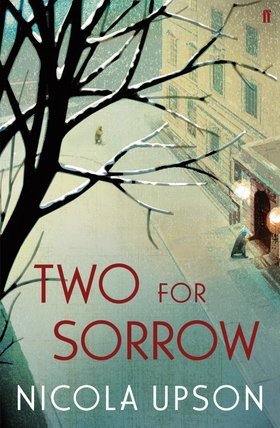
I'm going to be honest now, despite my reservations, I agreed to review this based off of two things. First, I fell in love with the synopsis. Ever since I read 31 Bond Street, I've been looking for well written fiction that deals with an actual crime. Second, I loved the cover. It is one of the loveliest I've seen in a long time. Once I got the book in the mail, the cover was an even bigger treat than I at first thought. There is a texture to it, as if the real paint had been used to do the illustrations, book by book. I can't tell you how many times I would just run my hand along the cover as I was reading. I have never thanked a cover illustrator before, but I think Mick Wiggins did a wonderful job.
Much like with 31 Bond Street, I thought this author did a really wonderful job researching the actual crime involved and making the story come to life on the page. I almost think it's harder to include a real case into a work of fiction than it is to make something up. The author has to craft their story around something that they have no control of, instead of taking an event and being able to play with the details in order to tell the story they want to put out there for the reader. Two For Sorrow is a perfect example of an author crafting a story around a real life event and doing it in such away that there are no seams or imperfections between what's real and imagined. What was brilliant about it was that while Amelia and Annie play a role in the book, through reading excerpts of the novel that Josephine is writing, they only color what's going on in the present time, they are not the focus.
I also enjoyed the way Nicola Upson brought to life Josephine Tey and her world in London in the early part of the twentieth century. Josephine Tey became a real person to me, not just a mystery author I've been meaning to read. Her life and personality came off the page in such a way that if I find out that she wasn't like this in real life, I may be a bit disappointed. What I did not know until this book, and I did confirm it through other sources, was that Josephine Tey was either gay or at the minimum bisexual. The way the subject was treated was rather intriguing to me. It seemed as if lesbianism (no real idea of how gay men were treated) was almost accepted, if not in general society, than in the world that Josephine Tey and her friends inhabited. It was part of who she was and doesn't seem to have been an issue, at least not in the fictional side of her. It's made me want to know, not only more about Josephine Tey, but about history of gay men and lesbians during that time in history.
The story itself was wonderfully engaging. It didn't move at lightning speed the way I'm used to with most mysteries. Instead it meandered along between the past and present, following it's own course. It kept me wanting more. I wanted to know who the person was that could perform such a viscous, violent act against the young seamstress as she was preparing to finish a cape late at night. I wanted the guilty party to be punished for their extreme crimes. But even more than that, I wanted to be there. I wanted to be part of the story. I wanted to help Josephine and Archie figure out what happened. It's been a while since I've read a story that drew me in so much, that I wanted to be part of it. I wanted to get to know the characters and live in their world. I just hope it's an experience that keeps happening to me, just on a more regular basis.
It's a good plot, it really is. It borrows a little from a couple of Christie mysteries I've read, as to the murder and the motive, but that doesn't make it bad. What does is the fact that I really, really do not like Josephine Tey. She's one of the more annoying characters I've come across in mystery fiction, and I've read a fair few of them. She doesn't even have the saving grace of solving the mysteries - her friend, the competent detective Archie Penrose does that. She's there for stopping the plot dead in the water. Get rid of her and there's a cracking mystery. With her it's a mind-numbing bore. I read Nicola Upson books because she's a U author and that's very helpful in so many challenges, but she doesn't make it easy. I wish she'd get rid of Tey - she's not doing any favors to the historical Miss Mackintosh.
It might be a bias for period lady lovin but I really did enjoy this one most of the three Josephine Tays I've listened to so far. Nicola Upson creates wonderful three-dimensional characters who are very much anchored in their time period; nonetheless most of them show a remarkably feminist attitude toward life - a result of WWI and the liberated 1920s. Sexuality is portrayed as fluid, and it is far from being the defining attribute of her characters. Instead, homosexuality and bisexuality in various shapes and sizes is present in her novels without any sign of prejudice.
Since I listened to the audiobooks - the narrator has done an excellent job, adding subtle changes and accents to the characters without making it seem overbearing.
Why would you write a novel about a real person that you admit that you could not find enough information about their life to write a biography? And the reason that you could not find this information - because this writer was such an intensely private person. I feel like Upson is trampling all over Tey's soul for the sake of money. I have no problem with money itself, or earning money but earning money through a 'fictionalized' account of a private person is something I won't be supporting with my money. I won't bother reading any more of these novels.
Really struggling with this book, I’ve liked the previous two in the series but this one is far too long and meandering. The subplot of Josephine’s love life is dull and uninteresting and a struggle to get through. I’ve lost track of who has been killed and what the major details are!
Audio book of Two For Sorrow… meticulously plotted and dipping into actual crimes of the early twentieth century but somehow overly complex.
The character of Josephine Tey seemed secondary to the detective Archie Penrose who is the more charismatic and interesting character. Somehow empathy for the privileged is harder with our twenty first century perspectives.
"I shouldn't put real people into a novel and manipulate them for the sake of a story. It's not right."
So thinks Josephine Tey in this book. I wonder what Nicola Upson was thinking when she wrote that.
This is one of the stranger mysteries I've read. Taken purely as a mystery, it's very good: well-written (although Upson needs to learn the difference between "that" and "which"—unfortunately, copy editors are a thing of the past), well-plotted (with a nice twist at the end), and full of interesting characters and scenes. However, she goes farther than any other author I've ever read in blurring the distinction between fact and fiction. Using real people (long dead, in most cases) as fictional characters has become commonplace in detective fiction, but consider this:
"Josephine Tey" was one of the pen names used by Elizabeth Mackintosh (1896–1952), who wrote plays and detective novels. She never used the name except on her books, and no one ever called her by it, but in this book it's the only name she has. She was friends with Margaret and Sophie Harris, who with a third woman formed the theatrical design firm called Motley. "Motley" plays a large part in this book, but the owners are sisters named Ronnie and Lettice Motley, who have a cousin who happens to be a Scotland Yard detective. The detective is also a friend of Tey's, and he does the real sleuthing in the story. The plot is bound up in a series of murders from the turn of the century which were, once again, real: a woman named Amelia Sach, in association with another woman, killed an unknown number of illegitimate infants. In this book, Amelia Sach is a leading character, as are her husband, daughter, and maid—but the other characters have been given fictional names and fictional fates. Upson has spun an elaborate fictional web out of some real people.
It all amounts to fiction developed out of shards of truth, and I wonder about the ethics of that. It seems unfair to the real people involved, who would surely have been indignant about having themselves manipulated for the sake of a story (see quote above). Upson clearly has no qualms, because she's continued to write "Josephine Tey" mysteries. And I will probably read them, because this one was absorbing and entertaining. But I can't help wishing that she'd allowed her imagination free rein and fictionalized the real characters as well as the ones she invented.
SPOILER ALERT, DO NOT CONTINUE IF YOU HAVEN'T READ THE BOOK: One thing bothered me. When Marjorie Baker went to visit Ethel Stuke, why didn't she simply show her the photo and ask if the woman in question really was Celia Bannerman?
I was a bit disappointed with the last book in this series, so I was really hoping to enjoy this one. And I did - I thought it was great. The heroine, Josephine Tey is back in London. She is researching a true crime novel about 'baby farmers'. These were women who would for a fee, take in unmarried pregnant women (the book is set at the beginning of the twentieth century), then when the baby was born they would pretend to get the baby adopted, but would in fact kill it. Josephine has a tenuous connection with one such case, a former teacher of hers was a prison warden in Holloway Jail when two baby farmers, Amelia Sachs and Annie Walters were executed. This former teacher, Celia Bannerman now works at the Cowdray Club, where Josephine stays when she is in London. There is a particularly gruesome murder of an employee of Lettice and Ronnie, Josephine's good friends. This brings into the picture Archie Penrose, the policeman who Josephine has a close, but confused relationship with. The dead girl was a former prisoner at Holloway Jail, and it seems as if there might be a connection with the Cowdray Club. There is a glamour to this book, and the first in the series which I felt was lacking in the second. The world of the theatre in which Josephine moves is exciting and Lettice and Ronnie in particular, as successful costumiers evoke the glitzy, glamourous life of the wealthy in the 1920s. This contrasts with the squalor of the crimes, and the poverty that was so close by. I loved this book, and can't wait for the next one.
This book was a little hard to rate. It isn't as much a mystery as a "true crime" story with a more current mystery added on. In 1903, two women were hanged as "baby farmers." That is, women who cared for mothers during the birth of their children, mainly illegitimate children and were supposed to be finding them good homes. In reality, they often killed the babies while they maintained the delusion that the children were in happy homes. This was all mixed up in the extremely contradictory practices and laws of the Victorian era. In so many cases, the women had very little choice and what was done to many of the was criminal.
Josephine Tey, the main character, and also a real person was writing a book about the life of the two women hanged and the author has her involved in a number of coincidences which at times stretch the imagination. The point of the book isn't who committed these crimes, but why.
There is also a section of the book devoted to a lesbian relationship which I found very distracting as it had virtually nothing to do with the book. While somewhat grounded in truth in that Tey was almost certainly a lesbian, this relationship is fictitious and does nothing to contribute.
Sadly I found the first two-thirds of this novel extremely tedious - which was frustrating because the subject matter (the execution of two baby farmers and the repercussions of this over thirty years) was fascinating. The writing, unfortunately, was slow and dull, and there was far too much of it. I don't need to know what is happening in every character's head - in fact, I think it's much more interesting to work a few things out for myself.
I only kept on reading because I was very interested in the murder victim and was curious as to who had killed her and why. The action finally picked up in the final third; Upson's plotting is as good and intricate as ever, and when the revelations come they really do come. Although I'd worked out the final twist well ahead of time, I still enjoyed the last third of the book. Sadly it didn't make up for my resentment at trawling through the first two-thirds.
I love Josephine Tey and was so excited about the idea of these books. I liked the first installment but couldn't choke down this one. Too bleak, slow, violent, depressing, and it was starting to feel like every female was trying to have sex with every other female. These together, along with the fact that there was nothing Tey-like about this mystery, made the story unpalatable for me.
Nothing wrong with the writing and I love her main characters, but it was the subject matter... baby farming of the 1930s. I love a good mystery but I couldn't get past the descriptions. So, no idea where the book was going because I only made it to about page 30. I will happily try the others in the series, just couldn't stomach this one.
This entire review has been hidden because of spoilers.
huh. Good writing and fascinating plot, but it was too graphic for my taste and I wasn't wild about the lesbian-affair-side-plot or the not-so-subtle feminist subtext. I'd give this author a miss next time.
I’m very much getting into this Nicola Upson series, and enjoyed reading this book.
Overall, it’s a great whodunnit - it certainly kept me guessing with one or two clever twists and some gruesome detail that actually added credibility’s I think the slow development across the series of some of the characters - particularly the detective, Archie Penrose is excellent.
Upson is surprisingly humble about what I assume is criticism of fictionalising a real person - with commentary from a character in the book about how being fictionalised after death would feel. I appreciate that but still feel the Jospehine Tey character is the weakest in the book. I struggle to see any depth brought out in her and understand the motivations but maybe that’s just cautiousness from the author.
My only other criticisms would be that at times it felt a bit too long, and it certainly crescendoed far too soon, which made the 60 odd pages after the reveal a bit of a drag. An enjoyable read all in all though.
This mystery was a lot darker than I expected so it took me some time to get into. However, once the story got its claw into me, I read right through to the end quite quickly. The twist in the end didn't surprise me as I somehow predicted it earlier on but I still like the showdown at the end. Loved Archie Penrose and Bill Fallowfield, not so much Josephine Tey as characters... I think I just wasn't so keen on the personal side of things in this novel; the angst and the affairs, urgh.
3rd of the series. I thought talking about baby farmers (inspired by the true story) was very interesting as it is not something we (me in any case) usually read. The plot twist at the end was good.
BUT I really thought that the hole Josephine/ Martha story was very boring and unnecessary. Apart from showing the personal turmoil of Josephine. Between following a love story, hurt her friends and just deciding to not pursue it.
It was already hard to follow who is who and who has done what.
Enjoyable enough historical crime, though I guessed the twist a mile off, and found the central romantic relationship unconvincing (ironically, since it was based on a real life affair).
Two for Sorrow by Nicola Upson is the third novel in her historical mystery series featuring Josephine Tey (aka Eilizabeth Mackintosh). In order to fully understand the relationships between various recurring characters, I would definitely suggest that anyone interested in reading the novels begin at the beginning (An Expert in Murder). Upson anchors her third book with the true criminal case of Amelia Sach and Annie Walters--better know at the turn of the twentieth century as the Finchley baby farmers. Josephine Tey is researching the case thirty-some years later for a book she intends to write based upon the story of the only double-hanging of women in modern times. Tied to the case is Celia Bannerman, former wardress of Holloway prison--present for the infamous hanging--and current secretary to the Cowdray Club, key figure in nursing administration and welfare work. Josephine is a member of the club and Miss Bannerman is one of the first people she interviews.
But the historical case isn't the only one that involves the club. Inspector Penrose, Josephine's friend, is called in to investigate a series of blackmail letters sent to members and petty thefts. It's easy for the ladies of the club to want to blame the ex-convicts that Celia Bannerman has given jobs in an effort at rehabilitation, but Penrose isn't so sure. And when another rehabilitated young woman who works for his cousins, the Motley sisters, in their sewing establishment is brutally killed while in the midst of working overtime to help prepare for a gala ball at the club, he is more convinced than ever that there is more going on than simple blackmail and thievery. The deeper he digs, the more ties he finds to the crimes of the past and soon his investigation and Josephine's research point to a very surprising suspect.
This is an engaging mystery and Upson works the historical crime into her story of Josephine Tey with great skill. While, it's true that the "modern" (for Tey's time) crimes are fictional, they are a logical outcome of the fictional rendering of the Finchley baby murders. She has also become quite skillful at transporting us bak to the years between the World Wars. Not quite as absorbing as the first two, but an enjoyable read none-the-less and the reveal of the culprit came as quite a surprise. I thought I knew who did it--based not on the motive first given but on the identity of the blackmail letter-writer. I was wrong. Most disappointing, however, is the fact that the bulk of the blackmail letters are not explained at all--that little mystery gets lost in the capture of the murderer.
The one other item that stands out to me this time is the use of Elizabeth Macintosh's pen-name throughout. It finally hit (why it took till book three, I'm not sure) that it seems a bit odd that all of her friends refer to her as Josephine and not as Elizabeth. Was that really how she was known to her intimate circle?
But, again, a good solid read and I will definitely continue with the series.
First posted on my blog My Reader's Block. Please request permission before reposting. Thanks.
They were the most horrific crimes of a new century: the murders of newborn innocents for which two British women were hanged at Holloway Prison in 1903. Decades later, mystery writer Josephine Tey has decided to write a novel based on Amelia Sach and Annie Walters, the notorious, "Finchley baby farmers," unaware that her research will entangle her in the desperate hunt for a modern-day killer.
A young seamstress-an ex-convict determined to reform-has been found brutally slain in the studio of Tey's friends, the Motley sisters, amid preparations for a star-studded charity gala. Despite initial appearances, Inspector Archie Penrose is not convinced this murder is the result of a long-standing domestic feud - and a horrific accident involving a second young woman soon after supports his convictions. Now he and his friend Josephine must unmask a sadistic killer before more blood flows - as the repercussions of unthinkable crimes of the past reach out to destroy those left behind long after justice has been served.
In the latest mystery by Nicola Upson, Two for Sorrow, takes the readers into two different storylines. One is the story that Josephine has been researching on the Finchley baby farmers that were hanged in 1903. Found guilty of offering pregnant women alternatives to keeping their babies, they were accused of killing those babies instead of finding viable adoptive parents who were willing to adopt or purchase unwanted babies. The reader takes a journey as Josephine begins to write her book based on a true life mystery based on the facts she gleens from meeting with people who were present at the time the women were hanged. Amelia Sach's believed she was innocent even as she went to the gallows.
Now however in the midst of writing this book and researching more information on baby farming, a reformed woman prisoner from Holloway prison is found murdered. What connection does she have with the baby farmers and how far is the killer willing to go to make sure that justice is served in their minds.
I received this novel compliments of TLC Book Tours for my honest review and found this to be a most unusual story line. Interesting in that it takes a form of the book that you are reading as it's being written in parts by Josephine and while she begins to slowly unravel a new mystery right before her eyes while she is researching material for her book. I rate this book a 4.5 out of 5 stars.