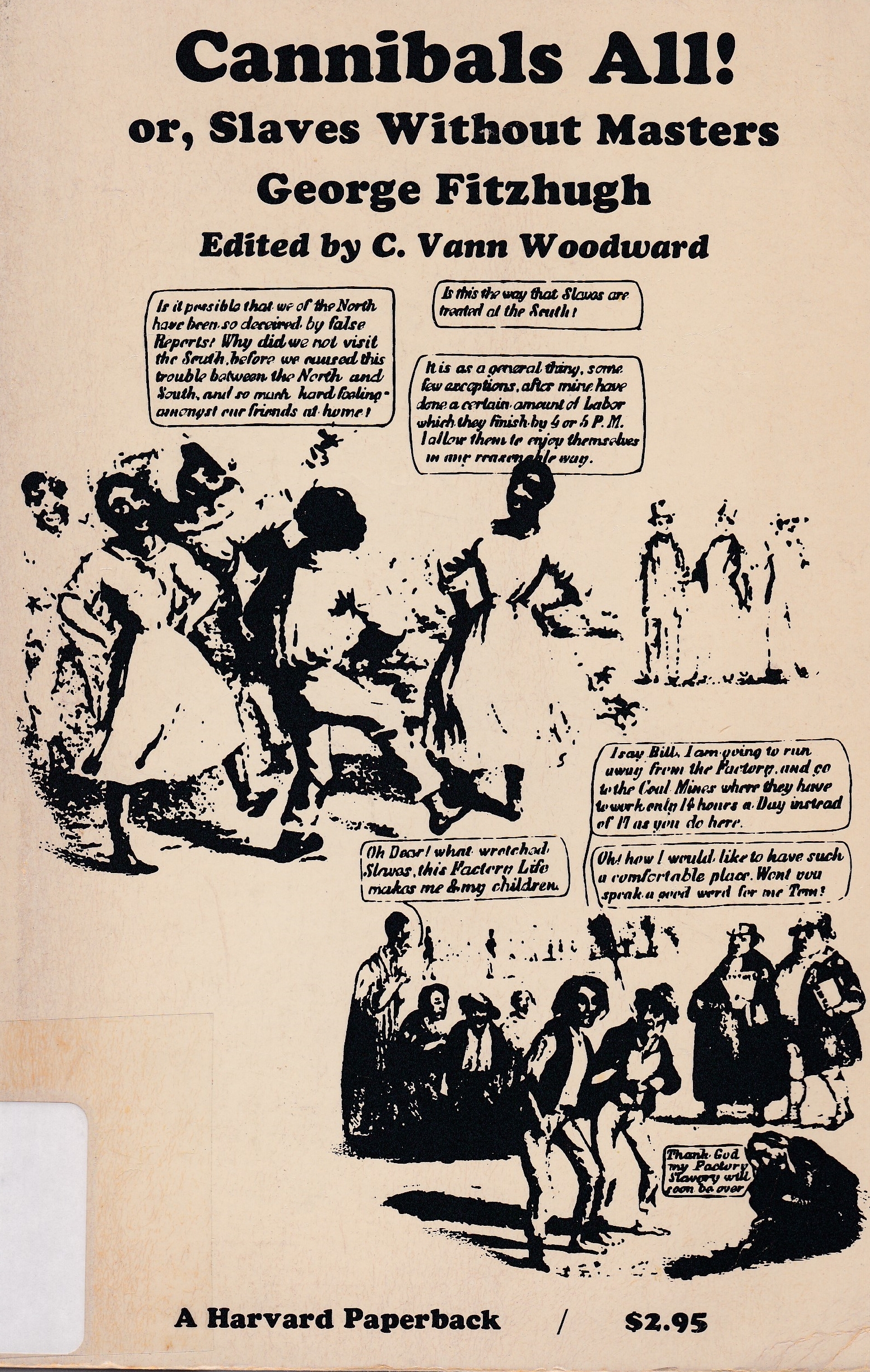
"Cannibals All!" got more attention in William Lloyd Garrison's "Liberator" than any other book in the history of that abolitionist journal. And Lincoln is said to have been more angered by George Fitzhugh than by any other pro-slavery writer, yet he unconsciously paraphrased "Cannibals All!" in his House Divided speech.
Fitzhugh was provocative because of his stinging attack on free society, laissez-faire economy, and wage slavery, along with their philosophical underpinnings. He used socialist doctrine to defend slavery and drew upon the same evidence Marx used in his indictment of capitalism. Socialism, he held, was only "the new fashionable name for slavery," though slavery was far more humane and responsible, "the best and most common form of socialism."
His most effective testimony was furnished by the abolitionists themselves. He combed the diatribes of their friends, the reformers, transcendentalists, and utopians, against the social evils of the North. "Why all this," he asked, "except that free society is a failure?"
The trouble all started, according to Fitzhugh, with John Locke, "a presumptuous charlatan," and with the heresies of the Enlightenment. In the great Lockean consensus that makes up American thought from Benjamin Franklin to Franklin Roosevelt, Fitzhugh therefore stands out as a lone dissenter who makes the conventional polarities between Jefferson and Hamilton, or Hoover and Roosevelt, seem insignificant. Beside him Taylor, Randolph, and Calhoun blend inconspicuously into the American consensus, all being apostles of John Locke in some degree. An intellectual tradition that suffers from uniformity--even if it is virtuous, liberal conformity--could stand a bit of contrast, and George Fitzhugh can supply more of it than any other American thinker.
He was a critic of the philosophical foundations of personal liberty and capitalism.
His Sociology for the South was an attack on Adam Smith, John Locke, & Thomas Jefferson and also the entire liberal tradition. He argued that free labor and free markets enriched the strong while crushing the weak.
His Cannibals All! was a sharp criticism of the system of "wage-slavery" found in the north.
I picked up this book at a campus booksale because it was just so odd. A book with the word cannibal in the title, which was also a defense of slavery where the author was not only boostering the slavery of Africans but the slavery of pretty much everybody? I had to read it. So I read it.
Fitzhugh is an interesting case, as he pretty much attacks every angle of what is now considered American virtue. Free enterprise? Democracy? Capitalism? In the eyes of Fitzhugh all of these were the worst of the worst, and something to be decried.
Here's the good part, Fitzhugh is an intelligent guy, and smart and funny to boot. I can't really find fault with his devastating critique of capitalism. He lays bare the worst of the extremes of capitalism. One hundred and fifty years later his criticisms are still pretty valid.
However, his suggestion for a replacement is monstrous.
Fitzhugh has no awareness of the awful devastation the institution of Southern slavery wrought upon humanity. In his eyes it is the most perfect institution ever created. Southern slavery is perfect, because like the family dog, slaves are happy to be indolent and cared for. A perfect institution, and why should anybody object to this state of affairs?
I remember I turned on this book when I realized what it was. I was reading it as a historical curiosity, but then it struck me like a bullet that this was just another example of all those crappy political books that are released every day. Dehumanize your enemies, then explain that your political views are the best of all human arguments.
Political argumentation. If Ann Coulter grew up in the age of slavery she would be sounding the bell of its continuation.
I slowly grew to hate Fitzhugh. Read this if you must for historical contrariness, but hate his arguments. This book is an awfulness.
Typically a book like this that serves my understanding of historical arguments gets a standard 3 stars (unless I find it particularly worthwhile). In this case, the moral bankruptcy and hypocrisy of its author compel me to take away a star. However, its value in clarifying philosophical arguments for slavery is real.
There is a trope on the American Right that *"The" Democrats supported slavery and Jim Crow*, and this is often extended to "the" "progressives" as well. "The" is in quotes as, of course, Democrats in 2016 are philosophically and politically distinct from Democrats in 1916 or 1856, etc. Fitzhugh is indeed a Democrat, but he attacks socialism throughout the book (as well as capitalism ["Free Society"], feminism, Free Love, anarchism, and various other "isms"). Fitzhugh, and obviously the Southern slave-holding society of the time, is ardently opposed to anything we would call "progressive" or "liberal" today. The trope is dishonest not only because it ignores the well-known history of white racists exiting the Democratic party in the years following the Civil Rights Act of 1964 (a process that wasn't immediate, which can also be used to dishonestly cherry pick facts), but even more egregious, as it attempts to paint Southern slaveholders as "progressive". Fitzhugh identifies himself as thoroughly conservative in this book, though he also occasionally refers to himself a "Socialist"-- in his case, a "Socialist" who rejects Socialism as unrealistic and destructive (he calls himself "Socialist" because he agrees that workers under a capitalist system are exploited, and puts forward slavery as a traditional, conservative, and Christian [and Socialist] solution).
Fitzhugh also displays "the treason of the intellectuals" as described by Julien Benda in his book of the same name. That is, he pillories intellectuals and intellectualism (even going so far as to argue that the physical look of a book is equally important to its content) while, of course, being himself an intellectual engaging in philosophy.
In sum, if you would like ammunition against the trope above, or if you would like historical insight into the arguments for and the philosophy of Southern slavery, and if you can stomach sustained moral and intellectual bankruptcy, this book will serve you well.
It is commonly said that Southerners initially defended slavery as a necessary weakness, but that as the peculiar institution came under increasing attack, they began characterizing it as a "positive good." Fitzhugh certainly takes the latter tack in this thought-provoking defense - nay, celebration - of the slave labor system. The author contends that the enlightened among us actually have a responsibility to enslave the weak in order to protect them. Analogizing to the family, he acknowledges that some masters unjustly abuse their slaves, but so too do some husbands abuse their wives and kids; yet we would never make the leap that marriage and fatherhood should be eradicated, as abolitionists then did with slavery. Quoting liberally from contemporary journals as to the horrid working conditions of wage laborers in occupations such as mining, he argues that the northern underclass of wage laborers was then worse off than the southern underclass of slave laborers. He expresses sympathy with liberals and socialists as to improving conditions of the working class, but says that the best way to do this is with slavery. Open-minded readers, prepare to be stimulated and challenged.
Absolutely recommend to anyone who wants to approach to the abolitionist and pro-slavery debate. Fitzhugh is a sui generis advocate of slavery, most of his theories were really uncommon among slaveholders. He defends the whole institution of slavery, and he thinks that the peculiar institution is natural, right and necessary not only for negroes, but for whites as well, at least for the weaks. It's society's responsibility to take care of weaks, and slavery is for those people, the best way. He defines negro slave "the happiest in the world", because he has his master that takes care of all his need. Another important aspect of Fitzhugh defence of slavery, is that he attacks free society and denounces its failure.
So “ left that its right-o” to paraphrase Ava Max. A very odd book intellectually. This is a kitchen-sink sort of intellectual defense of US slavery. The cover shows a contemporary (1856) starving English and Irish mill workers staggering off to work whilst happy, well fed slaves dance away “ after work”. That sums up Fitzhugh’s thesis succinctly. Fitzhugh’s argument is primarily that because slaves were property, they were treated better, because Capitalist planters did not want to waste their Capital value through overwork. He gives lots of examples of how the European working classes were exploited and desperately abused by Capitalists. This is in comparison to purportedly “happier” slaves on southern plantations. Fitzhugh ignored sexual abuse, denied families were split up and thought (“corrective”) beatings were much rarer than in English mills. He obviously was writing to his audience. In a bizarre( unexpected) turn, Fitzhugh uses a LOT of Marxist Labour analysis (value of products derived from labour etc) and demonstrates a very comprehensive knowledge of early Socialism. In fact, he considers slavery a higher form of socialism (really!). In a bizarre twist, he then decries the “ potential collapse” of the “ natural (racist) social order” as advocated by Abolitionists as a form of “ultimate egalitarianism/socialism”. I could not figure out if he was horrified by that prospect or so caught up in his argument he forgot the contradiction. It is doubtful that more than a handful of southern leaders ever read or absorbed Fitzhugh’s’ book. Certainly nobody in Pickets’ Division who crossed the fields at Gettysburg was thinking about Fitzhugh’s writings. I see Fitzhugh as a sort of Anderson of his day-critical, snarky, bitter and strangely Marxist. This Harvard reprint (bought for $1) is a very small contribution to understanding the history of the era. Don’t bother.
"The Abolitionists boast, that lands are dearer and labor cheaper in free than in slave society. Either proposition contains the admission that free laborers work more for others and less for themselves than slaves - in effect, that they are less free than slaves. The profits of land are what the landowner appropriates of the results of work of the laborer. Where he appropriates most, and leaves the laborer least, there lands are dearest, labor cheapest, and laborers least free. In Europe, lands sell much higher than at the North; hence laborers are less free in fact than at the North. In the North they sell higher than in the South, because the slaves consume more of the results of their own labor than laborers at the North, and leave less profit to the landowner. The high price of land is, in the general, an unerring indication of the poverty and actual slavery of the laboring class. Its low price, equally proves that the laborers, whether called slaves or freemen, work more for themselves, and less for the landowners, than where lands are dear. In settled countries, where all the lands are appropriated, this theory is undeniable and irrefutable.
As this is a short chapter, we take the opportunity to apologize for our discursive, immethodical and unartistic manner."
Fitzhugh's rhetoric is often incisive, and his assaults on the hypocrisies of abolition are always entertaining. However, this is certainly a book of its time, likely only of interest for the historically minded. I didn't mind, as I was fascinated by the exploration of the mid nineteenth century intellectual scene, in which a clever man like Fitzhugh could defend slavery, borrowing equally from Marx and Filmer. What a strange and delightful synthesis! My main problem with the book was that it was overlong, full of exhaustive repetitions and interminable extracts from the newspapers of "Tory socialism." Those aspects haven't necessarily aged well.
Strange to be transported back to the antebellum southern view of slavery. Fitzhugh's passion sounds like every sentence should be written in all caps. He is WAY over the top in his analogies and his passion for the slave economy. It's a meaningful read for anyone who wants to understand the slave owning mentality. Probably most interesting to modern readers is that Fitzhugh comes to his support of slavery from a left-wing / socialist view instead of the right-wing / racist view that would be expected of readers today.