A topical story from Ms Magazine in 1972, in which Ms and Mr Jones are selected to raise a baby without gender labels or stereotypes, as a secret psycho-social “Xperiment” [sic]. The baby isn’t a boy or a girl, but an X. The story makes its points with a gentle touch and a heartwarming, if predictable, narrative arc.
In the 2020s, trying to minimise the effects of gender stereotypes is mainstream, even if keeping a child’s gender private until they can decide is more niche.
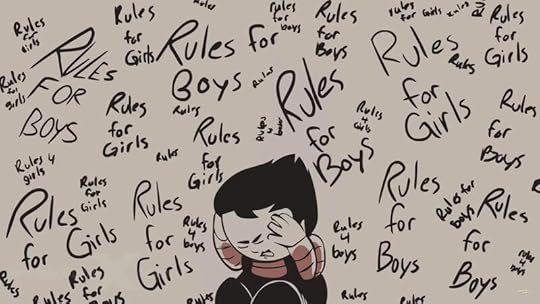
Image: Cartoon of little X, assailed by competing rules for girls and boys, by Joe Blevins (Source)
Nevertheless, in the 10 years since my now 30-year old kid told us they were non-binary gender, I have seen a broad change in knowledge and acceptance of gender diversity, among all age groups, which I find heartening - though I look at the speed of rollback across the Atlantic and worry.
An interesting aspect of this is that although the adoptive parents are fully committed to the idea of raising a child without and beyond gender (and carefully study the very lengthy instruction manual), the impetus is from detached scientists.
Pronouns
X is referred to as “it”, even when they are old enough for school. This jarred for me, even though it’s normal in my idiolect to refer to a baby as “it”. Language is wonderfully strange.
• If you struggle with singular “they” on grammatical grounds, see my review of Bongiovanni and Jimerson’s A Quick & Easy Guide to They/Them PronounsHERE.
• For a much broader, but highly readable, look at the broad spectrums of not just sex and gender, but relationships, bodies, emotions, and thinking, see Alex Iantaffi and Meg-John Barker’s Life Isn’t Binary, which I reviewed HERE.
How I found this story
I’ve been listening to X Man: The Elon Musk Origin Story on BBC Radio 4 HERE and other podcast platforms. Jill Lepore, a history professor at Harvard, explores parallels between Muskism and sci-fi he has identified with: • Batman, The Dark Knight (fighting or advocating fascism) • The Hitchhiker’s Guide to the Galaxy (technocracy, crypto, and “extreme capitalism”) • Planet B (catastrophism, PayPal, SpaceX, Mars, extra-terrestrial capitalism) • Iron Man/Tony Stark (Tesla saving the world) • The Dogefather (crypto again), • Baby X (X men (one of whom his trans daughter was named after), and X (one of his children with Grimes), and this story) • Invasion of the Body Snatchers ('woke mind virus', anti-trans, Cold War) • The Terminator (robots and AI)
Read or watch it
• You can read the full version of X: A Fabulous Child’s StoryHERE.
• You can watch a 10-minute animation by Brendan Bradley HERE. It strikes a darker tone, in part because the tiny school children look preternaturally old, and also because of the narrator.
This is so amazingly a period piece. I remember reading a review in a magazine circa 1980, and being intrigued by the idea. But I forgot about the book until recently. It's fascinating to see how issues of gender norms have changed and how they haven't. While there is much more tolerance in general for non-girly girls, and for girls to engage in boy pursuits, there is a more extreme fringe more vigorously enforcing the roles at either end.
As a nonbinary person who plans to be a parent, I have occasional worries about how to raise my future children. Should I let the world know their assigned gender and risk them being socialized one way or another? Or should I keep that information under wraps and let the child tell the world if and when they are ready? Is there an in-between? No matter what the answer is, this is a book I will definitely have in my nursery. I can't help but be impressed that this book was published several decades ago; it's still relevant today!
This is an inspiring story about the beauty of letting children be children without imprison them with a specific gender. It also shows how people often feel threatened when they are not given the chance to label things. I suggest reading this small book to give you perspective on why gender is not the answer.
I heard about this book a few months ago after the news about a "genderless" child hit the web. I think Gould proves a very valid point that we should let the child in question learn, grow and be who it wants to be and not who we think it should be.
It was also pretty nifty that X didn't feel alienated or anything of the sort from its peers, because sadly enough real life isn't so forgiving and open-minded.
Gosh, I read this years ago and thought it was brilliant then. Now of course, it should have a whole new audience. When X's parents won't say whether X is a boy or a girl, it sends folks into tizzies (Gosh, does this sound familiar and relevant?). All that is, except X, who is happy and joyful and only more so when Y the younger sibling arrives. I still have my ancient copy. This is a classic!
Cute little children's story about gender nonconformity and social freedom. Nowadays we'd probably say "they" instead of "it" when referring to X, as calling a child "it" sounds a little bit weird, but hey this was 1972 so who can really complain. I think the real hero of the story are the overalls: a true and enduring icon of nonbinary fashion for decades.
After a long and difficult search, a group of scientists find a couple to take part in their Xperiment. The Joneses, that’s the couple, will get an infant, if they promise not to raise the baby up as a boy nor a girl, but a x. The get a detailed manual along with the infant, and they’re good to go. The Xperiment comes with certain problems, such as people wanting to know if the baby is a boy or a girl. This becomes even more of a problem when it’s time for X to go to school.
It’s probably impossible to read a story about a couple raising a baby called X without thinking of a certain billionaire that is obsessed with the letter X for some reason, but essentially that’s not the most interesting part of this story. It’s mildly comical, and amusing, poking fun at gender roles, and scientists. The references to the baby manual, that clearly is thousands upon thousands of pages long, is often quite fun.
The more important is the way it treats gender roles. Some have seen this as an early children’s story about trans issues, but I’m not really seeing it that way. X does not fit into the boy/girl stereotype that society at the time was so determined to push everyone into, and could therefore be viewed as trans. Thing is though, X is raised as X, and becomes X when he grows older. The boys in the school X goes to are raised as boys, and the girls are raised as girls, and have become boys and girls. So what really is the difference between them and X. What I mean is, X gets Xes gender roles from scientists that decided to make the Xperiment. It does not come from within X but from influences X gets from the people around X.
So I don’t think the story is really about trans issues, but it is clearly about gender roles. X is much freer in Xes gender role, than the boys and girls at Xes school, and can do boyish, and girlish things. After all the drama around X in the school where parents of some of the other kids demand that X will be examined to figure out what X is. This does have certain connotations with what is happening with trans issues in the US now, but the story is clearly on Xes side, and it is determined that X is X and better balanced than the other kids. So the story is probably pointing out that the gender roles could be better handled.
At the very end Y shows up. Both sexes have X chromosomes, but males have also Y chromosomes, so that’s where the names of X and Y come from. What I think this means is that these two characters are meant to show the world where people have more equality because they are raised to be freer in their roles. They’re not raised to be a boy or a girl, but treat those roles freely. To be more equal than if they were stuck with either the boy or the girl roles. I think that fits the story better then reading trans into X, but I may be wrong. It’s one of those stories that are quite open to interpretation which makes it so interesting.
Literally this just popped into my head as a memory of having read it in school at some point and I can’t remember when? I was trying to remember a different story from a junior high English class, but I feel like it might have been a college class when I read this one? No clue, really. It’s an interesting piece if more than a little dated (do not ever use ‘it’ as a pronoun for a human, not good). Always important to remind oneself how gender is a social construct and challenge gender norms.
Baby X is a playfull romp thorugh gender identity. Me myself as a polysexual polyamerous genderfluid demiromantic intersexual WOMAN find this to be a great story to teach our children. My only problem with this is that it allows men to exist. I think all men should be wiped off of the earth, exept if they are gay. Gay people are cool.
Short story about how raising a child without gender has no effect on them or anyone around them. Also argues that it could improve other's lives by not having these rigid gender structures. Here we are still struggling with this 50 some years later. Interesting little story.
#just genderqueer things. i really loved this honestly. it’s kinda framed as a children’s story but i think a lot of people can benefit from it (what the little prince tried to do but “x” actually does it). i am so happy at its deconstruction of gender norms and especially the bit at the beginning where parents would say they didn’t care abt the gender of the child but really,,, they Did.
there are maybe a handful of things that don’t really stand up to the year 2022, i.e. the equating of genitals with sex/gender in a way that did not feel satirical like the critique of gender norms. but this was written in 1978 holy shit so it’s understandable and can be read as a relic of its time period. also x is an icon,,,, the it/its pronouns mwah (i also don’t know if that’s based in old gender theory but it’s cool as hell so i’ll allow it). anyways gould is a genderqueer icon for this & it slaps.
Wow! They don't make storybooks this thought provoking anymore. A great picture book that makes you analyze the gender roles we play in society simply because we were brought up to believe those are the roles we must play. Although some parts did remind me of SNL's "It's Pat" sketch comedy. I wonder if this book was the inspiration?
What a strange little book. This piece makes quite the statement about gender identity. Although it is technically a children's story, I would not recommend reading this book to children.