Jump to ratings and reviews
Rate this book
Rate this book
One day in September, a decade ago, all eyes were turned in the same direction. Ten years later, where are we looking? How do we see things differently? From Ground Zero to Kampala to London to Mumbai, we still feel the impact. The way we interact, the way we travel, our relationship to media and technology -- all have been irrevocably changed.

Granta 116 examines the consequences of the attacks that occurred on September 11, 2001, from a global perspective. Showcasing some of the most insightful essayists, fiction writers, poets and visual artists working today, Ten Years Later will explore the complexity of our perceptions of 9/11. The world changed -- but how?

256 pages, Paperback

First published August 1, 2011

2 people are currently reading
75 people want to read

About the author

John Freeman

55 books286 followers
Note: There is more than one author in the Goodreads database with this name.

John Freeman is an award-winning writer and book critic who has written for numerous publications, including The New Yorker, The New York Times Book Review, The Los Angeles Times, The Guardian, and The Wall Street Journal. Freeman won the 2007 James Patterson Pageturner Award for his work as the president of the National Book Critics Circle, and was the editor of Granta from 2009 to 2013. He lives in New York City, where he teaches at NYU and edits a new literary biannual called Freeman's.

Ratings & Reviews

What do you think?
Rate this book

Friends & Following

Create a free account to discover what your friends think of this book!

Community Reviews

5 stars
26 (26%)
4 stars
44 (44%)
3 stars
26 (26%)
2 stars
3 (3%)
1 star
1 (1%)
Displaying 1 - 15 of 15 reviews
Profile Image for Stacey D..
386 reviews29 followers
September 22, 2011
A great perspective on those who fought or lived through the Afghani and Iraqi wars of the past 10 years. I found the poems very moving and very real. The non-fiction writing is vividly descriptive of a world many of us will never know: the Middle East. Like Americans portrayed throughout Granta's various stories, many of us do not want to know about the wars being fought "over there". These essays bring it home. Though tragic, in the end I found myself wanting to read more.

I enjoyed almost everything, especially "Redeployment", "The Terminal Check", "Veterans of a Foreign War" and the amazing,"The American Age, Iraq". Not impressed with Nicole Krauss' story, whose books I haven't enjoyed either.

This is an observation and a tinge of criticism. Although I haven't read an issue in a while, Granta never fails to remind the reader that it is a liberal, UK-based publication and the writings typically trail an unmistakable whiff of anti-American/anti-Israeli sentiment. Sometimes it's refreshing, but more often, as an American Jew, it is irritating that this sentiment is pitched over and over again.
Profile Image for Kireja.
395 reviews25 followers
January 30, 2020
Book Riot Read Harder challenge 2020 task # 23: Read an edition of a literary magazine (digital or physical).

I read three pieces from the Granta 116 issue (which looks at the impacts of 9/11 ten years later) for this task titled: Letters to Omar by Edmund Clark; In a Land of Silence by Janine di Giovanni; and Redeployment by Phil Klay. All three pieces explore the lasting trauma that people face in a post 9/11 world.

Letters to Omar is about Omar Deghayes who was incarcerated at Guantanamo Bay for six years and was released without charge in December 2007 at the request of the British government. This piece is a powerful portrayal of the impacts that prolonged isolation and detainment can have on the human psyche. It shows how you lose control of every aspect of your life and hows the things that people take for granted -mail, blankets and pants-become tools that people can use to exercise control over you. The article included a few images of the mail Deghayes received- postcards, letters of support, images of cats and sheep- which was very interesting, but Deghayes describes how even this was a double-edged sword because over time he became so paranoid that he thought his interrogators were planting materials to disorient him. What really stood out for me was the impacts that this trauma will continue to have on his life; he may be free in a sense but he'll never be able to escape his experiences at Guantanamo. I did a little digging and came across a 2006 report prepared by the Center for Policy and Research at Seton Hall University Law School which said that over 80% of the prisoners were captured not by Americans on the battlefield but by Pakistanis and Afghans, often in exchange for bounty payments. Most of those detainees were actually low-level offenders who weren't even affiliated with any of the organizations on U.S. terrorist lists. In fact, then-Secretary of Defense Donald Rumsfeld even sent out a 2003 memo saying: "we need to stop populating Guantanamo Bay (GTMO) with low-level enemy combatants". What this taught me was that Omar Deghayes is one among many.

In a Land of Silence looks at political dissent in Libya, specifically during the 2011 Libyan Civil War and the 2011 NATO-led military intervention. The article centers around Kais al-Hilali who was a political cartoonist who was shot and killed in 2011, minutes after painting a caricature of Muammar Gaddafi on a wall in Benghazi. The story of Kais al-Hilali, who was known for using street art as a medium to promote revolution (by attacking Gaddafi and his son and by painting American and French flags as tributes to NATO bombers), shows the importance of using one's voice to stand up for your beliefs. Yet, it also shows the tremendous risk that these individuals take. Janine di Giovanni also met with Kais' mother for this article and it was heartbreaking to think about how she's dealing with this loss. It's also interesting to note that the author was cynical that the revolution would end up benefiting the locals. She writes how after a successful revolution "the West will pour money into it as they have in Afghanistan and Iraq , appointing international bureaucrats and business-school graduates to transform the country, and building ‘Green Zones’ that separate them from the local population". Yet, as of now (almost nine years after this issue was published), this "new Libya" hasn't materialized because the country is in a second civil war, with the U.S carrying out sporadic airstrikes and raids against Islamist groups. The aftermath of the NATO military intervention, even led Obama to admit that the worst mistake of his presidency was "probably failing to plan for the day after, what I think was the right thing to do, in intervening in Libya.” After reading this article I was left wondering where the people Janine di Giovanni writes about are now and what they think about the current political situation. It's sad to think that they were so hopeful about a post-Gaddafi world that never materialized.

Finally in Redeployment, Klay, who served in the United States Marine Corps from 2005 to 2009 and was deployed to Anbar Province in 2007–2008, uses his own experiences along with extensive research to write about the difficulties that soldiers face when reintegrating into civilian life. He writes honestly and evocatively about how soldiers are unsure how to decompress, have thoughts replaying in their heads, feel as if they weren't home even though they were on American soil, the nervousness of seeing family again, feeling uncomfortable not having their service weapons on them as civilians, wanting to return to the battlefield, being unable to let their guard down even though they were home, and the moral injury they face. This is the human cost of war. There are so many stories about the "system" failing to meet the needs of veterans and active duty soldiers and what I hope for more than anything after reading this piece is that they get the support they need. We ask a lot of these men and women, and the least we can do is help them when they need it the most. Klay writes how reintegration is not easy; it doesn't happen overnight. Instead you have to take it "one step at a time. You can get through anything, one step at a time".

Letters to Omar, In a Land of Silence, and Redeployment look at three very different issues, but all three pieces shows us the impact that 9/11 had/has. Though the attacks took place over the course of a single morning, its' reverberations continue to be felt across the world nineteen years later. The Granta 116 issue is powerful, haunting, and absolutely relevant to us today.
Profile Image for Puja.
54 reviews29 followers
November 26, 2020
A 9/11 MEMORIAL FOR THE WORLD
'Granta 116: Ten Years Later' is an up close and personal look at the world a decade after the September 11 attacks. A collection of brilliant, thought provoking essays, it gives an insight into how violence, political strife, social injustice, religious conflicts and the war with the west has ravaged nations and affected the lives of so many. I was blown away with the high quality writing - it is nothing short of literature, and it was a treat to read the 16 contributions of such gifted international writers. Through their reportage, creative short stories, poems and a photo essay, I got a glimpse of global communities coping with the complexities and hopelessness in the backdrop of economic hardships, dangerous wars and mayhem.

A LOOK AT SOME OF THESE STORIES with my very own titles (I had fun with that!)


Back to Reality
"We shot dogs. Not by accident. We did it on purpose .. I'm a dog person, so I thought about that a lot."
These are the opening lines in Phil Klay's 'Redeployment' in which Sergeant Price returns home to the US after a tour in Iraq. He struggles with shooting his cancer stricken mutt though he routinely killed dogs in another part of the world. The hardships veterans and soldiers face while attempting to reintegrate in the normal world after active duty is the moot point in Klay's essay.

Two Tales in One
'A Tale of Two Martyrs' by Tahar ben Jelloun gives two powerful accounts. One is of hope amidst gloom with the tale of Mohamed Bouazizi, a street seller in Tunisia. Repeatedly mistreated by everyone in the system, when his dignity is trampled upon in the most humiliating way - what he considered the last straw on the camel's back - he takes matters into his own hands with self-immolation. His martyrdom followed by the ruling dictator Ben Ali's apathy sparks off the Arab Spring, an important landmark in the region. The second tale is from Egypt where police brutality and absolute disregard for human life and justice under Hosni Mubarak's rule become the bane of a simple, poor family - such countless traumatic experiences helped bring in a revolution in the country.

The Wronged Man
'A Handful of Walnuts' is a memoir by Ahmed Errachidi, a London based chef who unfortunately ended up in the Guantanamo Bay prison set up by the US Military. His charitable nature, refusal to bow down to the many trials and tribulations, attempts to save the ants in his cell from the soldiers, courage in protesting the inhumanity to his captors and his strength as a righteous human being, were all inspiring and felt like a warm ray of light in this depressing story. I recall that the world was shamed into watching the horrors of the infamous interrogation camps including the one in Abu Ghraib. But I didn't know that Afghan looking foreigners or petty criminals or just about anyone caught in the wrong situation at the wrong time could be sold as bounty by authorities in Pakistan to the Americans who were looking to meet their terrorist quota for a special prison in a far away land. This is a testament to corruption and greed overruling religious affinity and ideology. The prisons functioned more like training camps for the inexperienced interrogators and the top echelons in Washington were aware about the wrong profile of prisoners. What stayed with me most from this account was Errachidi's initial narration of a gut-wrenching scene with American F-16 missiles emerging out of the sky and exploding on a bus carrying civilian passengers in front of him - a woman's smashed skull, torn limbs of women and children, a scene that he says would not be erased from his memory. Neither would it from mine, if I were to witness something like this. Oh and the Guantanamo detention camps are still operational.

Weapons of Mass Creation
Another excellent read is 'In a Land of Silence' by Janine di Giovanni, a stirring account of underground artists in Libya using street art as a creative medium to protest the tyranny of Gaddafi. Being mute and deaf does not deter these brave activists, neither does the murder of their famous predecessor who paid with his life for daring to offend the government through his graffiti. This is a story of eternal hope from a region which is suffering even after the removal of Gaddafi.

Two Lessons in History
'Jihad Redux' by Declan Walsh and 'The American Age, Iraq' by Anthony Shahid are both educative and absorbing; I learnt some history of the hundred years of conflict in the tribal North West of Pakistan and the birth and evolution of Al Qaeda and Taliban. I was thus interested in the recent news of the assassination in Iran of Al Qaeda's second-in-command leader who was very close to Bin Laden. The Iraq chronicle on the Jesuit-founded Baghdad College portrayed a very intimate relationship between the Arabs and Americans from 1945 to around the 60s, one that the alumni and Jesuits fondly reminisce.

Whose Jihad is It Anyway?
'Punnu's Jihad' by Nadeem Aslam had me rooting for the Pakistani boy who ends up joining the Taliban in Afghanistan and then becomes a fugitive of an Afghan warlord who wants to sell him for $5000 to the Americans. Punnu makes a bold plan to escape. Just like the trapped ants he tries to save, Punnu is trapped helplessly as a pawn in the grand war, a fighter to be owned or killed for power or money or religion or revenge or politics, whatever the selfish cause may be. On seeing the impression of soles of large boots leaving deep imprints on the muddy ground, Punnu realizes that America is everywhere making an impression on the world.

The Odd Man and the Sea
'The Third Mate' by Adam Johnson did not interest me initially because of the boat talk with all the technicalities on sailing, but it was superb writing. I stalled at some point, sickened to my stomach when the part on the insanely cruel shark fin hunting was being elaborated on. As someone who is well aware of this disgusting practice, I toyed with the idea of leaving this essay mid-way, but resumed it eventually and the suspenseful ending made it worth a read. I was struck with the dark reality of North Korea, a country where citizens' loved ones can be jailed and tortured for defection from the government. In the midst of all the discussions on America and Americans amongst the boat crew, this stuck with me -
"What about the people left behind?"

Love in the Time of Dogs
I didn't enjoy the writing style very much in Kathryn Kuitenbrouwer's 'Laikas I' but it was good imaginative fiction - a love story set in the background with homeless dogs. The idea that economic disadvantage could push Americans to give up their animal companions needing such saviors seemed a bit like 'The Man in the High Castle' and I couldn't help wonder that while street dogs are the central theme in the story, in reality the US pretty much euthanizes its strays and unwanted pets in shelters. In India, it is illegal to kill or harm street dogs, of course so many die or suffer from hunger, accidents, sickness or abuse.

TO SUM IT UP

Through this book, we certainly get to see the double standards of the US policies, but we also get to see the intricacies of regional politics and oppression in the other countries. Irrespective of what your political leanings are and how informed or misinformed you are, this 5-Star-review-worthy collection of stories from around our world - a world which continues to struggle to be peaceful -is definitely worth your time.

THE ANIMAL ANGLE
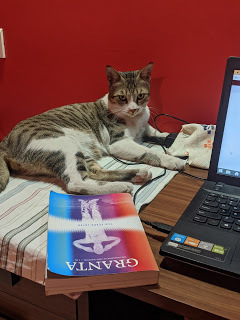
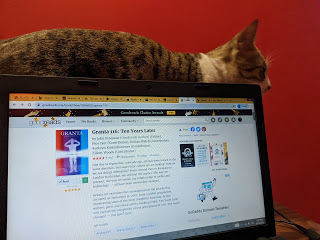
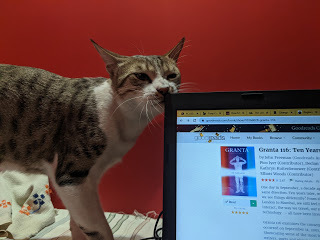
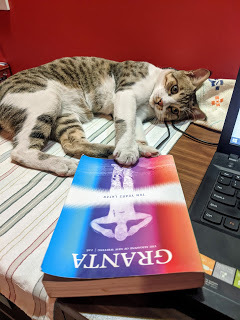
In these essays, I found the presence of animals which included street dogs, army dogs, pet dogs, hungry ants, diligent ants, innocent sharks who were left to die horribly, vulnerable prawns and vicious coyotes fascinating - it made me think, are the lives of the humans featured in these stories any different? I've added photos of my kitty with the book in this review, his way of protesting the absence of felines in all the stories. He's also helped me with deleting shoddy sentences.


BY THE WAY
It was nice to read about the contributors in the back of the book.
And I loved the format of the book, it's size, paper quality and typeface. Sorry, 'we' loved the touch and feel of the book. :-0 The cover design was okay.


FUN FACT
I just read in some of the reviews that 116 on the back page when inverted reads as 911!
Profile Image for Chris.
666 reviews12 followers
September 8, 2011
Granta's latest issue, focused the ten year anniversary of the attacks of September 2001. the issue number, 116, on the back cover when inverted reads 911.
I found Phil Klay's "Redeployment" moving. Pieces like "Jihad Redux" by Declan Walsh and "The American Age, Iraq" by Anthony Shadid provide some history to the debacleswe find ourselves in. (yes, we probably could have handled things differently.)
I enjoyed Adam Johnson's "The Third Mate". While I didn't like the writing so much, Kathryn Kuitenbrouwer's "Laikas I" had moments of engaging imagination.
Ten Years Later did well to include a goodly selection of pieces from writers in the lands for which 9/11 brought a state of war.
Profile Image for Artur Coelho.
2,619 reviews74 followers
September 12, 2011
Hora de recordar o onze de Setembro de 2001. Mas em vez de escolher as visões mediáticas de memoriais, recordações dos momentos chocantes ou a inevitável pergunta "onde estavas tu nesse dia nesse momento", olhemos para outras dimensões da tragédia terrorista e suas repercussões globais, dez anos depois. É esse o mote da mais recente edição da Granta, coligindo ficção que toca nas problemáticas postas a descoberto pelos descarados embates de aeronaves contra símbolos globais da pax americana.

Nestas discussões cai-se invariavelmente numa retórica de nós versus eles, sendo o "eles" a imensa massa humana que vive no norte de àfrica, médio oriente e ásia central. Esta edição da Granta procura dar voz aos "eles", seleccionando ficção e reportagem que focam as vidas de soldados regressados dos campos de batalha afegãos e iraquianos, as experiências de somalis com filhos raptados, supostos jihadistas apanhados em teias de corrupção que alimentam senhores da guerra, o quase incompreensível caos de zonas do planeta cujo isolamento e tenaz independência resistiram ao longo do século XX às incursões dos impérios da época, onde a pax americana é apenas mais uma iteração num historial de balas e sangue.

Se todas as peças contidas nesta edição são recomendáveis pelos diferentes pontos de vista e qualidade literária, destaco uma pelo sublinhar da inversão do mundo globalizado onde os pontos da rede global de transiência estão condenados à retórica alarmista-tecnológica do terror: a experiência de Pico Iyer, escritor britânico de origem indiana residente de longa data no Japão e promotor de uma cultura global alicerçada na viagem enquanto desocberta, que após o onze de Setembro passou a ter de viver com a desconfiança das autoridades e habitantes do seu país adoptivo apenas pela cor da sua pele.

A questão? Até que ponto estamos preparados para abdicar de liberdades, intercompreensão, a que atrocidades recorreremos em nome do medo?
Profile Image for Adrian Buck.
307 reviews67 followers
November 24, 2018
I started reading Granta in the hope it would introduce me to new writers. And it has done, though not very efficiently. Its biggest successes were, following an extract from Atonement persuading me to start reading Ian McEwan again. And the discovery of David Mitchell, though my feelings towards his work after reading Slade House resemble those after reading The Innocent - I'm not convinced I want to read another. I stopped reading Granta some six editions before I managed to cancel my subscription, and this was the last on my to-read shelf. I enjoyed it, as I usually did. Perhaps there was always too much reportage, and the variety was restricted by the tastes of the editor. After Ian Jack moved on, I began to want to. Goodreads is doing so much better at finding me things I want to read.
Profile Image for Cheryl.
330 reviews328 followers
November 7, 2011
The essay by Tahar ben Jelloun, about the Tunisian street vendor and the Egyptian nobody who symbolized everyone, and how they sparked the revolutions in their countries, was especially moving. Pico Iyer's essay is great too - he welcomes the white affluent Westerners to his world where dark-skinned people from not-the-west are routinely viewed with suspicion. Post 9-11 we all get to share in feeling aggrieved as we are treated by police, airport security, etc. as guilty of something. Nadeem Aslam's story Punnu's Jihad shows how little autonomy a young Afghan man has. The warlords control everything and so control the arc of his life.
Some good stories and essays, predictable but powerful nonetheless.
Profile Image for Lawrence.
342 reviews2 followers
September 3, 2011
A decent issue, Granta focuses on reporting generally in the volume. Shadid's look at Iraq through the Jesuit school is the best of these pieces. But I much preferred the fiction included: the story by Phil Klay, the excerpt from Farah's novel, and the odd story by Kuitenbrouwer. My advice: Skip the poetry altogether. Maybe it's just that I don't like poetry, but those included here just seemed bad or completely incomprehensible.
Profile Image for Candace Jensen.
15 reviews6 followers
November 21, 2011
a good, if depressing variety of memoirs and essay-style short stories about the world post 9/11. A few of the pieces were stand-out and eye-opening, especially the piece by Ahmed Errachidi regarding his time spent in Guantanamo. The photo essay was very striking. I don't want to read any more about the world "after 9/11", I want new terms to define the future.
Profile Image for Jason Ernst.
52 reviews3 followers
April 11, 2013
A big fat five stars for this collection of beautifully written, insightful, and thought-provoking essays, poems, and short stories that should be of interest to those interested in human rights, social justice, the ravaging mental, physical, and economic effects of war, as well as anyone who appreciates exceptional literature.
Profile Image for Gilgamesh.
142 reviews11 followers
September 3, 2011
Some great stories here. Phil Kay, Tahar Ben Jelloun, Nadeem Aslam, Nuruddin Farah, Pico Iyer and Declan Walsh have excellent pieces that are well worth reading.
Profile Image for Supriya.
126 reviews68 followers
August 30, 2011
Love Declan Walsh always. The rest of it was just flip flip flip, both for the browns and the whites.
Profile Image for Jim.
142 reviews
June 12, 2014
Some excellent pieces. I particularly liked "A Handful Of Walnuts" by Ahmed Errachidi, and "Veterans Of Foreign Wars" by Elliott Woods.
Displaying 1 - 15 of 15 reviews

Can't find what you're looking for?

Get help and learn more about the design.