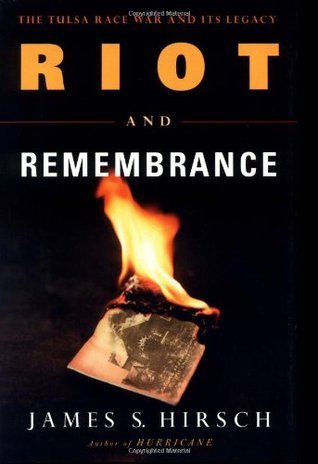
James Hirsch has written perhaps the definitive study of the 1921 race war in Tulsa, the racial and economic context of the conflict, its long-term consequences, and the empty victory that was the 1921 Tulsa Race Riot Reconciliation Act. His work has dramatically altered my own views of the event. Like most Oklahomans (I grew up in northern Okmulgee County, only 22 miles from Greenwood), I knew nothing about these events until the state established the Oklahoma Commission to Study the Tulsa Race Riot of 1921. My own family members, who may very well have been present in Tulsa during the conflagration, were participants in the white “conspiracy of silence.” That silence, along with the destruction of public records concerning the events of 31 May through 2 June, 1921, makes it unlikely that the “truth” will ever be established, certainly not in the sense of producing a legal cause of action.
Like many supporters of civil rights and equal opportunity, I had always assumed that white vigilantes took advantage of a volatile situation to terrorize innocent victims in Greenwood. The story presented by Hirsch, however, is much more nuanced than that. Irrespective of who “started the riot,” armed African Americans gave the whites and National Guard as good as they got in return. There are many documented instances of Greenwood citizens defending their community with careful, methodical, and lethal force. Hirsch makes clear that the Greenwood calamite was not a “race riot,” it was a “race war.” Therein lays the rub.
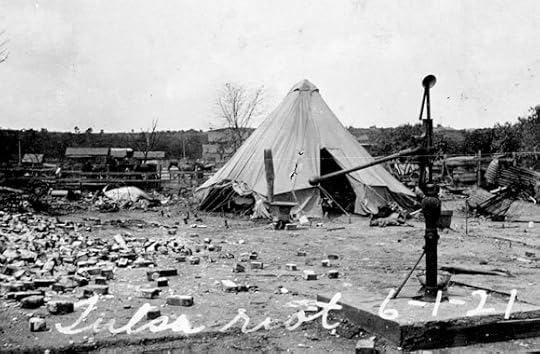
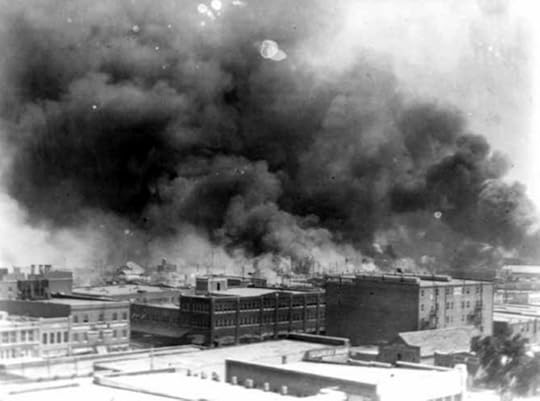
The Greenwood community was prosperous and mostly separated from white Tulsa by the city railroad. People took pride in their community and their civic accomplishments. They were not about to sit back meekly and allow whites to lynch another black man (Dick Rowland) and they certainly would not capitulate to an armed, invading, white mob, probably acting with the assistance of the Oklahoma National Guard. Many armed men sniped at the white invaders, who returned fire with Browning automatic rifles and, perhaps, incendiary bombs dropped from National Guard aircraft (this has never been proved). In the end, Greenwood’s defenders were simply overwhelmed by better armed, superior numbers. After the National Guard cleared Greenwood of snipers, the white mob proceeded to burn the community to the ground, destroying its hospital, middle school, hotels, restaurants, theaters, and private homes, creating somewhere between 7,000 and 9,000 refugees.
Ironically, perhaps, the same brave and heroic Greenwood defenders, a key part of the community’s collective memory and an important source of its pride, undermine the rationale for reparations. Maybe Greenwood men started the “riot” (or “war”) by shooting first, as white Tulsans have long contended and used as a reason to deny reparations. That, however, raises another problem for whites, namely, that their reaction was disproportionate as a lawful attempt to restore order and protect lives and property. Once armed resistance ended, the torching and pillaging began. The white mob and National Guard victimized innocent women and children, not simply “combatants.” There were no similar attacks on white property and businesses by blacks; whites could destroy Greenwood with impunity and without fear of retaliation.
From my perspective, the Greenwood race war reflected and foreshadowed the totality of modern warfare in the 20th century. Like Sherman in Atlanta, the Germans in Louvain, Warsaw, and Rotterdam, the Japanese in Shanghai, the British in Hamburg and Dresden, and the Americans in Tokyo, white Tulsans inflicted injuries on the guilty and innocent alike with the unspoken goal of destroying a community, a culture, and possibly preventing its resurrection forever. Like the annihilators above, white Tulsans blamed the destruction on the victims themselves, created moral and legal rationales for their actions, and denied responsibility for repairing the damage done. And like the annihilators above, or at least the victorious ones, white Tulsans have created a collective memory that defends and rationalizes the great harm done.