Jump to ratings and reviews
Rate this book

Filosofie voor beginners. Het ondraaglijke gewicht van de filosofie lichter gemaakt

Rate this book
Organized historically and augmented by more than 400 cartoons designed to make teaching and learning more fun, this lighthearted work, born of serious scholarship, can be used as a core text or as a supplement in introductory courses.

416 pages, Paperback

First published March 30, 1994

102 people are currently reading
895 people want to read

About the author

Donald D. Palmer

20 books17 followers
Emeritus Professor of Philosophy at the College of Marin in Kentfield, California. He is known for writing introductory books on philosophy and philosophers which attempt to make philosophical ideas accessible to novices. He also illustrates his own books.

Currently he is visiting Assistant Professor of Philosophy at North Carolina State University in Raleigh, North Carolina.

Ratings & Reviews

What do you think?
Rate this book

Friends & Following

Create a free account to discover what your friends think of this book!

Community Reviews

5 stars
222 (37%)
4 stars
215 (36%)
3 stars
121 (20%)
2 stars
22 (3%)
1 star
9 (1%)
Displaying 1 - 30 of 67 reviews
Profile Image for Ilse.
552 reviews4,443 followers
September 11, 2023
Looking at Philosophy – The Unbearable Heaviness of Philosophy Made lighter is an excellent and engrossing pedagogical book, making the great story of Western philosophy come to life, both for beginning students and philosophy dummies like me. My spouse recommended this – and Bertrand Russell’s A History of Western Philosophy - as an additional read for his introductory course to philosophy to his non-Dutch speaking music students and I feel I learnt a lot from it. For me it not only brushes up what I gathered about philosophy aeons ago (while studying philosophy of law, ethics, logic and epistemology, social and political theories) but also brings together some of the loose ends and dispersed information I picked up in various courses, contexts and books, helping me in discerning more clarity in the connectivity, the continuity and discontinuity of certain philosophical thoughts and theories.

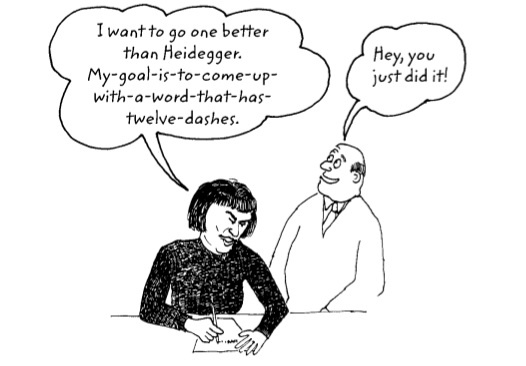
While at first glance one might think this is almost a comic book on philosophy, full of silly drawings, opening with Wittgenstein who would once have said that a whole philosophy book could be written consisting of nothing but jokes - the comprehensible and often slightly funny text is all with all pretty serious. The numerous cartoons and diagrams are often not only amusing but also an astute vehicle to visualize and elucidate the ideas in the text and facilitate greatly in anchoring the endless list of philosophers in your mind. Donald Palmer graciously cycles through the history of Western philosophy from the 6th century BC Pre-Socratic philosophers towards the seventies of the 20th century, closing with the post-structuralist feminist philosopher Luce Irigaray (of whom I had never heard before, she first studied at Leuven). Evidently, every choice in a sense implies a loss and I can imagine that the selection of Palmer could be discussed by people better versed in philosophy, inevitably there will be names and theories you might think crucial to Western philosophy – Auguste Comte, Henri Bergson, Popper- of which you can consider they are missing (or not). As Palmer’s book is solely focussing on Western philosophy omitting the philosophical traditions of India, China, Tibet, Japan, the Islam, you know from the very start you won’t get away with only reading this concise overview anyway.

While reading this book, I was struck by the amount of philosophical thoughts surfacing in some novels or stories I have recently been reading – the clash between the world views of Spinoza and Schopenhauer in Yasmina Reza’s Dans La Luge D'Arthur Schopenhauer (which made me aware how little I know about both philosophers), or the scene in E.B. White’s youth novel Charlotte's Web, where Wilbur the pig retorts the lamb refusing to play with him and telling him that to him pigs mean less than nothing, insightfully echoes Parmenides by pointing out ’What do you mean less than nothing? I don't think there is any such thing as less than nothing. Nothing is absolutely the limit of nothingness. It's the lowest you can go. It's the end of the line. How can something be less than nothing? If there were something that was less than nothing, then nothing would not be nothing, it would be something - even though it's just a very little bit of something. But if nothing is nothing, then nothing has nothing that is less than it is.’ Even this very morning, reading a crime novel by Friedrich Dürrenmatt, Der Verdacht, I bumped into a character asserting X=X, referring so to one of the three basic laws of thoughts, the principle of identity, stating that everything is identical to itself. Philosophy, like history, seems to be omnipresent and for that reason intrigues me.

Maybe overly simplified for some readers, I feel this will be something I’ll return to whenever getting to some more in depth reading, if only because this was the first time I read about Heidegger without getting a headache – no mean feat.

philo

Absorbing this book is, honesty compels me to admit I regret being such a scatterbrain – in the Dutch copy I found a list of exam questions of my spouse and heavens, I am painfully aware I wouldn’t pass at all after a first read. I’ll be re-reading this soon in the third edition, in which Palmer elaborates on ancient Greek philosophy, medieval philosophy, added Maimonides and Averroës and chapters on Frege and Quine. Next to a glossary of philosophical terms and a fair apparatus of footnotes, the third edition also includes a section with ‘topics for consideration’ at the end of each chapter which looks useful to students to evaluate their acquisition of the subject.

Readability implies that Palmer barely quotes from the original works of the philosophers discussed, my personal favourite this formulation of Kant’s categorical imperative: 'Act so that you treat humanity, whether in your own person, or in that of another, always as an end and never as a means only.'
Profile Image for Pedram.
2 reviews2 followers
January 1, 2018
كتاب جالبي بود
مني كه خيلي سخت با فلسفه ارتباط بر قرار مي كنم
از اين كناب لذت بردم
Profile Image for Mimi.
29 reviews1 follower
January 14, 2025
What can I say? I really enjoyed this book. Got it in two languages (I don’t know why, I was so enthused). This is what educational books must be like. Simple language, basic teachings without losing the complex nature of the material: all fit into chronological order. This is perfect for anyone who wants an outline of the basics for an elementary comparative understanding for further reading. I wish all books were written like this, accompanied by pictures to clarify the material with lame jokes. I’m giving this book 5 stars, because I went through many basic books, and this one I find to be the best. You may think “how hard can it be to write a basic book about philosophy?”. It’s probably harder than writing a complex one. His writing is also very unbiased and written with the reader in mind. Chapeau.
48 reviews4 followers
June 4, 2023
برای ورود به فلسفه کتاب خوبیه. شیرین و شیوا و روان.
تمرین هایی داره که به عمیق تر نگاه کردن کمک می کنه.
Profile Image for Don.
430 reviews22 followers
July 8, 2012
This is a perfect introduction to an almost opaque topic. I have tried to read some philosophy over the years and found it daunting. I dipped into a few books before and got all tangled up. I missed taking a class on the subject in school. This subject really needs a teacher to bounce questions off of. But this was so clearly stated and, no doubt, simplified, that I found it fascinating and compelling. And very funny.

In fact it can be hilarious! The cartoons kept me going. I was reading and chuckling by the pool, and a lady in the water wanted to know what the book was. “It must be wonderful to make you burst out laughing like that.” I told her it was a history of philosophy. She made a queer face and swam away. The mere threat of Nietzsche makes everyone anxious I suppose.

It’s hard to choose, but two cartoons that stick with me are Kant going for his imperious, daily constitutional seen from an ant's-eye view; and “The individual before the Yawing Abyss of Eternity” worried about his socks. The cartoon commentary on the text helped to make the concepts stick in my memory as the history continued to build upon itself.

People who have studied the subject will no doubt find this too elementary but it is a perfect beginners textbook.
Profile Image for Kelly.
21 reviews1 follower
April 9, 2011
I had to purchase this book for a humanities class my first semester of college. At the time I thought that I would never read this book unless it was assigned for homework. Then I picked it up one day to help with a paper in another class and I didn't put it down until I finished it. Donald Palmer takes the heavy and sometimes confusing philosophies of all the great philosophers since sixth and fifth centuries B.C.E. up to Post-Structuralism (from Thales to Irigary) and makes it understandable. Palmer puts the philisophies into words that anyone can comprehend. He also includes cartoons and diagrams that better assist in his explinations. A sense of humor comes out in his work that makes reading this book enjoyable as well as educational.
Palmer has inspired me to attempt writing my own version/understanding of theories or philosophies. Even in my papers for my classes I incorporate a sense of humor along with a simpler wording (what I understood) of the subject.
Profile Image for Shane Ver Meer.
234 reviews6 followers
November 10, 2021
As an introduction to philosophy, Palmer delivers a wonderfully succinct text, and the pictures help lighten the mood, especially as the concepts become a bit more esoteric.
Profile Image for Srini.
24 reviews7 followers
October 9, 2018
The pictures in this book made it so easy to understand. Good Book!
Profile Image for kimi ✰.
257 reviews5 followers
Read
November 11, 2023
I DID IT

did I retain much of the information? ✨no✨

but, I finished it!
Profile Image for Marloes Fröling.
61 reviews2 followers
June 27, 2019
Ik hou wel van filosofische boeken, maar ik kwam hier slecht doorheen. Hij somt de een na de andere filosoof op (rent er doorheen), waardoor het bijna een aaneengesloten lijst word zonder verhaal en betekenis. Hij maakt ook heel slechte 'weet je nog die filosoof vijf hoodstukken geleden dacht hier sus en zo over' momenten.Tegen het einde is hij beter met het schrijven, maar dan weet je al niet meer waar de eerste hoofdstukken over gingen en raast nog even snel door de laatste eeuw heen. Voor mij helaas een teleurstellend geschreven boek.
Profile Image for John Martindale.
891 reviews105 followers
February 16, 2013
Donald Palmer's illustrations in this book are often clever, creative and funny.
I like that he included many philosophers that I have not read about in other history of philosophy books.

Now as far as making the unbearable heaviness of philosophy lighter, hmm... Palmer kinda does this, but I don't think its his natural skill, he is out of his element. His writing doesn't necessarily flow and to get what he is saying, sometimes I needed to reread paragraphs. Other folks like Will Durant and Greg Boyd have the gift of making the complex simple and super readable. Palmer indeed tries, but I think fails.
Profile Image for tara bomp.
520 reviews162 followers
January 17, 2013
An excellent (to my uneducated mind) summary of a bunch of important philosophers and their relation to "the tradition" and their own movements. Does a great job of making some of their major ideas relatively understandable. The drawings are pretty goofy but sometimes do actually help to illuminate the text. Enjoyed it a bunch.

2 criticisms:
- It mentions Freud quite a few times but never really describes anything about him
- Doesn't challenge Western orthodoxy - treats the Dark Ages as, well, "dark" when this isn't true and mostly ignores Muslim works, giving them short shrift even when they're essential to what others wrote
Profile Image for تیهو.
95 reviews8 followers
May 12, 2020
به نظرم همچنان هم کتاب خوبی‌ست برای آشنایی سریع و جزئی با تاریخ فلسفه. و خب برای آشنایی دبیرستانی‌ها خیلی می‌تونه مفید باشه چون تصویر داره و خسته نمی‌شه کسی که مخاطب جدی فلسفه نیست.
Profile Image for Oscar Pettersson.
90 reviews5 followers
December 16, 2021
I think it’s at this level of depth that philosophy should be taught to all teenagers. The book gives a fun, somewhat easy, and interesting introduction to the greatest philosophical ideas of the west. It starts with the pre-Socratic era and stretches to Nussbaum in the 2100-century.

I was particularly struck by the philosophy of some. My rendition is obviously extremely light-weight and very much open to criticism.
--

Socrates had an immense curiosity and his humbleness to question assumptions led to great wisdom.

Plato came up with the Similie of the Line. There are four levels of this.
Using 'Beauty' as an example.
At the lowest level is the Imitation of Beautiful Entities (e.g., art, reflections, shadows, etc.).
At the second level are the Individual Beautiful Entities (e.g., the actual object the art depicts).
At the third level is the Concept of Beauty.
At the highest level is Superform, the Form of all Forms, meaning in this case, the 'Form of Beauty'.

Aristotle's moral philosophy of virtue. There are some traits we should cultivate. These are are "in accordance with the golden mean of moderation". For example, if we're faced with danger, we can either act with excess (fear), disregard it completely (foolhardiness), or act with moderation (courage). He gives further examples of these virtues. The golden mean of moderation is also realized through trial and error.

The Stoics realized that there are things in the world we can change and things we cannot. Our power lies in focusing on what we can change and accept what we cannot. This leads to wisdom, excellence and happiness (or equanimity?)

Spinoza equated nature with God. Everything is nature and the expression of God. This is called pantheism.

Kant distinguished between the phenomenal world (the world known by the human mind), and the noumenal world (the world impenetrable by the human mind).
Amongst other things, he also created a moral philosophy of consistency. This is what is called the categorial imperative. In short, we are to act to one another with (1)dignity and (2)universality. For example; I can't steal because that means I (1)don't respect what is yours and I don't want (2)others to steal from me. The counter-argument is sometimes context demands flexibility. E.g., lying to save someone's life.

Kierkegaard had an existential philosophy of not concocting existence with abstractions (thoughts, language, etc.)

I don't know if I necessarily agree with (William) James, but I found his Theory of meaning to be stimulating. Essentially, if two different ideas have the same practical consequences then there is no difference of meaning between them.

Dewey wrote about his theory of knowledge. Through education we enhance our thoughts and become better problem-solvers. Through education, therefore, we learn to delay our instinctual responses and act more intelligent in our environment.
"Thoughts that do not pass into actions that rearrange experience are useless thoughts. (The same if true of philosophies)" (Palmer, 2020, p. 348)

Wittgenstein said "The limits of my language are the limits of my world".
I found this sentence to be profound and wanted to include it here.
--

184 reviews1 follower
June 16, 2020
Toegankelijk aan de ene kant, maar diverse filosofen blijven toch moeilijk weer te geven. Wereld van Sofie moet dit aanvullen en verduidelijken.
Door de plaatjes blijven bepaalde gedachtes echter goed bij.
Profile Image for Paul Richardson.
1 review2 followers
May 29, 2015
This was the first book devoted exclusively to secular philosophy that I absolutely devoured cover to cover, with copious notes and references in all margins to my own writings. During my late teens, I had begun writing poetry and philosophy, much of which touched upon the same concepts and ideas discussed in this book. But because it is non-academic, and written like a non-fiction comic strip (with humorous drawings too!), it was like getting a gigantic high-five or affirmation by people who respected the same things I do (often ridiculed as useless by other engineers my own age).

If you have a precocious teenager in your life, or a young-adult who has little exposure to formal philosophy (but lots of questions/ideas) this is an excellent introduction to deeper reading in ethics, aesthetics, epistemology, and many other areas of philosophy. There is absolutely ZERO dry long constructions of theories or arguments, and no primary text (in fact, there are even minimal quotations). So all the content is written in simple modern colloquial english.

Palmer himself is apparently a very moderate and unopinionated politician in his use of slant and truly seems to have no mission other than accurate summary. At the time I read the book, the undercurrents never once appeared to my own sense to move from representation of others opinions, toward including Palmer's own. Better still (or worse for hate-mongers?) is that he assassinates no characters in his biographical coverage, while maintaining enough emotion to slip in light humor without diverting valuable space. There seems to be a genuine desire for fair and objective reporting of facts, minus hyperbole or misrepresentation of each biographed person's ideas, whether or not agreeable. This book in many ways, was a canary in the cave for Wikipedia ;-)
Profile Image for Maximilian.
42 reviews
January 10, 2021
A useful overview of some of the major Western philosophical movements. It’s not a complete look, but it is a great place to get a sense of where to go next and who you’ll need to look up and read more of.
Profile Image for Kessia Reyne.
110 reviews21 followers
August 5, 2009
I found the book very helpful in giving the broad strokes for any given philosopher's work. If you're looking for detail, this isn't the place, but in just a few hundred pages you go from before Parmenides to Sartre and beyond. Not bad.
Profile Image for Harsimran Khural.
64 reviews46 followers
May 18, 2017
A very approachable introduction to Western philosophy, and certainly the best among the few introductory texts I have read (The Story of Philosophy, Think, Tetralogue). The illustrations help lighten the text.
Profile Image for Javad Azadi.
193 reviews85 followers
October 8, 2021
تصور نمی‌کردم انقدر مفید و جذاب باشه. خلاصه تاریخ فلسفه و عصاره تفکرا فیلسوف‌هارو به خوبی و به زبانی ساده بیان کرده بود. استفاده از کاریکاتور و نمودار و... برای در آوردن متن از خشکی هم، به خوبی انجام شده بود. برای شروع خوانش تاریخ فلسفه یپشنهادش میدم حتما.
Profile Image for Luther Wilson.
62 reviews
June 9, 2010
Another fantastic overview book by Palmer. Can't recommend his books enough.
5 reviews
February 21, 2024
Overall a wonderful pickup for those looking for a holistic view of the genre. I learned a lot about some philosophers that I had not bothered to attempt to read due to their difficulty. I even had a couple chuckles at the in-page comics dispersed throughout!

However, I found Palmer has trouble seamlessly flowing from one section to the next, resulting in a choppiness that, as a reader, I was surprised by. I felt forced to stop and re-read entire sections again to gather what the point was, despite that the book was supposed to make philosophy "lighter" and, presumably, easier to digest.

A secondary gripe is how Palmer chooses to justify very early on why there are few female philosophers of note and why it's such a male-dominated book. For a book completely unrelated to gender, I did not feel this warranted dedicating a whole preface to explain. It felt forced upon the reader, like Palmer opted for a "cover your ass" insurance policy in his own book, only to then meagerly shove in at the last second a few pages on one female philosopher before abruptly ending the book.

Overall, I enjoyed it and would still recommend it as an easier way to tackle the history of philosophy and what its greatest thinkers discovered.
Profile Image for Kelly Gonzalez.
13 reviews1 follower
January 11, 2018
I had to purchase this book for a humanities class my first semester of college. At the time I thought that I would never read this book unless it was assigned for homework. Then I picked it up one day to help with a paper in another class and I didn't put it down until I finished it. Donald Palmer takes the heavy and sometimes confusing philosophies of all the great philosophers since sixth and fifth centuries B.C.E. up to Post-Structuralism (from Thales to Irigary) and makes it understandable. Palmer puts the philisophies into words that anyone can comprehend. He also includes cartoons and diagrams that better assist in his explinations. A sense of humor comes out in his work that makes reading this book enjoyable as well as educational.
Palmer has inspired me to attempt writing my own version/understanding of theories or philosophies. Even in my papers for my classes I incorporate a sense of humor along with a simpler wording (what I understood) of the subject.
Profile Image for Aniruddha Saha.
13 reviews48 followers
May 24, 2020
This was my first foray into the quite esoteric subject of philosophy. I found out about this book last summer and the proposition seemed interesting - "philosophy made lighter".

It was a difficult read anyhow but on the bright side it was a valuable history lesson on the origins of philosophy, theology, the tenets of major western religions, and related theories. Its treatment starts from the pre-Socratic era and continues into the 20th century. The glossary at the end of the book is quite valuable to refresh your memory on the difficult philosophical jargon mentioned in the book. I found some of the illustrations to be apt and put in the context which gives you a visual medium of understanding the text.
Profile Image for James Badger.
219 reviews6 followers
September 29, 2017
As philosophy textbooks go, this is probably the most enjoyable text available. I didn't read it as a textbook, however. I read it for fun, and I found that it was surprisingly fun.

Palmer does an excellent job of providing an approachable view of the great philosophers and philosophical movements since the days of Socrates. What makes this book a joy to read, however, are the many illustrations. Some of theme are hilarious little philosophical jokes, and others are very effective visual explanations of difficult concepts.

If you read only one philosophy textbook in your lifetime, this should probably be the one.
Profile Image for Wouter.
Author 2 books30 followers
April 17, 2018
Well put-together and filled to the brim with clever self-illustrated drawings that make me smile, even if some chapters still feel (very) heavy. I have to say that I miss Michel de Montaigne, one of my beloved (significant, according to Wikipedia) medieval philosophers. Donald claims he only touches upon the most influential works from presocratics to the end of the 20th century but I have the feeling the selection process went different. In any case, I was happy to learn basics of Kant, Hegel, Schopenhauer etc as I'm unschooled in philosophy. I now might be able to recognize metaphysical ideas when I come across them in later books.
Profile Image for David.
573 reviews9 followers
July 10, 2023
It is quite an interesting book for philosophy beginners BUT in some angle not an easy read…
It covers the old and classic details of pre-1900 philosophers but it lacks the coverage on post 1900 philosophers. One needs to have some historic and philosophical knowledge in order to grasp this book

目錄
●開場白
●導論
第一章 前蘇格拉底哲學家:公元前6-5世紀
第二章 雅典時期:公元前5-4世紀
第三章 希臘與羅馬時期:公元前4世紀-公元4世紀
第四章 中世紀與文藝復興哲學:公元5世紀-15世紀
第五章 歐陸理性主義與英國經驗主義:公元17-18世紀
第六章 康德之後的英國與歐陸哲學:公元19世紀
第七章 現象學傳統及其餘緒:公元19-20世紀暨21世紀初期
第八章 實用主義與分析傳統:19世紀晚期-21世紀初期 
●詞彙表
●譯後記
Profile Image for Maxime.
44 reviews
January 27, 2022
Begint goed volgbaar en interessant. Tegen het einde kijken de stukjes tekst per nieuwe filosoof of stroming steeds korter te worden en sneller achter elkaar te komen. Het werd wat moeilijker om te volgen. Er zijn heel weinig details. Wel grappige metaforen om begrippen uit te leggen en hele leuke illustraties.
Profile Image for Abhishek Kumar.
4 reviews
March 29, 2020
Teaches western Philosophy by comics and cartoons... The complex task is made simpler.
But does not get in to details of a philosophy. Can be taken as a starter or dessert but definitely not as main course.
Profile Image for Rick.
992 reviews28 followers
August 10, 2021
This deceptively intelligent book is an excellent summary of major philosophical movements. Deceptive? Yes. The cartoons make it seem to be a humorous volume, but it's not. It's erudite in its explanations.
Displaying 1 - 30 of 67 reviews

Can't find what you're looking for?

Get help and learn more about the design.