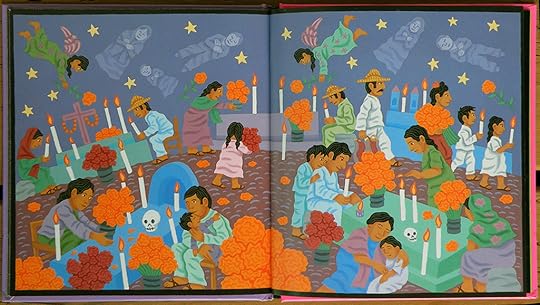
Above a small town in Mexico, the sun rises like a great marigold, and one family begins preparations for an annual celebration, El día de los muertos, the Day of the Dead. Soon they will go out into the night, join their neighbors, and walk to the graveyard to welcome the spirits of their loved ones home again. Framed by decorative borders and peppered with Spanish words, Day of the Dead is a glorious introduction to a fascinating celebration. A note at the end of the book provides factual information about the holiday.
Librarian Note: There is more than one author by this name in the Goodreads database.
Tony Johnston has written many acclaimed books for young people. She and her husband lived in Mexico for fifteen years, where they raised their children. She now lives in San Marino, California.
Summary: This story examines the Mexican holiday of the Day of the Dead. A family is preparing for this holiday and go to the cemetery to visit their loved ones. The Day of the Dead is used to commemorate the spirits of the departed while celebrating life and family.
Lesson Integration: This book can be used to celebrate cultural diversity within a classroom. Children can discuss about other major holidays from other countries, and bring traditional food eaten during that holiday.
Why does this book have to be so TINY? The art is wonderful, and the story has a great balance between narrative and interesting facts. But the whole thing is as big as my hand, so I don't know how successful of a read-aloud this would be unless I project it on the document camera...
I love that this book is bilingual and uses more challenging words like procession. It allows us to open dialogue about language and build literacy. I also appreciate how some pages have no text, so we may closely examine the illustrations which is another language and literacy. Like another reviewer, I wish the book was larger. It would be difficult to use for a read aloud with a group, but I may still try. It'd be great for a virtual story time using a document camera.
After learning about this holiday in her Spanish class, my daughter requested to learn more, so we checked out every picture book we could find. This is one of the best. It gives background information about the holiday with rich illustrations and a compelling narrative. I cannot speak to its cultural accuracy and the size of the book is really small, but we still enjoyed it.
I really enjoy reading this book to my class during our unit study on holidays and traditions. This story examines the Mexican holiday of the Day of the Dead which is used to commemorate the spirits of the departed while celebrating life and family. Most books about the Day of the Dead include pictures of scary skeletons, but this book is written as a sweet story that follows a family through the days of preparing foods, which are carried in a candlelight procession to the cemetery. The families celebrate at the graves of their loved ones by eating, singing and dancing all through the night. Spanish words and phrases can be found throughout the book. The children in the story are so excited about the celebration, that they are told repeatedly "esperense" (wait), when they want to try the various foods such as empanadas, tamales or mole. These words can easily be interpreted by context for the non spanish speaker.
This book Day of the Dead is about two young children who parents are cooking nonstop. They make all different types of Mexican food. The children are sitting there watching them make the food they don’t quite understand why their parents are making the food and they especially don’t understand why they can’t eat the food. As the story continues they start to pack up the food and carry it to a cemetery where they celebrate by eating all the food they have made by their loved one's grave.
The book, Day of the Dead has such fascinating art and wonderful facts about the holiday, Day of the Dead. This book does a great job explaining this holiday to young children as well as making it fun and easy for them to read. Although this book is written in English it has phrases written in Spanish as well. This book has a great background of showing different cultures and how they can be easily taught in a classroom.
This book is something that can be very useful in the classroom because it switches between Spanish and English in the dialogue of the book. This will help ELL students to make connection between phrases and words in English and Spanish to grow stronger in their English language. The book also talks about a tradition that we don't celebrate here, day of the dead. The book provides background about this hispanic celebration and what it means. This can be useful for English students to learn and understand that they are many traditions and holidays out there, just some that we may not celebrate. I really liked how many Spanish words this book had incorporated in it because it will really help our ELL students in the class.
This narrative is about a Mexican family's celebration of Day of the Dead. The children must wait all day to enjoy the different things collected for the celebration. They told to wait each time they ask to try the different foods being prepared by family members. The text includes Spanish vocabulary which is good to promote cultural diversity in the classroom. Patience is also promoted throughout the text as the children are told to wait countless times. It could also teach how to deal with loss and to celebrate the lives of those who have passed away. The illustrations are an awesome depiction of the story.
My daughter (almost 3) picked this out at the library thinking it was a Halloween book because of the skeletons. It ended up being a great introduction to Dia de los Muertos. I like having the opportunity to introduce my kids to celebrations/festivals/rituals from different cultures. Both kids enjoyed this. I think the book does a very good job of explaining the highlights of the holiday, and I love the folk art feel of the whole thing. I just wish it were bigger, because the illustrations are so great.
I thought this book was very good. I like how it explained the history of the holiday and all of the traditions still done to this day. My only complaint is how small this book is. It is only about 7” x 7” so because of this it would be difficult to read to an entire class so that all students could see the illustrations. I wish that it was larger because I thought the illustrations were great, but some were somewhat difficult to see. Overall, a good book but not one I would recommend to reading to a whole class.
Students can learn about the Day of the Dead through comprehension of the text. Teachers can show students a new way to think about death, as a celebration for the life that person lived. Students will sequence the materials brought to the celebration on a tombstone. This activity would be appropriate for kindergarten students, but the book could be used throughout elementary grade levels. The illustrations are beautiful, just wish the book was bigger!
I have not read many picture books on Day of the Dead but this was a wonderful one! It explains exactly what you do when celebrating Day of the Dead but in a fun way and from a child's point of view. It is a great book to have in the classroom to have some culturally diverse material that may interest students because they have never been exposed to it before. A good book to read in October before Day of the Dead happens to encourage students to explore it and learn more about it.
With brightly colored illustrations, this book tells of the traditions of the Day of the Dead. Some Spanish words are sprinkled throughout which are easily understood through context. Besides the children being told to “wait” repeatedly, there is not much of a narrative concerning the characters. I learned much about the traditions but the text was more of a list of food and event preparations rather than a story.
This story follows the days leading up to the Day of the Dead. The families prepare food for the celebration. The children cannot hold their anticipation, and don’t like to be told to wait. The children finally get to eat all of the food that was prepared. This book teaches some Spanish vocabulary and the rituals of the Day of the Dead.
I chose this book because I had learned about the Day of the Dead before and I wanted a refresher and something that I could use to teach young readers with. I liked it because it told about what all they do to prepare for the holiday and what they do on the holiday. I also like it because it gives a chance for some students who celebrate this to share their experiences in class.
this book was very fun. Not just for the vibrant colors but for the event that takes place. I want to experience this one day in my life, although through this book i feel that i got to live it already. Very cool to learn about the day of the dead and the festivities. I think this is a good book for all children to hear especially when talking about holidays in different cultures.
A family in Mexico celebrates the Day of the Dead with all the traditional trimmings, told through brightly colored illustrations. The book is only 6" x 6.5", and its small format makes it difficult to use as a read aloud.
A great and insightful look into a holiday in which many American children may not be aware of or accustomed to. The illustrations are wonderful and clear, despite being small. This would be an awesome book to share around the holidays for all students.
Wonderful book about the Day of the Dead. Great illustrations, great text with Spanish words and phrases throughout, repeated in English without sounding like a textbook ("'Ni una miga?' they ask. 'No,' mama says. 'Not one crumb.'").
The bright colors were what lead me to this multicultural book. I would recommend it for the 3rd-5th grade classroom. It was informational and presented the material in a way that would keep children interested.
Super colorful and quietly informative, giving my kids another angle on a holiday they are both curious about. My only hold up to giving 5 stars is that I would have loved some educational end pages, even one that would have helped me with pronouncing the Spanish correctly.
The day or the dead is an overview of the tradition of Dia de los muertos. It has Spanish words with their translations shortly after and eventually has those words without them assuming you know what they are by that time. It shows the anticipation of the children about the holiday.