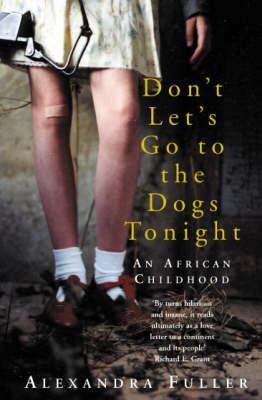
Don't Let's Go to the Dogs Tonight: An African Childhood
Alexandra Fuller was the daughter of white settlers in 1970s war-torn Rhodesia. Don't Let's Go to the Dogs Tonight is a memoir of that time, when a schoolgirl was as likely to carry a shotgun as a satchel. Fuller tells a story of civil war; of a quixotic battle against nature and loss; and of her family's unbreakable bond with a continent which came to define, shape, scar...more
Paperback, 310 pages
Published
2003
by Pan MacMillan
(first published 2001)
Friend Reviews
To see what your friends thought of this book,
please sign up.
This book is not yet featured on Listopia.
Add this book to your favorite list »
Community Reviews
(showing
1-30
of
3,000)
Mar 01, 2010
Jeanette
rated it
4 of 5 stars
·
review of another edition
Recommended to Jeanette by:
Elisabeth
Whenever I read an autobiography, I compare my childhood experiences with those of the author. What was happening in my life at that age? How would I have behaved under those circumstances?
With this book, the comparisons were difficult to make. I can't imagine growing up amid so much tumult and violence and uncertainty. Not to mention numerous inconveniences and an abundance of creepy and dangerous vermin.
I'm glad I didn't grow up in a place where terrorists were so common that they were refer...more
With this book, the comparisons were difficult to make. I can't imagine growing up amid so much tumult and violence and uncertainty. Not to mention numerous inconveniences and an abundance of creepy and dangerous vermin.
I'm glad I didn't grow up in a place where terrorists were so common that they were refer...more
This is one of my top-ten favorite books of all time. An extremely compelling memoir, well-written, poignant but not maudlin or precious. I've read it twice and feel another reread coming on.
The brutal honesty in this story is startling, and Fuller does not set out to insert political or social critique into her story. This is probably unsettling for readers who come face-to-face with her family's colonialist attitudes and expect to hear her criticize and critique them. However, I prefer that Fu...more
Dec 18, 2007
Allie
rated it
3 of 5 stars
·
review of another edition
Recommends it for:
Childhood memoir fans
I almost gave this book four stars because it was very well-written and evocative. But I just never felt much of a connection to the book or to any of the characters. The author's writing skill made it a pleasant enough read - at least, pleasant enough to finish. But it definitely wasn't a can't-put-it-down kind of book.
If I had to give concrete criticisms of the book, the main one would be that she doesn't develop any characters outside of her immediately family (in fact, it seemed her family...more
Jul 09, 2007
Anna
rated it
4 of 5 stars
·
review of another edition
Recommends it for:
all interested in childhood recounts and recent history
Shelves:
a-good-read,
autobios-bios-memoirs
An autobiography about growing up in colonial Rhodesia (present-day Zimbabwe). Two things made me curious about this book: it's from the perspective of the child of colonialists, and the events are fairly recent as it takes place in the 1970's-1990's.
The voice is that of a relatively innocent young girl (as innocent as you can be in midst of war and dire economic circumstances) and she's allowed to tell her childhood as she saw it, good and bad.
I've had fairly mixed feelings about this book: I w...more
The voice is that of a relatively innocent young girl (as innocent as you can be in midst of war and dire economic circumstances) and she's allowed to tell her childhood as she saw it, good and bad.
I've had fairly mixed feelings about this book: I w...more
The first few lines are gripping, to say the least.
Mom says, "Don't come creeping into our room at night."
They sleep with loaded guns beside them on the bedside rugs.
She says, "Don't startle us when we're sleeping."
"Why not?"
"We might shoot you."
"Oh."
Just a taste of what life was like for young Alexandra "Bobo" Fuller.
Living in a house with no electricity, Fuller recounted how she and her sister employed the "buddy system" to use the bathroom at night. One girl used the toilet while the other he...more
Mom says, "Don't come creeping into our room at night."
They sleep with loaded guns beside them on the bedside rugs.
She says, "Don't startle us when we're sleeping."
"Why not?"
"We might shoot you."
"Oh."
Just a taste of what life was like for young Alexandra "Bobo" Fuller.
Living in a house with no electricity, Fuller recounted how she and her sister employed the "buddy system" to use the bathroom at night. One girl used the toilet while the other he...more
There are many reviews that summarize this book, so I won’t repeat them. I found this book slightly anti-African. It left me feeling like; couldn't the British have left Africa alone and let them have their own country? It does not seem right for there to be a British Africa. Seems unnatural. I suppose American Indians may have felt the same way about the early colonists, as well. This was no Out of Africa. Now that was a great book and memoir. Different time period and location, of course.
No o...more
No o...more
This review has been hidden because it contains spoilers. To view it,
click here.
Apr 07, 2008
Amanda B.
rated it
3 of 5 stars
·
review of another edition
Recommends it for:
people who like to read books about African society
Shelves:
advisorybooks-2007-08
My initial thoughts about this book were that it would be a story of a young girl growing up with so much racism that she struggled to find herself and what to believe in. In some ways I was satisfied with my thoughts in comparison to the book but also dissatisfied. It was a memoir told my Alexandra Fuller herself looking back on her life in Africa during the war between Rhodesia and Zimbabwe. The stories she tells about her family revealed a lot about who she was and what kind of family she had...more
I read this book (well, most of it, I admit, I didn't finish and didn't want to) while in training as a Peace Corps Volunteer in Namibia, Africa. I found the writing to be disjointed and the colonial attitudes to be far to accurate. I might have liked it better before going to Africa, before seeing first-hand what various colonizing governments did to people, but maybe not. I might have liked it better if she told her memories in order, rather than jumping around so I had some clue as to where a...more
The tale of a girl growing up in a family gradually sliding down the economic rungs in a variety of Southeastern African countries. They endure war and drought and snakes and scorpions and bad water and venomous plants and flies and rats and mosquitos and fleas. And they hve lots of dogs. Virtually no characters outside of the family are developed, although there are lots brightly painted minor players who flit through their nomadic lives. The parents will never leave Africa, and while the girls...more
A well-written memoir that was fascinating if only because the author is exactly my age, born the year I was born, and lived a life so very different from my own. As she described each stage of her upbringing, I found myself thinking about what I had been doing at that same age and marveling that the two of us could possibly have occupied the same world at the same time. I envy her when I should probably not -- her life has clearly not been easy, but it has been rich with experiences. The other...more
For some time I've heard many good things about DON'T LET'S GO TO THE DOGS TONIGHT, Alexandra Fuller's memoir of growing up in Rhodesia (Zimbabwe) circa 1970's in the midst of civil war and political instability. I was enthralled by Fuller's ability to make the wild African landscape come alive with its varied smells, touches and sights. There were many passages in which I felt transported to the Rhodesian rugged and often-inhabitable landscape. But I became increasingly saddened how Fuller's na...more
I've already read Fuller's second book about her family's life in Africa, Cocktail Hour Under the Tree of Forgetfulness, so this wasn't as surprising a read as it might have been. Many of the events are the same, but this is Alexandra's view of her life in Africa, up to her marriage, so we see them from a different perspective. There's less insight into her mother's state of mind, but it's still very clear how difficult her parents' life was, and how much courage and determination they had, livi...more
Don’t Let’s Go to the Dogs Tonight is an autobiography about growing up in Rhodesia/Zimbabwe. It’s about growing up in a war — Fuller was only eleven at the time of independence — and about the last throes of white colonialism and a dying way of life.
Her parents had been living in Kenya, but after Mau Mau they moved to Rhodesia, where Ian Douglas Smith had declared that there would never be majority rule, and fought to keep at least one part of Africa under white rule. Then after Rhodesia became...more
There is a great deal about the war for independence fought in what was Rhodesia and is now Zimbabwe, the read seems more about what is a normal childhood and what isn't. Living with extreme heat, "terrorists," war and racial exclusion is normal for Fuller. I like that she doesn't dwell on the difference her "normal" childhood is from anyone else's "normal" childhood. [return][return]There are instances when her colonialist heritage sneaks into the narrative, like when she mentions the condition...more
A wonderfully written, inspiring tale of an unconventional childhood and life in Africa. I was particularly struck by the author's notes at the end of the book where she writes that she started out with 8 or 9 failed attempts to write a fictional novel based on her family and youth. I'm very glad she chose to tell her life story as it happened. It is heartbreaking and unforgettable. If nothing else, I have taken away from Alexandra Fuller's book a sense that one can do anything in this world as...more
This is a memoir about growing up in an English family in Africa during tumultuous times.
It's actually about real estate, and the moral is: Don't buy a farm in a region where war is likely to break out.
The family lives during much of the author's growing-years in Rhodesia, which becomes Zimbabwe after the war. They are living there on April 18, 1980, when Robert Mugabe becomes Zimbabwe's prime minister. It's interesting because Mugabe finally has finished runner-up in an election this year, alt...more
It's actually about real estate, and the moral is: Don't buy a farm in a region where war is likely to break out.
The family lives during much of the author's growing-years in Rhodesia, which becomes Zimbabwe after the war. They are living there on April 18, 1980, when Robert Mugabe becomes Zimbabwe's prime minister. It's interesting because Mugabe finally has finished runner-up in an election this year, alt...more
As i was reading this book, i got bored very easily. The authors writing style was definitely interesting, but it just wasnt one of those 'can't put it down' kind of books. i've had it for almost two weeks, any other time, i'd be done with it. but i'm only on page 103. i've realized that its not something to sit down and read all in one day. i have take it bit by bit to stay entertained, but that could just be me. the story line isn't really one that i can relate to very well, but the detail and...more
This review has been hidden because it contains spoilers. To view it,
click here.
This book is even more wonderful second time around. I especially loved the evocation of place. The reader feels as though he/she is there in the heat, with the bugs, and the smells - both good and bad. Fuller beautifully captures how 'African' her family feels despite the violence and hatred directed towards them. One's first impulse is to say these are people I shouldn't like. And then miraculously. one does. Above all this is a book about love - of family and place.
Mar 15, 2008
Brendan Detzner
rated it
4 of 5 stars
·
review of another edition
Recommends it for:
anyone
I read an article by a book reviewer a little while ago in which they talked about how sick they were of "growing up in fill-in-the-blank" books and wished people would be more original. I think that's incredibly misguided. Growing up isn't a cliche, it's just something that happens a lot that's important. So people are going to write about it, and good for them.
They don't usually write about it this well though. This is one of those books that tops out on many different levels at the same time-...more
Wonderful, unique read. An exotic setting, fun, dysfunctional family and lots of great story telling with a birds eye view of one angle of Rhodesian history. The narrative is a bit disjunct at times but always poetic and entertaining. I did hunger for more depth and detail often and had to do some outside time lining research to fill in some blanks but overall, the peek I got into a very unique childhood has me recommending this book.
Fuller was raised during the Rhodesian civil war, a time when white children over the age of five "learned how to load an FN rifle magazine, strip and clean all the guns in the house, and ultimately, shoot-to-kill." Fuller regales her readers with tales of how, as a small child, she would respond to African servants' attempts to discipline her with warnings that she could have them fired. Fuller artfully describes her parents' racism, the war and relationships between blacks and whites in the so...more
Wow, this is one of the best memoirs I've read in a while! Funny, dark, and searingly honest.
Alexandra Fuller (known as "Bobo") grew up in Rhodesia, Malawi, and Zambia, the child of gregarious, charming, heavy-drinking, and deeply racist parents of British descent. What I loved about this book was how richly Ms. Fuller paints the picture of her family and the segregated life of her childhood. There is little political commentary here, and no indictment of colonialism - yet, there is no softenin...more
Mum says, 'Don't come creeping into our room at night.'
They sleep with loaded guns beside them on the bedside rugs. She says, 'Don't startle us when we're sleeping.'
'Why not?'
'We might shoot you.'
'Oh.'
'By mistake.'
'Okay.'
I'm not usually fond of memoirs, but when I picked up the book and read those first few lines, I couldn't put it down anymore.
Fuller wrote how she grew up in a white farmer family in what is now Zimbabwe, Malawi and Zambia with such love and honesty, I can't help being nostalgic...more
They sleep with loaded guns beside them on the bedside rugs. She says, 'Don't startle us when we're sleeping.'
'Why not?'
'We might shoot you.'
'Oh.'
'By mistake.'
'Okay.'
I'm not usually fond of memoirs, but when I picked up the book and read those first few lines, I couldn't put it down anymore.
Fuller wrote how she grew up in a white farmer family in what is now Zimbabwe, Malawi and Zambia with such love and honesty, I can't help being nostalgic...more
An enjoyable read that really captured the pointed and somewhat distorted (hyperbolized?) memories of growing up: big-picture issues are simplified, while tiny details are magnified...which raises a lot of questions about what really is important?
Probably the most refreshing thing about this memoir is its avoidance of a sense of grandiosity...while we can pull (tug, perhaps unwillingly) deep, sweeping meaning out of it, what we really get are the recollections of a child growing up amongst compl...more
Fuller’s book, Don’t Let’s Go to the Dogs Tonight, describes with brutal honesty Fuller’s childhood in Zimbabwe and Malawe. In Fuller’s story, she describes her life with her family through the eyes of a growing child. The story is a remarkable one largely due to Fuller’s ability to capture and translate the relationships between herself and the rest of her family, while at the same time to create individual portraits of each family member, Tim, Tub, Van, and herself (Bobo).
Each character com...more
Alexandra Fuller: Don’t Let’s Go to the Dogs Tonight, Random House, Copyright 2001, 301 pages.
Don’t Let’s Go to the Dogs Tonight illustrates the life of a child living in colonial Rhodesia, during the country's 13-year civil war. Fuller gives the reader insight on how her life, and family were affected during and after the war. She teaches the reader brief historical facts about the time without creating a history book. The book also holds strong themes of coming of age as Bobo becomes more mat...more
I read "Cocktail hour under the tree of Forgetfulness" first, and found this book too repetitive - although it was written first. I loved Cocktail hour more.
However, I enjoyed Alexandra Fuller's candor, honesty, wit and great writing style as usual.
I somehow had enough now for a while of all the hardship, tragedy, hurt, and everything else related to the wars in Africa and everywhere else. I have experienced much the same as Alexandra Fuller, being part of the revolutionary times, the same wars...more
However, I enjoyed Alexandra Fuller's candor, honesty, wit and great writing style as usual.
I somehow had enough now for a while of all the hardship, tragedy, hurt, and everything else related to the wars in Africa and everywhere else. I have experienced much the same as Alexandra Fuller, being part of the revolutionary times, the same wars...more
This book, about a last generation of the white African ruling class, had some beautiful scenes and a good mixture of tragedy and comedy. I was struck by the strength of the family and its ability to endure, despite repeated heartbreak.
On the demerit side, I found all but the mother's character to be one-dimensional, especially when author Alexandra Fuller wrote of the blacks she encountered.
Still, I enjoyed the writing a lot and there were some very sad and lyrical passages:
"The story changes d...more
On the demerit side, I found all but the mother's character to be one-dimensional, especially when author Alexandra Fuller wrote of the blacks she encountered.
Still, I enjoyed the writing a lot and there were some very sad and lyrical passages:
"The story changes d...more
| topics | posts | views | last activity | |
|---|---|---|---|---|
| Dot2Dot Cafe Book...: November/December meeting | 1 | 8 | Nov 25, 2011 04:27am |
Alexandra Fuller has written four books of non-fiction.
Her debut book, Don’t Let’s Go to the Dogs Tonight: An African Childhood (Random House, 2001), was a New York Times Notable Book for 2002, the 2002 Booksense best non-fiction book, a finalist for the Guardian’s First Book Award and the winner of the 2002 Winifred Holtby Memorial Prize.
Her 2004 Scribbling the Cat: Travels with an African Soldie...more
More about Alexandra Fuller...
Her debut book, Don’t Let’s Go to the Dogs Tonight: An African Childhood (Random House, 2001), was a New York Times Notable Book for 2002, the 2002 Booksense best non-fiction book, a finalist for the Guardian’s First Book Award and the winner of the 2002 Winifred Holtby Memorial Prize.
Her 2004 Scribbling the Cat: Travels with an African Soldie...more
Share This Book
1 trivia question
More quizzes & trivia...
“How you see a country depends on whether you are driving through it, or live in it. How you see a country depends on whether or not you can leave it, if you have to.”
—
10 people liked it
“Once, I discovered the skulls of two impala rams, their horns locked into an irreversible figure-of-eight; the two animals had been trapped in combat, latched to each other during the battle of the rut. The harder they had pulled to escape from each other, the more intractably stuck they were, until they had fallen exhausted, to their knees, in an embrace of hatred that had killed them both. When I picked up the skulls to add to my growing collection of what Vanessa called "Bobo's smelly pile," the hooked horns fell away from each other and the story of the impalas' death struggle was undone.”
—
4 people liked it
More quotes…

Loading...


Feb 19, 2010 10:28am
Feb 19, 2010 11:17am