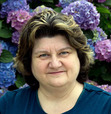
Interview with Author – Don Sakers
 Author Bio:
Don Sakers was launched the same month as Sputnik One, so it was perhaps inevitable that he should become a science fiction writer. A Navy brat by birth, he spent his childhood in such far-off lands as Japan, Scotland, Hawaii, and California. In California, rather like a latter-day Mowgli, he was raised by dogs.
As a writer and editor, he has explored the thoughts of sapient trees (The Leaves of October), brought ghosts to life (Carmen Miranda’s Ghost is Haunting Space Station Three, Baen 1989), and beaten the “Cold Equations” scenario (“The Cold Solution,” Analog 7/91, voted best short story of the year.)
Sakers is a member of the CoastLine SF Writers Group. He has taught sf-writing through Howard Community College.
In 2009, Don took up the position of book reviewer for Analog Science Fiction & Fact, where he writes the “Reference Library” column in every issue.
In his day job, Don works for the Anne Arundel County Public Library. His actual job title — “Library Associate” — makes it sound like he gives lots of money to the Library, but in fact it’s the other way around.
Don lives at Meerkat Meade with his spouse, costumer Thomas Atkinson.
What inspires you to write?
I’ve been writing since I was in grade school. There are wondrous worlds and characters inside my head, and I want to share them with others.
Tell us about your writing process.
It’s hard to make time to write in a busy schedule that includes a full-time job (as a Librarian), a spouse, a home to maintain, and a reasonably-active social life. I try to make some time every day to get something down, preferably at least a page of whatever project I’m working on. Weekends are good writing time. It’s very important to schedule time to write just as you schedule time to go to work or go shopping.
Once I have the basics of a book or story worked out, I make a simple scene-by-scene outline. By “simple,” I mean a few sentences: “Maarten takes Rikk to his home and introduces him to his family. Rikk is off-balance by Maarten’s family, particularly the multi-generational nature. Maarten introduces him to Jaelina, his daughter, and suggests that she will take over Maarten’s work if the plan fails and Maarten dies.”
This outline lets me know what 2-3 important things I need to accomplish with this scene. When it comes time to write the scene, I flesh out all the details of place, character, and plot.
I mostly write on my MacBook Pro using Pages. If I’m working on a book, I write directly in a template that mimics the printed page, so I can get a feel for what the book will look like.
I do a lot of editing as I go along, but I also try to re-read constantly and edit as I do so.
For characters, I have to know a lot about them before I can start writing them. I keep dossiers on my main characters, especially concentrating on their biographies…what brought them to where they are in the story? I have to know where someone is coming from before I can get a sense of where they’ll go. (Sometimes this information changes as the story progresses, then I have to go back and edit what I’ve said about the character’s background before.)
For Fiction Writers: Do you listen (or talk to) to your characters?
I listen. In the throes of creation, I sometimes feel as if I’m watching scenes unfold and transcribing what my characters say and do. (Then I go back and look over it and realize how many editing changes I have to make.)
What advice would you give other writers?
Write. There’s no substitute. Someone once said that every writer has a million lousy words in them, and the sooner they can get those lousy words out, the sooner the good ones will come. Unfortunately, it doesn’t actually work that way — the million lousy words are all through you like raisins in cereal. No matter how many you spew out, there are still more waiting.
But the more practice you have, the smaller the proportion of raisins. After about a million words, you’ll reach a plateau of competence, which can be a comforting floor beneath you as you rise higher.
How did you decide how to publish your books?
In the 1980s I had started on the traditional road: I had a couple of books published. But my first major title was orphaned…the editor who loved the book left before it was published, and no one else at the publisher had even read it. This book, as they say, was “not so much released as it escaped.” Promotion was nonexistent, sales were lousy, and I couldn’t sell anything else.
For a while I had an agent, one of the best in the business. He worked hard but couldn’t get any of my books published, so he took the cowardly way out and died.
In 2001, with POD just starting up, I turned to self-publishing. At least, I figured, this was a way to get my work before readers…something that wasn’t happening through traditional publishing.
My first self-published title came out in 2002, was reviewed in Publishers Weekly, and has sold over 4,000 copies. I now have about a dozen books in print. Some are more successful than others; all have at least broken even. (An editor at one of the Big Six heard me say that and said, “That puts you ahead of half the books I publish.”)
Ebooks have only made the self-publishing field wider and more dynamic. For the moment I’m publishing most of my books in print and ebook, but the ebook sales far outweigh the print ones. I have a number of shorter works in ebook-only.
What do you think about the future of book publishing?
I’ve worked in public libraries for nearly 40 years. Paper is not getting any cheaper, and the mass market for books — especially non-bestsellers — is narrowing due to competition from a million other entertainment possibilities. I think the hardcover book will be around for quite a while, as a status symbol — but I see ebooks replacing paperbacks in another decade or less. Once a Kindle-like device is available for around the cost of a standard hardcover book, the economics of paperbacks will no longer make any sense.
I believe that traditional publishers also see ebooks as the replacement of paperbacks — but they want ebooks to be priced the way paperbacks are today, and that’s just not sustainable. I believe that the natural price point for an ebook is under $5.00, probably closer to $2.00. Low enough to be an impulse buy, yet high enough to assure some minimal level of quality.
The biggest challenge the publishing industry will face in the near future is the problem of discovery: how do readers find books that they want to read? Recommendation engines (such as Amazon’s “People who liked this book also liked…”) are one answer. Personal recommendations — word of mouth, blogs like this one, more formal book reviews — are another. A third is coming from the library world: several projects are working on recommendation through textual analysis (take a look at BookLamp.org for an example) — i.e. do a computer analysis of each book to determine its features (vampires, romance, action, description, dialog), quantify these (“this book is 40% vampires, 28% cliffhangers, 47% college professors, reading level 8.2, etc.”), and then match other titles for recommendations.
In the end, some combination of all these — plus something out of left field — will probably emerge as a method of matching readers with the books they like.
What do you use?
Beta Readers
What genres do you write?
Science Fiction and Gay Young Adult Romance
What formats are your books in?
Both eBook and Print
Website(s)
Author Home Page Link
Link To Author Page On Amazon
Your Social Media Links
https://twitter.com/meerkatdon
The post Interview with Author – Don Sakers appeared first on Book Goodies.