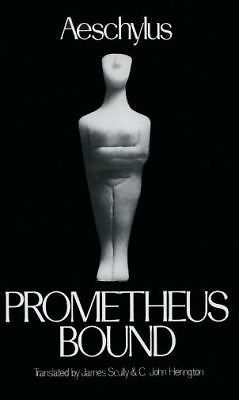
For readers accustomed to the relatively undramatic standard translations of Prometheus Bound, this version by James Scully, a poet and winner of the Lamont Poetry Prize, and C. John Herington, one of the world's foremost Aeschylean scholars, will come as a revelation. Scully and Herington accentuate the play's true power, drama, and relevance to modern times. Aeschylus originally wrote Prometheus Bound as part of a tragic trilogy, and this translation is unique in including the extant fragments of the companion plays.
Aeschylus (c. 525/524 BC – c. 456 BC) was an ancient Greek tragedian often described as the father of tragedy. Academic knowledge of the genre begins with his work, and understanding of earlier Greek tragedy is largely based on inferences made from reading his surviving plays. According to Aristotle, he expanded the number of characters in the theatre and allowed conflict among them. Formerly, characters interacted only with the chorus. Only seven of Aeschylus's estimated 70 to 90 plays have survived. There is a long-standing debate regarding the authorship of one of them, Prometheus Bound, with some scholars arguing that it may be the work of his son Euphorion. Fragments from other plays have survived in quotations, and more continue to be discovered on Egyptian papyri. These fragments often give further insights into Aeschylus' work. He was likely the first dramatist to present plays as a trilogy. His Oresteia is the only extant ancient example. At least one of his plays was influenced by the Persians' second invasion of Greece (480–479 BC). This work, The Persians, is one of very few classical Greek tragedies concerned with contemporary events, and the only one extant. The significance of the war with Persia was so great to Aeschylus and the Greeks that his epitaph commemorates his participation in the Greek victory at Marathon while making no mention of his success as a playwright.