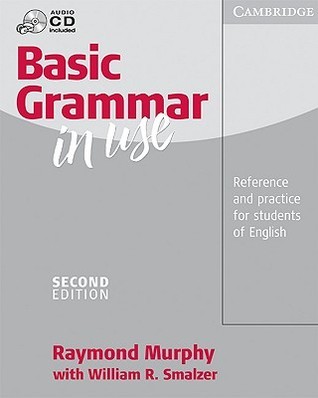
Basic Grammar in Use, Second Edition, is a new edition of a highly successful text for high-beginning to low-intermediate students. Each unit in the Basic Grammar in Use Student's Book is presented in a two-page spread, with simple, clear explanations on the left-hand page and practice exercises to check understanding on the right. This edition includes an Audio CD with example sentences, 10 units of new material, more exercises per unit, and a section of Additional Exercises, which give students the opportunity to consolidate what they have learned. Basic Grammar in Use, Second Edition, can be used as a class text or for self-study. A Student's Book with an answer key is also available.
Raymond Murphy's legendary titles are known and loved the world over, and have given literally millions of students the tools they need to tackle English grammar head-on. Raymond taught English as a foreign language for 17 years in Germany and the UK, but since 1988 has been a full-time writer of EFL materials.
He is the author of the following best-selling Cambridge titles: Essential Grammar in Use, English Grammar in Use, Basic Grammar in Use, Grammar in Use.
Raymond Murphy’s Basic Grammar in Use has been one of the most versatile and dependable resources in my work as an English instructor. While the book is designed for self-study, its clarity, structure, and extensive practice made it immensely valuable in my classroom as well. I found myself returning to it repeatedly—both to guide my explanations and to support students who needed strengthened foundations.
One of the strongest benefits I gained was Murphy’s ability to present grammar with unparalleled simplicity. His explanations are short, intuitive, and built around pattern recognition rather than technical terminology. Teaching with this approach significantly improved classroom comprehension. Students who previously struggled with abstract rules began to understand structures through clear examples and visual layouts.
The layout—explanation on the left page, exercises on the right—helped me design efficient lessons. I often introduced a topic using Murphy’s examples and immediately followed up with the facing-page exercises as guided practice. This seamless integration of instruction and practice made the book an essential partner in lesson planning.
Murphy’s use of everyday sentences also influenced my teaching style. The examples are practical and reflect real-life situations, making the grammar feel relevant. I adopted this philosophy by designing contextual examples for my own lessons. This approach increased student engagement and helped them apply grammar more naturally in conversation and writing.
Another advantage was the book’s strong emphasis on foundational topics—tenses, modals, questions, articles, prepositions. These are areas where learners often struggle despite years of study. Murphy’s step-by-step approach helped me identify and address gaps systematically. Students who worked with the exercises regularly showed noticeable improvement in accuracy and confidence.
The self-study design of the book also supported independent learning. I often recommended specific units to students who needed extra practice, and they appreciated the clarity of explanations and the reassuring structure. Knowing they had a reliable resource outside the classroom reduced their anxiety and strengthened their learning.
For me as an instructor, the book’s true value lay in the purity of its pedagogy. Murphy masterfully combines clarity, simplicity, and repetition—key ingredients for mastery. Teaching with Basic Grammar in Use reminded me that effective grammar instruction does not need to be complicated; it needs to be clear, patient, and consistent.
This book helped me become a more focused and learner-centered teacher, and it remains one of the most trusted grammar texts I use in my professional practice.
This is a good exercise book for students, yet it is lacking in explanations. It overwhelms the students with examples of how to utilize the grammar in a sentence, but it does not give them any lesson instruction. Units are setup in a way that requires students to figure out the grammatical rules based on the sample sentences provided. Therefore, this book is useful for classroom settings where students can be taught the missing information, however it might be too difficult for self-study.