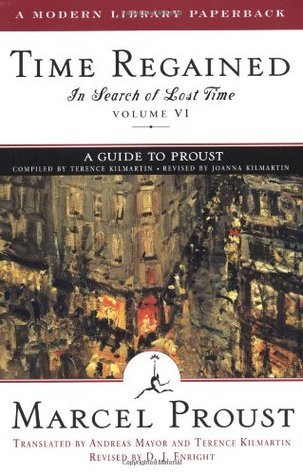
The final volume of In Search of Lost Time chronicles the years of World War I, when, as M. de Charlus reflects on a moonlit walk, Paris threatens to become another Pompeii. Years later, after the war's end, Proust's narrator returns to Paris, where Mme. Verdurin has become the Princesse de Guermantes. He reflects on time, reality, jealousy, artistic creation, and the raw material for literature-his past life. This volume also includes the indispensable Guide to Proust, an index to all six volumes of the novel.
Marcel Proust was a French novelist, best known for his 3000 page masterpiece À la recherche du temps perdu (Remembrance of Things Past or In Search of Lost Time), a pseudo-autobiographical novel told mostly in a stream-of-consciousness style.
Born in the first year of the Third Republic, the young Marcel, like his narrator, was a delicate child from a bourgeois family. He was active in Parisian high society during the 80s and 90s, welcomed in the most fashionable and exclusive salons of his day. However, his position there was also one of an outsider, due to his Jewishness and homosexuality. Towards the end of 1890s Proust began to withdraw more and more from society, and although he was never entirely reclusive, as is sometimes made out, he lapsed more completely into his lifelong tendency to sleep during the day and work at night. He was also plagued with severe asthma, which had troubled him intermittently since childhood, and a terror of his own death, especially in case it should come before his novel had been completed. The first volume, after some difficulty finding a publisher, came out in 1913, and Proust continued to work with an almost inhuman dedication on his masterpiece right up until his death in 1922, at the age of 51.
Today he is widely recognized as one of the greatest authors of the 20th Century, and À la recherche du temps perdu as one of the most dazzling and significant works of literature to be written in modern times.
O lectură provocatoare și antrenantă! Iată că, în final, Marcel s-a apucat să scrie povestea...
"Se spune, și aceasta explică atenuarea progresivă a anumitor afecțiuni nervoase, că sistemul nostru nervos îmbătrânește. Aceasta este just nu numai în ce privește eul nostru permanent, care se prelungește pe perioada întregii noastre vieți, dar și în ce privește eurile noastre succesive care, de fapt, îl compun în parte."
"Dar jurnalele le citești așa cum iubești: legat la ochi. Nu cauți să înțelegi faptele. Asculți vorbele dulci ale redactorului-șef, așa cum le asculți pe cele ale amantei tale. Ești bătut și mulțumit, fiindcă nu te crezi bătut, ci învingător."
Nimic altceva decât o clipă din trecut? Poate mult mai mult decât atât, ceva ce, comun atât trecutului cât și prezentului, este mult mai esențial decât amândouă.
“Timpul regăsit” pune punct final ciclului “În căutarea timpului pierdut”, dar și vieții celor mai multe dintre personajele sale, chiar și celei a naratorului și apare după moartea autorului. Din această cauză este cel mai puțin cizelat volum, neexistând o dactilogramă cu revizuirile autorului.
Deși a fost o lectură dificilă, deseori greu de pătruns, romanul în întregul său mi-a plăcut (mai puțin decât mă așteptăm totuși) și este evidentă contribuția sa importantă în simfonia literaturii universale.
Metafora morţii ca o prăbuşire de pe picioroange mi se pare cel mai inteligent lucru întâlnit într-o carte. Este pentru mine ca fraza lui Vinteuil pentru Swann.