

What do you think?
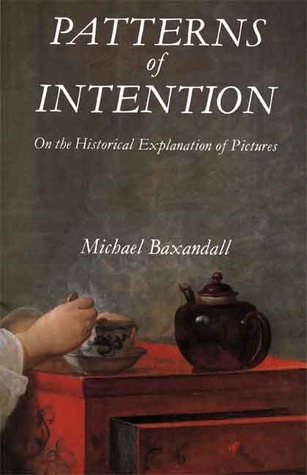
Patterns of Intention: On the Historical Explanation of Pictures
This book is an inquiry into the historical understanding of pictures -- something sought not only by art historians but by anyone who looks at a picture in the knowledge that it is old or comes out of a culture different from his own. Michael Baxandall begins by developing a scheme for the explanation of concrete historical objects in general, taking as an example how we think about a complex artifact such as a bridge, the Forth Bridge in Scotland. He then shows how this scheme is adapted to the explanation -- or inferential criticism -- of pictures. Analyzing in detail Picasso's Portrait of Kahnweiler, Chardin's A Lady Taking Tea, and Piero della Francesca's Baptism of Christ, Baxandall discusses the painter's goal, his sense of what is wanted from him and what he wants, the market in which he works, the culture from which he draws resources, his relation to other painters, and the use he makes of philosophical or scientific ideas. Baxandall then reflects on how far we can understand the mind of an artist living in a different culture and to what extent we can test and evaluate a historical interpretation of a picture. Braxandall does not claim that the method of inferential criticism is the only way to think about pictures. But if we accept that behind a superior picture there is a superior organization -- perceptual, emotional, and constructive -- it seems evident that attempting to discover the artist's intentions will sharpen our legitimate satisfaction in the picture itself.
180 pages, Paperback
First published January 1, 1985
About the author
Michael Baxandall
29 books31 followersArt historian who developed the theory of period eye. He worked as a curator at the Victoria and Albert Museum, London as well as teaching at the Warburg Institute and the University of California.
Ratings & Reviews
Friends & Following
Create a free account to discover what your friends think of this book!
Community Reviews
Displaying 1 - 1 of 1 review

October 21, 2019
Michael Baxandall, em sua explicação histórica dos quadros, propõe que a intencionalidade do artista não é um “estado de espírito” ou “psicológico” reconstruído, mas “uma relação entre o objeto e suas circunstâncias”; em outros termos, é evocada diante do aparecimento de um problema experimentado pelo artista, mas cujas respostas podem ter sido dadas de modo inconsciente, como resultado das instituições a que aderiu ou, ainda, das disposições adquiridas ao longo de sua trajetória biográfica e que, conquanto possam eventualmente ter sido alvo de reflexão, passam à dimensão das capacidades ou habilidades corporais capazes de lidar com tarefas objetivas (BAXANDALL, 2006, p. 81).
Essa noção de intencionalidade é sumarizada por Baxandall a partir da triangulação revelada entre um
problema objetivo, uma situação que apresenta um conjunto de possibilidades culturalmente
determinadas e uma resposta. Postos diante das respostas-obras de um artista, cabe perguntarmo-nos, de acordo com a proposta do autor, a respeito do binômia composto pelas figurações em que tal agente artístico toma parte ― considerado que as interdependências funcionais limitam ou possibilitam as ações individuais, conforme os vínculos de reciprocidade ― e pelos problemas que enfrenta. Ora, se a obra é vista como solução a problemas que
aparecem em determinadas situações, podemos a partir de então sumarizar o problema referente
à psicogênese de um artista a partir da pergunta: que problemas tinha e sob quais condições eles foram experimentados como tal?
Essa noção de intencionalidade é sumarizada por Baxandall a partir da triangulação revelada entre um
problema objetivo, uma situação que apresenta um conjunto de possibilidades culturalmente
determinadas e uma resposta. Postos diante das respostas-obras de um artista, cabe perguntarmo-nos, de acordo com a proposta do autor, a respeito do binômia composto pelas figurações em que tal agente artístico toma parte ― considerado que as interdependências funcionais limitam ou possibilitam as ações individuais, conforme os vínculos de reciprocidade ― e pelos problemas que enfrenta. Ora, se a obra é vista como solução a problemas que
aparecem em determinadas situações, podemos a partir de então sumarizar o problema referente
à psicogênese de um artista a partir da pergunta: que problemas tinha e sob quais condições eles foram experimentados como tal?
Displaying 1 - 1 of 1 review