

What do you think?
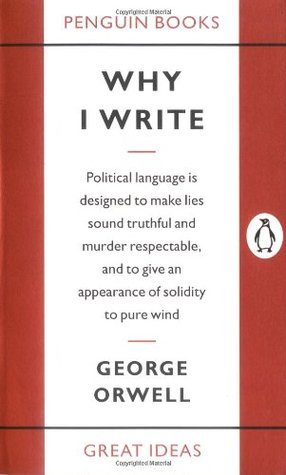
Why I Write
Whether puncturing the lies of politicians, wittily dissecting the English character or telling unpalatable truths about war, Orwell's timeless, uncompromising essays are more relevant, entertaining and essential than ever in today's era of spin.
Contents:
"Why I Write", first published 1946
"The Lion and the Unicorn", first published 1940
"A Hanging", first published 1931
"Politics and the English Language", first published 1946
Contents:
"Why I Write", first published 1946
"The Lion and the Unicorn", first published 1940
"A Hanging", first published 1931
"Politics and the English Language", first published 1946
120 pages, Paperback
First published January 1, 1946
About the author
George Orwell
1,416 books53.5k followersEric Arthur Blair was an English novelist, poet, essayist, journalist and critic who wrote under the pen name of George Orwell. His work is characterised by lucid prose, social criticism, opposition to all totalitarianism (both fascism and stalinism), and support of democratic socialism.
Orwell is best known for his allegorical novella Animal Farm (1945) and the dystopian novel Nineteen Eighty-Four (1949), although his works also encompass literary criticism, poetry, fiction and polemical journalism. His non-fiction works, including The Road to Wigan Pier (1937), documenting his experience of working-class life in the industrial north of England, and Homage to Catalonia (1938), an account of his experiences soldiering for the Republican faction of the Spanish Civil War (1936–1939), are as critically respected as his essays on politics, literature, language and culture.
Orwell's work remains influential in popular culture and in political culture, and the adjective "Orwellian"—describing totalitarian and authoritarian social practices—is part of the English language, like many of his neologisms, such as "Big Brother", "Thought Police", "Room 101", "Newspeak", "memory hole", "doublethink", and "thoughtcrime". In 2008, The Times named Orwell the second-greatest British writer since 1945.
Orwell is best known for his allegorical novella Animal Farm (1945) and the dystopian novel Nineteen Eighty-Four (1949), although his works also encompass literary criticism, poetry, fiction and polemical journalism. His non-fiction works, including The Road to Wigan Pier (1937), documenting his experience of working-class life in the industrial north of England, and Homage to Catalonia (1938), an account of his experiences soldiering for the Republican faction of the Spanish Civil War (1936–1939), are as critically respected as his essays on politics, literature, language and culture.
Orwell's work remains influential in popular culture and in political culture, and the adjective "Orwellian"—describing totalitarian and authoritarian social practices—is part of the English language, like many of his neologisms, such as "Big Brother", "Thought Police", "Room 101", "Newspeak", "memory hole", "doublethink", and "thoughtcrime". In 2008, The Times named Orwell the second-greatest British writer since 1945.
Ratings & Reviews
Friends & Following
Create a free account to discover what your friends think of this book!
Community Reviews
Displaying 1 - 3 of 3 reviews

December 18, 2025
Przeczytałem całą (nie to żeby była jakaś długa) książkę dlatego, że chciałem dotrzeć do informacji która zawarta była w ostatnim eseju, a właściwie w jego 6 głównych punktach. Uważam, że pisanie jest istotną formą nie tylko przekazywania informacji, ale także kształtowania opinii ludzi. Żeby mogło się to dziać efektywnie - autor musi być w stanie swoje myśli wyrazić w klarowny sposób, zrozumiały dla jak największej liczby osób, jednocześnie nie ogłupiając czytelników na kształt przeciętnej gazety czy stacji telewizyjnej.
Sztuka o której pisze Orwell polega na wyrażaniu swoich myśli w sposób przejrzysty, a pisanie lub też ich zapisywanie stanowi jedynie narzędzie którym należy się wspomóc.
Ta lektura opisuje głównie polityczną sytuację Wielkiej Brytanii w 20 wieku i poglądy Orwella, a nie sposoby w które należy pisać. Zresztą swoje rekomendacje autor był w stanie zawrzeć w 6 zwięzłych punktach:
1. Never use a metaphor, simile, or other figure of speech which you are used to seeing in print.
2. Never use a long word where a short one will do.
3. If it is possible to cut a word out, always cut it out.
4. Never use the passive where you can use the active.
5. Never use a foreign phrase, a scientific word, or a jargon word if you can think of an everyday English equivalent.
6. Break any of these rules sooner than say anything outright barbarous.
Jeśli ktoś ma zamiar wyciągnąć z tej lektury porady odnośnie właśnie pisania, wystarczy ograniczyć się do ostatniego eseju książki.
Sztuka o której pisze Orwell polega na wyrażaniu swoich myśli w sposób przejrzysty, a pisanie lub też ich zapisywanie stanowi jedynie narzędzie którym należy się wspomóc.
Ta lektura opisuje głównie polityczną sytuację Wielkiej Brytanii w 20 wieku i poglądy Orwella, a nie sposoby w które należy pisać. Zresztą swoje rekomendacje autor był w stanie zawrzeć w 6 zwięzłych punktach:
1. Never use a metaphor, simile, or other figure of speech which you are used to seeing in print.
2. Never use a long word where a short one will do.
3. If it is possible to cut a word out, always cut it out.
4. Never use the passive where you can use the active.
5. Never use a foreign phrase, a scientific word, or a jargon word if you can think of an everyday English equivalent.
6. Break any of these rules sooner than say anything outright barbarous.
Jeśli ktoś ma zamiar wyciągnąć z tej lektury porady odnośnie właśnie pisania, wystarczy ograniczyć się do ostatniego eseju książki.
May 7, 2025
Czy zgadzam się ze wszystkim co pisze Orwell…Nie, ale nie mogę mu odebrać tego, że i tak jest jakieś 100 razy mądrzejszy ode mnie, więc nawet możliwość dojścia do takich szczegółowych wniosków (do tego dosłownie w trakcie trwania i zaraz po wojnie) dalej wydaje mi się bardzo odkrywcza!
September 22, 2026
Zbyt intelektualistyczne na mój mały chłopski umysł
Displaying 1 - 3 of 3 reviews