

What do you think?
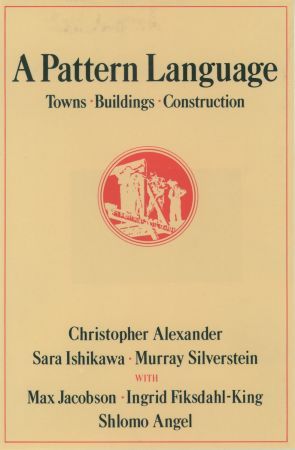
A Pattern Language: Towns, Buildings, Construction
At the core of A Pattern Language is the philosophy that in designing their environments people always rely on certain ‘languages,’ which, like the languages we speak, allow them to articulate and communicate an infinite variety of designs within a formal system which gives them coherence.
This book provides a language of this kind. It will enable making a design for almost any kind of building, or any part of the built environment. ‘Patterns,’ the units of this language, are answers to design problems: how high should a window sill be?; how many stories should a building have?; how much space in a neighborhood should be devoted to grass and trees?
More than 250 of the patterns in this language are outlined, each consisting of a problem statement, a discussion of the problem with an illustration, and a solution. As the authors say in their introduction, many of the patterns are archetypal, so deeply rooted in the nature of things that it seems likely that they will be a part of human nature and human action as much in five hundred years as they are today.
A Pattern Language is related to Alexander’s other works in the Center for Environmental Structure series: The Timeless Way of Building (introductory volume) and The Oregon Experiment.
This book provides a language of this kind. It will enable making a design for almost any kind of building, or any part of the built environment. ‘Patterns,’ the units of this language, are answers to design problems: how high should a window sill be?; how many stories should a building have?; how much space in a neighborhood should be devoted to grass and trees?
More than 250 of the patterns in this language are outlined, each consisting of a problem statement, a discussion of the problem with an illustration, and a solution. As the authors say in their introduction, many of the patterns are archetypal, so deeply rooted in the nature of things that it seems likely that they will be a part of human nature and human action as much in five hundred years as they are today.
A Pattern Language is related to Alexander’s other works in the Center for Environmental Structure series: The Timeless Way of Building (introductory volume) and The Oregon Experiment.
1171 pages, Hardcover
First published January 1, 1977
About the author
Christopher W. Alexander
26 books479 followersChristopher Wolfgang John Alexander was an Austrian-born British-American architect and design theorist. He was an emeritus professor at the University of California, Berkeley. His theories about the nature of human-centered design have affected fields beyond architecture, including urban design, software, and sociology. Alexander designed and personally built over 100 buildings, both as an architect and a general contractor.
In software, Alexander is regarded as the father of the pattern language movement. The first wiki—the technology behind Wikipedia—led directly from Alexander's work, according to its creator, Ward Cunningham. Alexander's work has also influenced the development of agile software development.
In architecture, Alexander's work is used by a number of different contemporary architectural communities of practice, including the New Urbanist movement, to help people to reclaim control over their own built environment. However, Alexander was controversial among some mainstream architects and critics, in part because his work was often harshly critical of much of contemporary architectural theory and practice.
In software, Alexander is regarded as the father of the pattern language movement. The first wiki—the technology behind Wikipedia—led directly from Alexander's work, according to its creator, Ward Cunningham. Alexander's work has also influenced the development of agile software development.
In architecture, Alexander's work is used by a number of different contemporary architectural communities of practice, including the New Urbanist movement, to help people to reclaim control over their own built environment. However, Alexander was controversial among some mainstream architects and critics, in part because his work was often harshly critical of much of contemporary architectural theory and practice.
Ratings & Reviews
Friends & Following
Create a free account to discover what your friends think of this book!
Community Reviews
Displaying 1 - 1 of 1 review

January 27, 2025
Beste handboek dat ik ooit gelezen heb
Displaying 1 - 1 of 1 review