

What do you think?
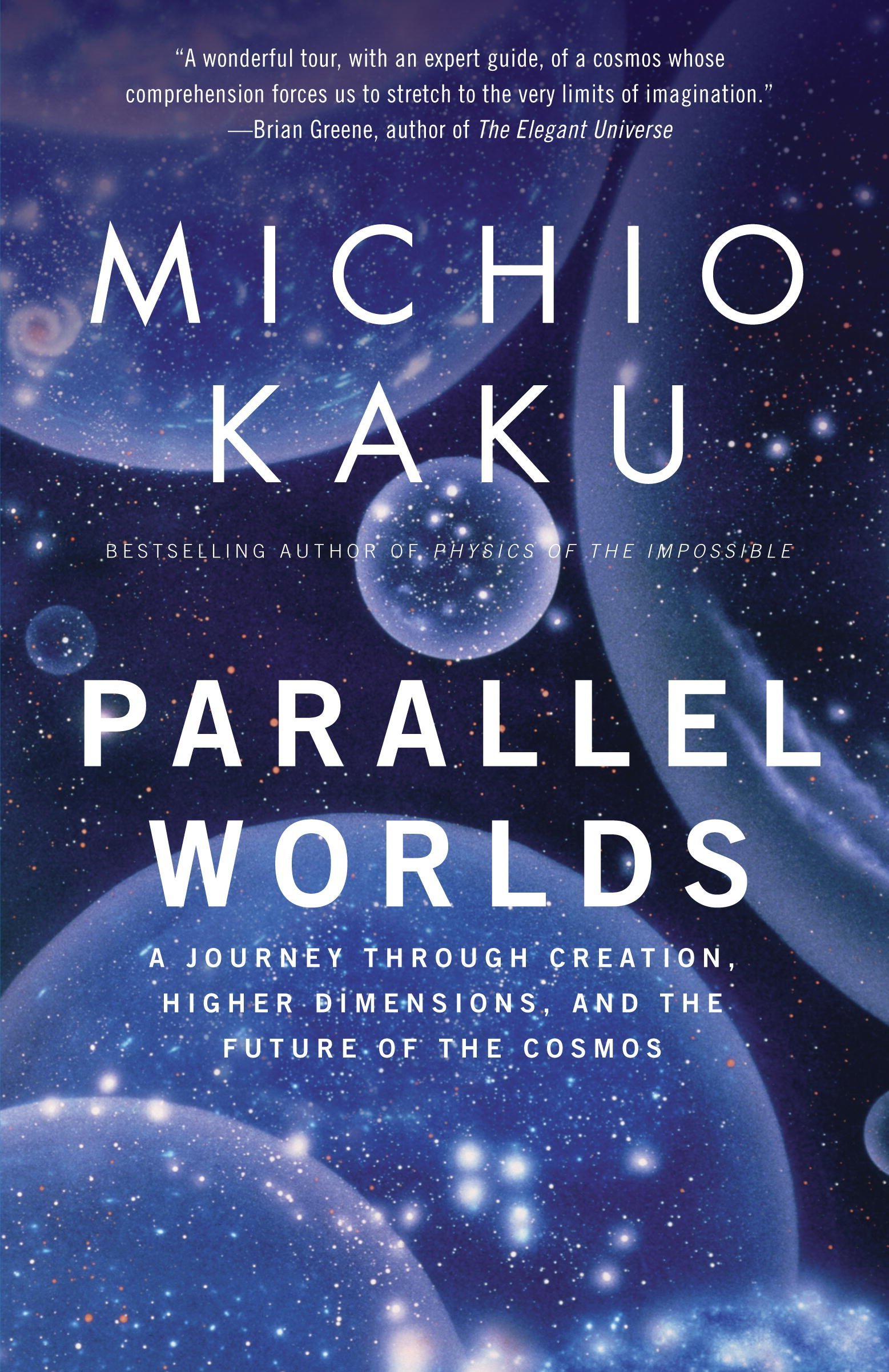
Parallel Worlds: A Journey through Creation, Higher Dimensions, and the Future of the Cosmos
In this thrilling journey into the mysteries of our cosmos, bestselling author Michio Kaku takes us on a dizzying ride to explore black holes and time machines, multidimensional space and, most tantalizing of all, the possibility that parallel universes may lay alongside our own. Kaku skillfully guides us through the latest innovations in string theory and its latest iteration, M-theory, which posits that our universe may be just one in an endless multiverse, a singular bubble floating in a sea of infinite bubble universes. If M-theory is proven correct, we may perhaps finally find answer to the question, “What happened before the big bang?” This is an exciting and unforgettable introduction into the new cutting-edge theories of physics and cosmology from one of the pre-eminent voices in the field.
361 pages, Paperback
First published January 1, 2004
About the author
Michio Kaku
62 books7,053 followers(Arabic: ميشيو كاكو
Russian: Митио Каку
Chinese: 加來道雄)
Dr. Michio Kaku is an American theoretical physicist at the City College of New York , best-selling author, a futurist, and a communicator and popularizer of science. He has written several books about physics and related topics of science.
He has written two New York Times Best Sellers, Physics of the Impossible (2008) and Physics of the Future (2011).
Dr. Michio is the co-founder of string field theory (a branch of string theory), and continues Einstein’s search to unite the four fundamental forces of nature into one unified theory.
Kaku was a Visitor and Member (1973 and 1990) at the Institute for Advanced Study in Princeton, and New York University. He currently holds the Henry Semat Chair and Professorship in theoretical physics at the City College of New York.
Russian: Митио Каку
Chinese: 加來道雄)
Dr. Michio Kaku is an American theoretical physicist at the City College of New York , best-selling author, a futurist, and a communicator and popularizer of science. He has written several books about physics and related topics of science.
He has written two New York Times Best Sellers, Physics of the Impossible (2008) and Physics of the Future (2011).
Dr. Michio is the co-founder of string field theory (a branch of string theory), and continues Einstein’s search to unite the four fundamental forces of nature into one unified theory.
Kaku was a Visitor and Member (1973 and 1990) at the Institute for Advanced Study in Princeton, and New York University. He currently holds the Henry Semat Chair and Professorship in theoretical physics at the City College of New York.
Ratings & Reviews
Friends & Following
Create a free account to discover what your friends think of this book!
Community Reviews
Displaying 1 - 3 of 3 reviews

January 14, 2018
Ci avrà forse messo del suo anche la traduzione, ma ho trovato questo libro a tratti confuso, pieno di ripetizioni e (all'estremo opposto) di passaggi poco spiegati, con termini e concetti dati per scontati. Si può scrivere di fisica senza formule e con linguaggio semplice ma risultando lo stesso incomprensibili? Beh, qui succede diverse volte. L’ultima parte poi è altamente "speculativa" e sommaria, tanto da sfiorare l’inutile (IMHO) trattata così: si immaginano gli ipotetici modi che una ipotetica civiltà di tipo III (in un "tanto per parlare" la Scala di Kardašëv ci sta a pennello!) potrebbe ipoteticamente utilizzare per trasferirsi in un ipotetico altro universo (nel caso creandolo, qualora ipoteticamente non esistesse) sfuggendo in tal modo alla (meno) ipotetica morte entropica del nostro. Più di 2 stelle non mi sento di dare.

September 19, 2023
Parte bene, ma poi vira verso la fantascienza di bassa lega
La data originale di pubblicazione di questo libro è il 2003: sappiate dunque che non potrete trovare le "ultime notizie" sulla cosmologia, come per esempio la rilevazione di onde gravitazionali. (Non che mi pare ci sia stato molto altro: occhei, il bosone di Higgs, ma Kaku lo dava già praticamente per scontato). Kaku è siouramente innamorato della sua materia, e lo si vede quando racconta le cose. La prima parte del libro è ottima per avere uno sguardo globale sulle varie facce della cosmologia. Poi però nella seconda parte comincia a esagerare con la teoria - anzi LE teorie - delle stringhe, che per fortuna hanno perso l'appeal che avevano al tempo. La terza parte sugli universi paralleli è proprio a livello di romanzetto di fantascienza, e si può tranquillamente saltare. Non aspettatevi insomma troppo.
Qualche caduta nella traduzione di Andrea Migliori, con un "piuttosto" alla milanese e le decades che diventano secoli.
La data originale di pubblicazione di questo libro è il 2003: sappiate dunque che non potrete trovare le "ultime notizie" sulla cosmologia, come per esempio la rilevazione di onde gravitazionali. (Non che mi pare ci sia stato molto altro: occhei, il bosone di Higgs, ma Kaku lo dava già praticamente per scontato). Kaku è siouramente innamorato della sua materia, e lo si vede quando racconta le cose. La prima parte del libro è ottima per avere uno sguardo globale sulle varie facce della cosmologia. Poi però nella seconda parte comincia a esagerare con la teoria - anzi LE teorie - delle stringhe, che per fortuna hanno perso l'appeal che avevano al tempo. La terza parte sugli universi paralleli è proprio a livello di romanzetto di fantascienza, e si può tranquillamente saltare. Non aspettatevi insomma troppo.
Qualche caduta nella traduzione di Andrea Migliori, con un "piuttosto" alla milanese e le decades che diventano secoli.

December 8, 2012
Un'interessante escursione nella cosmologia moderna, dall'origine dell'universo alla sua fine, affrontato dal punto di vista della fisica quantistica.
Displaying 1 - 3 of 3 reviews