

What do you think?
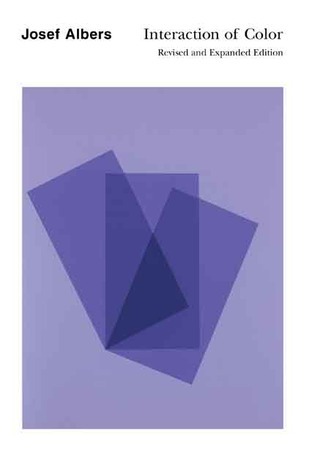
Interaction of Color
Josef Albers’s Interaction of Color is a masterwork in twentieth-century art education. Conceived as a handbook and teaching aid for artists, instructors, and students, this timeless book presents Albers’s unique ideas of color experimentation in a way that is valuable to specialists as well as to a larger audience.
Originally published by Yale University Press in 1963 as a limited silkscreen edition with 150 color plates, Interaction of Color first appeared in paperback in 1971, featuring ten representative color studies chosen by Albers. The paperback has remained in print ever since and is one of the most influential resources on color for countless readers.
This new paperback edition presents a significantly expanded selection of more than thirty color studies alongside Albers’s original unabridged text, demonstrating such principles as color relativity, intensity, and temperature; vibrating and vanishing boundaries; and the illusions of transparency and reversed grounds. Now available in a larger format and with enhanced production values, this expanded edition celebrates the unique authority of Albers’s contribution to color theory and brings the artist’s iconic study to an eager new generation of readers.
Originally published by Yale University Press in 1963 as a limited silkscreen edition with 150 color plates, Interaction of Color first appeared in paperback in 1971, featuring ten representative color studies chosen by Albers. The paperback has remained in print ever since and is one of the most influential resources on color for countless readers.
This new paperback edition presents a significantly expanded selection of more than thirty color studies alongside Albers’s original unabridged text, demonstrating such principles as color relativity, intensity, and temperature; vibrating and vanishing boundaries; and the illusions of transparency and reversed grounds. Now available in a larger format and with enhanced production values, this expanded edition celebrates the unique authority of Albers’s contribution to color theory and brings the artist’s iconic study to an eager new generation of readers.
160 pages, Paperback
First published January 1, 1963
About the author
Josef Albers
116 books125 followersSimple geometric patterns of various colors characterize works, such as the series Homage to the Square (1950-1959), of German-born American painter Josef Albers.
This artist and educator in Europe and the United States formed the basis of modern programs of the 20th century.
https://en.wikipedia.org/wiki/Josef_A...
This artist and educator in Europe and the United States formed the basis of modern programs of the 20th century.
https://en.wikipedia.org/wiki/Josef_A...
Ratings & Reviews
Friends & Following
Create a free account to discover what your friends think of this book!
Community Reviews
Displaying 1 - 2 of 2 reviews

January 27, 2020
non è un saggio ma una poco interessante raccolta di esercizi da far fare in classe.

September 20, 2016
Un libro/workshop sul colore, che consiglio a chiunque di usare in modo pratico.
Non si tratta infatti di un manuale con teoremi, assiomi e ferree teorie da leggere annoiandosi.
L’autore - alla luce di laboratori/lezioni con studenti - analizza effetti ottici causati dall'accostamento dei colori.
Invoglia il lettore a testare personalmente le teorie riportate, sia per una migliore comprensione della lezione sia per ‘’allenare l’occhio’’ e scoprire ulteriori e inaspettati effetti.
Il testo é strutturato in due parti: prima metá teorico-descrittiva e seconda metá contenente tavole grafiche esplicative.
Le tavole sono utilissime, perché se non hai proprio voglia di testare personalmente hai degli esempi chiarissimi, cioé i piú eclatanti che l’autore sia riuscito a riscontrare.
Inoltre Albers non mi é sembrato particolarmente sciolto come divulgatore e spesso ho faticato a comprenderlo. Tutt’ora credo che qualche frase non mi sia particolarmente chiara.
Non si tratta infatti di un manuale con teoremi, assiomi e ferree teorie da leggere annoiandosi.
L’autore - alla luce di laboratori/lezioni con studenti - analizza effetti ottici causati dall'accostamento dei colori.
Invoglia il lettore a testare personalmente le teorie riportate, sia per una migliore comprensione della lezione sia per ‘’allenare l’occhio’’ e scoprire ulteriori e inaspettati effetti.
Il testo é strutturato in due parti: prima metá teorico-descrittiva e seconda metá contenente tavole grafiche esplicative.
Le tavole sono utilissime, perché se non hai proprio voglia di testare personalmente hai degli esempi chiarissimi, cioé i piú eclatanti che l’autore sia riuscito a riscontrare.
Inoltre Albers non mi é sembrato particolarmente sciolto come divulgatore e spesso ho faticato a comprenderlo. Tutt’ora credo che qualche frase non mi sia particolarmente chiara.
Displaying 1 - 2 of 2 reviews