

What do you think?
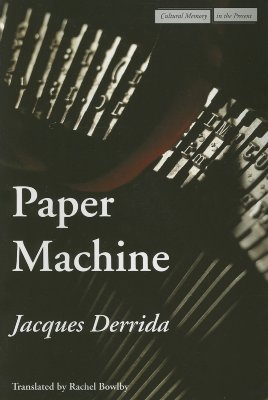
Paper Machine
This book questions the book itself, archivization, machines for writing, and the mechanicity inherent in language, the media, and intellectuals. Derrida questions what takes place between the paper and the machine inscribing it. He examines what becomes of the archive when the world of paper is subsumed in new machines for virtualization, and whether there can be a virtual event or a virtual archive. Derrida continues his long-standing investigation of these issues, and ties them into the new themes that governed his teaching and thinking in the past few the secret, pardon, perjury, state sovereignty, hospitality, the university, animal rights, capital punishment, the question of what sort of mediatized world is replacing the print epoch, and the question of the “wholly other.” Derrida is remarkable at making seemingly occasional pieces into part of a complexly interconnected trajectory of thought.
222 pages, Paperback
First published October 8, 2001
About the author
Jacques Derrida
655 books1,875 followersJacques Derrida was a French philosopher best known for developing deconstruction, a method of critical analysis that questioned the stability of meaning in language, texts, and Western metaphysical thought. Born in Algeria, he studied at the École Normale Supérieure in Paris, where he was influenced by philosophers such as Heidegger, Husserl, and Levinas. His groundbreaking works, including Of Grammatology (1967), Writing and Difference (1967), and Speech and Phenomena (1967), positioned him at the center of intellectual debates on language, meaning, and interpretation.
Derrida argued that Western philosophy was structured around binary oppositions—such as speech over writing, presence over absence, or reason over emotion—that falsely privileged one term over the other. He introduced the concept of différance, which suggests that meaning is constantly deferred and never fully present, destabilizing the idea of fixed truth. His work engaged with a wide range of disciplines, including literature, psychoanalysis, political theory, and law, challenging conventional ways of thinking and interpretation.
Throughout his career, Derrida continued to explore ethical and political questions, particularly in works such as Specters of Marx (1993) and The Politics of Friendship (1994), which addressed democracy, justice, and responsibility. He held academic positions at institutions such as the École des Hautes Études en Sciences Sociales and the University of California, Irvine, and remained an influential figure in both European and American intellectual circles. Despite criticism for his complex writing style and abstract concepts, Derrida’s ideas have left a lasting impact on contemporary philosophy, literary theory, and cultural criticism, reshaping the way meaning and language are understood in the modern world.
Derrida argued that Western philosophy was structured around binary oppositions—such as speech over writing, presence over absence, or reason over emotion—that falsely privileged one term over the other. He introduced the concept of différance, which suggests that meaning is constantly deferred and never fully present, destabilizing the idea of fixed truth. His work engaged with a wide range of disciplines, including literature, psychoanalysis, political theory, and law, challenging conventional ways of thinking and interpretation.
Throughout his career, Derrida continued to explore ethical and political questions, particularly in works such as Specters of Marx (1993) and The Politics of Friendship (1994), which addressed democracy, justice, and responsibility. He held academic positions at institutions such as the École des Hautes Études en Sciences Sociales and the University of California, Irvine, and remained an influential figure in both European and American intellectual circles. Despite criticism for his complex writing style and abstract concepts, Derrida’s ideas have left a lasting impact on contemporary philosophy, literary theory, and cultural criticism, reshaping the way meaning and language are understood in the modern world.
Ratings & Reviews
Friends & Following
Create a free account to discover what your friends think of this book!
Community Reviews
Displaying 1 - 1 of 1 review

August 11, 2007
"La huella no es una sustancia, un ente presente, sino un proceso que se altera permanentemente. No puede sino reinterpretarse y siempre, finalmente, se trastoca."
*
"Hay dos categorías de "rechazo" [...], dos tipos de no-lectores. En primer lugar los que no trabajan bastante y se creen autorizados a hacerlo; éstos se desalientan rápidamente suponiendo que un texto debe ser accesible inmediatamente, sin el trabajo que consiste en leer y en leer a los que yo leo, por ejemplo. Luego están los no-lectores que ponen como pretexto esa supuesta oscuridad para descartar, en verdad para censurar, algo que les amenaza o les inquieta, les molesta. El argumento de la dificultad se torna entonces una coartada detestable."
*
"La im-posibilidad, lo posible como imposible, va siempre unida a una irreductible divisibilidad que afecta a la esencia misma de lo posible. De ahí la insistencia en la divisibilidad de la letra y su destino."
*
"Hay dos categorías de "rechazo" [...], dos tipos de no-lectores. En primer lugar los que no trabajan bastante y se creen autorizados a hacerlo; éstos se desalientan rápidamente suponiendo que un texto debe ser accesible inmediatamente, sin el trabajo que consiste en leer y en leer a los que yo leo, por ejemplo. Luego están los no-lectores que ponen como pretexto esa supuesta oscuridad para descartar, en verdad para censurar, algo que les amenaza o les inquieta, les molesta. El argumento de la dificultad se torna entonces una coartada detestable."
*
"La im-posibilidad, lo posible como imposible, va siempre unida a una irreductible divisibilidad que afecta a la esencia misma de lo posible. De ahí la insistencia en la divisibilidad de la letra y su destino."
Displaying 1 - 1 of 1 review