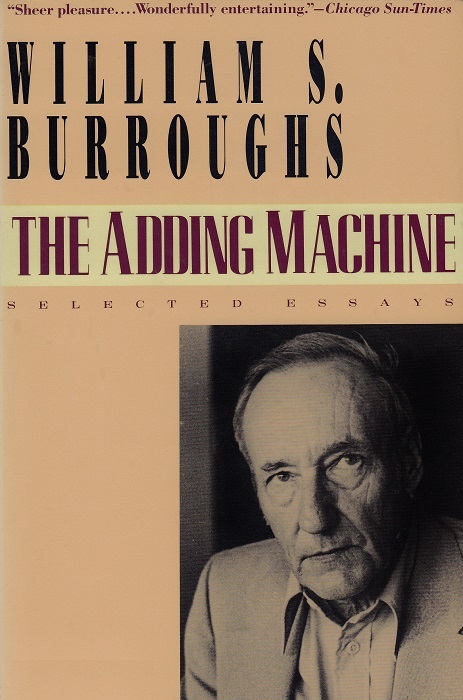
Acclaimed by Norman Mailer more than twenty years ago as "possibly the only American writer of genius," William S. Burroughs has produced a body of work unique in our time. In these scintillating essays, he writes wittily and wisely about himself, his interests, his influences, his friends and foes. He offers candid and not always flattering assessments of such diverse writers as Ernest Hemingway, F. Scott Fitzgerald, Joseph Conrad, Graham Greene, Jack Kerouac, Allen Ginsberg, Samuel Beckett, and Marcel Proust. He ruminates on science and the often dubious paths into which it seems intent on leading us, whether into outer or inner space. He reviews his reviewers, explains his famous “cut-up” method, and discusses the role coincidence has played in his life and work. As a satirist and parodist, William Burroughs has no peer, as these varied works, written over three decades, amply reveal.
William Seward Burroughs II, (also known by his pen name William Lee) was an American novelist, short story writer, essayist, painter, and spoken word performer. A primary figure of the Beat Generation and a major postmodernist author, he is considered to be "one of the most politically trenchant, culturally influential, and innovative artists of the 20th century". His influence is considered to have affected a range of popular culture as well as literature. Burroughs wrote 18 novels and novellas, six collections of short stories and four collections of essays. Five books have been published of his interviews and correspondences. He also collaborated on projects and recordings with numerous performers and musicians, and made many appearances in films. He was born to a wealthy family in St. Louis, Missouri, grandson of the inventor and founder of the Burroughs Corporation, William Seward Burroughs I, and nephew of public relations manager Ivy Lee. Burroughs began writing essays and journals in early adolescence. He left home in 1932 to attend Harvard University, studied English, and anthropology as a postgraduate, and later attended medical school in Vienna. After being turned down by the Office of Strategic Services and U.S. Navy in 1942 to serve in World War II, he dropped out and became afflicted with the drug addiction that affected him for the rest of his life, while working a variety of jobs. In 1943 while living in New York City, he befriended Allen Ginsberg and Jack Kerouac, the mutually influential foundation of what became the countercultural movement of the Beat Generation. Much of Burroughs's work is semi-autobiographical, primarily drawn from his experiences as a heroin addict, as he lived throughout Mexico City, London, Paris, Berlin, the South American Amazon and Tangier in Morocco. Finding success with his confessional first novel, Junkie (1953), Burroughs is perhaps best known for his third novel Naked Lunch (1959), a controversy-fraught work that underwent a court case under the U.S. sodomy laws. With Brion Gysin, he also popularized the literary cut-up technique in works such as The Nova Trilogy (1961–64). In 1983, Burroughs was elected to the American Academy and Institute of Arts and Letters, and in 1984 was awarded the Ordre des Arts et des Lettres by France. Jack Kerouac called Burroughs the "greatest satirical writer since Jonathan Swift", a reputation he owes to his "lifelong subversion" of the moral, political and economic systems of modern American society, articulated in often darkly humorous sardonicism. J. G. Ballard considered Burroughs to be "the most important writer to emerge since the Second World War", while Norman Mailer declared him "the only American writer who may be conceivably possessed by genius". Burroughs had one child, William Seward Burroughs III (1947-1981), with his second wife Joan Vollmer. Vollmer died in 1951 in Mexico City. Burroughs was convicted of manslaughter in Vollmer's death, an event that deeply permeated all of his writings. Burroughs died at his home in Lawrence, Kansas, after suffering a heart attack in 1997.
It is tempting to say that Burroughs’s writing represents either the urgent dispatches from a social observer warning of impending danger or the ravings of a paranoid crank. However, as Burroughs himself points out, either/ or thinking is reductive, and so if one wants to get at the complexity of his work, it’s preferable to take a both/ and approach, and indeed, while some of Burroughs’s ideas seem pretty loopy, others are right on (that’s right, I started out with a straw man. Mea culpa).
Although associated with them, as author and individual Burroughs is not really like other members of the Beat Generation. I’ve seen a photograph of him with a couple of the Beats—perhaps it was Allen Ginsberg and Jack Kerouac—and they’re at the beach, and while the others are wearing trunks and T-shirts, Burroughs conspicuously wears a formal suit. It’s like those pictures of the Rolling Stones in which everyone has long hair and mod clothes except for Charlie Watts, who looks more like a banker than a drummer in a rock and roll band.
Burroughs has been called the godfather of punk. Some have suggested that his literary experiments with the “cut-up technique” can be read as early experiments in hypertext. He’s best known for Naked Lunch, a novel about heroin and sex that somewhere got spliced with science fiction dystopism and mutated into one of the central texts of social satire of the last fifty years (yes, read it!)
So, The Adding Machine? It’s a book of essays on a number of subjects. There’s literary criticism, as Burroughs discusses the work of writers like Ernest Hemingway, Samuel Beckettand Marcel Proust. There’s philosophy both aesthetic (Burroughs talks about the creative process) and ethical (Burroughs comments on the “Johnsons” he’s known, and contrasts them to the $#!&s he’s met).
Yet although the work is a collection of essays, it’s not necessarily non-fiction. One essay starts out as a fictional dialogue between two film producers, at some point becoming a non-fictional discussion about a real drug that could help junkies kick their addiction to heroin, but that is unavailable in America because the FDA has prohibited it. Another begins as literary criticism, with Burroughs commenting on The Great Gatsby; it ends, however, as fiction, with Burroughs suggesting an alternate ending for F. Scott Fitzgerald’s novel, and reproducing a passage of experimental writing in which he “cuts-up” The Great Gatsby with other texts. In addition to these there are the “speculative” essays, in which Burroughs writes about subjects like coincidence or orgone accumulation; the fictionality or non-fictionality of these subjects frequently depends more on the credulity of the reader than on what can be proven scientifically.
The essays are short, some of them only three or four pages long, and more conventionally constructed than are most of his novels. Funny and alarming all at once, Burroughs is a kind of canary in the coalmine, a surreal satirist, as much George Carlin as George Orwell. You might think of him as that character who appears in the opening of the B horror picture—the old timer who can tell you what you want to know about the mysterious goings on “up yonder the old Vineland place.” So if you want to make it past the third reel, you could do worse than to listen to what Burroughs has to say before going to investigate for yourself what’s locked up in the basement of the creepy house that is contemporary Amerika.
Acquired Apr 15, 2010 Powell's City of Books, Portland, OR
William S. Burroughs' book of essays, The Adding Machine: Selected Essays, was culled from a variety of sources, including transcripts from his creative writing course at the Jack Kerouac School of Disembodied Poetics.
The usual books get mentioned throughout this collection, including Jack Black's You Can't Win and The Biography of a Grizzly which, according to Beatnik legend, inspired Burroughs' first literary work, "The Autobiography of a Wolf".
Unusually, 'The Picture of Dorian Gray' (Modern Library Classics) inspired Burroughs to write a tale about, "English gentlemen...planning an expedition to the Pole."
He also admits to having bled all over Paul Bowles' copy of One Arm, after sitting around all day, shooting junk.
Burroughs stresses again and again that it is OK to borrow from other works to enrich your own. A chapter in 'Under Western Eyes' (Penguin Classics), he admits, helped him round out a Dr. Benway scene in Naked Lunch. Also, a book called 'The Left-Handed Passenger' was consulted prior to the drafting of "Twilight's Last Gleamings" from Nova Express.
In the essay entitled, wonderfully, "The Beauty and the Bestseller", Burroughs gifts the reader by slipping into his familiar con-artist voice as he sets fiction up against non-fiction.
"Of course," he writes, "writing like 'Alive: The Story of the Andes Survivors' (Avon Nonfiction) is even more trouble than well researched fiction like 'The Day of the Jackal'. The writer has to get down to Uruguay and get the ghouls to talk to him to scoop the whole tasty good thing before someone else does."
Beat scholars know that Burroughs was adept at finding and applying unusual techniques to his writing.
Burroughs cites 'Science and Sanity: An Introduction to Non-Aristotelian Systems and General Semantics' (International Non-Aristotelian Library) and 'An Experiment With Time' (Studies in Consciousness) as starting points. The first, for eliminating abstract words from writing, like "fascism", and the latter for using dreams as raw material in the creative process.
The world needs creative writers. It also needs creative readers. In the essay on creative reading, Burroughs makes reference to: 1. 'Jaws' 2. 'The Great Gatsby' 3. 'Lord Jim' (Penguin Classics) 4. 'Appointment in Samarra: A Novel' 5. 'Maiden Voyage' 6. 'Critical Threshold (The Daedalus Mission, Book 2)' (According to Burroughs, "Colonists stranded on a distant planet undergo an alteration through contact with a powerful hallucinogenic substance given off by mating butterflies.") 7. 'The Great Sunflower: A novel' (Burroughs comes off as a bit of a grouch in his analysis of the book, saying, "It's just the old 'Nothing will ever bring me to reveal what I saw in that infamous crypt...'(where the inventiveness of the writer lies buried).") 8. 'Biological Time Bomb' 9. 'To night' (Enoch Pratt Free Library Poetry Broadsides) 12. 'Intimations of Inmortality' (Phoenix 60p Paperbacks) ("Wordsworth," writes Burroughs, "like so many artists, was an alien...an immortal alien feeling the estrangement of human mortality.")
As could be expected of a card-carrying member of the Illuminates of Thanateros, Burroughs was an avid student of the occult. The phenomenon of tape recording the voices of the dead gets an overview, with 'Psychic Discoveries and Breakthrough: An Amazing Experiment in Electronic Communication With the Dead' cited.
"Writers operate in a magical universe," writes Burroughs in "On Coincidence".
Writers, he explains, aren't cheating by using foreshadowing in their novels. They're being quite realistic. Life is full of signs and omens like the "sinister clown" in 'Death in Venice' and the "warnings of misfortune and death ignored by...the extroverted and spiritually underpriveleged WASPs" in 'The Stories of John Cheever'.
In a world which, one suspects, is nothing more than an occult contrivance, the idea of control and controllers seems to be a bit archaic. As if the controllers have as much control over everything as a gamer does over an unplugged video game console.
Still, Burroughs manages to nourish the paranoid within, and discusses both the control of the mind and the minds of the controllers, reviewing, at length, 'Physical control of the mind: Toward a psychocivilized society' (Harper Colophon books) and 'The Origin of Consciousness in the Breakdown of the Bicameral Mind'.
Fans of Burroughs's work are familiar with his 'routines'. These are short, darkly humorous skits of a vaudevillian nature that are, more or less, Burroughs's sole contribution to the shape of post-modernism.
In the routine, "The Last Junky", Burroughs' character A.J. riffs on how Watergate and Marathon Man have left the public open to movies featuring "the clean-cut" and "the slimy" working in cahoots.
Later, in the same routine, A.J. seriously considers turning 'The Anthrax Mutation' into a musical documentary featuring a chorus of cows and an animated "Mr. Anthrax" visiting a top-secret military lab.
Musings on immortality are made, of course, as Burroughs was, it seems, permanently 90+ years old. Starting with a quote from 'James Dean: The Mutant King: A Biography', Burroughs looks to sci-fi for answers, including 'The Methuselah Enzyme' and 'IN HIS IMAGE: The Cloning of a Man'.
Burroughs' tendency to ramble does, unfortunately, take this essay to unexpected territory, with a few paragraphs discussing 'The Republic '(Dover Thrift Editions) and how, exactly, alien invaders "could rapidly immobilize the earth."
The concluding pay-off is a beautiful quote from 'Black Elk Speaks: Being the Life Story of a Holy Man of the Oglala Sioux', that, again, has nothing, really, to do with the ethics of cloning which Burroughs was this close to nailing.
A sadness permeates the essay entitled "Beckett and Proust". Burroughs relates a meeting that he and Ginsberg had with Samuel Beckett in Berlin.
While Burroughs admits that the author of 'Three Novels: Molloy, Malone Dies, The Unnamable' is, "perhaps the purest writer who has ever written," you still get the sense that the Godfather of the Beats felt a bit slighted, hurt by Beckett's cool demeanor.
"You could imagine his turning in disinterest from an extraterrestrial," Burroughs writes.
In the next-to-last essay, appropriately titled "Light Reading", Burroughs' protagonist, Audrey, picks a selection of books to take with him on his outer space journey to the planet Ba'Dan. His choices include: 1. 'An Outcast of the Islands' (Oxford World's Classics) 2. 'Brak: The Barbarian' 3. 'Shootist' 4. 'The High Destiny' 5. 'Anabase' (Publications de la Fondation Saint-John Perse)
Finally, 'The Adding Machine: Selected Essays' concludes with a mash note to the Wild Boys of London, the Sex Pistols, whom, one can imagine, Burroughs had a thing for.
"Bugger the Queen" transforms the anti-monarch sentiments of "God Save the Queen" from Never Mind the Bollocks, Here's the Sex Pistols into a routine featuring The Gombeen Man, an incubitic blackmailer and butcher, and chanting crowds advancing on Buckingham Palace.
Despite the dated socio-political references, this snotty, surreal, Python-meets-punk flare-up ends the book of essays on a refreshing, revolutionary note.
As I mentioned before, Burroughs had a superb voice -not only in speaking terms, but that you can hear it through his writing. It's hard for me to think on the top of my head, who else has that 'voice' in their work. Maybe Capote? But i don't hear it. But Burroughs can only write in one way or fashion, and he does it the best.
This collection of essays are a series of his voice on particular subject matters. He's like the guy who is entertaining at the nearby pub or bar. Kind of cranky, kind of insane, but incredibly entertaining. So in a sense Burroughs was an entertainer. And he entertained me for many many years now.
I recommend this as a starting point for anyone who is wanting to get into Burroughs. This collection of essays gives the reader a view into his early, failed attempts at writing as a teenager, along with glimpses of some of the trauma that he went through as a young adult and how this led to his unique views and style. These essays are not all biographical, as Burroughs also explores some of his idea generators as a writer/artist (such as cut-ups and experiments with photography and sound), along with analyzing the work of a few authors. From a personal standpoint, I was thoroughly befuddled the first time that I picked up 'Nova Express', but this book taught me how to read some of Burroughs more experimental writing. I also think that this would be an excellent work to use as a text in a beginning level creative writing college course.
شاید نوشتن برای او صرفاً امری طبیعی باشد، جلوهای از وجودش که به نحوی موظف به بیان آن است. ماهیت این وظیفه به سختی قابل تشخیص است. شاید منظور او از «وظیفه» چیزی کاملاً متفاوت از معنای معمول این کلمه باشد. آیا ما موظف به نفس کشیدن هستیم؟ او، به گمانم، به اندازهای که یک انسان میتواند، کارش را نفس میکشد. بکت همه قوانین و قراردادهای رماننویسی را زیر پا میگذارد: قوانینی خودسرانه، البته، که در اواخر قرن هجدهم شکل گرفتند و در قرن نوزدهم تثبیت شدند. در آثار بکت هیچ تعلیقی وجود ندارد. بکت فرای تعلیق میرود. هیچ پایانبندی هیجانانگیزی در انتهای فصل نیست. هیچ شخصیتی به معنای واقعی کلمه وجود ندارد، و قطعاً سیر تکامل کاراکتری وجود ندارد. او شاید خالصترین نویسندهای باشد که تاکنون نوشته است. هیچچیز جز خود نوشتن وجود ندارد. هیچ ترفند،آرایش، هرچیزی که خواننده بتواند با آن همذاتپنداری کند. همهچیز به جای بیرون، به درون حرکت میکند، به سوی نوعی دروننگری نهایی، هستهای غایی. همانطور که فیزیکدانان به سوی درون پیش میروند، دامنه بکت همیشه کوچکتر و دقیقتر میشود. «پایان بازی» روان را به اشخاصی تقسیم میکند تا تقسیمبندی و تلاش بیهوده برای پایان دادن به بازیای را به نمایش بگذارند که بدون پایان دادن به همه شخصیتها نمیتوان آن را خاتمه داد، زیرا همه آنها بخشی از یک موجودیت واحد هستند.
Mi sarei aspettato un libro focalizzato sulla scrittura e invece mi sono ritrovato innumerevoli micro saggi su ogni tipo di argomento. Tra 2,5 e 3 stellette per Papà Burroughs questa volta!
Though I'm a great lover of the prose by William Burroughs, I'm not a great fan of his theories. He's a bit of a nutter, I guess. Raging paranoia is also a description. Of course his writing is also in these mostly short essays brilliant. Stylistically hardly anything compares to it. But there are two things which really struck me reading this collection about fantastical theories that he believed in:
1: William Burroughs really was a centre of the counterculture of the sixties and seventies. So many of those ideas which weren't supported by any science at all or at best pseudo-science, were celebrated and propagated by him. Even the strange stories and theories by contemporaries found a reflection in his writing. He was some kind of lynchpin in those days. The uncle that made it alright for you to utter complete nonsense.
2: Plenty of writers clearly influenced him, like Fitzgerald and Proust. Something you would not easily think when reading him. For Hemingway he even had a pet name: Papa. Being the opposite in sensibility and style he seems very enamored by the man. Ofcourse they do share a sense of adventure, though Burroughs is the man for the journey within and Hemingway... Well, you know.
What comes to mind is that this very excentric writer who few people can really appreciate is very much a man of his times and age. With his hand on the pulse of society.
Ofcourse the collection is hurt now and then by repetition. The essays were often written for different magazines, so overlap wouldn't be a problem, and Burroughs is after all a man with a singleminded message, which gets tedious now and then. But what a writer and what insights in writing. So easy and crisp. The Hemingway-piece is something many in my country, The Netherlands, should read, since there is a tendency to view writing only as good according to the journalistic and sparse style of the great man.
great stuff. occasionally slips into the hallucinogenic mode of his fiction, but mostly these essays are sharp & fascinating on a wide range of subjects from his own influences & history to meditations on the world at large, politically & otherwise. thoughts on "coincidence" especially resonate, & tho there are some repetitions (haven't we heard this anecdote before?), the ideas of this singular mind are more relevant than radical & need to be absorbed by all. mutate or die!
The best advice a writer wanna-be can acquire from one of the greatest deceased writers in history. I recommend this to you, even if you have no desire write. In the end, you will.
A great collection of essays which gives a wealth of insight into Burroughs' perspective on writing and the creative process. There is also the inclusion of several routines that come off more as hit-and-miss, but they are now used to illustrate points being made in some of the essays (i.e. over-population, immortality). But with the best routines in this book, one can see Burroughs channeling his inner Johnathan Swift and offers macabre and pessimistic views of the human condition.
I read probably half of this. I mean some of it is really good, and man some of it is just nonsense. I get that’s the Burroughs way, but I don’t always feel the need to use my time that way. Anyways, there’s some good here and there.
Tom Robbins has often been called the most dangerous writer alive. Well, William Burroughs just may be the most dangerous writer since Joyce.
In these essays, Burroughs really takes notes and rips into his enemies, whether they be other writers or members of the government. He takes no prisoners. His humour is incisive, acerbic and as sardonic as ever. As Kerouac once famously said, he truly IS "the greatest satirist since Johnathan Swift"
I think Burroughs' analysis of Proust and Beckett is spot on. Beckett, despite all of his literary merits, DOES come across as aloof and cold as Burroughs correctly point out while Proust is not only someone who is a true master of French prose but also someone who has stamped such unforgettable characters indelibly into the record of French letters.
Burroughs's essay on Kerouac, entitled Remembering Jack Kerouac, was both sharp and wistful, with WSB reminiscing about their collaboration on And the Hippos Were Boiled In Their Tanks which was about the Kammerer murder by Lucien Carr.
My favourite essay was his Review of the Reviewers in which he takes literary critics to task. His analysis is both scathing and extremely valid. All the essays in this book, come to think of it, are fantastic. This is really Burroughs at his best and a great place to start with WSB if you have just started reading him and have yet to discover the true diamonds of his mind fully unleashed.
In many ways, this is superior to Burroughs' longer, fictional works. In the true spirit of a cut-up novel, one can open to any page and just start reading. The healthy variety of editorial comments, personal reflections and short essays in this collection offer a fascinating albeit limited portrait of one of the 20th century's great American writers. Evolution, psychology, scientific advances... he proves himself to be incredibly well-read, with a mind that ventures far beyond the themes of addiction and sexual vulgarity that brought him fame in Naked Lunch.
The book is infinitely quotable, for instance:
"I believe that Richard Nixon will go down in history as a true folk hero, who struck a vital blow to the whole diseased concept of the revered presidential image and gave the American virtues of irreverence and skepticism back to the people."
The best essays, however, deal with writing - the art, and the personalities. Burroughs' reflections on Fitzgerald and Beckett are thoughtful, interesting and written in a unique, literary fashion as opposed to drab, scholarly tones. The same goes for his comments on the craft itself. This is arguably one of the most accessible introductions to Burroughs a reader can find, and I certainly recommend it.
This should make for an interesting review, although it wasn't a particularly interesting book - it was nowhere near as gripping as Burroughs' fiction. Written over three decades, these essays cover everything from Burroughs' thoughts on 'creative reading' and the 'technology of writing', to discussions about the writers who influenced his style, including Ernest Hemingway, Joseph Conrad and Samuel Beckett.
Burroughs doesn't limit himself to the dead greats, though - he also writes about his relationships with fellow beat writers Jack Kerouac and Allen Ginsberg. It seems like all of the great beat writers wrote about each other, thus enhancing the careers and awareness of each participant. Many beat readers first read On The Road by Jack Kerouac, and it's only after that they delve in to the work of Burroughs, Ginsberg, Synder et al.
Two last points to mention before I hit my word limit - first, there's an interesting discrepancy in the title. UK editions are called 'Collected Essays' and American editions are called 'Selected Essays'. Secondly, the title itself is a reference to Burroughs' grandfather's famous invention - the adding machine.
William Burroughs always has such an interesting perspective on everything. I find his approach to writing, reading, language, anthropology, and science very appealing, because it has less to do with any sort of objective truth and more to do with presenting things in a way that simply makes you see it differently; and this new way of seeing it being a form of truth. He kind of proves that there really is no such thing as an "objective truth" because the world is still always seen through our own blind eyes. He says language is a virus, almost discrediting any practical use language may have, so his own use of language often becomes satirical. He outlines his 'cut up' process which I myself have used in some of my own writing, and speaks about many occult subjects such as precognition, voice phenomena on electronic devices, and magick. I have an interest in the occult but rarely can I find an author who can so eloquently outline the purpose of occult studies and the benefit that these taboo subjects may have on our education.
The adding machine is one of those books I go back to every now and again. It was the first WSB book I read after reading the incredible biography William Burroughs: El Hombre Invisible. El Hombre invisible had such an impact on my life that I named my business Los Estudios Invisibles (The Invisible Studios). The adding machine is a great place to start with Burroughs because it is a bit Burroughs "light" in its complexity. Most of the stories give you the sense of his style, without confusing the hell out of you with cutups, transcending viruses, metafictional prose, etc. He creates a world that is always right below big city street level, below most authoritative radar, and in between the current of everyday life.
I was surprised that not a single William S. Burroughs work was ever assigned (or even mentioned) at any of the colleges/universities that I attended. Were I to select a single work by Burroughs that seems most significant to readers, writers and artists, this collection of essays would be it. The Adding Machine serves as both a summary of the author's writings and as an introduction.
This is a masterpiece. So different from what Huxley did. Burroughs was like a transhuman, ahed of his time. He constructed himself, he altered what he was, in the way Terence McKenna talks about and consciousness hackers aim for. And when he wrote essays, they were absolutely brilliant and original. This is enticing, unexpected, just a great read.
310515: collection of essays throughout his career, some are great, some are less. always easier to read than his fiction, though i am not sure this should be thought 'non-'. fast to read. unvarnished critiques, loopy paranoia, persistent misanthropy. sort of like an internet-taught crank. sometimes very comic, other times... less. always fun to read...
I immensely enjoyed this book. While focusing on literature (Both literary criticism as well as his insights on the writing process,) Burroughs tackles a fairly wide range of subjects, including, among many other topics, the ways a democratic nation exerts control and influence over it's subjects, the role of money in government, his remembrances of Jack Kerouac, drugs, law, and science. It is only in the later subject that these essays fall flat. He seems given to conspiracy theories and pseudo-science, and so while his essay about opioid peptides or the ethics of cloning are interesting, his essays about space travel, aliens, the orgone accumulator and the like border on the embarrassing.
None of this comes across as pretentious or dry, as Burroughs has a talent for dramatics and surrealistic comedy - As evident in the twisted & blackly humorous parables he sometimes employs to illustrate a point. Definitely worth a read. Hell, even if you disagree vehemently with every opinion he has, you'll still have a lot of fun reading the book.
4.5/5 It's a blast, but a little pruning could have made this a masterpiece.
The Adding Machine is a highly stimulating collection of essays (and previously published articles?). Burroughs has a style that turns nonfiction readily into storytelling. There were times, I was actually not sure if what I was reading was either. Current 2025 events seemed relevant to discussions of politics, control, government, cultural mores and agendas. There’s a bit of a peek-a-boo quality as well, understanding more behind the man if one has not read forwards to their novels or a biographies. Something I will come back to time and time again is his one remark about being an elitist and popular, democratic governing being problematic (because it trends to the lowest-quality / -common denominator characters. Maybe we won’t have that issue any more with the rise of Trump and Musk as they presently disassemble the structures we’ve enjoyed for most of our lifetimes. Like Burroughs, I’ve got enough libertarian/anarchic qualities about my world views. What I cannot stand is tyranny. Life if a cut up, Burroughs viewed life symbolically — mystically. In fact, the Adding Machine will also be a nice book to return to, making new connections, new futures.
Funnily enough, The Adding Machine is kind of a counterpoint to Kathy Acker's Bodies Of Work collection - here instead of adding context to a writers work by portraying itself through a more dry, sober perspective, The Adding Machine is pure trademark Burroughs; bending language against itself to both articulate unconscious truth and generate some kind of egress. At its best when it's detailing Burroughs' views on magic, capitalism and language. It's obviously not as razor tight as it could be due to both its inherent broadness as a collection and Burroughs linguistic experimentation, but its a really valuable supplemental piece for understanding the fiction of Burroughs.
This book is a collection of essays that I picked up a long time ago, I would read a few put it down for something else for a bit come back and did this for probably a good nine months till I finished it. Pretty enjoyable and the usual wit and insights from Burroughs, lots of literary criticism and analysis of writing/specific writers which was mostly enjoyable, but, less so in some cases if it was a subject-matter I wasn't too interested in. Overall though very enjoyable and nice to pick up and read a few pages at a time and get a dose of Burroughs.
Whether you agree or disagree, it is irrelevant. Regardless of whether you believe or not, there are interesting topics you never thought about but should have. There are others on the subject of writing for people who seriously contemplated writing. That is you stopped talking about it, and do it. He also recommends every would-be writers to read, if you want to do good writing. You don't read, there's no point in writing. Overall, Burroughs, as always, unapologetic a rebel as always.