

What do you think?
Getting Off Clean
The one thing that Eric Fitzpatrick wants is to escape--both from his family and the racially tense town in which he lives. The only son of an Italian-Irish family in a working class suburb of Boston, he intends to go away to college and leave his old life far behind. But all his plans are set askew when he meets Brooks, a mysterious, wealthy, black student at a local prep school. As their relationship grows ever deeper and more complicated, Eric must come to terms not only with his family and community, but with his warring ambitions and desires.
336 pages, Paperback
First published February 15, 1997
About the author
Timothy Murphy
2 books4 followersLibrarian Note: Also writes under the name Tim Murphy.
Ratings & Reviews
Friends & Following
Create a free account to discover what your friends think of this book!
Community Reviews
Displaying 1 - 12 of 12 reviews

January 12, 2023
I think if I had read this when I was a teenager, it would've felt very foundational to me in some ways and I would've appreciated the melodrama of it in a way you simply can't when you're well beyond the years you spent manufacturing your own. I wish the ending hadn't been so incredibly stupid and I wish the one non-familial adult who wasn't a garbage bag hadn't been treated with disdain and mild suspicion, but I am going to forever remember the review that said their classmate wrote this and, "he really hated all of us!"
September 7, 2024
(I was going to remove the first two paragraphs but have decided to let them stand but if you want the considered, rather the vitruputive part of my review, skip to paragraph three)
Definitely one of the most disappointing books I have ever read because it was mediocre, which in ways is far worse than bad. I have things to say but I can't face saying them now.
What I will say is that after this obscenely ordinary novel which manages to plumb every cliche of growing up in an 'ethnic' family, neighbourhood, town and community along with every high school trope and, most of all, let us not forget that of being a closeted gay high school senior from an ethnic family in an ethnic neighborhood, town etc. wracked by racial tension, I will never, ever crack the cover of any of his more recent novels, most particularly his roman a clef of the good old ACT-UP days called 'Cristod0ra'.
I read an excerpt from this novel, or more probably of the novel in progress, ages ago (unfortunately I cannot remember the anthology) but it impressed me so much that it has sat not simply on my TBR list but on my to buy list but this took some time to accomplish because being based in the UK there are an awful lot of novels that never saw publication here and acquiring them, while not impossible, can be expensive. The excerpt was, in memory, wildly impressive, particularly the poor white boy, rich black boy plot which I thought unusual for 1997 (it was still unusual in 2020 when John Gordon Russell published 'Hark') and, from the excerpt I'd read, I imagined that story line was going to be the dominant one.
Unfortunately it wasn't, the main story was about Eric Fitzpatrick from a lower middle class Irish/Italian background in his a last year of high school before going, he hopes, to Yale while dealing with a complicated family (one sister is down syndrome another pregnant, there is grandmother slipping into senility and both parents working all hours to maintain their precarious hold on the bottom rungs of the American dream). Eric wants to escape his suffocating small town and family all of which is the stuff of a million American (and in a different way) UK novels. Then Brooks, a black boy at the local Prep school wanders int o his life and Eric all of a sudden has to deal with sex and race (there is a whole sub plot around racial conflict).
The real problem is that the gay/racial parts of the novel are really only there to add a certain 'spice' to Eric's rather dull and predictable tale of 'breaking away' (see the 1979 film of the same name). There is nothing wrong with a tale of a Italian or Irish working class family dealing with the world of the 1980s ('Secret Words' by Jonathan Strong and 'Quaspeck' by by Eric Gabriel Lehman do this wonderfully, though only 'Quaspeck' has a 'gay' sub plot). But Timothy Murphy handles his material with leaden obviousness that reminded me of the awful 'Through it Came Bright Colors' by Trebor Healey.
It is very difficult with mediocre novels like this to disentangle what the author thinks from the views expressed by his characters. When a character says "...(what) he cherished about America...was that anyone, even a poor inner city kid like him could get a top-notch education and achieve success...That's why America was so much better then Europe or Japan or anywhere else...where only a select few got to go on a pursue their dreams..." (page 173) there is no indication that the author intends us to understand that the character is talking horse shit. There is no irony or nudge-nudge to the reader that this is a very debatable view. Maybe Mr. Murphy believed it to be true? But when? in 1987 when the novel is set, or 1997 when it was published?
Unfortunately Mr. Murphy's blindness to complexities is most jarring in the way he writes about the black boy Brooks who is a deeply troubled youth, primarily because although he has money and comes from money and attends an exclusive prep school he can't walk down the street without being hassled by police and residents because he is black. Nor does Mr. Murphy give any indication that just because he has money he doesn't face horrendous prejudice within his fancy school where he is the only black boy. Just because his schoolmates and teachers don't use the 'n' word doesn't mean they aren't thinking it. Tolerance is hugely different from acceptance. Mr. Murphy gives absolutely no indication that he understands anything about racial prejudice and at times he appears in several situations when Brook has experienced racial prejudice to blame him, the 'victim', for being in the wrong place at the wrong time.
I don't know if Mr. Murphy intended the role reversal in the relationship of Eric and Brooks, with Eric playing the impossibly perfect Sidney Poitier of 'Guess Whose Coming to Dinner' and Brooks as the flawed rich/bad boy who learns wisdom from his more poor but worthy opponent/ultimate friend, to be at the forefront of readers minds. I don't think so, the novel isn't that good, but I rather think he did draw on these stereotypes - but then everyone and everything in the novel is a stereotype of one sort or another.
Bad novels are always easier to write about than good ones, 'Getting Off Clean' was bad in 1997 and it has only got worse as time has gone on.
Definitely one of the most disappointing books I have ever read because it was mediocre, which in ways is far worse than bad. I have things to say but I can't face saying them now.
What I will say is that after this obscenely ordinary novel which manages to plumb every cliche of growing up in an 'ethnic' family, neighbourhood, town and community along with every high school trope and, most of all, let us not forget that of being a closeted gay high school senior from an ethnic family in an ethnic neighborhood, town etc. wracked by racial tension, I will never, ever crack the cover of any of his more recent novels, most particularly his roman a clef of the good old ACT-UP days called 'Cristod0ra'.
I read an excerpt from this novel, or more probably of the novel in progress, ages ago (unfortunately I cannot remember the anthology) but it impressed me so much that it has sat not simply on my TBR list but on my to buy list but this took some time to accomplish because being based in the UK there are an awful lot of novels that never saw publication here and acquiring them, while not impossible, can be expensive. The excerpt was, in memory, wildly impressive, particularly the poor white boy, rich black boy plot which I thought unusual for 1997 (it was still unusual in 2020 when John Gordon Russell published 'Hark') and, from the excerpt I'd read, I imagined that story line was going to be the dominant one.
Unfortunately it wasn't, the main story was about Eric Fitzpatrick from a lower middle class Irish/Italian background in his a last year of high school before going, he hopes, to Yale while dealing with a complicated family (one sister is down syndrome another pregnant, there is grandmother slipping into senility and both parents working all hours to maintain their precarious hold on the bottom rungs of the American dream). Eric wants to escape his suffocating small town and family all of which is the stuff of a million American (and in a different way) UK novels. Then Brooks, a black boy at the local Prep school wanders int o his life and Eric all of a sudden has to deal with sex and race (there is a whole sub plot around racial conflict).
The real problem is that the gay/racial parts of the novel are really only there to add a certain 'spice' to Eric's rather dull and predictable tale of 'breaking away' (see the 1979 film of the same name). There is nothing wrong with a tale of a Italian or Irish working class family dealing with the world of the 1980s ('Secret Words' by Jonathan Strong and 'Quaspeck' by by Eric Gabriel Lehman do this wonderfully, though only 'Quaspeck' has a 'gay' sub plot). But Timothy Murphy handles his material with leaden obviousness that reminded me of the awful 'Through it Came Bright Colors' by Trebor Healey.
It is very difficult with mediocre novels like this to disentangle what the author thinks from the views expressed by his characters. When a character says "...(what) he cherished about America...was that anyone, even a poor inner city kid like him could get a top-notch education and achieve success...That's why America was so much better then Europe or Japan or anywhere else...where only a select few got to go on a pursue their dreams..." (page 173) there is no indication that the author intends us to understand that the character is talking horse shit. There is no irony or nudge-nudge to the reader that this is a very debatable view. Maybe Mr. Murphy believed it to be true? But when? in 1987 when the novel is set, or 1997 when it was published?
Unfortunately Mr. Murphy's blindness to complexities is most jarring in the way he writes about the black boy Brooks who is a deeply troubled youth, primarily because although he has money and comes from money and attends an exclusive prep school he can't walk down the street without being hassled by police and residents because he is black. Nor does Mr. Murphy give any indication that just because he has money he doesn't face horrendous prejudice within his fancy school where he is the only black boy. Just because his schoolmates and teachers don't use the 'n' word doesn't mean they aren't thinking it. Tolerance is hugely different from acceptance. Mr. Murphy gives absolutely no indication that he understands anything about racial prejudice and at times he appears in several situations when Brook has experienced racial prejudice to blame him, the 'victim', for being in the wrong place at the wrong time.
I don't know if Mr. Murphy intended the role reversal in the relationship of Eric and Brooks, with Eric playing the impossibly perfect Sidney Poitier of 'Guess Whose Coming to Dinner' and Brooks as the flawed rich/bad boy who learns wisdom from his more poor but worthy opponent/ultimate friend, to be at the forefront of readers minds. I don't think so, the novel isn't that good, but I rather think he did draw on these stereotypes - but then everyone and everything in the novel is a stereotype of one sort or another.
Bad novels are always easier to write about than good ones, 'Getting Off Clean' was bad in 1997 and it has only got worse as time has gone on.

January 30, 2023
This seems written well before it's time, as I kept flipping to the copyright page 1997. Set in 1986-1987 New England, touching on racial tensions, family dynamics, and a surprising love found between two young men. Eric, the main character, is graduating high school, and poised to go to Yale next year. During his senior year, Eric meets Brooks, a wealthy Virginia native, and together embark on a tumultuous journey of coming of age.
Beautifully written, with scenes so visual it, instead, seemed like reading closed-caption on a 6-hour movie. I hope to discover more from this author. And I wish I had known of this when I was coming of age, I will definitely have looked to this as a standard of which to mark every other gay men's love story against.
Beautifully written, with scenes so visual it, instead, seemed like reading closed-caption on a 6-hour movie. I hope to discover more from this author. And I wish I had known of this when I was coming of age, I will definitely have looked to this as a standard of which to mark every other gay men's love story against.

November 27, 2007
I'm enthralled. This is a former HS classmate of mine. It's interesting to read the subtext. And he really hated all of us!

June 27, 2023
As the author of two of my absolute favorite books of the last several years I found this book more intriguing as an early work showing the author’s extraordinary growth as a writer.
As far as the book itself, it is as serviceable. It dealt with social issues that have been handled much better in other books and though one of the characters is immensely unlikeable and the other constantly acting irrationally based on his perceived personality, the storyline was still interesting enough to hold my attention.
If you haven’t read this author before I cannot recommend Correspondents and Christadora strongly enough which were written under the name Tim Murphy.
As far as the book itself, it is as serviceable. It dealt with social issues that have been handled much better in other books and though one of the characters is immensely unlikeable and the other constantly acting irrationally based on his perceived personality, the storyline was still interesting enough to hold my attention.
If you haven’t read this author before I cannot recommend Correspondents and Christadora strongly enough which were written under the name Tim Murphy.

March 18, 2019
This could have been a four star review, were it not for two major elements I didn't like.
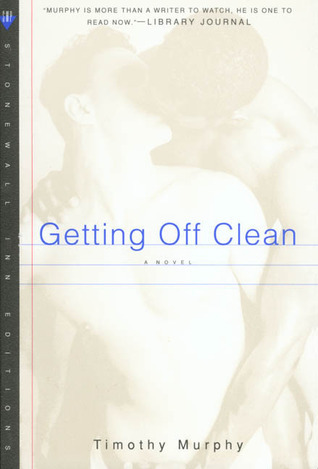
But first of all, I would like to underscore how misleading both the title and the design of the cover are. With the potential bad pun and the sexy image, I was expecting one of those naughty M/M Romance numbers that's quickly read and just as quickly forgotten. Fun and titillating in the moment but gone the next. How wrong I was.
Getting Off Clean is in fact an engrossing, literary coming of age/coming out story with much depth, where the love story is rather secondary to more serious themes such as white male privilege and the effects of prejudice.
By uncharacteristically (for its genre and time) bringing together a black and a white character, and switching expected social positions (the white character is poor, while the black one is rich), Murphy can highlight social racism to great effect. It is also interesting to note that there is a disabled character that features fairly prominently. Considering that the book was published in 1997, it feels incredibly "woke" and still very relevant to more current preoccupations around diversity. More much more recent "gay books" don't even attempt to cover that sort of ground.
The writing is generally very good and gripping (despite a few odd corners, such as, mostly notably, the repeated use of "kneejerk" as an adverb!). My big issues with the book, however, are as follows:
Brooks, the love interest of the hero, Eric, is a total asshole (as Eric points out himself) and as such the relationship is not believable. It's never really clear what attracts sweet, slightly naive Eric to the mean, self-loathing and sarcastic Brooks and makes him fall in love. And while that's the case, it seems odd that this first-love should not be more all-consuming for the hero.
The ending, of the clichéd show-down-at-the-graduation-ceremony type, is not only disappointing, it feels much too artificial. It is also overly melodramatic for the rest of the story, and as such is both unsubtle and devoid of much meaning.
Despite this, there is much to like in this powerful page-turner of a book. A very pleasant surprise.
But first of all, I would like to underscore how misleading both the title and the design of the cover are. With the potential bad pun and the sexy image, I was expecting one of those naughty M/M Romance numbers that's quickly read and just as quickly forgotten. Fun and titillating in the moment but gone the next. How wrong I was.
Getting Off Clean is in fact an engrossing, literary coming of age/coming out story with much depth, where the love story is rather secondary to more serious themes such as white male privilege and the effects of prejudice.
By uncharacteristically (for its genre and time) bringing together a black and a white character, and switching expected social positions (the white character is poor, while the black one is rich), Murphy can highlight social racism to great effect. It is also interesting to note that there is a disabled character that features fairly prominently. Considering that the book was published in 1997, it feels incredibly "woke" and still very relevant to more current preoccupations around diversity. More much more recent "gay books" don't even attempt to cover that sort of ground.
The writing is generally very good and gripping (despite a few odd corners, such as, mostly notably, the repeated use of "kneejerk" as an adverb!). My big issues with the book, however, are as follows:
Brooks, the love interest of the hero, Eric, is a total asshole (as Eric points out himself) and as such the relationship is not believable. It's never really clear what attracts sweet, slightly naive Eric to the mean, self-loathing and sarcastic Brooks and makes him fall in love. And while that's the case, it seems odd that this first-love should not be more all-consuming for the hero.
The ending, of the clichéd show-down-at-the-graduation-ceremony type, is not only disappointing, it feels much too artificial. It is also overly melodramatic for the rest of the story, and as such is both unsubtle and devoid of much meaning.
Despite this, there is much to like in this powerful page-turner of a book. A very pleasant surprise.

August 19, 2012
When I had read this novel quite a few years ago, it's still becomes fresh in my mind. It had become one of my favourite coming-of-age stories. I couldn't put the novel down at times and ended up losing a bit of sleep over it.
Two teenage boys: Eric Fitzpatrick - an Italian-Irish teen from a working-class family in Boston. And Brooks - a wealthy, black student at a local prep school. Living different lifestyles all of a sudden meet and things change for them and their emotions for each other, especially from Eric. Despite Eric's wants and needs to leave his life of leaving the racially tense town, meeting Brooks changes everything in a span from September 1986 - April 1987.
This story is told in the first person character of Eric. And as I was reading the story, I find that it doesn't matter if you're gay or straight, race, unfortunately, still has a major factor for most communities. What's even worse is that the gay issue makes it twice as worse. But throughout the novel, you start to picture how these two overcome every obstacle they come across from their families, community, and even themselves. Remember, it's the late 80's, and either coming out as or being gay was NOT something ever accepted when religion is still passionately strong within people's being.
Without giving away the ending... in my opinion, it was both bittersweet and satisfying at the same time for both Eric and Brooks. But that's just my opinion.
Two teenage boys: Eric Fitzpatrick - an Italian-Irish teen from a working-class family in Boston. And Brooks - a wealthy, black student at a local prep school. Living different lifestyles all of a sudden meet and things change for them and their emotions for each other, especially from Eric. Despite Eric's wants and needs to leave his life of leaving the racially tense town, meeting Brooks changes everything in a span from September 1986 - April 1987.
This story is told in the first person character of Eric. And as I was reading the story, I find that it doesn't matter if you're gay or straight, race, unfortunately, still has a major factor for most communities. What's even worse is that the gay issue makes it twice as worse. But throughout the novel, you start to picture how these two overcome every obstacle they come across from their families, community, and even themselves. Remember, it's the late 80's, and either coming out as or being gay was NOT something ever accepted when religion is still passionately strong within people's being.
Without giving away the ending... in my opinion, it was both bittersweet and satisfying at the same time for both Eric and Brooks. But that's just my opinion.
March 29, 2023
Honestly one of my fav queer books, it really is a simple yet magical story, the characters are so beautifully written and i was thinking about this book for months on months.

April 23, 2013
This coming of age tale focusses on 17-years-old sensible working class Eric Fitzpatrick who works hard at school and spends nights working at a sandwich bar as part of his plan to move away to college. Racial divisions and tensions are high in his local community post the rape and murder of a local white girl. Eric knows he’s gay but hasn’t acted on his sexual desires – mainly because the lack of opportunity to date. In the meantime, he plays it straight and hangs out with his closest friends at school Charlie and Phoebe (punk rock hippie non-conformist types), tries to avoid Phoebe’s romantic overtures, plays peacemaker to his volatile sister and mother’s battles at home, stays out of the way of his sister’s homophobic Italian cop boyfriend, and looks after his mentally challenged younger sister as well as physically ill staunchly Catholic grandmother. What a hero … Eric would be first in line for all sorts of academic and humanitarian medals should they be given out in his local community.
But …. Eric’s world gets turned upside down when a 'total opposite' boy walks into his sandwich bar shift one evening and gives him much attitude over placing his order. Brooks is a slightly older and wealthy black student from a nearby privileged private prep school – carefree, hedonistic and seemingly fearless of any personal consequence. The ensuing friendship and developing relationship with Brooks pushes all of Eric’s boundaries and standards – will Eric end up abandoning his friends, family and community for a lover who may not be all who he says he is. Would Eric’s gamble and risk to give up everything be worth it in the end?
As his final year comes to an end, Eric wins a significant writing competition and makes the academic honour roll. In stark contrasting this – home front family tensions explode around his sister and mother and Brooks gets embroiled in the local community and law enforcement’s drive to vindicate the white girl’s murder. How will Eric keep his squeaky clean record / image but yet help his headstrong and devil-may-care boyfriend? Does Eric have what it takes to stand up for himself, his lover and his family in the end? Will he be willing to lose everything to find himself in the end? A good solid read, engaging plot with a couple of not always likeable albeit meaty characters and great dialogue. A recommended read.
But …. Eric’s world gets turned upside down when a 'total opposite' boy walks into his sandwich bar shift one evening and gives him much attitude over placing his order. Brooks is a slightly older and wealthy black student from a nearby privileged private prep school – carefree, hedonistic and seemingly fearless of any personal consequence. The ensuing friendship and developing relationship with Brooks pushes all of Eric’s boundaries and standards – will Eric end up abandoning his friends, family and community for a lover who may not be all who he says he is. Would Eric’s gamble and risk to give up everything be worth it in the end?
As his final year comes to an end, Eric wins a significant writing competition and makes the academic honour roll. In stark contrasting this – home front family tensions explode around his sister and mother and Brooks gets embroiled in the local community and law enforcement’s drive to vindicate the white girl’s murder. How will Eric keep his squeaky clean record / image but yet help his headstrong and devil-may-care boyfriend? Does Eric have what it takes to stand up for himself, his lover and his family in the end? Will he be willing to lose everything to find himself in the end? A good solid read, engaging plot with a couple of not always likeable albeit meaty characters and great dialogue. A recommended read.
July 17, 2021
Feeling torn about this book. I thoroughly enjoyed reading it and the characters are very well defined but the ending is just so incredibly melodramatic and unbelievable.

June 9, 2011
One of my favourite books. It left a deep impression me and I related to Eric as he struggled to come up and come out in an intolerant, racially tense environment. Brooks is one of those characters that feels like no one you know yet some one you would like to invite to a dinner party.
I defintely intend to purchase a copy of this book for my shelf.
I defintely intend to purchase a copy of this book for my shelf.

June 13, 2014
It's been a while since I read this book, but I just remember how much I loved reading it. Eric was so easy to relate to and Brooks was a mystery, but an intriguing one. While both of them were far more in their heads than most high schoolers I know, they were believable. A great coming-out story that also addresses issues of race and class. A very enjoyable read.
Displaying 1 - 12 of 12 reviews