

What do you think?
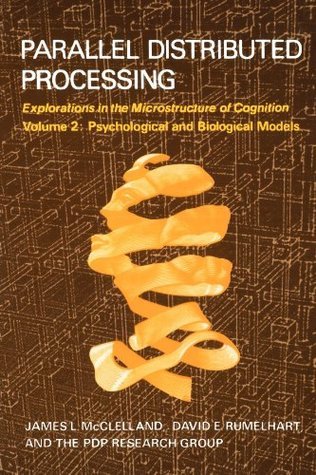
Parallel Distributed Processing: Explorations in the Microstructure of Cognition: Volume 2: Psychological and Biological Models
What makes people smarter than computers? These volumes by a pioneeringneurocomputing group suggest that the answer lies in the massively parallelarchitecture of the human mind. They describe a new theory of cognition calledconnectionism that is challenging the idea of symbolic computation that hastraditionally been at the center of debate in theoretical discussions about themind.The authors' theory assumes the mind is composed of a great number ofelementary units connected in a neural network. Mental processes are interactionsbetween these units which excite and inhibit each other in parallel rather thansequential operations. In this context, knowledge can no longer be thought of asstored in localized structures; instead, it consists of the connections betweenpairs of units that are distributed throughout the network.Volume 1 lays thefoundations of this exciting theory of parallel distributed processing, while Volume2 applies it to a number of specific issues in cognitive science and neuroscience, with chapters describing models of aspects of perception, memory, language, andthought.David E. Rumelhart is Professor of Psychology at the University ofCalifornia, San Diego. James L. McClelland is Professor of Psychology atCarnegie-Mellon University. A Bradford Book.
632 pages, Paperback
First published June 1, 1986
Ratings & Reviews
Friends & Following
Create a free account to discover what your friends think of this book!
Community Reviews
Displaying 1 - 1 of 1 review

June 18, 2021
Since 1988 wanted to read this...
Classics
Classics
Displaying 1 - 1 of 1 review