

What do you think?
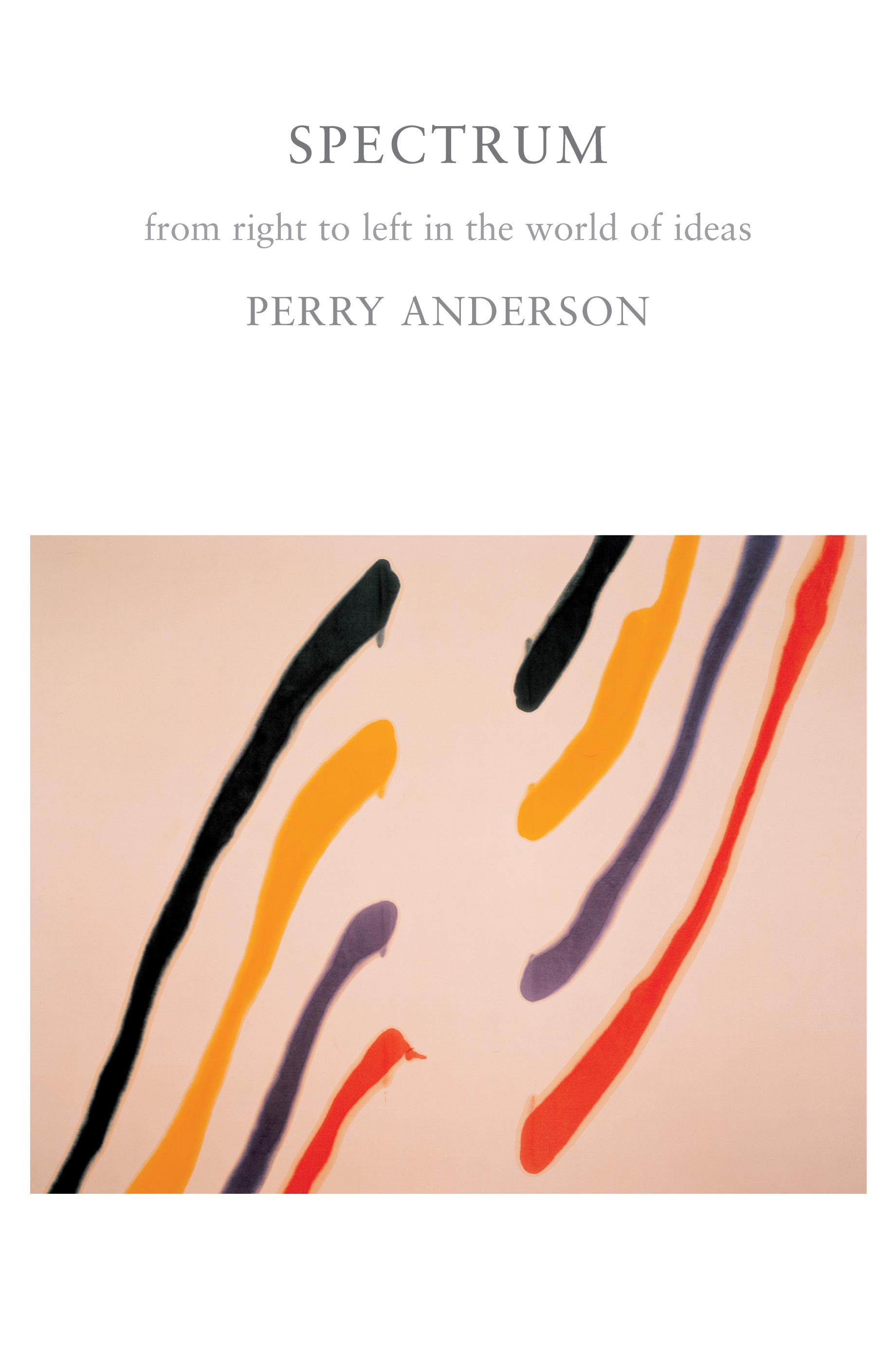
Spectrum: From Right to Left in the World of Ideas
Perry Anderson, eminent historian of the New Left, assesses the competing claims of rival intellectual groupings from the far right, the liberal centre and the Marxist left.
The focus of Spectrum is the range of contemporary ideas that runs from conservative to liberal to radical conceptions of state and society, rarely considered in the same optic. It looks at the theories of major minds of the twentieth-century Right, including Carl Schmitt, Leo Strauss and Friedrich von Hayek; liberal philosophers such as John Rawls, Jurgen Habermas and Norberto Bobbio; and significant figures in the culture of the Left: the historians Edward Thompson, Robert Brenner and Eric Hobsbawm; the classicist Sebastiano Timpanaro; the sociologist Goran Therborn; the novelist Gabriel Garcia Marquez. The book concludes with some comparative observations on the two leading intellectual periodicals of the UK and USA, the London Review of Books and New York Review of Books; and a piece of family history.
The focus of Spectrum is the range of contemporary ideas that runs from conservative to liberal to radical conceptions of state and society, rarely considered in the same optic. It looks at the theories of major minds of the twentieth-century Right, including Carl Schmitt, Leo Strauss and Friedrich von Hayek; liberal philosophers such as John Rawls, Jurgen Habermas and Norberto Bobbio; and significant figures in the culture of the Left: the historians Edward Thompson, Robert Brenner and Eric Hobsbawm; the classicist Sebastiano Timpanaro; the sociologist Goran Therborn; the novelist Gabriel Garcia Marquez. The book concludes with some comparative observations on the two leading intellectual periodicals of the UK and USA, the London Review of Books and New York Review of Books; and a piece of family history.
416 pages, Paperback
First published January 1, 2005
About the author
Perry Anderson
131 books278 followersPerry Anderson is an English Marxist intellectual and historian. He is Professor of History and Sociology at UCLA and an editor of the New Left Review. He is the brother of historian Benedict Anderson.
He was an influence on the New Left. He bore the brunt of the disapproval of E.P. Thompson in the latter's The Poverty of Theory, in a controversy during the late 1970s over the scientific Marxism of Louis Althusser, and the use of history and theory in the politics of the Left. In the mid-1960s, Thompson wrote an essay for the annual Socialist Register that rejected Anderson's view of aristocratic dominance of Britain's historical trajectory, as well as Anderson's seeming preference for continental European theorists over radical British traditions and empiricism. Anderson delivered two responses to Thompson's polemics, first in an essay in New Left Review (January-February 1966) called "Socialism and Pseudo-Empiricism" and then in a more conciliatory yet ambitious overview, Arguments within English Marxism (1980).
http://en.wikipedia.org/wiki/Perry_An...
He was an influence on the New Left. He bore the brunt of the disapproval of E.P. Thompson in the latter's The Poverty of Theory, in a controversy during the late 1970s over the scientific Marxism of Louis Althusser, and the use of history and theory in the politics of the Left. In the mid-1960s, Thompson wrote an essay for the annual Socialist Register that rejected Anderson's view of aristocratic dominance of Britain's historical trajectory, as well as Anderson's seeming preference for continental European theorists over radical British traditions and empiricism. Anderson delivered two responses to Thompson's polemics, first in an essay in New Left Review (January-February 1966) called "Socialism and Pseudo-Empiricism" and then in a more conciliatory yet ambitious overview, Arguments within English Marxism (1980).
http://en.wikipedia.org/wiki/Perry_An...
Ratings & Reviews
Friends & Following
Create a free account to discover what your friends think of this book!
Community Reviews
Displaying 1 - 11 of 11 reviews
May 14, 2008
Magisterial essays on political thinkers. Anderson's style is perfect and the intelligence oozes off the page. (Careful where you put it down!) Same style as in A Zone of Engagement -- first the precise, sympathetic precis, then the identification of points of tension or obscurity or contradiction, which gradually develop into a critique so ferocious that in the end no two stones are left standing ... with a final sentence or two of praise for the ruins. That's true, at least, of the first set of essays, on conservative thinkers -- Oakeshott, Schmitt, Hayek, etc. -- and the second, on Rawls, Habermas and Bobbio (the latter two repeat engagements from the earlier book.) The later essays, on figures he's more unambivalently admiring of, feel a bit different.
It lacks the clear focus of A Zone of Engagement, which was more or less explicitly test-driving possible successor theories to Marxism (none were satisfactory) but it's just as precise in laying out the key concerns of the various thinkers, the debates they were part of, and their limitations. And the writing! He crafts his sentences as carefully as Henry James.
It lacks the clear focus of A Zone of Engagement, which was more or less explicitly test-driving possible successor theories to Marxism (none were satisfactory) but it's just as precise in laying out the key concerns of the various thinkers, the debates they were part of, and their limitations. And the writing! He crafts his sentences as carefully as Henry James.

July 4, 2014
I've had this book sitting on my shelves for a few years now and I finally pulled it off the shelves because I fancied reading some essays and Verso are a reliably excellent publisher. Perry Anderson enjoys a very high reputation amongst a very small group of people. He's the former editor of the New Left Review and an influential Marxist. This book is a collection of his essays on important thinkers ranging from the right, through the centre to figures on the left, ranging from Hayek to Hobsbawm. He is an old school Mandarin, utilizing a vocabulary full of words that the reader probably has never encountered before and will not again. He is also a polymath with a very impressive command of history, politics, sociology and economics at his fingertips. I found the book interesting and educational, but I have to admit I found it less engaging than comparable essay collections by the likes of Christopher Hitchens or Tony Judt. Well worth reading, but it didn't give me the jolt of having my thinking profoundly changed or challenged that other essay collections have before.

July 27, 2009
Here we have an essayist dancing nimbly over the loftiest and most derivative material. Philosophy. History. Politics. Sociology. All are handled with ease and dexterity. With commentary as humbling as it is penetrating, Anderson proves himself a synoptist of the first order; no subject too complex for his distillations; no thinker outbounding his intellectual cartography.
Is there an writer that sees through the opaque geological strata of history as lucidly as Perry Anderson?? Only Christopher Hitchens can be mentioned in the same breath.
Is there an writer that sees through the opaque geological strata of history as lucidly as Perry Anderson?? Only Christopher Hitchens can be mentioned in the same breath.

June 11, 2020
This book is split up into four sections, dealing with the right, the centre, the left, and the author's "debts", and collects essays published mostly in the London Review of Books, with a few more from the New Left Review (which he formerly edited) and elsewhere.
The highlight of the first section is an essay that deals with what Anderson calls "the intransigent right" (Schmitt, Strauss, Hayek, and Oakeshott), and points out the affinities of their thought, which share an opposition to popular sovereignty, and a possible motivation by the experience of interwar political tumult. This project instantiates itself in the thought of Hayek and Oakeshott as a political theory that demands the state be driven entirely by procedural norms rather than the pursuit of concrete goals.
The middle section ends with a critical investigation of the liberal centre's cheerleading of military adventurism abroad through readings of Rawls, Habermas, and Bobbio. The individual essays on Rawls and Habermas are also quite good, sharp and critical while always meeting those authors on their own terms. They skewer the weakness of any social theory that at once avoids the stringent demands of abstract philosophy while failing to engage with its objects of inquiry as they actually exist.
The third section, dealing with leftist writers, has two particularly good long essays. One is on Robert Brenner, and reads his work on the transition from feudalism to capitalism (which started the "Brenner debate") alongside his more recent work on global economic history after 1945. Similarly, the long essay on Eric Hobsbawm counterpoises his autobiography with his trilogy on the "long nineteenth century" and his long volume on the "short twentieth century", while also serving as a history and a diagnosis of the "vanquished left".
Similarly, the final essay of the book is a biographical piece on his father, "an Anglo-Irishman in China" who worked for the Chinese Maritime Customs Service, but the narrative doesn't shy away from the complicated political contexts that influenced the institution he served, one inextricably bound to the grand triumphs and tragedies of Chinese history in the first half of the twentieth century, with its warlord cliques, foreign imperialists, and unruly citizenry.
What is great about Anderson's writing is that he is never tempted to transform the world of ideas into a sterile arena for sophistry, but is always concerned with the social and historical contexts of those ideas. Thus his essay on the intransigent right ends with an acknowledgement of their lasting influence on conservative governments in the anglophone world, and his critique of Rawls and Habermas is grounded as much on the social realities of the world they purport to describe as on the weaknesses of their theoretical apparatus. Conversely, his admiration for the historical and empirical investigations of Thompson, Brenner, and Hobsbawm does not dissuade him from pointing out alternative theories, interpretations, and possibilities when they might add something to the raw material already unearthed.
The highlight of the first section is an essay that deals with what Anderson calls "the intransigent right" (Schmitt, Strauss, Hayek, and Oakeshott), and points out the affinities of their thought, which share an opposition to popular sovereignty, and a possible motivation by the experience of interwar political tumult. This project instantiates itself in the thought of Hayek and Oakeshott as a political theory that demands the state be driven entirely by procedural norms rather than the pursuit of concrete goals.
The middle section ends with a critical investigation of the liberal centre's cheerleading of military adventurism abroad through readings of Rawls, Habermas, and Bobbio. The individual essays on Rawls and Habermas are also quite good, sharp and critical while always meeting those authors on their own terms. They skewer the weakness of any social theory that at once avoids the stringent demands of abstract philosophy while failing to engage with its objects of inquiry as they actually exist.
The third section, dealing with leftist writers, has two particularly good long essays. One is on Robert Brenner, and reads his work on the transition from feudalism to capitalism (which started the "Brenner debate") alongside his more recent work on global economic history after 1945. Similarly, the long essay on Eric Hobsbawm counterpoises his autobiography with his trilogy on the "long nineteenth century" and his long volume on the "short twentieth century", while also serving as a history and a diagnosis of the "vanquished left".
Similarly, the final essay of the book is a biographical piece on his father, "an Anglo-Irishman in China" who worked for the Chinese Maritime Customs Service, but the narrative doesn't shy away from the complicated political contexts that influenced the institution he served, one inextricably bound to the grand triumphs and tragedies of Chinese history in the first half of the twentieth century, with its warlord cliques, foreign imperialists, and unruly citizenry.
What is great about Anderson's writing is that he is never tempted to transform the world of ideas into a sterile arena for sophistry, but is always concerned with the social and historical contexts of those ideas. Thus his essay on the intransigent right ends with an acknowledgement of their lasting influence on conservative governments in the anglophone world, and his critique of Rawls and Habermas is grounded as much on the social realities of the world they purport to describe as on the weaknesses of their theoretical apparatus. Conversely, his admiration for the historical and empirical investigations of Thompson, Brenner, and Hobsbawm does not dissuade him from pointing out alternative theories, interpretations, and possibilities when they might add something to the raw material already unearthed.

June 14, 2025
Once upon a time Marxist historians analyzed ideas in their relationship to the class struggle. Not here. In a sign of the declining significance of class, to intellectuals at any rate, these brilliant yet strangely cold analytical gems are utterly detached from politics. The darlings of the right, Michael Oakeshoatte, Frederich von Hayek, Leo Strauss, and Carl Schmitt, are diagnosed in terms of other philosophers of the Global North, while left-wing historians, including old Perry frenemy Edward Thompson, in a most moving obituary, and bitter foe Eric Hobsbawn, in a scathing review of THE AGE OF EXTREMES,"The Defeated Left", come in for scrutiny to the degree that their analysis of twentieth century politics proved prophetic or bankrupt. Perry Anderson is obviously more in sympathy with the intellectual center, Jurgen Habermas, John Rawls, and Noberto Bobbio, while bemoaning their right-wing turn around the time of Clinton and the 1990s Balkan Wars. (But, then again, according to Anderson, maybe Rawls's "decline in old age" explains his bellicosity.) This collection of essays is a must for students of political philosophy and a sad testament to the decline of Marxism as an explanatory tool for changing the world.

June 14, 2023
Este libro ha sido de los que me ha costado este curso (lo empecé a leer allá por septiembre), tanto por su considerable tamaño como por su composición desordenada. Aborda -como reza el subtítulo- diversos autores de derecha a izquierda en el siglo XX y comienzos del XXI. Pensadores muy diversos y procedentes de campos muy diversos: historia, literatura, filosofía, periodismo, política.
Por lo general el estilo de Anderson es agudo y crítico; se le da bien esto de la biografía intelectual. Especialmente recomendable los capítulos de la derecha intransigente (Schmitt, Strauss, Hayek y Oakeshott), la izquierda liberal (Rawls, Bobbio y Habermas) y el de Eric Hobsbawm. La pega: hay muchos capítulos de personales del mundo anglosajón completamente infumables.
Por lo general el estilo de Anderson es agudo y crítico; se le da bien esto de la biografía intelectual. Especialmente recomendable los capítulos de la derecha intransigente (Schmitt, Strauss, Hayek y Oakeshott), la izquierda liberal (Rawls, Bobbio y Habermas) y el de Eric Hobsbawm. La pega: hay muchos capítulos de personales del mundo anglosajón completamente infumables.

March 5, 2026
Batı Marksizmi'nin (ve Yeni Sol'un) entelektüel tarihini, Habermas'tan Rawls'a, Bobbio'dan Hobsbawm'a kadar sağdan ve soldan yirmiye yakın düşünürü eleştirerek inceleyen, ağır sıklet bir teorik eserdir. Anderson, sosyalist hareketin 1970'lerden sonra yaşadığı tarihsel yenilgiyi ve siyasal geri çekilişi, bu düşünürlerin teorik tavizleri ve liberalizme kayışları üzerinden acımasızca teşhir eder. Devrimci bir sınıf siyasetinden vazgeçip, sadece "insan hakları" ve "demokrasi" sınırlarına hapsolan günümüz entelijansiyasının haritasını çıkarır. Teorik uzlaşmazlığın ve Leninist dirayetin ne kadar elzem olduğunu hatırlatan muazzam bir eleştiri kitabıdır.

January 24, 2008
Highlights are definitely the essays on Rawls/Habermas/Bobbio, and the story of his father's work in China. His analysis is always cutting but fair, and his writing is so precise, although the style is just slightly more relaxed than in his early historical stuff, where it's just devastatingly perfect. A couple of the pieces in the middle weren't really necessary but this is well worth reading.

March 3, 2020
A low quality work from another academic bureaucrat: many empty words, and you have to believe him the facts as the numbers are the reason Anderson had to choose between the Humanities and a job flipping burgers at McDonald's. Cute, vacuous phrasing like:
> The first, and ultimately the least important, [...]
> The first, and ultimately the least important, [...]

January 28, 2011
Inosculating intellectual profiles of conservative dramatis personae - Hayak, Schmitt, Oakeshott, Strauss - and their left wing "counterparts" - Habermas, Thompson, Hobsbawn. By turns conversational and erudite, polymathic and dry.

November 27, 2007
Lots of essays, most of them incomprehensible. Of all the books we read during the semester, this is the one my class hated most. And believe me, that says a lot.
Displaying 1 - 11 of 11 reviews