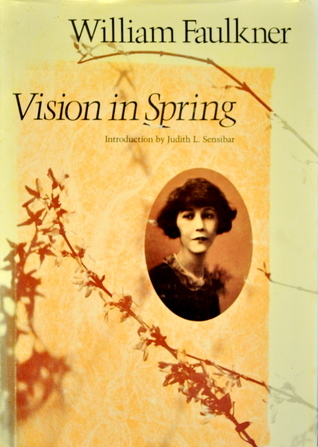
Acknowledgments Introduction to Vision in Spring Vision in Spring by W. Faulkner A note on the text Appendix A: list of known versions of poems in Vision in Spring Appendix B: Vision in Spring fragments
William Cuthbert Faulkner was an American writer. He is best known for his novels and short stories set in the fictional Yoknapatawpha County, Mississippi, a stand-in for Lafayette County where he spent most of his life. A Nobel laureate, Faulkner is one of the most celebrated writers of American literature and often is considered the greatest writer of Southern literature. Faulkner was born in New Albany, Mississippi, and raised in Oxford, Mississippi. During World War I, he joined the Royal Canadian Air Force, but did not serve in combat. Returning to Oxford, he attended the University of Mississippi for three semesters before dropping out. He moved to New Orleans, where he wrote his first novel Soldiers' Pay (1925). He went back to Oxford and wrote Sartoris (1927), his first work set in the fictional Yoknapatawpha County. In 1929, he published The Sound and the Fury. The following year, he wrote As I Lay Dying. Later that decade, he wrote Light in August, Absalom, Absalom! and The Wild Palms. He also worked as a screenwriter, contributing to Howard Hawks's To Have and Have Not and The Big Sleep, adapted from Raymond Chandler's novel. The former film, adapted from Ernest Hemingway's novel, is the only film with contributions by two Nobel laureates. Faulkner's reputation grew following publication of Malcolm Cowley's The Portable Faulkner, and he was awarded the 1949 Nobel Prize in Literature for "his powerful and unique contribution to the modern American novel." He is the only Mississippi-born Nobel laureate. Two of his works, A Fable (1954) and The Reivers (1962), won the Pulitzer Prize for Fiction. Faulkner died from a heart attack on July 6, 1962, following a fall from his horse the month before. Ralph Ellison called him "the greatest artist the South has produced".
Sometimes an idea or a theme gets lodged in a poet's brain and there's no shaking it loose. The fever must run its course, and the poet will try to write down words to net the evasive vision-fragment that always seems to slip away. Revision leads to revision; one attempt is shelved to make way for a new approach. Always the refinement effort goes on and on, beach pebbles tumbling in the surf, sharp edges knocked off, smoothed out, polishing the original conception away beyond recovery. We can see the effects of this buffing process to different degrees in a pair of Bob Dylan songs from the early 1960s: "Lay Down Your Weary Tune" and "Chimes of Freedom." Both involve a poet preoccupied with conveying his esthesis of the concrete world being itself a phenomenal expression of deeper musical forms. Joan Baez suggested that Dylan used to put his audience to sleep with his performances of "Lay Down Your Weary Tune." "Chimes of Freedom," on the contrary, is poetic brilliance of a more immediately recognizable variety, even if it never achieved the repute of Dylan's greatest hits.
The first third of Faulkner's Vision in Spring is closer in effectiveness to "Lay Down Your Weary Tune" than it is to "Chimes of Freedom." Here Faulkner is abstract to the point of disjunction with the real world that awaits on our doorsteps. Characters and setting and action are absent, or if they are not absent then they might as well be, for the reward of trying to seek them out defies the effort that would be required. Faulkner's poetic control is fine enough, and I reject his claim that he was the "failed poet" he always claimed to be, but poetry also requires toeholds that the audience, or the readers, can latch onto. Effective poetry requires striking imagery, and usually if not characters, then a feeling or a notion that expands through time: it requires a reason to be read, to be experienced: it needs to evoke a sympathetic emotional response. But the first third of Vision in Spring lacks this fundamental ability to connect. It puts the audience/reader to sleep with its simplistic and infernally repetitious language isolated from any sense of place or passage of time. It is a long, softly lapping lagoon of unexciting ― indeed, of uninteresting ― words. Sluggish as "Lay Down Your Weary Tune" may be, at least that song is not uninteresting.
Faulkner began his abortive career in poetry in about 1916 when he was nineteen years old, so he was about as good a poet as he was ever going to be by the time he got around to 1921's Vision in Spring (he started writing his first novel, Soldiers' Pay, in 1925). This book, or booklet, is deeply informed by the same conceit that would preoccupy Bob Dylan almost four decades later, that the bones of the world are musical forms, that what we see and experience in the world are physical expressions of music. In the Introduction to Vision in Spring Judith L Sensibar provides a fine accounting for why this should be, and also why we should view this particular poem-cycle of Faulkner's as evidence of the beginning of his transformation into a Modernist writer, or at least a Modernist thinker. I won't challenge Sensibar too much on her opinions or conclusions. Most definitely in the last two thirds of Vision in Spring Faulkner has become conspicuously influenced by TS Eliot in particular. Although what results is unfortunately blatantly derivative, the result is to impose a focus in the poems which the preceding material lacked. The audience/reader begins to waken, as now there are characters and motion and action and emotion present. We begin to have something to cling too, even if we've seen this movie before.
Here Faulkner is zeroed in on an abundance of small details that inflate voluminously outward from very small foci in time and space. It can be thought of as a scaled-down version of the near-infinite expansion we encounter in Joyce's Ulysses, for example, or perhaps it is a harbinger of the tumescent distension we'll eventually find in Absalom, Absalom! As poetry Vision in Spring eventually becomes tolerable, although it lacks power or any compelling voice. It never comes close to challenging "Chimes of Freedom." It remains a ghostly whisper, but one which suggests that maybe change is on the way.
Faulkner called himself “a failed poet,” and this book is a collection of some of the poems that he wrote before his first novel. Of course that’s too pat a dismissal. You can see Faulkner working on his craft here, and the diction gets stronger through the collection. But it’s definitely juvenilia, and worth reading mainly to understand where he was as a writer before he was a novelist.
By his own admission, William Faulkner was a failed poet. Faulkner wrote the majority of his poetry before transitioning to fiction, and certainly before achieving critical and commercial success. Most of the people familiar with Faulkner’s poetry are Faulkner scholars---academics who can analyze his poetry and note its influences on his fiction. With this in mind, Vision in Spring, a sequence of fourteen love poems, will be of interest to most readers not for the poetry itself, which is not strong work, but for how “his poetry in general and this sequence in particular inform the intention, the mode, and the moral preoccupations of his great fiction.” Faulkner wrote Vision in Spring, bound it by hand, and gave it to Estelle Oldham Franklin, his future wife, during the summer of 1921. It is debatable whether Faulkner intended for these poems to see a larger audience beyond Estelle, and the manuscript for Vision in Spring has been lost. Jill Faulkner Summers, Faulkner’s daughter, recovered a photocopy of the sequence, and the University of Texas Press published Vision in Spring in 1984. Naturally, the question arises: Would these poems have seen the light of day if Faulkner had not achieved such prominence? Reading the sequence feels invasive, and I often felt embarrassed, as if I had glimpsed my best friend’s paraplegic mother wearing only soiled undergarments. Writers publish work when we’re ready, and not before. Yes, Vision in Spring shows a beginning writer experimenting with language, but the results are most often tedious and melodramatic. Alliteration and Faulkner’s poetic lines are the best of friends. Lines like, “Your formless flower face upon the dusk” and “…music dying down a monstrous brain” make for eye-rolling poetry, but they would certainly fit well as lyrics for contemporary goth songs. Enough. I could go on for paragraphs bemoaning the quality of work---the repetitive use of words and unimaginative rhyme schemes. There are, fortunately, two aspects to this version of Vision in Spring that are extremely interesting. Faulkner’s poetry has often been dismissed as juvenilia, but several of the poems in Vision in Spring focus on the theme of mortality. The maturity and beauty with which Faulkner approaches this subject shows his potential. In the poem “Portrait,” Faulkner writes, “You are so young. And frankly you believe/This world, this darkened street, this shadowed wall/Are bright with beauty you passionately know/Cannot fade nor cool nor die at all.” This outward contemplation of youth segues into introspection in “Love Song”: “And shall I walk these streets while passing time/Softly ticks my face, my thinning hair?/I should have been a priest in floorless halls/Wearing his eyes thin on a faded manuscript.” In Vision in Spring, Faulkner’s themes are more mature than the language he uses to express them, but his intentions, if nothing else, move these poems beyond the condescending label of juvenilia. His preoccupation with mortality also elevates the sequence beyond simple love poems. Judith L. Sensibar’s thorough, eloquent introduction is the second most appealing feature of this edition. She writes about these poems with respect and deep interest, and she makes an argument that Faulkner intended them for eventual publication. I would recommend the poems in Vision in Spring for only the most devoted Faulkner reader, but I encourage others to read Sensibar’s thoughts about Vision in Spring. Her explorations of these poem’s backgrounds, influences, themes, designs, and points of view could be more intelligent than the actual poems. Regardless, Sensibar asserts that Vision in Spring is “a cycle that signals and describes his (Faulkner’s) transformation from mediocre poet and dreamer to potentially brilliant novelist.”
This entire review has been hidden because of spoilers.
I purchased this book at my favorite used bookstore because I wanted to read some poetry and it is springtime! I know Faulkner by name and understand that he is considered an important writer. So, this collection was interesting for me.
Judith L. Sensibar’s introduction explains that Faulkner began his writing career as a poet. Well, he tried to. He spent several years writing poetry and seeking out publishers, but no one was very enthused. Sensibar argued that within his poetry he began to identify and experiment with the techniques, themes, and characters that would go on to describe his fiction.
The collection in question is considered the work that symbolizes his coming to terms with the fact that he would not become a published and acclaimed poet. It was at this time he began to transition to fiction.
Sensibar framed this poetry in a way that made me anticipate disliking it. First, she described it as difficult to understand and engage with. Secondly, she said it was derivative of modernists like T.S. Eliot, literally taking lines and ideas from these writers. I am not an expert on modernism by any means, but when I read Eliot's The Waste Land I didn't enjoy it. My major complaint focused on Eliot's ego and his sexism. Sensibar wrote about how badly Faulkner portrays women in this collection so I was not sure what to expect.
The text exceeded my expectations. I found it to be accessible. Beyond that, the surreal settings were not over the top. In addition to setting, Faulkner uses structure and repetition to ruminate on the topic at hand: mortality. Faulkner's narrator continues to reach towards his dreams. He never seems to succeed and is hopeless for the majority of the book. Faulker contrasts his character's experiences against the night sky, which represents death, something one cannot avoid. As the narrator grasps at minuscule hope that he will achieve his dreams and love, death looms. The end of the collection leaves us with a note of hope that the narrator will be able to move forward and experience pleasure before the inevitable, but due to the cycle of the collection, we know this won't happen.
I did not find the treatment of women in this collection offensive. The narrator is depressed and hopeless, pathetic really. His idealization and failure to achieve a relationship with a woman is a mere extension of that.
Commentary on this collection treat it like it is a small window into Faulkner's talent. If that's the case, I can't wait to read more of his work.
In 1921, when he was still largely unknown to the public, William Faulkner assembled a collection of poems for Estelle Franklin, a married musician that he had a crush on. Vision in Spring is hard to find, since it originally was not published and the version that eventually went too be printed had been copied from the gift; there was not a separate manuscript. The exact nature of their relationship is still largely unknown but Faulkner clearly wanted to win her over with his writing. The 14 poems he wrote for Estelle are mostly about love and music. Faulkner had the sheets of poems bound by hand in purple ribbon on old parchment; it’s hard to think of a more meaningful way of communicating his feelings. But upon reflection, the poems are not the best poems ever. They show signs of his emerging talent but they are unrefined. Some of the best ones are about music. He writes of the anticipation of the concert beginning, row upon row of expectant listeners, faces turned up expectantly. He writes of the dark that falls before the music opens and the pause in the music between movements. He wants to us (or wanted Estelle) to imagine harp and violin; the music ‘sighs and gropes and sings’ And he writes of love ~ being at a party and watching the gleam of light off hair, assuming a pose, cups and napkins everywhere…And then leaving unfulfilled Down a quiet street in the dark Alone… But for his soul It’s powerful and beautiful.
Faulkner, el poeta. Aunque él no se consideraba a sí mismo poeta. En este bello libro, despliega un talento que, si bien es diferente a la prosa a la que nos tiene acostumbrados, no es menos maravilloso. Esta faceta de Faulkner es, sin duda, fascinante pues demuestra a un hombre que amó, amó mucho a diversas mujeres a lo largo de su vida, pero quien, al parecer, jamás encontró el amor terrenal del que tanto se habla. Su frase "quizá tuvieron razón al encerrar el amor en los libros. Tal vez no podría vivir en ningún otro lugar" en Luz de agosto, una de sus grandes novelas, resulta más que adecuada para describir ese sentimiento, anhelado por todos y conseguido por pocos.
Although this may not be the most skillfully written poetry collection, the insight into Faulkner’s writing process that it provides certainly makes this worth reading. Additionally, I really felt that the emotional quality of the collection was palpable, a difficult feat to accomplish. I really was happy to read this and would give it 4 out of 5 stars.
This book makes it pretty obvious why Faulkner chose to give up poetry and focus on prose. It’s an interesting snapshot of a young author finding himself and the seeds of his later brilliance are definitely there but actually reading these poems is only necessary for the true Faulkner completionist. Sensibar’s introduction might actually be the most valuable part of the book.