

What do you think?
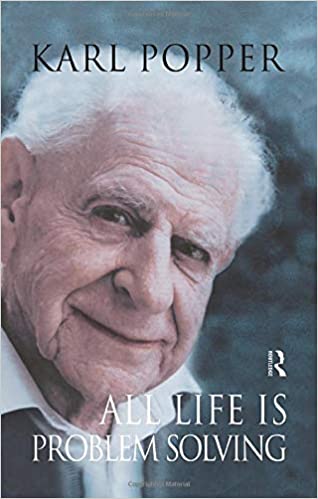
All Life is Problem Solving
'Never before has there been so many and such dreadful weapons in so many irresponsible hands.' - Karl Popper, from the Preface
All Life is Problem Solving is a stimulating and provocative selection of Popper's writings on his main preoccupations during the last twenty-five years of his life. This collection illuminates Popper's process of working out key formulations in his theory of science, and indicates his view of the state of the world at the end of the Cold War and after the collapse of communism.
All Life is Problem Solving is a stimulating and provocative selection of Popper's writings on his main preoccupations during the last twenty-five years of his life. This collection illuminates Popper's process of working out key formulations in his theory of science, and indicates his view of the state of the world at the end of the Cold War and after the collapse of communism.
184 pages, Paperback
First published January 1, 1994
About the author
Karl Popper
311 books1,793 followersSir Karl Raimund Popper, FRS, rose from a modest background as an assistant cabinet maker and school teacher to become one of the most influential theorists and leading philosophers. Popper commanded international audiences and conversation with him was an intellectual adventure—even if a little rough—animated by a myriad of philosophical problems. He contributed to a field of thought encompassing (among others) political theory, quantum mechanics, logic, scientific method and evolutionary theory.
Popper challenged some of the ruling orthodoxies of philosophy: logical positivism, Marxism, determinism and linguistic philosophy. He argued that there are no subject matters but only problems and our desire to solve them. He said that scientific theories cannot be verified but only tentatively refuted, and that the best philosophy is about profound problems, not word meanings. Isaiah Berlin rightly said that Popper produced one of the most devastating refutations of Marxism. Through his ideas Popper promoted a critical ethos, a world in which the give and take of debate is highly esteemed in the precept that we are all infinitely ignorant, that we differ only in the little bits of knowledge that we do have, and that with some co-operative effort we may get nearer to the truth.
Nearly every first-year philosophy student knows that Popper regarded his solutions to the problems of induction and the demarcation of science from pseudo-science as his greatest contributions. He is less known for the problems of verisimilitude, of probability (a life-long love of his), and of the relationship between the mind and body.
Popper was a Fellow of the Royal Society, Fellow of the British Academy, and Membre de I'Institute de France. He was an Honorary member of the Harvard Chapter of Phi Beta Kappa, and an Honorary Fellow of the London School of Economics, King's College London, and of Darwin College Cambridge. He was awarded prizes and honours throughout the world, including the Austrian Grand Decoration of Honour in Gold, the Lippincott Award of the American Political Science Association, and the Sonning Prize for merit in work which had furthered European civilization.
Karl Popper was knighted by Queen Elizabeth II in 1965 and invested by her with the Insignia of a Companion of Honour in 1982.
(edited from http://www.tkpw.net/intro_popper/intr...)
Popper challenged some of the ruling orthodoxies of philosophy: logical positivism, Marxism, determinism and linguistic philosophy. He argued that there are no subject matters but only problems and our desire to solve them. He said that scientific theories cannot be verified but only tentatively refuted, and that the best philosophy is about profound problems, not word meanings. Isaiah Berlin rightly said that Popper produced one of the most devastating refutations of Marxism. Through his ideas Popper promoted a critical ethos, a world in which the give and take of debate is highly esteemed in the precept that we are all infinitely ignorant, that we differ only in the little bits of knowledge that we do have, and that with some co-operative effort we may get nearer to the truth.
Nearly every first-year philosophy student knows that Popper regarded his solutions to the problems of induction and the demarcation of science from pseudo-science as his greatest contributions. He is less known for the problems of verisimilitude, of probability (a life-long love of his), and of the relationship between the mind and body.
Popper was a Fellow of the Royal Society, Fellow of the British Academy, and Membre de I'Institute de France. He was an Honorary member of the Harvard Chapter of Phi Beta Kappa, and an Honorary Fellow of the London School of Economics, King's College London, and of Darwin College Cambridge. He was awarded prizes and honours throughout the world, including the Austrian Grand Decoration of Honour in Gold, the Lippincott Award of the American Political Science Association, and the Sonning Prize for merit in work which had furthered European civilization.
Karl Popper was knighted by Queen Elizabeth II in 1965 and invested by her with the Insignia of a Companion of Honour in 1982.
(edited from http://www.tkpw.net/intro_popper/intr...)
Ratings & Reviews
Friends & Following
Create a free account to discover what your friends think of this book!
Community Reviews
Displaying 1 - 5 of 5 reviews

Read
February 22, 2025Wir wissen gar nichts 😧😧

February 5, 2020
Ich habe dieses Buch parallel zum Verfassen meiner Bachelorarbeit geschrieben und dadurch viele Erkenntnisse über das wissenschaftliche Arbeiten erhalten. Hat man einmal Popper gelesen, lässt einen seine Wissenschaftslogik nicht mehr los.

November 26, 2025
Der Mann am Rand des Regals entpuppt sich als der große biologische Optimist der Philosophie. Popper destilliert die gesamte Evolution – von der Amöbe bis zu Einstein – in eine entwaffnend einfache Gleichung: Wir raten, wir irren, und wir versuchen, dabei nicht zu sterben. Sein Standort am äußersten Rand ist kein Zufall, sondern ein philosophisches Arrangement: Dort steht er Wache, damit keines der Nachbarbücher heimlich in den Totalitarismus kippt. Als Türsteher der offenen Gesellschaft misstraut er jedem geschlossenen System und bewacht den Notausgang des Denkens. Denn das nächste Problem lauert garantiert irgendwo – und Popper möchte sicherstellen, dass wir noch beweglich genug sind, es zu lösen.
October 22, 2025
Ein faszinierendes und inspirierendes Buch! Popper schafft es, komplexe philosophische Gedanken verständlich und lebendig zu vermitteln. Seine zentrale Idee – dass Fortschritt nur durch das Lösen von Problemen entsteht – regt wirklich zum Nachdenken an. Ich habe viel über Wissenschaft, Erkenntnis und das Leben selbst gelernt. Kein einfaches Buch, aber unglaublich lohnend für alle, die gerne über den Tellerrand hinausdenken.
Das Buch habe ich zweimal gelesen, denn es hilft das Kausale irdische Leben auf unserem herrlichen Planeten Erde besser zu verstehen.
Das Buch habe ich zweimal gelesen, denn es hilft das Kausale irdische Leben auf unserem herrlichen Planeten Erde besser zu verstehen.
September 12, 2021
„Das Leben verbessert die Umwelt für das Leben. Es hat das seit Millionen von Jahren getan, und wir sind die glücklichen Erben.“ - Ein wundervolles, wunderschönes Buch, in dem Popper uns auffordert, uns selbst immer wieder in Frage zu stellen, um eine bessere Zukunft zu schaffen. Ich wünschte, ich hätte das Buch früher gelesen.
Displaying 1 - 5 of 5 reviews