

What do you think?
Current Studies in Linguistics
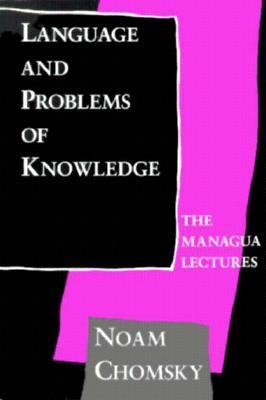
Language and Problems of Knowledge: The Managua Lectures
Language and Problems of Knowledge is Noam Chomsky's most accessible statement on the nature, origins, and current concerns of the field of linguistics. He frames the lectures with four fundamental questions: What do we know when we are able to speak and understand a language? How is this knowledge acquired? How do we use this knowledge? What are the physical mechanisms involved in the representation, acquisition, and use of this knowledge? Starting from basic concepts, Chomsky sketches the present state of our answers to these questions and offers prospects for future research. Much of the discussion revolves around our understanding of basic human nature (that we are unique in being able to produce a rich, highly articulated, and complex language on the basis of quite rudimentary data), and it is here that Chomsky's ideas on language relate to his ideas on politics.The initial versions of these lectures were given at the Universidad Centroamericana in Managua, Nicaragua, in March 1986. A parallel set of lectures on contemporary political issues given at the same time has been published by South End Press under the title On Power and Ideology: The Managua Lectures.Language and Problems of Knowledge is sixteenth in the series Current Studies in Linguistics, edited by Jay Keyser.
216 pages, Perfect Paperback
First published January 1, 1987
About the author
Noam Chomsky
1,011 books17.5k followersAvram Noam Chomsky is an American professor and public intellectual known for his work in linguistics, political activism, and social criticism. Sometimes called "the father of modern linguistics", Chomsky is also a major figure in analytic philosophy and one of the founders of the field of cognitive science. He is a laureate professor of linguistics at the University of Arizona and an institute professor emeritus at the Massachusetts Institute of Technology (MIT). Among the most cited living authors, Chomsky has written more than 150 books on topics such as linguistics, war, and politics. In addition to his work in linguistics, since the 1960s Chomsky has been an influential voice on the American left as a consistent critic of U.S. foreign policy, contemporary capitalism, and corporate influence on political institutions and the media.
Born to Ashkenazi Jewish immigrants (his father was William Chomsky) in Philadelphia, Chomsky developed an early interest in anarchism from alternative bookstores in New York City. He studied at the University of Pennsylvania. During his postgraduate work in the Harvard Society of Fellows, Chomsky developed the theory of transformational grammar for which he earned his doctorate in 1955. That year he began teaching at MIT, and in 1957 emerged as a significant figure in linguistics with his landmark work Syntactic Structures, which played a major role in remodeling the study of language. From 1958 to 1959 Chomsky was a National Science Foundation fellow at the Institute for Advanced Study. He created or co-created the universal grammar theory, the generative grammar theory, the Chomsky hierarchy, and the minimalist program. Chomsky also played a pivotal role in the decline of linguistic behaviorism, and was particularly critical of the work of B.F. Skinner.
An outspoken opponent of U.S. involvement in the Vietnam War, which he saw as an act of American imperialism, in 1967 Chomsky rose to national attention for his anti-war essay "The Responsibility of Intellectuals". Becoming associated with the New Left, he was arrested multiple times for his activism and placed on President Richard M. Nixon's list of political opponents. While expanding his work in linguistics over subsequent decades, he also became involved in the linguistics wars. In collaboration with Edward S. Herman, Chomsky later articulated the propaganda model of media criticism in Manufacturing Consent, and worked to expose the Indonesian occupation of East Timor. His defense of unconditional freedom of speech, including that of Holocaust denial, generated significant controversy in the Faurisson affair of the 1980s. Chomsky's commentary on the Cambodian genocide and the Bosnian genocide also generated controversy. Since retiring from active teaching at MIT, he has continued his vocal political activism, including opposing the 2003 invasion of Iraq and supporting the Occupy movement. An anti-Zionist, Chomsky considers Israel's treatment of Palestinians to be worse than South African–style apartheid, and criticizes U.S. support for Israel.
Chomsky is widely recognized as having helped to spark the cognitive revolution in the human sciences, contributing to the development of a new cognitivistic framework for the study of language and the mind. Chomsky remains a leading critic of U.S. foreign policy, contemporary capitalism, U.S. involvement and Israel's role in the Israeli–Palestinian conflict, and mass media. Chomsky and his ideas are highly influential in the anti-capitalist and anti-imperialist movements. Since 2017, he has been Agnese Helms Haury Chair in the Agnese Nelms Haury Program in Environment and Social Justice at the University of Arizona.
Born to Ashkenazi Jewish immigrants (his father was William Chomsky) in Philadelphia, Chomsky developed an early interest in anarchism from alternative bookstores in New York City. He studied at the University of Pennsylvania. During his postgraduate work in the Harvard Society of Fellows, Chomsky developed the theory of transformational grammar for which he earned his doctorate in 1955. That year he began teaching at MIT, and in 1957 emerged as a significant figure in linguistics with his landmark work Syntactic Structures, which played a major role in remodeling the study of language. From 1958 to 1959 Chomsky was a National Science Foundation fellow at the Institute for Advanced Study. He created or co-created the universal grammar theory, the generative grammar theory, the Chomsky hierarchy, and the minimalist program. Chomsky also played a pivotal role in the decline of linguistic behaviorism, and was particularly critical of the work of B.F. Skinner.
An outspoken opponent of U.S. involvement in the Vietnam War, which he saw as an act of American imperialism, in 1967 Chomsky rose to national attention for his anti-war essay "The Responsibility of Intellectuals". Becoming associated with the New Left, he was arrested multiple times for his activism and placed on President Richard M. Nixon's list of political opponents. While expanding his work in linguistics over subsequent decades, he also became involved in the linguistics wars. In collaboration with Edward S. Herman, Chomsky later articulated the propaganda model of media criticism in Manufacturing Consent, and worked to expose the Indonesian occupation of East Timor. His defense of unconditional freedom of speech, including that of Holocaust denial, generated significant controversy in the Faurisson affair of the 1980s. Chomsky's commentary on the Cambodian genocide and the Bosnian genocide also generated controversy. Since retiring from active teaching at MIT, he has continued his vocal political activism, including opposing the 2003 invasion of Iraq and supporting the Occupy movement. An anti-Zionist, Chomsky considers Israel's treatment of Palestinians to be worse than South African–style apartheid, and criticizes U.S. support for Israel.
Chomsky is widely recognized as having helped to spark the cognitive revolution in the human sciences, contributing to the development of a new cognitivistic framework for the study of language and the mind. Chomsky remains a leading critic of U.S. foreign policy, contemporary capitalism, U.S. involvement and Israel's role in the Israeli–Palestinian conflict, and mass media. Chomsky and his ideas are highly influential in the anti-capitalist and anti-imperialist movements. Since 2017, he has been Agnese Helms Haury Chair in the Agnese Nelms Haury Program in Environment and Social Justice at the University of Arizona.
Ratings & Reviews
Friends & Following
Create a free account to discover what your friends think of this book!
Community Reviews
Displaying 1 - 1 of 1 review

July 15, 2025
Die folgenden Anmerkungen und Reflexionen beziehen sich auf die deutsche Übersetzung von Noam Chomskys „Language and Problems of Knowledge“, die unter dem Titel Probleme sprachlichen Wissens in der Übersetzung von Michael Schiffmann erschienen ist. Leider ist gerade diese Ausgabe auf Plattformen wie Goodreads bislang nicht gelistet, was bedauerlich ist – nicht nur wegen der bibliografischen Lücken, sondern auch, weil Übersetzungen (und ihre jeweiligen Entscheidungen) einen erheblichen Einfluss auf die Rezeption philosophischer und linguistischer Werke haben.
Schiffmanns Übersetzung ist kenntnisreich, aber nicht unproblematisch: Sie folgt dem Original in Ton und Struktur zwar meist gewissenhaft, doch es finden sich immer wieder terminologische Unebenheiten und stilistische Glättungen, die die argumentative Schärfe des Originals mitunter abschwächen. Wer Chomskys Werk also aus der Perspektive der deutschen Übersetzung diskutiert, tut gut daran, diese zusätzliche interpretative Ebene mitzudenken.
In den späten 1970er- und frühen 1980er-Jahren war Nicaragua ein symbolisch aufgeladenes Terrain der globalen Systemkonkurrenz zwischen Nord und Süd, Kapitalismus und Sozialismus, Imperialismus und Selbstbestimmung. Das zentralamerikanische Land rückte 1979 schlagartig in das Zentrum der internationalen Aufmerksamkeit, als die Sandinistische Befreiungsfront (FSLN) nach Jahrzehnten des Widerstands den Somoza-Clan, eine brutale, von den USA gestützte Familiendiktatur, stürzte.
Die Somozas hatten das Land seit den 1930er-Jahren beherrscht – mit stillschweigender oder offener Billigung Washingtons. Erst unter Jimmy Carter (1977–1981) kam es zu einem Kurswechsel: Carter setzte erstmals in der US-Außenpolitik auf eine Rhetorik der Menschenrechte und stellte die Waffenlieferungen an das Regime ein – ein innenpolitisch umstrittener, aber außenpolitisch symbolträchtiger Schritt. Diese diplomatische Distanzierung bereitete indirekt den Weg für den revolutionären Machtwechsel im Juli 1979, als die Sandinisten triumphierend in Managua einzogen.
Mit dem Sturz der Somozas verband sich international eine doppelte Hoffnung: einerseits auf eine gerechtere Gesellschaftsordnung im Zeichen sozialistischer Reformen, andererseits auf eine Abkehr von der jahrzehntelangen neokolonialen Bevormundung durch die USA. Nicaragua wurde zum Experimentierfeld für eine neue politische Ökonomie der Peripherie – mit Alphabetisierungskampagnen, Landreformen und einer Betonung kultureller Emanzipation. Diese Phase wurde jedoch rasch durch neue Konfliktlinien überlagert.
Die sandinistische Regierung sah sich schon bald einer aggressiven Gegenoffensive der Reagan-Administration (ab 1981) gegenüber, die die sogenannten Contras – rechtsgerichtete Aufständische, oft ehemalige Somoza-Offiziere – logistisch, finanziell und paramilitärisch unterstützte. Die US-amerikanische Einmischung eskalierte zum offenen Stellvertreterkrieg, der Nicaragua in den 1980er-Jahren schwer erschütterte und internationale Solidarität ebenso mobilisierte wie Kritik an der US-Außenpolitik.
Chomskys Besuch in Managua 1986 – der Ursprung der Vorlesungen, die später als Language and Problems of Knowledge veröffentlicht wurden – war vor diesem Hintergrund mehr als eine akademische Geste. Es war eine politische Bekundung intellektueller Solidarität mit einem Land, das sich inmitten eines ideologisch aufgeladenen Ringens um Selbstbestimmung, Bildung und kulturelle Souveränität befand. Die Entscheidung, gerade dort über Sprache, Wissen und Erkenntnis zu sprechen, lässt sich auch als subtile Antwort auf die epistemische Arroganz des geopolitischen Nordens lesen.
Noam Chomsky diskutiert in seinen Vorlesungen die Spracherwerbsfähigkeit des Menschen, die er als ein angeborenes „Sprachorgan“ im Gehirn betrachtet. Er argumentiert, dass Kinder Sprache nicht durch Nachahmung oder umfassende Erfahrung lernen, sondern durch grundlegende, biologisch determinierte Prinzipien der „Universellen Grammatik“, die es ihnen ermöglichen, aus begrenzten Daten komplexe Sprachsysteme zu entwickeln. Chomsky hinterfragt traditionelle Ansichten, die Sprache als reines Gewohnheitssystem oder als Fähigkeit betrachten, und betont die Strukturabhängigkeit sprachlicher Regeln. Er vergleicht den Spracherwerb mit der körperlichen Entwicklung und schlägt vor, dass die menschliche Erkenntnisfähigkeit über die Sprache hinaus auch angeborene Eigenschaften für Moral, Kunst und sogar Mathematik umfasst. Insgesamt stellt er die menschliche Natur als einen Satz spezifischer, spezialisierter kognitiver Fähigkeiten dar, die durch die Umwelt „ausgelöst“ und geformt werden, aber nicht vollständig von ihr bestimmt sind.
FORTSETZUNG FOLGT!!!!!!!!!
Schiffmanns Übersetzung ist kenntnisreich, aber nicht unproblematisch: Sie folgt dem Original in Ton und Struktur zwar meist gewissenhaft, doch es finden sich immer wieder terminologische Unebenheiten und stilistische Glättungen, die die argumentative Schärfe des Originals mitunter abschwächen. Wer Chomskys Werk also aus der Perspektive der deutschen Übersetzung diskutiert, tut gut daran, diese zusätzliche interpretative Ebene mitzudenken.
In den späten 1970er- und frühen 1980er-Jahren war Nicaragua ein symbolisch aufgeladenes Terrain der globalen Systemkonkurrenz zwischen Nord und Süd, Kapitalismus und Sozialismus, Imperialismus und Selbstbestimmung. Das zentralamerikanische Land rückte 1979 schlagartig in das Zentrum der internationalen Aufmerksamkeit, als die Sandinistische Befreiungsfront (FSLN) nach Jahrzehnten des Widerstands den Somoza-Clan, eine brutale, von den USA gestützte Familiendiktatur, stürzte.
Die Somozas hatten das Land seit den 1930er-Jahren beherrscht – mit stillschweigender oder offener Billigung Washingtons. Erst unter Jimmy Carter (1977–1981) kam es zu einem Kurswechsel: Carter setzte erstmals in der US-Außenpolitik auf eine Rhetorik der Menschenrechte und stellte die Waffenlieferungen an das Regime ein – ein innenpolitisch umstrittener, aber außenpolitisch symbolträchtiger Schritt. Diese diplomatische Distanzierung bereitete indirekt den Weg für den revolutionären Machtwechsel im Juli 1979, als die Sandinisten triumphierend in Managua einzogen.
Mit dem Sturz der Somozas verband sich international eine doppelte Hoffnung: einerseits auf eine gerechtere Gesellschaftsordnung im Zeichen sozialistischer Reformen, andererseits auf eine Abkehr von der jahrzehntelangen neokolonialen Bevormundung durch die USA. Nicaragua wurde zum Experimentierfeld für eine neue politische Ökonomie der Peripherie – mit Alphabetisierungskampagnen, Landreformen und einer Betonung kultureller Emanzipation. Diese Phase wurde jedoch rasch durch neue Konfliktlinien überlagert.
Die sandinistische Regierung sah sich schon bald einer aggressiven Gegenoffensive der Reagan-Administration (ab 1981) gegenüber, die die sogenannten Contras – rechtsgerichtete Aufständische, oft ehemalige Somoza-Offiziere – logistisch, finanziell und paramilitärisch unterstützte. Die US-amerikanische Einmischung eskalierte zum offenen Stellvertreterkrieg, der Nicaragua in den 1980er-Jahren schwer erschütterte und internationale Solidarität ebenso mobilisierte wie Kritik an der US-Außenpolitik.
Chomskys Besuch in Managua 1986 – der Ursprung der Vorlesungen, die später als Language and Problems of Knowledge veröffentlicht wurden – war vor diesem Hintergrund mehr als eine akademische Geste. Es war eine politische Bekundung intellektueller Solidarität mit einem Land, das sich inmitten eines ideologisch aufgeladenen Ringens um Selbstbestimmung, Bildung und kulturelle Souveränität befand. Die Entscheidung, gerade dort über Sprache, Wissen und Erkenntnis zu sprechen, lässt sich auch als subtile Antwort auf die epistemische Arroganz des geopolitischen Nordens lesen.
Noam Chomsky diskutiert in seinen Vorlesungen die Spracherwerbsfähigkeit des Menschen, die er als ein angeborenes „Sprachorgan“ im Gehirn betrachtet. Er argumentiert, dass Kinder Sprache nicht durch Nachahmung oder umfassende Erfahrung lernen, sondern durch grundlegende, biologisch determinierte Prinzipien der „Universellen Grammatik“, die es ihnen ermöglichen, aus begrenzten Daten komplexe Sprachsysteme zu entwickeln. Chomsky hinterfragt traditionelle Ansichten, die Sprache als reines Gewohnheitssystem oder als Fähigkeit betrachten, und betont die Strukturabhängigkeit sprachlicher Regeln. Er vergleicht den Spracherwerb mit der körperlichen Entwicklung und schlägt vor, dass die menschliche Erkenntnisfähigkeit über die Sprache hinaus auch angeborene Eigenschaften für Moral, Kunst und sogar Mathematik umfasst. Insgesamt stellt er die menschliche Natur als einen Satz spezifischer, spezialisierter kognitiver Fähigkeiten dar, die durch die Umwelt „ausgelöst“ und geformt werden, aber nicht vollständig von ihr bestimmt sind.
FORTSETZUNG FOLGT!!!!!!!!!
Displaying 1 - 1 of 1 review