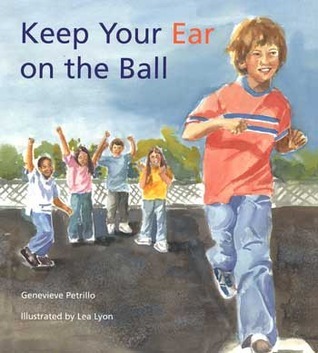
Davey, a blind student, refuses all help from his new classmates, even while playing kickball at recess, until they find a way to help without doing everything for him.
I am an elementary school teacher-turned-author/poet.
My book, Keep Your Ear on the Ball is based on an incredible year I spent teaching David, a blind child in my sighted 4th grade classroom. It's difficult to tell who learned more - David, his classmates, or ME!
I love, love, love visiting schools and libraries to talk to kids about writing. Being an author/poet is a blast!
Check out my dog, Cupcake's blog at http://earontheball.com She loves talking about being the pet of a children's writer/poet. She is hilarious and WHAT A DIVA!
When Davey joins Ms. Madison's class, the other students soon discover that their new classmate likes to do things for himself. He may be blind, but that doesn't mean he needs to hold anyone's hand to get through the lunch line, have someone else open his bottles for him, or throw away his trash. Responding instinctively to his self-confidence, and obvious independence, the other children accept Davey as he is. But when a game of kickball ends with a series of missed kicks, and a mishap at first base, it seems they've encountered something he can't do. Or have they...?
I really enjoyed this tale - based on a true story from Genevieve Petrillo's career as a teacher - of a group of children who find an innovative way to make kickball work for their disabled peer. Although we often see portrayals of the cruelty of children, from bullies to bystanders - and these are important behaviors to explore - it's good to be reminded that young people also have within them the potential for tolerance, and creative problem-solving. I also really liked the fact that Davey learns that sometimes it's OK, even for a disabled kid determined to prove his worth, to accept help. With a wonderful story, and appealing illustrations from Lea Lyon, Keep Your Ear on the Ball would make an excellent selection for disabled children struggling to "fit in," as well as for their friends and classmates. Highly recommended!
This is one of the best children’s books I’ve come across about being self-reliant and trying to fit in in what could be perceived as an impossible or extremely difficult situation. Keep Your Ear on the Ball tells the story of a little boy named Davey who’s blind and attends regular public school with sighted children. He does everything the other children do including playing kickball.
The book is well written (though I wasn’t a fan of the water color illustrations) and teaches children that just because someone is blind doesn’t mean that they automatically need help or should be pitied. Davey gets around all by himself without relying on anyone nor does he want anyone’s help. He can open his own bottles and throw out his own garbage without asking someone to do it for him. He manages to find his way around. He politely refuses when the other children constantly offer to help him with one thing or another. The author also shows the frustration that the sighted children feel whenever Davey refuses their help because they think that with the help offered he’d be able to do things better which isn’t necessarily the case. Davey is never presented as a victim nor do any of the children make fun of him which was refreshing. The focus isn’t “oh look at the blind kid, you should be nice to him”. They pretty much all want to be his friend because he’s cool guy.
During a kickball game Davey can’t see the ball so he doesn’t know where to go. The children devise a sound system so that he knows where the ball is and can participate. The sighted children came together to get Davy to participate and not just sit out on the sidelines during the game which would have been a natural reaction --if you can’t see the ball how can you expect to play. This part of the story teaches children inclusion instead of exclusion. They had to brainstorm and come up with a solution instead of just accepting the “problem”. What was great about the book is that Davey, though blind, acted just like all the other kids and in the end he knew that sometimes asking for help was not a bad thing which is something that anyone could learn from.
I’d highly recommend this book to all children to show them that the blind are not disabled just “differently abled” and I’d also recommend it as an encouraging story for blind children to show them that anything is possible no matter how insurmountable the task at hand may appear as long as you try.
I was very touched by this based on a true story about a new boy in a classroom, a boy who happens to be blind, and wants to be independent and does not willingly accept help; self reliance is important to him. While he can do most things for himself, kickball presents a challenge. How his classmates devise a way for him to successfully participate, and how he learns to accept some level of help, while remaining able to do for himself, makes for a very uplifting story. (Not pertinent to this story, but I do know there are balls that make noise for the benefit of blind players.)
I was particularly thrilled that the library gave me a spiral bound Children’s Braille Book Club edition. Every other page is plastic with Braille, the other pages are paper and have text and illustrations. (Oh, I hope I never go blind because learning Braille seems challenging to me. Of course, there are also many audio books now too.) Interestingly, there’s a note at the front that says: “Warning: Do not leave this print/Braille book in the sun, or place near a heater. The plastic will melt.” I’ve never read a book with Braille before; I don’t think, although many years ago I saw Braille editions. It’s very appropriate that this book be available in Braille; I hope that many/most books are available, for both kids and adults.
I think this is a terrific book for kids. It shows how children can get along with one another, respect each other’s differences, keep to a fine balance of when and how much to help one another, to learn to develop appropriate interdependence.
Off on a tangent: In summer school third grade (the summer before third grade) there were two blind girls in my class. The rest of us vied to be the ones to get close to them, and help them when needed. I don’t remember that either of them were as fiercely resistant to help as Davey in this story. They were both from a school for the blind and were “being mainstreamed” for the summer only. I was in summer school because the teacher was Kay Boyle and my mother wanted me to be in her summer school class. She was okay as a teacher.
I really enjoyed this book. Davey is a blind boy whom everyone wants to help. But when they give him the chance to join their kickball team, a child is left trampled on. Working together, all the children figure out the best ways to include him in activities, whilst respecting his unique abilities. This book is aimed at junior aged pupils and really helps them to identify that people with other abilities can do the same things, but differently. It may be good to introduce this story for citizenship lessons.
Davey is a blind boy who joins a new classroom. At recess, Davey's classmates offer to help him during the kickball game, but Davey is insists that he doesn't need help. He relies on his hearing to successfully contribute to the team. This book is intended for readers in ~grades 1-3. I chose this book for my classroom library because it teaches students about differences and the importance of inclusion. The book also teaches a valuable lesson about not giving up, despite challenges. Key themes and topics of this book include: blindness, boundaries, independence, teamwork, inclusion, empathy, and accessibility. This book is also available in braille!
Based on a true story - which is always compelling to me, Keep Your Ear on the Ball is a wonderful story about how children work together to solve a problem in class. So many books with disabled protagonists end up becoming inspiration porn. This book avoids that. Also, I really like that the children are the ones who solve the problem really well on their own without adults stepping in. In the end of the book, everybody learns something.
This book is about a boy named Davey. He comes to a new school and meets his new classmates, but they soon find out that he is blind. He touches the wall and the desks as he makes his way to his new desk. His classmates were able to see how when they read, he does too, but his books are in braille. When one of his friends asked if they wanted them to walk Davey down to the cafeteria he said no. Throughout the book, his friends continued to ask him if he needed help doing things but Davey continued to say no. They soon realized that just because they were not used to the way Davey had to do things doesn't mean that he needed help. He has been living his entire life like this and it's completely normal to him. I think it was very kind for his friends to offer their assistance, but its important for them to realize that he can do the same things they can too. I would use this book in my classroom to teach my students about people who are blind and how they've learned to do things. It's important to be grateful to those around you, but to also know that just because someone may have a disability it doesn't mean that they can't do things by themselves.
This book created such good conversation in my house around disabilities and how “wanting to help” isn’t actually helpful unless you are actually looking for a solution to a legitimate problem.
The students all want to help the main character, who is blind, but constantly offer to help with things he doesn’t need and he consistently politely refuses their help until they feel rejected and a divide forms. It feels honest, it’s so understandable that the boy with a disability wants to be independent and doesn’t want the other kids following him making suggestions. It’s understandable that the other kids want to be helpful to someone they perceive or imagine must be struggling but who doesn’t actually need that help. And when he actually does need a solution to a problem the group comes up with one that works.
Rated a 4 only because the illustrations were not engaging to my kids and turned them off initially.
Keep Your Ear on the Ball is one of the best books about disability that I have ever read. It comes from the perspective of a boy in class who adjusts along with the rest of the class to having a blind student join them. Everyone wants to help him, but Davey is very independent. When it comes to kickball, however, Davey struggles. This story is a perfect example of how students can work together to build an environment where Davey can thrive and succeed. He doesn't need them to hold his hand, but it is helpful when they quiet down. My favorite thing about this book is that Davey is a real character with a personality and his own faults. A lot of the time with books like these that are aimed towards abled children, the disabled character is just a stock photo with no actual role other than to be observed. This book is fantastic for any classroom bookshelf and certainly mine.
Davey is just like every other boy except for one thing. He's blind. His class mates mean well and want to help him. "Thanks but no Thanks" is the response. Davey can do it himself. In most things Davey does just as well as the other class mates. His class mates just want to help but, slowly they realize Davey is determined to be independent. All goes well until a game of kickball goes wrong... Now no one wants Davey on their team! The students try to come up with clever ideas not leave their class mate out. Will they come up with a solution that is right for everyone? Based on a true story from the author Genevieve Petrillo during her time teaching. This is a sweet and charming story about how being independent is important but sometimes working with others is too.
This is such a sweet story!! This is an inspiring story about a blind boy Davis coming to a new school and navigating his way through getting along with his seeing classmates. They start the story by explaining his appearance, explaining how he looks like any other kid. Although he's blind, he's able to do anything else a seeing kid could do, just in a different way. Davis experiences a bit of trouble trying to communicate with his classmates he wants to be treated normally after some playground conflict but after a while, we get to see the process of the kids understanding how to accommodate Davis to help him without making him seem like an outcast. This book is so educational and wholesome. A classroom essential for sure.
1.) No awards 2.) Appropriate grade levels: 2nd-5th grade 3.)Original 3 line summary: Davey, a blind boy, is new to a public school. His new friends are quick to learn that Davey likes to do things on his own. However, during a kickball game he may need to work together with his friends. 4.) Original 3 line review: I really liked how the main character, Davey, showed his independence throughout the book. I also enjoyed how his new friends came up with many ways they could all work together in kickball. Overall, I though this story was amazing and would recommend this to others. 5.) One in class use would be having students participate in a teamwork building activity.
This book surprised me with two important declarations. Not all blind people need help and are capable of doing a lot of things on their own. The narrative also shows how going out of your way to help may come to form a good place, but may not be necessary or it could cause harm by sounding patronizing. Finally, just because a disabled person may be self-sufficient, that doesn’t mean they don’t need help.
When Davey moves to town, his classmates want to help him because he's blind. Davey likes to do thinks on his own. When he struggles in kickball during recess, his friends have to figure out a way that he can do it on his own.
This book was awesome! The genre of this book is Fiction. The book was very interesting in that it took place in a school where kids can easily to connect to the events occurring in the book. Children reading this will probably question why the main character always says no to extra help. The story contained a nice plot! It was about how a character who is blind uses his keen sense of hearing to play kickball. The problem at first was that he kept missing the ball and running into other children, but this problem was resolved when there was complete silence and he could focus on hearing his surroundings to carry out his action precisely! The illustrations were great because it showed diversity and did not stereotype any individual. The only one line that the book could have avoided is when a peer criticizes him for playing kickball incorrectly, and says he is blind so he cannot do anything. The whole book builds up by saying all that the main character can do, so it seemed rude for the classmate to say such a thing. However, overall the book was definitely to my pleasing!
This book was a super cute book on how classmates figured out a way to help their blind friend. At first everyone offered to do tasks for him such as telling him when to kick the ball during kickball or offering to run the bases for him since he cannot see them. He politely tells everyone no; he can do it himself. But one day someone came up with the idea of blowing a whistle so everyone can be quiet so he could hear the ball on the ground. We all know that when one of our five senses are down, the others are working harder to make up for the one lost. This proves that by being quiet, he was able to kick the ball because he could hear it rolling on the pavement outside. Everyone was able to come together to make sure nobody was left out!
This is a short picture book about a boy called Davey who is blind. He is very confident and independent and becomes annoyed wishes the other students are too friendly and offer to do everything for him. He repeats the phrase 'thanks, but no thanks' and it adds to the comical effect in the book, as readers we know what Davey's response will be. Davey wants to be treated the same as everyone else and constantly reminds the other children that he does have other senses and can do the same activities as them if they are adapted slightly. Towards the end of the book the other children begin to understand Davey more and accept him for who he is. I enjoyed this book because the illustrations are fantastic, with quite soft neutral colours, unlike many children's books which are often very bold and bright. It was not a story for the reader to feel sorry for Davey, but a story to feel proud of him for embracing life and not letting his blindness stop him from doing what he wants to do. The book was also aimed at fully sighted children as it dealt with the frustrations and annoyance other children may feel, when trying to help someone with a condition or disability, if that person is rude or turns down their help. The book creates a better understanding of why that is and how often activities need to be adapted slightly, rather than non participation from the person with a disability or condition. I believe this book would be ideal for independent reading for a year two class or to inspire creative writing. Children could write about how they would feel if they lost one of their senses and what activities they may find difficult.
Keep your ear on the ball Author: Genevieve Petrillo Illustrator: Lea Lyon Publisher: Tilbury House Copyright: 2007 Pages: 32 Developmental Age: 3rd grade Themes: helping, blind, teams, self-reliance Synopsis: After Davey, a blind boy, is new to a classroom all the students want to help him, but all they hear is "thanks but no thanks." When they all go to play kick ball they realize that unlike everything else Davey has a hard time kicking the ball, until they become quite so he can hear the ball to kick it. Personal Response: I thought keep your ear on the ball was an inspiring book and an easy read. The only thing I did not like about the book were the water color illustrations. I felt that they were lacking and a little unclear. The illustrator did not use vibrant colors or eye catching pictures. My favorite part of the story was when the other children realized that Davey could play kick ball by listening to the ball and with a little help. The main point of this story is about being self-reliant and trying to fit in in a new situation when you are perceived as being different.
A new student who “looked like every other new kid,” a “regular kid,” is actually blind. When students discover this, they attempt to help Davey do everything such as throw away his garbage at lunch, and investigate the classroom. Davey responds, “Thanks, but no thanks at least a hundred times.” By reading this simply illustrated book in a classroom, students can be introduced to the idea that people with disabilities want independence. When Davey runs into a problem because he cannot run the bases during a kickball game, readers will discover that a collective effort to help someone be independent is possible. Reading to discover how the students devised a way for Davey to “hear “ his way around the bases is inspirational.
We read this today after getting it through the (newly redone!) inter-library loan. Julia wasn't as eager to read it as I would have hoped but maybe I didn't present the book as well as I could have. The illustrations are unclear and lacking a little and I think it's harder for Julia to get into a book right now with this type of art. The story itself is nothing if not uplifting. Others have already gone through the story line so there's no sense in doing that again. I will say it's worth reading, if only to open your child up to the knowledge that there are other children in the world that have differences like this. That there are children like him or her that learn to deal with this and work around any problems that arise.
Davey is a third grader who is blind. His fellow students and friends are always asking Davey if he needs help doing everyday tasks, and Davey also insists that he is perfectly able to do everything that everyone else can do. His friends and fellow students realize that he is, in fact, able to do everything that everyone else can do. One day, when Davey and his classmates play kickball, Davey is not as good as the other kids. He keeps missing the ball, and initially, while the other kids don't want Davey on his team, they later decide to figure out a way to include him in their activities while simultaneously respecting his decision to be an independent as possible. This picture book is most appropriate for teaching inclusion and respect to grades 1-3.
I found this book with my kindergartner in the Braille section of our library. She was fascinated by the translucent Braille overlays, and as a new (sighted) reader herself, was interested in the ways differently-abled people can follow a story, and participate in common school activities. The text is a little too advanced for her to read on her own, but she admired the watercolor paintings and could easily follow the personal, repetitive, child-narrator's point of view.
This is a great book about a boy with a disability who wants everybody to stop trying to help him so much. He wants his classmates to see that he is just as able as they are, until they decide to play kickball and he might need just a little help. This is a great book that I hope to one day have in my classroom.
This is a really great story about a new kid in the class who looks like every other kid but is blind. This would be good to read if you have students with special needs in your class. It lets other children know that students with special needs can do things in their own unique way.
Meh. The message of giving and accepting help is nice, but the illustrations didn't stand out at all to me. I also didn't find it believable that all the kids in the class would instantly want a blind boy on their kickball team.
A positive portrayal of a boy who is blind, with a focus on his abilities rather than his disability. It also depicts kids working cooperatively to find a way to accommodate Davey in kickball games. A good book to kick off discussion about differing abilities.
Fantastic book about Davey, a blind boy, who doesn't need help, he just wants to do things for himself. With a few ideas from his classmates, he joins in and has fun playing kick ball.