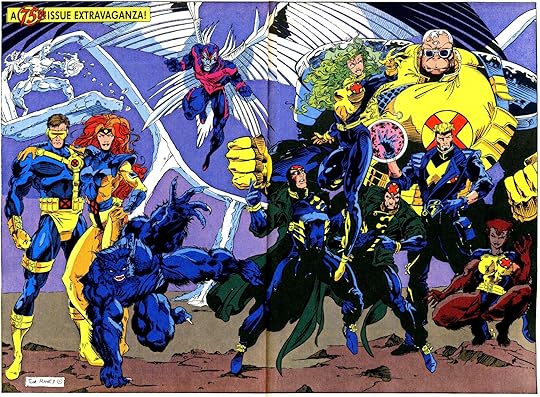
The war in Genosha has boiled over, and the X-Men, X-Factor and the New Mutants will never be the same! With the never-deadlier Cameron Hodge pulling the strings, the heroes are kidnapped, killed, stripped of their powers and forced into combat! And when the dust settles, the teams change lineups, sending the X-Men into a new era! COLLECTING: Uncanny X-Men #235-238, #270-272; New Mutants (1983) #95-97; X-Factor (1986) #60-62
Chris Claremont is a writer of American comic books, best known for his 16-year (1975-1991) stint on Uncanny X-Men, during which the series became one of the comic book industry's most successful properties.
Claremont has written many stories for other publishers including the Star Trek Debt of Honor graphic novel, his creator-owned Sovereign Seven for DC Comics and Aliens vs Predator for Dark Horse Comics. He also wrote a few issues of the series WildC.A.T.s (volume 1, issues #10-13) at Image Comics, which introduced his creator-owned character, Huntsman.
Outside of comics, Claremont co-wrote the Chronicles of the Shadow War trilogy, Shadow Moon (1995), Shadow Dawn (1996), and Shadow Star (1999), with George Lucas. This trilogy continues the story of Elora Danan from the movie Willow. In the 1980s, he also wrote a science fiction trilogy about female starship pilot Nicole Shea, consisting of First Flight (1987), Grounded! (1991), and Sundowner (1994). Claremont was also a contributor to the Wild Cards anthology series.
I really enjoyed how cohesive this story felt compared to Inferno.
I liked that each issue moved the story forward, dealing with the one that came before. I also appreciated that the recapping was kept to the beginning issues.
I will say, Hodge was one annoying guy! He kept popping up EVERYWHERE, and I felt like his suit got like 10 different features each issue.
I know they couldn't make it too easy, but I just wish this were a little less blasting and fighting and more character-based. There were some good moments, but they were few and far between.
I was also surprised by how easily the teams worked together. There was no contention about whose orders they should follow or anything. It might've been a little more interesting if there had been some of that drama (and less of the weird pseudo love triangle thing they've reignited).
Oh, and the whole world knows the X-Men are actually alive. So I can't wait to gather the old members!
I don't know what happened, but in the last few comics, all the ladies got more... Curvy?
It was distracting; it was very obvious what they were trying to do.
Overall, a decent story that brought the 3 teams together and felt different with the new characters thrown in.
Side note: There was a scene where Scott and Cable were in the same panel, which I think only happened the one time. Does Cable know who Scott is? I'm not too familiar with Cable lore at the moment.
All three X-teams, X-Factor, X-Men and Cable & the New Mutants are caught up in a manic plot to use Genosha as a base to cause the X-tinction of mutant kind starting with the X-teams. Not as good as the Genosha debut story in the pages of The Uncanny X-Men, but apparently a classic... especially because of Jim Lee's artwork. It gets off to a nail biting compelling start but the last few chapters are pretty pretty poor in my opinion. 5 out of 12. Uncanny X-men #270 - #272. New Mutants #95 - #97 and X-factor #60-62.
Of all the comics that really got me into comics besides Batman, was X-men. The city library had a few comics, for some reason, that were ripped, in bins that you could check out. They didn't have all of them, but they did have parts of this Saga. With the rich backstory, told in brief, and Jim Lee's fabulous penciling, many of the panes in these pages burned into my memory as the epitome of action, drama and visual storytelling.
I'm happy to re-read this set of comics, from beginning to end.
The story is compelling. This time, a sovereign nation built on the backs of mind-controlled mutants seeks to protect its "property" this time enveloping members of the X-men. Controlled by the mastermind evil Cameron Hodge, who hates with his last breath, who made a deal with a demon that he could never die, and then at the center of a super-cybernetic suit, the X-men seem to have met their match.
Of course, as a comic series, the story must go on! And the last issue was unsatisfying to me, wrapping things up neatly. The bad guys of course, are so bad, they cannot cohere their values to work together. The good guys, of course, despite differences are able to work together and achieve unity. That's the main difference between them. In fact, these good guys are so good, they seek unity in all sentient beings, including mutants and humans... eventually turning members of the bad guys over to their side.
Considering the political implications of "what is human" and this nation's human rights violations, the story wraps up too quickly once the action sequence is done. The President in chains, and bad guys turned good all getting their just reward (the other main bad guy loses his life in stopping the real main bad guy)... the ending really soured for me what I recall being a rich tapestry of character and political questioning.
Despite twisting the characters for good at the end, all in all though, quite good, as most of the time, re-reading old comic sagas never turn out well. I enjoyed much of the early artistry and story telling best of all. The ending's main failing was that it turned generic at the end, as very apparently the story "blew its load" and then quickly turned around to fall asleep.
I am probably rating this more highly than I would otherwise, because these are some of the first comic books that I ever read as a boy (though I only read the X-Men and X-Factor issues, and not the New Mutants ones, so I missed some pretty important parts). I remembered a lot of the events, as well as a great many individual panels, but this much later read has definitely teased out a lot more of what is going on here, particularly the geopolitical parts, which flew right over my 10 year old self's head. It's that writing that really saves this. The art is definitely hit or miss, and even at its best, this was definitely the '90s. I did appreciate that they included the precursor issues that set up the story in the trade, since it set the scene nicely, though it did mess with my head a bit, having recently read Inferno, and getting confused about the chronology (it takes place between those two parts of the story, and I guess I thought it was after I had started reading X-Men, which really confused me for a bit). Still, this is... pretty good. Hodge was really creepy, though I would have liked if his look was a bit more consistent throughout, and I found that the female president of Genosha looked just like Ronald Reagan kind of amusing, though a bit odd. I liked it, and it obviously didn't turn me off of X-Men comics as a 10 year old, but rather drew me in, so I guess it can't have been all that bad, but it was definitely a long crossover event in the denser style of older comics, so it is a significant investment of time to read. Still, I think it was worth it for me.
Slowly catching up on canonical X-Men stories. I decided to start in the 90s. The first Omnibus I read was the Claremont/Lee volume 1, this is the next chronological book. The story isn't too bad, the art however hasn't aged well except the 3 issues illustrated by Jim Lee ( the cover art made by Jim Lee 23 years ago remain amazing)... This is kind of a pivotal book as its success started the age of the crossover for X-Men. This is the last X-Men story before the relaunch of the X-Men in 1991 which saw the X-Men divided into two teams each with their own title ( Uncanny X-Men and X-Men).
I never read this storyline; it occurred right before I started reading X-Men in the 90s and I never went back to read the collection. It had some huge ramifications for sure, bringing all the characters back together for the first time in years, a major death, and the allegory of the Genoshan state. That said, it is very uneven. There are many Claremontisms, and storylines begun and ended, but the dialogue is fairly painful. Also, except for the Silvestri and Lee artwork from the Uncanny issues, the rest of the artwork is completely atrocious. Thankfully, new artists had taken over by the time I started reading! I'm glad I finally read this from a completist standpoint, as so many parts still impact today's X-Men, but I wouldn't recommend to the casual X-Men reader.
Art is outstanding. A really big flash from the past for me, which I thoroughly enjoyed. The story though, feels a lot less like an X-Men collection and more like an X-Factor.
A good case for the importance of writer/artist symmetry. It’s not that either are bad, but they just don’t seem to work together. There’s no harmony. It feels more like competition.
This is especially unfortunate as this volume sees an ending to two long running characters, and based on similar moments during other events, their departure should be far more impactful than how they are handled here.
It’s a great, high stakes X-Men story that gets lost behind muddled artwork and a fog of thought bubbles and word balloons.
X-Men: X-Tinction Agenda is a nine part Marvel comic book crossover from 1990 featuring the top selling X-Titles of the day: Uncanny X-Men, X-Factor and New Mutants. The story returns to the island nation of Genosha and focuses on the kidnapping of several mutants and the resulting trial for alleged 'transgressions' against the state.
Introduced some 40 issues before, Genosha is a thinly veiled stand-in for places like South Africa and Nazi Germany. Writers Chris Claremont and Louise Simonson use it as a vehicle to explore race relations and the dangers of segregation (and subjugation). You can't miss the social commentary; it's the driving force in an otherwise forgettable narrative. That doesn't made it bad, however. There are several moments throughout that will stick with you long after reading them. The artwork is also strong, particularly Jim Lee's work on X-Men and Rob Liefeld's work on New Mutants.
Feeling editorial pressure to give Jim and Rob more freedom in the titles, perhaps Claremont and Simonson saw this as their last opportunity to leave their mark on the franchise. Both writers would leave their posts within a year, this being their final collaborative work after a long and successful tenure. Jim and Rob would also leave to form Image Comics, but not before shattering sales records and cementing X-Men as the publisher's top property. In the end, X-Tinction Agenda is aptly named: it represents a somewhat acrimonious passing of the torch to the young turks would work catapult the X-Brand into superstardom in the early 1990s.
My trip working my way through the X-Men has finally brought me to the '90s. Let's start with the good: following the generally messy and *very* loosely scripted crossovers of the 80s (Mutant Massacre and Fall of the Mutants), this is a positively tight crossover, story-wise. It's clear that there's a unified vision for what this story is supposed to be, and the characters move pretty consistently through the story. Unlike the former X-Overs, there are no weird stand-alone issues or books that have nothing to do with each other, here. Every book pushes the story forward and leads from the previous entry to the next. It's... honestly a lot better than I remembered, and it's really refreshing. It wasn't great for 1990 Roybot, who was relying on whatever comics he could get from the newsrack at the local convenience store, but it makes for a much more cohesive and compelling trade.
Conclusion: Despite a few weak elements and some shaky art, in places, this was still a pretty awesome crossover event, and it's easy to see why it became the template for future X overs. In addition to the great artwork by Lee, this book resolves a number of lingering plot points, shakes up the teams and reunites the X-Men who have been far flung since entering the Siege Perilous. This definitely feels like the start of a new era, for better and for worse.
Hikaye bir doksanlar klasiği olarak kendini ciddiye alıyor ve bunu yaparken kimi maceraların aksine yapmacık durmamayı da başarıyor başarmasına. Yani yazım kısmında kalite adına bir istikrar söz konusu. Ayrı düşmüş ve uzun süredir bu şekilde kalmış X-Men ekibinin, New Mutants'ın ve orjinal beşli X-Factor'ın olaya topta dahil oluşuyla ortaya çıkan ve insana gaz veren bir tekrar bir araya geliş teması hikayeyi çerçeveliyor. Lakin özellikle X-Factor sayılarındaki çizimlerin bir kısmının feci olması, anlatım kalitesinin görsel cepheye aynı oranda yansımamasına sebep oluyor. X-Men mitosunda önemli yeri olan Genosha'nın nereden nereye geldiğini görmek ve Gambit ile Jubilee gibi o zaman için taze ekip üyelerinin ilk büyük maceralarına tanık olmak adına okunması gereken ama süper-über kaliteli olmayan bir crossover.
The Genosha origin story that kicks off the new edition of this volume is quite good. You can see that Claremont's dialogue is starting to descend into parody, but this is a strong story with questions of family and human rights both front and foremost [7.5/10]. The X-Tinction Agenda story proper is good in theory, returning to Genosha, getting some more of the X-Men back together, and reviving Cameron Hodge. Unfortunately, the execution is poor, at least in part due to the fact that Simonson doesn't hold a candle to Claremont's writing, and she writes two-thirds of this crossover. Thus we get a long back and forth, as people are captured, freed, and captured again, with the major plot moments few and far between [6/10].
Extra star for this edition’s inclusion of the “prequel” issues detailing the X-Men’s first adventure in Genosha. These early books represent Claremont at his best. The South Africa apartheid allegory shines in these issues, but is kind of lost in the action-heavy 1990’s super villain battle that dominates the actual “X-Tinction Agenda” storyline.
Decent, but just too repetitive. The entire story seems to consist of various groups of X-Men being captured, escaping, recaptured, escaping, etc. The final chapters seem to go on forever as the X-men engage in battle with the villain. Still, there's a lot of good artwork on display... But also some really atrocious artwork by Rob Liefield.
Overall, this is a decent book. But that's about it.
I like that this edition has the pre-"Inferno" issues. The main crossover is a mess- the Best part being the UNCANNY issues by Claremont & Lee. Lee looks fantastic and the rest of the book is horrendous. It's a page-turning chore.
I would have liked this better if the artists' styles weren't so different. That is not a knock at any of the artists, and issues from an earlier story arc were not needed and did not enhance the story.
As I keep making my way through old X-Men comics, the stories continue to get better!! I LOVED Inferno, and now X-Tinction agenda built on that!! Fantastic X-book with a genuinely horrible enemy in Cameron Hodge!!
An excellent cross-over event! Tight plotting and great looking. Leaps and bounds better than Inferno. Kicks off the 90's with great promise! Can't wait to see what happens next.
The artwork in this book is a textbook example of everything that was wrong with 1990s mainstream comic books. Lee, Liefeld, and Silvestri's crimes against art are too numerous to name, suffice it to say that they set the medium back so far that it has only recovered in the past 5-10 years. These were the guys who got me to quit comics in late 1989/early 1990, as their work left me cold.
The writing is also pretty rough. While the concept is solid, the dialogue and third party narratives are so overwritten that this book was a chore to get through. I love the work of Claremont and Simonson, but this was not their finest hour. Things seem to go on and on and on for no good reason.
Now that I have gotten all of my gripes off of my chest, let's get down to business. Genosha is an island off of the coast of South Africa that has an economy and standard of living that is the envy of the world. This was a metaphor for Apartheid and the events that occurred in South Africa in the 1980s and early 1990s. Genosha has a dirty little secret, though. It has achieved all of this progress by forcing mutants into slavery by exposing them to a process that makes them into nearly mindless zombies called mutates. The problem was exposed when Wolverine, Rogue, and Madelyne Pryor were kidnapped (#235-238), resulting in X-Men intervention.
Cameron Hodge was once the PR guy for X-Factor before being exposed as the head of the mutant hate group The Right. He was decapitated by Archangel (Angel) and his head was attached to a hideous robotic body by the demon N'astirh during the Inferno crossover. This brings us up to where he is now, as his spider-like magickal robot body has his human head attached to it, resulting in one of the butt-ugliest villain designs in the history of comics. Thanks '90s. Hodge was working with the Genegineer to turn the X-Men into mutates. He had part of the team kidnapped, which is where the long winded nine issue core crossover came from. Also in this crapfest Storm, who was regressed to a teenager somewhere along the way, is returned to adulthood in a way that makes about as much sense as anything else in this gobbledygook stew. Gambit and Cable are also present and totally suck ass.
This era of the X-Men means a lot to 1990s kids, so add two points to my rating if you were 8-13 when these issues were originally on the stands.
Invecchiata maluccio. Volevo darle un 3/5, ma poi ci ho ripensato e si prende un 2/5. Salvo solo le seguenti cose:
1) I disegni di Jim Lee, che al tempo di pubblicazione del crossover erano davvero sopra la media e regalavano il giusto sapore anni '90 che quelle storie meritavano. In più, quando penso ai design dei personaggi in quel periodo, la mia mente li associa automaticamente al suo stile; 2) Era un Jim Lee che ancora non era venuto a noia, non ancora osannato per meriti che solo i lettori vedevano. E trovo inoltre che disegni molto meglio su queste pagine che dopo la trasferta in DC: fatta eccezione di "Batman: Hush", dove lì aveva abbattuto i suoi stessi limiti. Ma dopo quella, caduta libera; 3) Qualche sequenza carina viene messa a segno, come il segmento tra Wolverine e Jean Grey o quelle con Cable. Che, ok, si comporta da "action hero" macchietta di quegli anni, però era ancora un personaggio nuovo e misterioso e si faceva leggere; 4) Si comincia a lasciare spazio a qualche autore oltre a Chris Claremont, che comunque - pur con impaccio - dimostra di poter dire qualcosa di nuovo.
Per il resto, secondo me "X-Tinction Agenda" non doveva essere un crossover. In certi momenti la storia gira su stessa e non porta a nulla se non a macinare numeri e foliazione richiesti per essere un incontra fra testate. Ma stavamo entrando in quel periodo e la Marvel voleva che X-Men diventasse un franchise grosso; alla fine ha avuto ragione a puntarci, però certo storie sarebbero state più belle se presentate in maniera più asciutta e diretta, senza giri inutili. In più abbiamo forse il Claremont più scazzato nella scrittura che io abbia mai visto. Da una parte è comprensibile, lo stavano ostracizzando per dare spazio a nuovi autori e lui non si sentiva più motivato; dall'altra, dopo 17 anni di storie, c'era ormai chi poteva prendere le redini della testata e continuare la strada da lui tracciata su un gruppo in cui non ha mai creduto nessuno. Era giusto lasciare spazio e questa storia è la prova che serviva novità.
A third of this book has crappy art and bad writing, sure! But the good art, the action-heavy plot, and the sheer novelty of all the mutants (sans Excalibur) finally working together more than makes up for the wonky words and images. This is the comics equivalent of the big, dumb action movie.
Now, I still hate how the book left Warlock, Rahne, and Havok. I still can’t figure out Liefeld’s hatred of eyeballs and feet. I’ll never understand Simonson’s urge to pen terrible dialogue. However, X-Tinction Agenda counts as one of the best X-Men events because it had a few vital things going for it: 1) the plot engine was strong enough for all its 9 issues, stronger even. 2) the storytelling was sequential, it progressed, and you never saw the same scene twice. 3) characters remembered to respond and interact with each other in logical ways—as opposed to ignoring massive changes in the status quos of friends and family. 4) the villains were villains, they weren’t good guys gone rogue, and they had their own clear goals and motivations (well, except the psychotic President.) 5) the 90s-ness of it all was at its peak.
Finally, I have to mention the final page. Whenever I read that page I get annoyed and bummed out. Why is GODDAM BOOM BOOM and RICTOR spreading Warlock’s ashes on Doug’s grave??? Louise Simonson was on her way out the door, but all of her problems can’t be blamed on Rob Liefeld. She did literally nothing good on New Mutants. Her entire tenure sucked. She blames everyone but herself, I guess. The fact that she killed two beloved characters was bad enough, but then have two virtual strangers lead this “heartfelt” moment? She’s a hack!
As of March 2024, I think I’m on my third massive chronological read through of all things X and this always feels like a watershed moment. More so than the relaunch even. For better or worse, superhero comics were defined by these 9 comics for years to come.
Off the coast of Africa, on the new country of Genosha, horrible things are being done to mutants under the leadership of one of the X-Men's most fierce and powerful villains... Cameron Hodge.
This volume certainly took me back to my young days of reading X-Men. It is a storyline that has a lot of that 90's X-Men flavor to it. Off the wall action, a maniacal villain, and the X-teams joining forces to take the threat down, this one will play to the nostalgia factor.
However Nostalgia alone isn't something that can save a storyline. Because while this volume certainly has its cool moments, there are a lot of issues that I found with pacing, plot convenience, and dialogue that I didn't realize back then. Not to say this one isn't a blast to read, but when read through the scope of comics today, which tend to be a bit more polished, this one has sections that feel like a chore to read and moments where the plot slows down only to draw out the storyline and pad out the single issues. However when the final battle begins, the pacing is fast and furious carried by the momentum of so many issues leading towards it.
The art has its high moments, mostly with Jim Lee and Jon Bogdanove as they have an energy that is perfect for the X-Men. Other artists are also on some of these books that I didn't like as much, but were perfectly serviceable. Not to say that their art was bad, but more of a matter of preference in terms of art.
Overall I would recommend this more for die hard X-Men fans. It is a crazy storyline that takes a lot of twists and turns. The casual reader might be left wondering what exactly just happened. But for an X-Men fan, this type of chaotic adventure is right up our alley.
The crux of this part of the book is that the X-Men, currently believed dead but actually operating out of a ghost town in Australia, witness a Genoshan expatriate mutate be kidnapped by the government, and follow them all to Genosha, a nation where mutants are a slave caste to a military junta who try and pretend their nation is a paradise.
While the rescue mission is going on, Madelyne Pryor, who's been working as a tech advisor to the X-Men slowly evolves into The Goblin Queen, as this story dovetails into X-Men: Inferno.
The X-Men is about to get very silly to me as Claremont goes further and further afield from his original stories. I do like the Genosha element in this book, though, and wish he'd handed the title over to Jim Lee after the end of this storyarc.
This is also the basis for a storyline in X-Men The Animated Series, and while most of The Animated Series episodes take Claremont stories and vastly improve them, I think this arc is on par with the Animated Series version.
If you enjoy your X-Men comics politically progressive, and action packed, this is for you, if you're the kind of person who thinks comics are too woke right now....why are you even bothering to try and read the X-Men?
Like many of this era's crossovers, X-Tinction Agenda is marked first and foremost by its inconsistency. The premise is effective and there's certainly potential here, but some flat writing and poor artwork largely sinks it.
The first section of the book sets up the majority of it, introducing the island nation of Genosha, where mutants are brainwashed and effectively turned into slaves of the state. These first few issues are solid but unremarkable, and again serve mostly to set up the remainder of the book.
There's a sharp divide through that remainder. On the one hand, you have the baseline X-Men issues being written by Chris Claremont and illustrated by Jim Lee. The pair are in fine form here, particularly Lee, whose work would understandably serve as one of the main anchors for the comics industry as a whole in the coming years. Prolific X-Men writer Claremont isn't necessarily at his best here, but he's turning in serviceable work.
The breakdown comes in the issues of X-Factor and New Mutants, both being written in overly broad strokes by Louise Simonson while being given even poorer art, including some early Rob Liefeld work.
And while a showdown between the X-Men and the Genoshan state amidst international tensions could have been interesting, the story quickly devolves into an overly-long battle with an arbitrarily powerful foe. As the plot drags, the compositional deficiencies only become more prominent.
The end result is a book that should be skipped by anyone who isn't on an X-Men completionist mission.
Se destaca el arte de Jim Lee sus diseños basados en el Manga/Anime. Las historias fueron hechas por Chris Claremont y Louise Simonson, está última aportó mucho a Chris claremont después de que Dave Cockrum y John Byrne lo dejaron. Después de la partida de Byrne, Claremont nunca hizo historias de la calidad de Proteus, Dark Phoenix Saga y Days of the Future Past.
Claremont se las arregla para meter a Carol Danvers su Mary Sue, en la historia cuando nunca fue un X-Men. Madelyn Pryor fue personaje fallido, Chris no sabía que hacer con ella, cambió su origen primero como sólo alguien parecido a Jean Grey luego introdujo a la Fuerza Fénix y final era un clon. Otro personaje fallido fue Cameron Hodge que importa este aburrido personaje solo odia y ya. Los intrancedentes new mutants nunca alcanzaron la popularidad de los X-Men y nunca tuvieron historias como la de la saga de Fénix Oscura y Días del Futuro Pasado. Havok otra vez bajo control mental vs. Cyclops, esto es muy repetitivo, lo hizo Claremont desde 1975-76.
Hace una historia basada en Sudafrica, mejor hubieran hecho un comic basado en el comficto de Palestina o ¿A caso había conflicto de intereses en eso?
En fin, en Marvel se tardaron en quitarle el libro de los X-Men a Claremont.
This entire review has been hidden because of spoilers.
A arte de Jim Lee pra mim é a definição dos X-Men início dos anos 90, e acho que aqui ele demonstra isso muito bem. Psylocke ninja pra mim é um dos designs mais emblemáticos dessa época. Muito bom!
A do Liefeld é podre em proporção e anatomia, mas tem um certo charme inerente que só os anos 90 poderiam permitir.
Já a arte do Bogdanove aqui é terrível, uma coisa grotesca. Acho muito inconsistente comparado com os outros, e é mais triste porque a última arte é dele... pelo que eu vi ele melhora muito na época de Morte do Superman, ainda não li, mas só dando uma pesquisada parece muito aperfeiçoada... aqui ainda é terrível. A forma que ele desenha Wolverine e Fera é papo de piores desenhos de todos.
A história em si é muito divertida! Acho que ela é um pouco enrolada ali no meio, poderia ser um crossover com 6 partes, mas no final ela consegue mover a história sem perder o ritmo, algo que nos anos 80 dos X-Men ocorria com frequência.
Trzy zespoły: X-Factor, X-Men wraz z Cablem oraz New Mutants zostają uwikłani w kolejną kabałę, tym razem taką, która ma na celu wyeliminowanie całej mutanckiej rasy. Wróg używa Genoshy jako bazy, a pozbycie się wspomnianych ekip ma być tylko zaczynem, mającym pozbawić mutków głównych sił uderzeniowych i ułatwić dostęp do reszty 'odmieńców'.
Kilka naprawdę niezłych bijatyk, jak ta z udziałem Cable'a czy sam główny wróg, który ma bardzo klimatyczny design to zdecydowanie za mało, aby się dobrze bawił przy tym nużącym doświadczeniu. Czytałem już kamienie milowe X-men, które mimo upływu lat były niezłe. Tu nie ma tego. Miejscami broni się jeszcze oprawa, ale sama historia jest pulpą charakterystyczną dla tych lat.
Niestety, moim zdaniem 'X-Tinction Agenda' to jedno z najsłabszych odsłon tych klasycznych wydań.
Collects Uncanny X-Men #235-238, 270-272, The New Mutants #95-97 and X-Factor #60-62 (November 1990 - January 1991 with a prelude in October - November, 1998).
This is the point at which the X-Men comics sort of become a non-stop crossover hell at the expense of developing the individual titles. This storyline at least remains fairly consistent and coherent and the artwork moving between all three titles isn't too jarring. The X-Men start to reform here after being in a sort of limbo for a couple of years.