

What do you think?
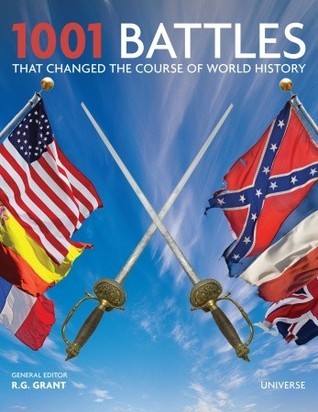
1001 Battles That Changed the Course of World History
A worthy addition to any history buff’s shelf, this visually arresting volume has a commanding grasp of more than 4,500 years of military history. On the eve of the 150th anniversary of the start of the American Civil War comes this latest addition to the 1001 series. It includes the seminal details about key battles that changed the course of history and shaped the political and cultural landscapes of our world—from the Battle of Troy and the Siege of Antioch to Gettysburg, Iwo Jima, and up to the present with battles of the Iraq War. 1001 Battles That Changed the Course of World History traces 4,500 years of armed conflict, from the small-scale battles of the ancient world (involving only a few hundred foot soldiers) to the epic military engagements of the American Civil War, the devastating world wars, and the smaller military actions of today. Military history from throughout the world is included, from the Mongols’ exploits in the Far East to the dramatic Spanish conquest of the Incas, and from the Boer War in South Africa to America’s engagements in Vietnam and Korea. Each entry describes the battle in full detail, including tactical moves, strategy, and military or technological breakthroughs, and reveals the part it played in the larger war or campaign as well as its wider political and social impact on society and history. The book is illustrated throughout with battle plans and maps, detail-rich medieval tapestries, dramatic commemorative paintings, and evocative photographs.
960 pages, Hardcover
First published January 1, 2011
About the author
R.G. Grant
131 books47 followersR.G. Grant is a historian who has written extensively on many aspects and periods of history. Among his more than fifty published books are: Battle, Soldier, and Battle at Sea (2005, 2007, 2008). He was also a major contributor to the ITV Visual History of the Twentieth Century (1999) and consultant for Chronology of World History (1995). He is also a contributor to 1001 Battles That Changed the Course of History, where earlier versions of his contributions to Britannica first appeared.
Ratings & Reviews
Friends & Following
Create a free account to discover what your friends think of this book!
Community Reviews
Displaying 1 - 14 of 14 reviews

May 9, 2013
I have read enough of this to know that this was a good purchase for my reference bookshelf.
From estoreric battles during the Ionian wars to battles of the 30 years war that I've never heard of, to modern, The Battle of Marjah in February 2010. The Ionian battles are not the oldest in this work and for this review just serve as an example. The Hittites even make the cut.
Arranged in chronological order and by campaign or war, this is a history reference than can be read chapter (page or two) or battle by battle as well.
I have seen few works like this and none in this format or size.
The primary weakness inherent to a work of this scope is that there can be little depth in coverage of each incident. While the Boer War for example entries cover all the important information about the listed battles, the incredible background and history of the combatants is missing.
Well worth considering for any military or war history reader that doesn't have some other work or combination of works in such an accessible format. One volume. Hardbound. Slick pages accent text, illustrations and photographs. Well indexed and organized.
A goodread and well worth the 4 stars.
From estoreric battles during the Ionian wars to battles of the 30 years war that I've never heard of, to modern, The Battle of Marjah in February 2010. The Ionian battles are not the oldest in this work and for this review just serve as an example. The Hittites even make the cut.
Arranged in chronological order and by campaign or war, this is a history reference than can be read chapter (page or two) or battle by battle as well.
I have seen few works like this and none in this format or size.
The primary weakness inherent to a work of this scope is that there can be little depth in coverage of each incident. While the Boer War for example entries cover all the important information about the listed battles, the incredible background and history of the combatants is missing.
Well worth considering for any military or war history reader that doesn't have some other work or combination of works in such an accessible format. One volume. Hardbound. Slick pages accent text, illustrations and photographs. Well indexed and organized.
A goodread and well worth the 4 stars.

July 1, 2013
What a fantastic book for reference but as well for information on battles within ancient and modern history. great book

January 9, 2021
This book is exactly the sort of thing for people who enjoy learning about concurrent history.
Are you the sort of person who likes to learn how there were mammoths during the Ancient Egyptian era? While England and Spain were fighting in 1588, Japan's second unifier was just finally cracking down on the last great clan in Kanto?
This book is 1001 battles put into chronological order, so on one page you'll get info about Rome battling the Germanic tribes, and a few down the line the Three Kingdoms will be fighting at Red Cliffs.
The entries are short, so you can't use it for reference, but if something like the Battle of Okehazama piques your interest, you can always do some independent study. It's not a book designed to be read cover to cover, but you can do if you'd like to see a canvas of history and how ages link to one another if you want.
The later battles will obviously have more information than the older ones, as in WWI and onwards we started keeping track of casualties better, etc. But overall the book is great. If what I've said sounds interesting, get a cheap secondhand copy and have a look - or rent it from your library.
Are you the sort of person who likes to learn how there were mammoths during the Ancient Egyptian era? While England and Spain were fighting in 1588, Japan's second unifier was just finally cracking down on the last great clan in Kanto?
This book is 1001 battles put into chronological order, so on one page you'll get info about Rome battling the Germanic tribes, and a few down the line the Three Kingdoms will be fighting at Red Cliffs.
The entries are short, so you can't use it for reference, but if something like the Battle of Okehazama piques your interest, you can always do some independent study. It's not a book designed to be read cover to cover, but you can do if you'd like to see a canvas of history and how ages link to one another if you want.
The later battles will obviously have more information than the older ones, as in WWI and onwards we started keeping track of casualties better, etc. But overall the book is great. If what I've said sounds interesting, get a cheap secondhand copy and have a look - or rent it from your library.

October 27, 2017
Would definitely say it's more of a reference book.
July 26, 2026
A serious effort was put into compiling this and I don’t envy whoever had the task of reducing human history to 1001 battles. That being said, there is clearly a bias towards the West/United States. Did the American War of Independence/Civil War really need so many pages?
According to ancient writing, Publius Claudius consulted the omens at this point, as was customary during battle. When the sacred chickens refused to eat (which would have predicted a victory, he ordered them thrown overboard with the comment, "Well, let them drink." In the battle that followed, the better organized Carthaginian fleet picked off Claudius's scattered ships one by one. Claudius escaped, to stand trial in Rome-not for the defeat, but for his sacrilegious behavior toward chickens. Drepana 249 BCE (p. 56)
The battle between China and the Muslim Abbasid caliphate at the Talas River, in modern-day Kazakhstan, was arguably a turning point in world history. It may have ensured that Central Asia became part of the Islamic world and advanced the transfer of Chinese technology to the West…
…Tradition states that among the Chinese prisoners were two experts in papermaking who, put to work in Samarkand, introduced paper to the Islamic world, from whence it spread to Christian Europe. Shortly after the battle, Tang China was plunged into civil war and expansionist projects were abandoned. Over following centuries, the Turkic and Iranian peoples of Central Asia were Islamicized. Talas 751 (p. 118)
Barbarossa tied prisoners, some of them children, to the front of the siege tower as it advanced into battle, so that they were killed by their own friends and relatives. The Cremese answered by hacking prisoners into pieces in full view of the besieging army…
"Barbarossa understood his election as a mission to restore the lost dignity of the Roman Empire..... His sheer ruthlessness in attempting to do so [made] him one of Hitler's heroes." Crema 1159-1160 (p. 147)
By the time Timur approached Delhi, his army was so encumbered with loot and captured slaves that military efficiency was imperiled. Timur's solution was to order his followers to kill all their slaves-possibly around 100,000 people...
…By one account, Timur had camels loaded with kindling that was set on fire, releasing them to spread panic among the Indian elephants. The charge of Timur's horsemen was certainly decisive, reportedly scattering the Indian soldiers "as hungry lions scatter a flock of sheep." Victorious in the field, Timur unleashed his warriors upon Delhi in an orgy of destruction from which the city took a century to recover. Delhi 1398 (p. 211)
With all other ships sunk or burned, the devastated San Augustin managed to raise the white flag, but the Dutch did not accept the surrender. Instead, they rowed among the ruined Spanish fleet, shooting and stabbing survivors as they floated in the water. Gibraltar 1607 (p. 314)
Vernon planned his attack carefully and made sure his captains had precise orders. in reality, the delenses of Porto Bello were far from formidable; undermanned and with only a few serviceable guns... …This easy success was acclaimed in Britain as a great victory. Thomas Arne wrote "Rule Britannia" for the celebrations, districts of London and other cities were named for the battle, and George Washington's half brother Lawrence renamed the family estate in Virginia "Mount Vernon' in the British admiral's honor. Portobello 1739 (p. 411)
British troops went on the rampage for the next three days; when order was restored as many as 4,000 civilians had been killed. Badajoz 1812 (p. 533)
Bolivar's risky maneuver had failed, it seemed, especially when his main column, mounting a frontal attack on La Torre's force, was greeted by a hail of fire from 3,000 Spanish muskets. Utterly demoralized, they broke and fled. But the "British Huntsmen" mercenaries saved the day-and the future of an independent Venezuela. Holding firm, with desperate courage they met the enemy fire with volleys of their own before fixing bayonets and blindly charging. The astonished Spanish simply broke and ran. Carabobo 1821 (p. 561)
Hampton Roads, an encounter between the Union and Confederate navies, was the first battle fought between steam-powered ironclad warships. It persuaded naval experts worldwide that unarmored wooden-hulled sailing ships were obsolete. A new era in naval warfare had begun. Hampton Roads 1862 (p. 610)
The Russo-Japanese War provided a large-scale trial of the latest military technology and tactics, including artillery firing high-explosive shells beyond line of sight, directed by observers with field telephones, and infantry equipped with rapid-fire rifles and machine guns. The battle at Liaoyang witnessed the devastation an army could expect when attacking troops equipped with such weaponry. Liaoyang 1904 (p. 692)
Admiral Togo Heihachiro achieved a victory worthy of his hero, Nelson, and established Japan's place among the world's major naval powers. Tsushima 1905 (p. 694)
According to ancient writing, Publius Claudius consulted the omens at this point, as was customary during battle. When the sacred chickens refused to eat (which would have predicted a victory, he ordered them thrown overboard with the comment, "Well, let them drink." In the battle that followed, the better organized Carthaginian fleet picked off Claudius's scattered ships one by one. Claudius escaped, to stand trial in Rome-not for the defeat, but for his sacrilegious behavior toward chickens. Drepana 249 BCE (p. 56)
The battle between China and the Muslim Abbasid caliphate at the Talas River, in modern-day Kazakhstan, was arguably a turning point in world history. It may have ensured that Central Asia became part of the Islamic world and advanced the transfer of Chinese technology to the West…
…Tradition states that among the Chinese prisoners were two experts in papermaking who, put to work in Samarkand, introduced paper to the Islamic world, from whence it spread to Christian Europe. Shortly after the battle, Tang China was plunged into civil war and expansionist projects were abandoned. Over following centuries, the Turkic and Iranian peoples of Central Asia were Islamicized. Talas 751 (p. 118)
Barbarossa tied prisoners, some of them children, to the front of the siege tower as it advanced into battle, so that they were killed by their own friends and relatives. The Cremese answered by hacking prisoners into pieces in full view of the besieging army…
"Barbarossa understood his election as a mission to restore the lost dignity of the Roman Empire..... His sheer ruthlessness in attempting to do so [made] him one of Hitler's heroes." Crema 1159-1160 (p. 147)
By the time Timur approached Delhi, his army was so encumbered with loot and captured slaves that military efficiency was imperiled. Timur's solution was to order his followers to kill all their slaves-possibly around 100,000 people...
…By one account, Timur had camels loaded with kindling that was set on fire, releasing them to spread panic among the Indian elephants. The charge of Timur's horsemen was certainly decisive, reportedly scattering the Indian soldiers "as hungry lions scatter a flock of sheep." Victorious in the field, Timur unleashed his warriors upon Delhi in an orgy of destruction from which the city took a century to recover. Delhi 1398 (p. 211)
With all other ships sunk or burned, the devastated San Augustin managed to raise the white flag, but the Dutch did not accept the surrender. Instead, they rowed among the ruined Spanish fleet, shooting and stabbing survivors as they floated in the water. Gibraltar 1607 (p. 314)
Vernon planned his attack carefully and made sure his captains had precise orders. in reality, the delenses of Porto Bello were far from formidable; undermanned and with only a few serviceable guns... …This easy success was acclaimed in Britain as a great victory. Thomas Arne wrote "Rule Britannia" for the celebrations, districts of London and other cities were named for the battle, and George Washington's half brother Lawrence renamed the family estate in Virginia "Mount Vernon' in the British admiral's honor. Portobello 1739 (p. 411)
British troops went on the rampage for the next three days; when order was restored as many as 4,000 civilians had been killed. Badajoz 1812 (p. 533)
Bolivar's risky maneuver had failed, it seemed, especially when his main column, mounting a frontal attack on La Torre's force, was greeted by a hail of fire from 3,000 Spanish muskets. Utterly demoralized, they broke and fled. But the "British Huntsmen" mercenaries saved the day-and the future of an independent Venezuela. Holding firm, with desperate courage they met the enemy fire with volleys of their own before fixing bayonets and blindly charging. The astonished Spanish simply broke and ran. Carabobo 1821 (p. 561)
Hampton Roads, an encounter between the Union and Confederate navies, was the first battle fought between steam-powered ironclad warships. It persuaded naval experts worldwide that unarmored wooden-hulled sailing ships were obsolete. A new era in naval warfare had begun. Hampton Roads 1862 (p. 610)
The Russo-Japanese War provided a large-scale trial of the latest military technology and tactics, including artillery firing high-explosive shells beyond line of sight, directed by observers with field telephones, and infantry equipped with rapid-fire rifles and machine guns. The battle at Liaoyang witnessed the devastation an army could expect when attacking troops equipped with such weaponry. Liaoyang 1904 (p. 692)
Admiral Togo Heihachiro achieved a victory worthy of his hero, Nelson, and established Japan's place among the world's major naval powers. Tsushima 1905 (p. 694)

December 25, 2019
A book of basic summaries of the 1,001 most impactful battles in human history.
I found this book to be well organized and educational to read. The summaries did a good job in giving me a basic idea of what happened and why it was important. The point of the book is to help the reader put world history together in the form of famous battles. Ultimately I think it accomplished its goal.
One thing I found very interesting is how the book put battles together in chronological order rather than by war. So battles line up in the book don’t necessarily have anything to do with one another. You find American battles during the War of 1812 mixed with battles from the Napoleonic Wars. People don’t normally mix various wars together while studying so this book opened my eyes.
There were a few battles that I wondered why they were included in the book. The summary pretty much said that a battle happened but everything returned to the way it was after the battle. My thought would be that that particular battle wasn’t that important. Ultimately I think they could have had about 800 battles that really changed the world and about 200 others that are noted in most history books so they were included even though they might not have changed the world.
I used this book as a night stand book. At night when I had a few minutes to spare before I got ready for bed I could get a few battles in every night.
Overall I liked the book and would recommend it to others. You can easily read the book when you have a spare moment and you don’t need to keep a plot or character developments in your head.
I found this book to be well organized and educational to read. The summaries did a good job in giving me a basic idea of what happened and why it was important. The point of the book is to help the reader put world history together in the form of famous battles. Ultimately I think it accomplished its goal.
One thing I found very interesting is how the book put battles together in chronological order rather than by war. So battles line up in the book don’t necessarily have anything to do with one another. You find American battles during the War of 1812 mixed with battles from the Napoleonic Wars. People don’t normally mix various wars together while studying so this book opened my eyes.
There were a few battles that I wondered why they were included in the book. The summary pretty much said that a battle happened but everything returned to the way it was after the battle. My thought would be that that particular battle wasn’t that important. Ultimately I think they could have had about 800 battles that really changed the world and about 200 others that are noted in most history books so they were included even though they might not have changed the world.
I used this book as a night stand book. At night when I had a few minutes to spare before I got ready for bed I could get a few battles in every night.
Overall I liked the book and would recommend it to others. You can easily read the book when you have a spare moment and you don’t need to keep a plot or character developments in your head.

October 24, 2020
Enjoyed the book and learned more about history itself through the centuries. Short descriptions of battles not missing on the highlights. Main body font is small though and gray I suggest to make it black so as to be more readable. Overall I like the book. I can always go back to review some battles.

September 23, 2019
Not only a sort of encyclopedia of the shocking brutality of the human race but also the strategic analysis of warfare decisions.

July 26, 2021
Doesn’t have the battle of Maserfield but other than that a great supplemental history reads.

March 16, 2022
I still cannot find a history book that can beat this book so far. Absolutely goated.

September 29, 2024
Solid reference book for history enthusiasts. Took me a time to read (small print and massive amount of information), but definitely good to have on the shelf.

April 29, 2018
1001 Battles That Changed the Course of History is an essential guide to the most intense, dramatic, important and extraordinary conflicts over the last 5,000 years and the consequences of those clashes on societies around the globe.
The book traces 5,000 years of armed conflict around the globe, revealing the part each battle played in the course of a campaign or war and the wider political or social impact it had on the region or country as a whole.
Illustrated throughout with ancient carvings, detail-filled tapestries, dramatic paintings and evocative photographs, 1001 Battles That Changed the Course of History is packed with striking imagery and illuminating text, tracing the changing face of warfare around the globe and throughout history, and highlights the fascinating and often surprising consequences of individual conflicts on the history of the world.
The book traces 5,000 years of armed conflict around the globe, revealing the part each battle played in the course of a campaign or war and the wider political or social impact it had on the region or country as a whole.
Illustrated throughout with ancient carvings, detail-filled tapestries, dramatic paintings and evocative photographs, 1001 Battles That Changed the Course of History is packed with striking imagery and illuminating text, tracing the changing face of warfare around the globe and throughout history, and highlights the fascinating and often surprising consequences of individual conflicts on the history of the world.

November 17, 2016
Es una excelente revisión de los eventos cruciales de la Historia mundial, con una muy cuidada revisión y resumen de cada batalla, sin embargo, en aras de lograr las 1001 batallas, se incluyen hasta escaramuzas menores y de escasa importancia, que bien podrían haberse obviado

December 7, 2011
Took me a month to get through it. I liked it, but I was disappointed by the lack of maps and the absence of some modern battles. For instance, the invasion of Grenada is listed but not Panama.
Displaying 1 - 14 of 14 reviews