Jump to ratings and reviews
Rate this book

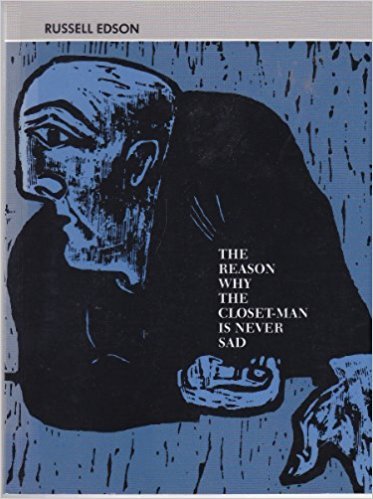
The Reason Why the Closet-Man Is Never Sad

Rate this book
In this new collection of prose poems, Russell Edson presents, beneath a sprightly surface, vignettes that are surprisingly pained, dark, animistic. As in his earlier works, Edson undermines our familiar descriptions of the world and restores it to its strangeness and lyricism. This volume can be read either as an anthology of black humor or as a series of cosmological and visionary tales

72 pages, Paperback

First published January 1, 1977

Loading...
Loading...

About the author

Russell Edson

50 books116 followers
Russell Edson (December 12, 1928 – April 29, 2014) was an American poet, novelist, writer, and illustrator. He was the son of the cartoonist-screenwriter Gus Edson.

He studied art early in life and attended the Art Students League as a teenager. He began publishing poetry in the 1960s. His honors as a poet include a Guggenheim fellowship, a Whiting Award, and several fellowships from the National Endowment for the Arts.

Russell Edson was born in Connecticut in 1935 and lived there with his wife Frances. Edson, who jokingly has called himself "Little Mr. Prose Poem," is inarguably the foremost writer of prose poetry in America, having written exclusively in that form before it became fashionable. In a forthcoming study of the American prose poem, Michel Delville suggests that one of Edson's typical "recipes" for his prose poems involves a modern everyman who suddenly tumbles into an alternative reality in which he loses control over himself, sometimes to the point of being irremediably absorbed--both figuratively and literally--by his immediate and, most often, domestic everyday environment. . . . Constantly fusing and confusing the banal and the bizarre, Edson delights in having a seemingly innocuous situation undergo the most unlikely and uncanny metamorphoses. . . .

Reclusive by nature, Edson has still managed to publish eleven books of prose poems and one novel, The Song of Percival Peacock (available from Coffee House Press).

Ratings & Reviews

What do you think?
Rate this book

Friends & Following

Create a free account to discover what your friends think of this book!

Community Reviews

5 stars
53 (50%)
4 stars
33 (31%)
3 stars
14 (13%)
2 stars
3 (2%)
1 star
2 (1%)
Displaying 1 - 13 of 13 reviews
Profile Image for Glenn Russell.
1,566 reviews13.6k followers
February 2, 2018


Here are four of my favorite Russell Edson pieces from this collection that I've read over and over and over again. Somewhat in the same spirit, at the very bottom is my own micro-fiction I had published some years back.


THE AUTOPSY
In a back room a man is performing an autopsy on an old raincoat.
His wife appears in the doorway with a candle and asks, how does it go?
Not now, not now, I'm just getting to the lining, he murmurs with impatience.
I just wanted to know if you found any blood clots?
Blood clots?
For my necklace . . .


THE CLOSET
Here I am with my mother, hanging under the molt of years, in a garden of umbrellas and rubber boots, together always in the vague perfume of her coat.
See how the fedoras along the shelf are the several skulls of my father, in this catacomb of my family.


THE LONELY TRAVELER
He's a lonely traveler, and finds companion in the road; a chance meeting, seeing as how they were both going the same way.
. . . only, the road has already arrived at its end; like a long snake, its eyes closed in the distance asleep . . .


THROUGH THE DARKNESS OF SLEEP
In sleep: softly, softly, angel soldiers mob us with their brutal wings; stepping from the clouds they break through the attic like divers into a sunken ship.

A handful of shingles they hold, leafing through them like the pages of our lives; the book of the roof: here is the legend of the moss and the weather, and here the story of the overturned ship, sunken, barnacled by the markings of birds . . .
. . . We are to be led away, one by one, through the darkness of sleep, through the mica glitter of stars, down the stairways of our beds, into the roots of trees . . . slowly surrendering, tossing and turning through centuries of darkness . . .


TAKING A SHOWER
A man is about to step into the shower when he discovers a chimpanzee in the tub.

"Well, let's give you a little water," the man says as he bends over and with a snap of the wrist turns on the hot.

The chimpanzee starts shrieking and tries desperately to get out. By that time, though, the man has pulled the shower curtain closed and punches at the outline of the chimp through the cloth.

The door creeks open. Alarmed, the man twists around and sees another chimpanzee lope in; outnumbered he bolts.

Now his eyes really bulge, his naked flesh trembles. The hallway is full of chimpanzees. And when the chimps gander at his horrified face, they all start jumping up and down, baring their teeth, creating a din with their high-pitched screeching. Surging forward, flailing his arms like an over-wound windup toy, the man takes a running leap toward the stairs leading down to the parlor where his wife is hosting afternoon tea.

The chimps clutch at him with their hairy arms, and when he tumbles down the stairs, no less than seven chimps tumble with him. The mass of hair, teeth, penises, tails and white sweaty flanks crash at the foot of the stairs.

The ladies glance over from their tea for a moment and continue their conversation.

Untangling themselves, the embarrassed chimps race out the back door and are followed quickly by their fellows who stampede down the stairs, trample the man's legs, and head on the way.

The man ceremoniously picks himself up, bows to the ladies, executes a left face, and marches back up the stairs and into the bathroom. Clutching the soap with a burly hand, he proceeds to scrub himself. Just when he's about to reach for the shampoo, the first chimp vaults back into the tub. Hastily, the man snatches him up by the neck and tail, sprints to the head of the stairs, and flings the chimp airborne to the bottom.

"Your first flying lesson," he snickers, brushing off his palms one against another with a flourish.

He stomps back to the bathroom that by this time has really steamed up. There's a wet bar of soap on the floor - his foot hits it. He takes a nasty fall. Unable to get up, he writhes in pain on the white hexagonal tiles.

Meanwhile, all the chimps come rumbling back up the stairs, trample over his belly, and pile into the tub.

"The soap, sir, where is the soap?" the chimp, now wearing aviator goggles, beseeches, and then spotting the shining bar in the corner, steps out to retrieve it. The man splutters pleas for help, but his voice is drowned out by all the whooping.
Profile Image for Ray Nessly.
385 reviews39 followers
August 4, 2017
My second try at appreciating this author, and I vow to keep trying, because no one writes like Russell Edson. No one. Whatever you want to call them--prose poems, fables, little fictions--he constantly amazes and confounds. 3.5 stars.

A few favorites. Note that, for some reason, apparently Goodreads won't accept the correct formatting. (I've edited it and reedited it several times to no avail-- when I post it, it's incorrect. I give up.)

The Parental Decision

A man splits into two who are an old woman and an old
man.
They must be his parents. But where is the man? Perhaps
he gave his life for them . . .
I ask the old couple if they've seen their son.
The old woman says, we've decided not to have any children.

The Taxi

One night in the dark I phone for a taxi. Immediately a
taxi crashes through the wall; never mind that my room is on
the third floor, or that the yellow driver is really a cluster of
canaries arranged in the shape of a driver, who flutters apart,
streaming from the windows of the taxi in yellow fountains . . .
Realizing that I am in the midst of something splendid I
reach for the phone and cancel the taxi: All the canaries flow
back into the taxi and assemble themselves into a cluster
shaped like a man. The taxi backs through the wall, and the
wall repairs . . .
But I cannot stop what is happening. I am already reaching
for the phone to call a taxi, which is already beginning to
crash through the wall with its yellow driver already beginning
to flutter apart . . .
Profile Image for Haley.
52 reviews
December 31, 2021
I don’t want to say this was a bad book. I’m sure there are people who would enjoy it, and I’ve never read anything quite like it before. However, Russell Edson’s writing just isn’t my thing. It made me feel like I was inside a washing machine.
Profile Image for Jack Rousseau.
200 reviews4 followers
August 15, 2026
This is the house of the closet-man. There are no rooms, just hallways and closets.
Things happen in rooms. He does not like things to happen.
. . . Closets, you take things out of closets, you put things into closets, and nothing happens . . .
Why do you have such a strange house?
I am the closet-man, I am either going or coming, and I am never sad.
But why do you have such a strange house?
I am never sad . . .
- The Reason Why the Closet-Man Is Never Sad (pg. 62)


In The Reason Why the Closet-Man Is Never Sad, Russell Edson further asserts his status as the master of the American prose poem. How best to summarize Edson's approach to prose poetry? His imagery, his absurdity, his departure from logical coherence... His obsessions (such as animals, decapitation, and the transformation of something natural into something mechanical or man-made), which he returns to frequently in The Reason Why the Closet-Man Is Never Sad as much as in his previous collections...

There was a man who made things because he was lonely. And so he made tears, which he thinks are tiny examples of the mystery that is large enough at times to swallow whole ships, and to be the road of the great whales. . . .
The man makes tears which he thinks come out of his eyes from the memory of ponds and oceans. And he thinks they are the tears of a marionette whose head is a jug of water with a sad face painted on it. . . .
- A Man Who Makes Tears (pg. 45)


Edson repetition of the description "small but shapely" applied to different objects in "All Those Small But Shapely Things" is perhaps the most poetic prose poem in the collection...

Aunt Hobbling in her kitchen making a small bu shapely breakfast turns and smiles in such a way as to make us aware of the constant space that surrounds her, embracing her, among those things of constant use, things that have become a king of body music, echoed in the natural sounds of the forest, and in the faint thunders of the distant sky.
She thinks of the finery scarred; rough seductions, as though one could collect a wealth made ugly by breaking through locked doors to those small bu shapely interiors. . . . One's feelings numbed now by that inner awareness of all the outward shows of all those small but shapely mercies. . . .
Yet, in the meantime, the dew, like small glass beads, aligns itself with the sun to make those small but shapely pieces in the grass of what we take to be the purity of light. . . .
She floats, suddenly enlightened, like a Kleenex in the wild. . . .
Meanwhile, we return once more to the kitchen of Aunt Hobbling, where she turns once more, smiling. And we see her among her things, as part of a collage in which the adhesive withers, so that the piece flutters, or shall we say, shivers, in those small but shapely winds that enter open windows with mercurial desire. . . .
- All Those Small But Shapely Things (pg. 12)


In The Reason Why the Closet-Man Is Never Sad, Edson re-imagines the fairy tale form to better serve his curious, inventive vision. Or perhaps it would be more accurate to say he updates the fairy tale form, placing them into a modern context or otherwise incorporating modern elements. In fact, Edson re-imagines specific fairy tales, such as The Gingerbread Man and Noah's Ark...

An old woman bakes a life-sized gingerbread man, whom she immediately married and lives happily ever after with, save that she's one of those wives who've the habit of picking on their husbands, and putting the pieces in their mouths.
When she notices all the holes it's too late; so she knocks off the rest of him.
- Pounding on the door, two huge gingerbread policemen; they drag her through the night to the gingerbread judge, who orders her to the gingerbread jail.
But she's a clever old woman, and makes a key out of gingerbread and opens the gingerbread lock, and escapes from the gingerbread jail.
But, on the outside, finds everything has turned to gingerbread, the trees, the streets, the people walking in the streets, all made of gingerbread, even rocks and insects. She is the only thing not made of gingerbread . . .
Meanwhile, two gingerbread policemen, with drawn gingerbread guns, full of gingerbread bullets, are chasing her down the gingerbread streets . . .
- The Gingerbread Crime (pg. 29)


. . . I didn't think it would work, the crew was entirely composed of animals.
The captain is a talking dog. If you manipulate his throat while he whines he can make the word mama. Is this enough to run a ship?
Then there's a horse who can answer simple addition by stamping one of his hooves.
There's a seal too, who balances a beach ball on his nose, and applauds with his front flippers on command.
I wonder if this is enough of a crew?
Somehow the ship makes its way into the harbor and out to sea. The elephants, in a chain, linked by their tails and trunks, are walking around the deck.The horse is counting something out with its front hoof. A monkey is pushing a little cup at me for money. I fail to see any seamanship in this . . .
Then the ship begins to sink. I manipulate the captain's throat that he might issue some emergency orders. But all he can seem to say is mama.
Mama, at a time like this?
But the captain seems more interested in a bone he keeps under his bunk.
The elephants continue to parade around the deck. And I can't see why the seal continues to applaud; unless it's because he realizes his good fortune, being the most aquatic of any of us on board.
Then the captain suddenly manages papa; maybe he'll be bale to find some words of instruction for the crew before it's too late.
The monkey is still pushing its little begging cup at me for money. But even as I manage to find some change the water is coming over the gunwales . . .
Final note: We were all saved, except for the seal, who continued the voyage on his own.
Observation: In my opinion the captain's vocabulary does not recommend him to a position of command, particularly at sea. In my judgement, both the captain and the crew would be better served in a circus; some, even, as house pets . . .
- Going to Sea with Animals (pg. 30-31)
Profile Image for Denis Mačor.
256 reviews49 followers
February 24, 2025
THE DOUBLE BED For a while now a woman has been turning into a double bed. She no longer wears regular clothes, but finds bedsheets and covers more fitting and comfortable to her new physical frame. Her mother and father implore her not to encourage the seeming aspect by wearing bedclothes in the street. The time was coming when she would no longer be able to leave the house, when she would have to remain in one of the bedrooms. Her father removed the bed and said, I don't suppose you'll need a bed, because you are yourself a bed. The family studied her to see just what style of bed she was becoming, so that they might buy matching furniture for her bedroom. Her mother was afraid that she might be becoming some of that modern stuff. Her father hoped she wouldn't be too old-fashioned, be- cause that would seem too spinsterish. The woman listens to her father and mother murmuring at night in the room next to hers. Her father murmuring in the dark, perhaps if she had gotten married there would have been a man in her double bed, and she wouldn't have to become a double bed all by herself. Oh, yes, it helps when you're married, it's such a lonely thing for a woman to become a double bed all by herself, murmurs her mother in the dark. (str. 22)
Profile Image for Sofia.
355 reviews43 followers
August 28, 2018
Read this, his highest-rated-here, in place of The Tunnel, the selections from his first volume having been promising, but the second having seemed a paltry imitation of Tender Buttons. This reads like a gorier James Tate, whom I read first. I guess that's okay. I wish I could just read Bill Knott's Naomi.
Profile Image for Joseph M..
149 reviews8 followers
October 14, 2019
I normally really like surreal and absurdist stories like these, but for some reason this book just didn't strike a chord with me. Some of the stories are almost... a little stupid. Edson has a great imagination but for some reason these stories just struck me as almost... dull.
Profile Image for B.
74 reviews
December 4, 2021
This author is absolutely insane. I think I’ve found a kindred spirit!
Profile Image for Lake.
32 reviews
April 27, 2023
Funny little guys. Not so interested in all the ones about time as a concept ir whatever. Enjoyable but not my favorite set of edson poems
Profile Image for Evan Pincus.
209 reviews26 followers
July 20, 2023
I admit, I still don't really get the apes, but I'm pretty sure I get everything else. At the very least, it gets me, and that's what matters, no?
Displaying 1 - 13 of 13 reviews