Jump to ratings and reviews
Rate this book

The Japanese Chronicles

Rate this book
Based on three decades of travel throughout Japan, collects the author's recollections and views on life in the Land of the Rising Sun

225 pages, Paperback

First published January 1, 1989

30 people are currently reading
789 people want to read

About the author

Nicolas Bouvier

102 books109 followers
Nicolas Bouvier (1929-1998) was a Swiss writer and photographer.

His travels all over the world incited him to recount his experiences and adventures. His work is marked by a commitment to report what he sees and feels, shorn of any pretence of omniscience, leading often to an intimacy bordering on the mystical. His journey from Geneva to Japan was in many ways prescient of the great eastward wave of hippies that occurred in the sixties and seventies - slow, meandering progress in a small, iconic car, carefully guarded idiosyncrasy, a rite of passage. Yet, it differs in that the travelogues this journey inspired contain deep reflections on man's intimate nature, written in a style very much aware and appreciative of the traditions and possibilities of the language he uses. (He wrote mainly in French, though he does mention writing a series of travel articles in English for a local journal during his stay in Ceylon.)

His most famous books are The Way of the World, The Japanese Chronicles, and The Scorpion Fish.

Ratings & Reviews

What do you think?
Rate this book

Friends & Following

Create a free account to discover what your friends think of this book!

Community Reviews

5 stars
149 (29%)
4 stars
222 (43%)
3 stars
113 (22%)
2 stars
20 (3%)
1 star
8 (1%)
Displaying 1 - 30 of 37 reviews
Profile Image for Jason.
1,321 reviews139 followers
April 10, 2021
A book of two halves, one is a concise history of Japan and it’s people and the second half is a travelogue of one of the most chilled travel writers you’ll ever read.

The history of Japan is not something I know much about, it has only briefly been mentioned in other books so this was the most in-depth I’ve gone. As with a lot of countries they are plodding along nicely…you could say thriving….until the Europeans come along and cause chaos and much bloodshed. The people in Japan did manage to do quite a good job of holding them off and it is because of that achievement they are such a strong nation today. Bouvier has a great love of Japan and this comes through in his writing, a subject that could be rather dry is brightened by his wonderful way with words. I think I would have to re-read this book to get a better understanding as it is difficult to remember all the place names and people.

The second half of the book is the memoirs of a man who has spent many years living in and exploring Japan. He comes across as being super relaxed, going with the flow and in no hurry at all. He does his travelling with very little money sleeping in some awful places full of fleas, this is one of the best things about being an armchair traveller 🙂 He meets some extraordinary people, Bouvier was the sort of person that could befriend anybody and get them to take him in and show him around, the fact he had a camera opened a lot of doors for him. He has a great sense of humour too, I loved the bit where he meets a group of kids and they all give him bits of paper for his autograph and he writes lots of different names for them as a joke.

The best part of the book was at the Abashiri Museum, he meets the owner who is happy to take things out of cabinets for Bouvier to photograph, it turns out this museum is his personal collection of years and years of travelling, he was a brilliant character.

A couple of years ago I read So It Goes by this author and I felt it was a mistake to read his last book before any of his others and I was right, this book is fantastic and will give me a whole new perspective of So It Goes when I read that again.

Blog Review: https://felcherman.wordpress.com/2021...
Profile Image for P.E..
966 reviews761 followers
August 22, 2024
Carnet de route

'Quant à toi, Eliane, tu ajoutes : Regarde bien Kyoto pour moi, j'en ai l'ennui. Toi ? Toi qui t'y sentis si souvent étrangère, exilée et perdue. Etonnante alchimie du souvenir ! la même qui transforme nos morts en ombres inoffensives et chères. Maintenant que tout ce qui te pesait ici, que la légère odeur de deuil qui flotte parmi tant d'autres est tenue à distance, tu tires du vivier de ta mémoire les images qui te plaisent et tu les enlumines patiemment en levant parfois les yeux sur les prés verts d'Europe. Et c'est ainsi que les livres s'écrivent.'

Un ensemble varié et d'une lecture agréable d'observations faites par Nicolas Bouvier lors de deux périodes de voyage au Japon. Les portraits de gens croisés alternent avec les poèmes comiques, les grands survols historiques avec des choses vues au quotidien. Le résultat d'ensemble est très agréable à lire, porté par un passionné de voyages dont la voix singulière a d'emblée rencontré ma sympathie.
'J'ai même de la compagnie : 3 chiffonniers édentés et pansus qui passent la journée comme des mulots dans ces ordures.[...] Deux vieux, une vieille à la peau grise, aux dents déchaussées. L'après-midi, adossés aux tas que la fermentation fait mitonner, ils lisent, la sueur au front, des fragments de magazines arrachés au poubelle journaux de catch, des bandes dessinées, des pages collées d'épluchures [...]. Ce sont des Eta, ces anciens parias dont la restauration Meiji a fait des Japonais comme les autres. Mais ils continuent à se partager les bas métiers avec les Coréens. Le monde les méprise et j'ai l'impression que ces trois-là le lui rendent bien.'
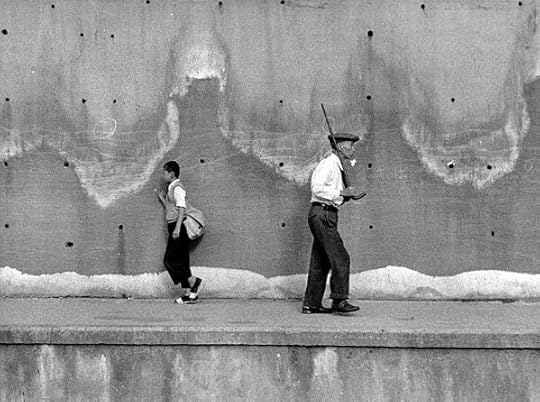

Le Mur, quartier d'Araki-chô, Tokyo (1956) - Nicolas Bouvier.

Voir aussi :
Les Japonais (TEXTO)
Le Japon
Sur les chemins noirs
Le tour de la France par deux enfants d'aujourd'hui (Equateurs Littérature)
Besoin de mer
Satori In Paris
Profile Image for Smiley .
776 reviews18 followers
March 5, 2018
3.5 stars

Categorized as ‘Literary travel’ and translated from French by Anne Dickerson, this paperback would be interestingly sentimental due to its reminiscence-like narratives to those Japanophiles or travelers who try to recapture those glimpses in their past trips in the Land of the Rising Sun; however, it could be all right for some tourists who read it before visiting there because “this immensely readable compendium of Japanese etiquettes, folklores, history, and anecdotes provides a key to understanding the Japanese people, their motivations, and their behavior.” (back cover) I don't mean it as a ready made one, rather it should be taken, that is, read for their background familiarity and intimacy so that they are well-prepared for the real thing with amazement, admiration and wonder while visiting there till they can't help comparing what they see with their countries.

From its contents, there are five parts followed by its topics:
1: The Magic Lantern (+ 12)
2: The Year of the Monkey, 1956 (+3)
3: The Pavilion of the Auspicious Cloud, 1964 (+ 2)
4: The Village of the Moon, 1965 (+ 1)
5: The Island without Memory, 1965-1970 (+ 10)

Interestingly, the author has designed a topic of ‘The Gray Notebook’ and used it as an introduction (Kyoto, February 24, 1964 Looking for lodging) and as intermissions (Kyoto, temple of the Ryoan-ji, April 3, 1964; Miyama, Kyoto-fu, 1964; Pages on the road, 1966-1970) but a few don't record any place or date. Moreover, there are 11 black-and white illustrations by the author.
Profile Image for Joselito Honestly and Brilliantly.
755 reviews431 followers
September 20, 2014
Part-Japanese history, part-travelogue, part-personal memoir. This was originally written in French under the title "Chronique Japonaise." But the translation is excellent for it succeeds in preserving the breathtaking poetry that the author has shown possible in the act of seeing new places and faces. Passages like this one, for instance:


"AT SEIBO HOSPITAL, TOKYO, DECEMBER 1964 TO MARCH 1965


"Even when you look through a kinetoscope or magic lantern, you should not kid yourself: the most essential connections are formed beyond the rational mind and are only rarely expressed in books: they are found in the tattoos seen at the beach or the morgue; in the pressure of two hands on a shoulder at the railroad station, fingers that cling--maybe too long--to this warmth and elasticity; in the cards written by soldiers, addressed so indecipherably that they arrive by mistake at the homes of old fools who have never heard anything so tender; in the quietness of two faces sunk deep in a pillow, as if they would like to disappear there; in this rarely satisfied and deeply held desire of the dying to find the end of the maze and something to say; in a window about to open; in the face of a child dissolving in tears, lost in the murmur of a strange language.

"Courage. We are much closer than we think, but we don't always remember it."


Whatever it means, I am sure you'll agree with me: it is beautiful.
Profile Image for Sophie.
50 reviews
March 21, 2016
J'ai adoré la partie récit de voyages mais j'ai eu plus de mal avec la partie sur l'histoire du Japon, je ne m'y attendais pas et j'ai eu du mal à rentrer dans le livre au départ. Par contre le style précis et "ciselé " de Nicolas Bouvier est un régal.
Profile Image for Paul Duncan.
12 reviews
January 28, 2024
Nice. Drops into Japan in the early sixties and then weaves around from 50s to 70s with eccentric anecdotes sprinkled with his take on the outline of Japanese history. Written from his own poetic perspective but very insightful. Trails off towards the end with a fair amount of repetition of ideas.
Profile Image for Carlotta Borasio.
Author 6 books53 followers
August 28, 2013
A metà tra il diario di viaggio personale e quella di una civiltà che ne incontra un'altra. Quando gli occidentali sono arrivati in Giappone? Cosa è successo? Qual è la storia dei valore di questo incredibile paese? E poi c'è la storia di Nicolas Bouvier alla scoperta del Giappone. Impressioni, scatti, vite. Alcune riflessioni vale la pena di appuntarsele.
Una lettura interessante.
Profile Image for André.
2,514 reviews32 followers
February 5, 2023
Citaat : Tegen de vrouw of de broer van wie je houdt zeg je niet eens alles, maar deze dames, die toch echt niet gek zijn, deze dames met linnen handschoentjes, die in Parijs niet eens van slager zouden durven ruilen (te riskant, je weet niet met wie je te maken hebt, misschien is de rosbief er wel niet zo mals) eisen dat ze bij vertrek een pakketje met ‘de ziel van Japan’ meekrijgen. Wat willen ze toch? Alles natuurlijk, en wel onmiddellijk, en dat hun onwetendheid in een handomdraai wordt omgezet in kennis, stevige kost en helder uiteengezet, alstublieft, zodat ze er thuis over kunnen vertellen.
Review : Van de Zwitserse schrijver, journalist en fotograaf Nicolas Bouvier (1929-1998) verscheen dit jaar zijn Japanse kroniek, de derde vertaling van zijn reisverslagen bij de kwaliteits Uitgeverij Bas Lubberhuizen. Bouvier maakte vele reizen door Europa en Azië. Hij schreef daar meerdere boeken over, waarvan De wegen van de wereld en De schorpioenvis eerder in Nederlandse vertaling verschenen.

Nicolas Bouvier groeide op in Genève en maakte talrijke reizen door Europa en Azië, waarover hij verschillende boeken publiceerde. De wegen der wereld uit 1963 is zijn belangrijkste werk. Nicolas Bouvier en zijn vriend, de tekenaar Thierry Vernet, reisden in 1953-1954 in een oude Fiat Topolino van Genève, via Joegoslavië, Turkije, Perzië, Pakistan, Afghanistan, en via de Kyberpas naar India. Het verslag daarvan groeide uit tot een van de beste cultboeken van de reisliteratuur, net zo invloedrijk als On the road van Jack Kerouack en In Patagonia van Bruce Chatwin.


En dan is er nu Japanse kroniek. Nicolas Bouvier, die in de periode 1956-1966 langere tijd in Japan verbleef, geeft inzicht in dit raadselachtige land door beknopte, indringende en vaak grappige schetsen van de geschiedenis, religie en cultuur af te wisselen met zijn persoonlijke indrukken en ervaringen. Hij zet in met de ontdekking van Japan door de Europeanen. In een reisverslag van Marco Polo leest Christoffel Columbus over de goudschatten van het eiland Zipangri. In 1492 zet hij koers naar het eiland, tegenwoordig Japan geheten, maar ontdekt in plaats daarvan Amerika. Pas meer dan honderd jaar later belanden Portugese handelslieden als eerste westerlingen in Japan, even later gevolgd door de jezuïeten. De Japanners hebben weinig sympathie voor de nieuwkomers en van een christelijke God die zijn zoon aan een kruis laat nagelen begrijpen ze al helemaal niets. Onbegrip en misverstand, het zijn lang de kernwoorden in de betrekkingen tussen het Westen en Japan.


Volgens de essays van de auteur arriveren we in dit karige en sobere land met de stofwisseling van een veelvraat: dat is het Westen ten voeten uit. Gouden serviezen, maharadja’s, robijnen zo groot als eieren, dat was wat onze eerste reizigers imponeerde en wat ze graag wilden zien, terwijl het ware kenmerk van Azië nu juist matigheid is. Een bijzonder werk.

Profile Image for Yves S.
49 reviews9 followers
September 30, 2023
I had read L'usage du monde some 15 years ago, and I had, kept safe I thought, in my memory, this beautiful book, one of the best travel story I had ever read, and, truly, even with this positive recollection, I had forgotten how good a writer Nicolas Bouvier was, and so was agreeably surprised to encounter again in these Japanese Chronicles, this lively, knowledgeable and precise prose, full of intellectual and cultural generosity.

At a time when nations have, to put it mildly, a xenophobic and self-centered tendency (I live in a country which voted itself out of its own continent from fear of it), the openness of this book, its smiling curiosity and open mindedness for the Other and for what is different, and how much more different Japan can be from Bouvier’s natal Switzerland, for all this, this book has been incredibly refreshing.

Bouvier was a true 20th century humanist, and this is not put mildly.

J'avais lu L'usage du monde il y a une quinzaine d'années, et j'avais dans mon souvenir, celui d’un beau livre, un des meilleurs récits de voyage que j'ai lu, mais vraiment, même avec ce souvenir positif, j'avais oublié à quel point Nicolas Bouvier était un bon écrivain et j'ai donc été agréablement surpris de retrouver dans ces Chroniques japonaises cette prose vivante, savante et précise, pleine de générosité intellectuelle et culturelle.

À une époque où les nations ont, c’est un euphémisme, une tendance prononcée pour la xénophobie et le nombrilisme (je vis dans un pays qui, par peur de l’autre, a joyeusement pris les urnes pour s’exclure lui-même de son propre continent), ce livre, sa curiosité souriante et son ouverture d'esprit pour l'Autre et de ce qui est différent, et je ne sais pas qu’il y est de lieux plus différent de la Suisse natale de Bouvier que le Japon, pour tout cela, ce livre donc et sa lecture ont été incroyablement rafraîchissants.

Bouvier était un véritable humaniste du XXe siècle, et ça, ce n’est pas un euphémisme.


Profile Image for Muriel.
20 reviews
October 4, 2025
Écrits entre 1956 et 1970, les textes de cette chronique nous ouvrent les portes d'un Japon immémorial, mais depuis des rencontres, des tableaux du quotidien prélevés sur un Japon qui n'est plus. C'est peut-être ce qui fait la Stimmung si particulière de ce livre.
Une pépite :
"À l'auberge de Matsushima
Dans l'esprit de bien des Japonais, l'Occidental est un être troublé plein de scories et de caillots. Tout à fait moi ce soir. Aussi la perfection de cette chambre nue m'écrase. Me réprouve. Me donne l'impression d'être sale alors que je sors du bain. D'avoir trop de poils, et de désirs immodestes, et peut-être même un ou deux membres superflus. Il y a dans ce décor - comme d'ailleurs dans la nourriture - une immatérialité qui répète sans cesse : faites-vous petits, ne blessez pas l'air, ne blessez pas notre œil avec vos affreux blousons de couleur, ne soyez pas si remuants et n'offensez pas cette perfection un peu exsangue que nous jardinons depuis 800 ans.
Je comprends bien, mais le pays et l'été m'ont déjà gobé comme un œuf, ne laissant que la coquille, et je vois mal ce que je pourrais faire de plus pour lui et comment exister moins. Matsushima, dans la province de Sendai, est un des "Trois Paysages" du Japon. Quand le moine-poète Basho est arrivé ici il y a 300 ans et qu'il a vu cette baie alors sauvage, ces douzaines d'îles chevelues sur le miroir de la mer avec peut-être un peu de brume pour adoucir ce que cet horizon marin aurait eu d'intolérablement grand, il y a été si saisi que son poème de l'étape s'est réduit à :
Matsushima yah !
Matsushima yah !
Matsushima yah...
Cela se chante un peu sur un demi-ton d'écart et sans doute ne pouvait-on dire mieux : il y a des cas où la répétition s'impose, et l'Asiatique le comprend mieux que nous. Ce cri, l'écho d'un cri, puis l'écho d'un écho qui s'abolit lui-même, et l'on ne sait Si c'est l'homme ou le paysage qui a disparu."
Profile Image for Alina Stepan.
284 reviews20 followers
March 9, 2024
A treia carte din seria peregrinarilor prin lume a lui Bouvier nu se dezminte. Aceeasi ironie, autoironie, profunzime a observatiilor si prospetime a privirii. ‘Rostul lumii’ ramane insa cartea lui principala. Mi-e teama sa ma opresc aici, parca e o conversatie oprita brusc si care trebuie ajutata sa mearga mai departe. E greu, insa, caci a scris putin si cartile i se gasesc greu.

Zice el: ‘Azi oamenii nu mai pot progresa in arta de a se distruge, in schimb mai au mult de facut in arta de a se intelege.’

Zic si eu: Din anii ‘60 (cand e intamplata cartea) si pana acum, oamenii au invatat in continuare metode din ce in ce mai sofisticate de a se distruge (unii vorbesc chiar de controlul/declansarea fenomenelor naturale (?)), si ne intelegem din ce in ce mai putin.
Profile Image for Chlöe.
91 reviews4 followers
August 14, 2024
Chouette manière de découvrir un pays, sous la plume d'un voyageur aguerri qui, pourtant, se laisse porter par ses impressions, par la simplicité des interactions qu'il rencontre, par la beauté des paysages, par le quotidien des villages.
Une plume qui dépeint avec intimité un Japon des années 60-70 sans a priori ni stéréotypes, mais qui, au contraire, nous le livre avec l'authenticité d'une expérience humaine et sincère.
Profile Image for Prayash Giria.
150 reviews2 followers
December 10, 2025
A collection of essays and vignettes on Japan’s history and the author’s own travels in the country. Some are genuinely engaging - especially the story of Yuji, who lost his family during and immediately after the Second World War. But the bulk of the book is sadly dense, rambling, and too author-centred. If you have a niche interest in 50s Japan or the experience of Francophone Europeans therein, then go for it. Otherwise, there are far better books on the place to read.
Profile Image for Madeleine McDonald.
Author 19 books2 followers
July 1, 2019
Twenty years of wanderings and musings in Japan, underpinned by a genuine interest in the country. A series of snapshots and anecdotes (with frequent references to the author’s lack of money) always viewed in the context of Japan’s centuries of isolation from the world, its history, traditions, and religions. A good translation from the French original.
112 reviews
July 20, 2025
I borrowed this book from my local library because I may go to Tokyo for a few months and thought this could be an interesting introduction to Japan. Overall many of the chapters were interesting and I am glad I read it but it also wasn’t as engaging as I was hoping. Probably wouldn’t read again-
398 reviews
November 14, 2019
Un livre très utile pour comprendre l’histoire et la culture japonaise. Un peu daté cependant
Profile Image for Maria Stallmann.
104 reviews
February 5, 2023
3,5 - a fascinating glimpse into a culture i knew so little about, beautifully painted in poetic and amusing language.
Profile Image for lune .
70 reviews
July 4, 2024
nicolas bouvier cette année je veux que
34 reviews3 followers
February 9, 2025
Exquis. L’absolu contraire de la cuistrerie, vulgarité et banalité d’un Sylvain Tesson.
Profile Image for scarlettraces.
3,093 reviews20 followers
February 5, 2024
I'm not sure about the potted history (although it was entertaining and super digestible, plus I loved his comment about Ruth Benedict completely missing the bonkers side of the Japanese pysche) but the travel writing. Oh my word. I wish he'd written more, but then again, maybe it could be this good when distilled.
3 reviews
October 10, 2021
Interesting read to learn about Japan, especially Japan on the cusp of modernity, but not as poetic and lyrical as The Scorpionfish.
Profile Image for Valeriu Gherghel.
Author 6 books2,069 followers
September 6, 2023
Mulți prieteni pretind că știu cîte ceva despre Japonia. Dacă-i întrebi de unde știu, îți răspund radioși: din romanele lui Haruki Murakami. Dar romanele lui Murakami sînt cele mai occidentale romane cu putință. La Murakami se ascultă Bach, Schubert, Mozart, Wagner, jazz și se bea bere la greu. Imaginea care rezultă din romanele lui e un amestec bizar de Occident cu o fărîmă de Japonia (numele personajelor).

Te poți apropia de Japonia, de religia și cultura ei, mai degrabă, prin cărți ca aceasta. Nicolas Bouvier a stat ani și ani în Japonia, a vizitat temple și sanctuare, localități, sate, i-a ascultat pe călugării buddhiști, dar și pe oamenii de rînd. Imaginea lui e mult mai aproape de adevăr. Știu asta, îndrăznesc să spun, pentru că și eu am stat în Japonia (în Narita, Tokyo și Kyoto). Drumul e chinuitor, avioane schimbate, turbulențe (mai ales deasupra Chinei), dar răsplata e pe măsura chinului.

Am făcut greșeala să spun prietenilor de pe Facebook că pe japonezi nu-i prea interesează religia. Pentru un japonez, întrebarea „În ce crezi?” nu are sens. Au un simț difuz al sacrului (care poate fi peste tot), dar chestiunile religioase nu-i tulbură foarte tare. Îți răspund, de obicei, că sînt non-religioși. În Japonia, lumea nu se împarte între fanaticii shinto și fanaticii lui Buddha. O astfel de împărțire e de neînchipuit. Oare de ce?

Găsim un răspuns în cartea lui Bouvier. Religia japoneză, dacă există una, ar putea fi caracterizată astfel:

- lipsește ideea de păcat,
- nimeni nu e îndemnat să practice asceza,
- nu există o etică, o disociere strictă între bine și rău, mult mai importantă de opoziția dintre pur și impur,
- nu are formule dogmatice, argumente în favoarea existenței zeilor,
- nu există pedeapsă, suferință expiatorie, nimeni nu încurajează angoasa, nimeni nu crede într-un infern, într-un loc al suferinței veșnice,
- nici un zeu japonez nu poate fi definit prin formula lui Rudolf Otto: „mysterium tremendum et fascinans”. Japonezii nu tremură...

Oamenii obișnuiți își vizitează destul de rar templele (sînt prea obosiți pentru asta, japonezii muncesc pe rupte, n-ar putea înțelege „Povestea unui om leneș”). Dacă intră într-un templu (Templul de Aur nu se poate vizita), nu trebuie să facă nimic, să îngenunchieze ori să se bată cu tîmpla de podele. La intrarea în templu, singura obligație e să te descalți. De Anul Nou, japonezii se adună și ascultă clopotele templelor. E un obicei, nu o obligație.

De altfel, în Japonia nu există legi, interdicții, ci numai recomandări. Nu e nimic ciudat că le și urmează...
121 reviews1 follower
February 14, 2013
Lyrical, poetic writing about his travels as a young man in Japan, living in a Zen temple as a caretaker in Kyoto, working as a young freelance journalist and photographer in Tokyo. He offers a decent sketch of Japanese history from very early days' contact with Korea and China up through the European missionaries, the closing off of Japan to the West, the forced opening by Commodore Perry, the fantastic one-generation of industrialization, the colonization of Korea and China, and finally the humiliating and - to the Japanese - inexplicable defeat at the end of WWII.

He also gives a sympathetic and gently humorous portrait of the Japanese character while detailing all the reasons why he loves Japan.

I read it on my way from Shanghai to Sapporo, continuing on to the easternmost part of Hokkaido. Was happy to see several of the places now (2013) and compare them to his pictures from 1964 - 66 as well as my other two trips to Japan in 1961 and 2006.

I stumbled across this book by reading a preface to someone else's book on travel. The preface was written by William Dalrymple, a favorite of mine in the travel genre, who listed book after book, author after author of travel writers he likes. I ordered every author I could on Kindle (great for us expat travelers who can't stuff our suitcases with a year's worth of reading but can put a year's worth on a "device") and the rest bought used and sent to Joanna's house in Seattle. This turns out to be among the best of these so far.
Profile Image for Harald.
484 reviews10 followers
March 29, 2016
Japan er kommet noe i skyggen for Kina de siste årene, men Nicolas Bouvier gir en god innføring i hvorfor Japan er kulturelt viktig og japanerne samtidig et folk som det er vanskelig for folk i Vesten å forstå fullt ut. Første del av boka gir en kort, leseverdig innføring i japansk kulturhistorie. Bouvier framhever de ofte mislykte møtene mellom europeere og japanere fra 1500-tallet fram til 1854 da amerikanerne «åpnet» landet for full vestlig påvirkning, men samtidig åpnet for japansk innflytelse den andre veien.

I resten av boka skriver Bouvier om sine egne lange opphold i Japan på 1950- og 1960-tallet. Uten særlig penger selv ble han godt kjent med andre mennesker som måtte klare seg med lite. Men som han selv observerer forandret livet i storbyene Tokyo og Kyoto seg raskt med økende velstand, og det har helt sikkert forandret seg flere ganger siden. Selv om han stort sett skriver positivt, peker han også på at «Det japanske samfunnet er en gapestokk hvor det bare finnes en utvei: oppover». Bare de eldre virker helt frigjorte.
Profile Image for DoctorM.
842 reviews2 followers
June 27, 2011
Nicolas Bouvier was one of the finest travel writers of the last century, though a writer overshadowed by the brilliant English wanderers--- Thesiger, Fermor, Robt. Byron, Newby ---who gave us travel lit as a serious genre. The Swiss Bouvier left home in the early 1950s and drove from Belgrade to the Khyber Pass ("The Way of the World") and then moved on to Japan. "Japanese Chronicles" is a lovely, gentle, luminous account of his arrival in Japan in the mid-1950s and his return a decade later. Finely-crafted, entrancing, and with an eye for place and detail. Travel lit about Japan is a favourite genre for me, and Bouvier's little book is a lovely addition.
Profile Image for Beroha.
388 reviews4 followers
February 24, 2017
Nicolas Bouvier is a French writer and photograph, who deserves to be known for his travel writings such as Chroniques Japonaises. The reader will not be given tips about places to visit or any touristic advice but something else, something more precious: the experiences and feelings of someone who lived and traveled in Japan in the 60's and 70's. Poetic descriptions, cultural discovery and vivid memories await the patient reader who decides to follow this adventurer on his fascinating journey.
Profile Image for David.
638 reviews130 followers
July 13, 2009
Bouvier was a Swiss traveller who visited Japan from the 1960s.

As Bill Bryson knows, travel writing is best when the writer is having a boring or horrible time. Fortunately, there's a fair bit of that here. Bumming around Tokyo, a miserable trip to a boring festival that has crap food, not understanding Buddhism. Sadly, it ends with a “my amazing experience in Hokkaido where I was very sensitive when taking photos and buying stuff from Ainu people, unlike all the other tourists” affair.
Profile Image for Catherine.
75 reviews26 followers
October 1, 2014
I found this in the travel section, and as I am going to Japan soon I thought it will be good for background reading.
I was surprised it read more like a memoir rather then a factual novel, though not disappointed as Nicolas weaves his words together to paint a detailed picture of the country, from it's religious merging with Buddhism to it's more recent rediscovering from USA.
Not quite a must read, but certainly enjoyable.
Displaying 1 - 30 of 37 reviews

Can't find what you're looking for?

Get help and learn more about the design.