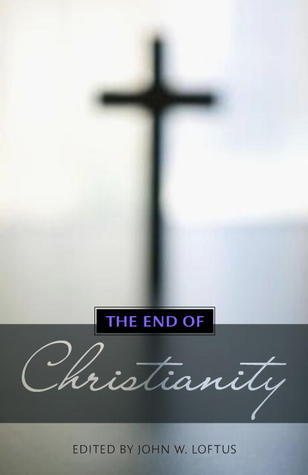
In this successor to his critically acclaimed anthology, The Christian Delusion: Why Faith Fails, a former minister and now leading atheist spokesperson has assembled a stellar group of respected scholars to continue the critique of Christianity begun in the first volume. Contributors include Victor Stenger, Robert Price, Hector Avalos, Richard Carrier, Keith Parsons, David Eller, and Taner Edis. Loftus is also the author of the best-selling Why I Became an Atheist: A Former Preacher Rejects Christianity. Taken together, the Loftus trilogy poses formidable challenges to claims for the rationality of the Christian faith. Anyone with an interest in the philosophy of religion will find this compilation to be intellectually stimulating and deeply thought provoking.
"End of Christianity is a diverse collection of interesting essays put together by the excellent author John W. Loftus. The essays are about matters that should lead reasonable Christians to end their religious faith based on compelling and sound arguments. This book includes some of the best atheist authors of our time and is the third of the excellent anthology by Mr. Loftus. This 435-page book is broken out into the following four parts: I. Why Two Thousand Years are Enough, II. Putting an Ancient Myth to Rest, III. Living on Borrowed Tim, and IV. Science Puts an End to Christianity.
Positives: 1. Mr. Loftus has set a high standard of quality. This anthology is well written and well researched. 2. Great contributions from some of the best atheist authors of our time. There is conviction and passion behind these essays."I do not choose not to believe the Christian story; I cannot." 3. Always thought-provoking. So many interesting takes and diverse opinions based on sound logic and grounded on reality. As an example, "How does something that is spirit create something material, or interact with it, unless there is some point of contact between them that they both share?" Hmmm... 4. Hits on so many fascinating religious topics. The format of the book makes it so that you can jump from one essay to another. As an example, I jumped directly to Dr. Stenger's mesmerizing essay about life after death. 5. You are guaranteed to learn something new. A gift to all who seek knowledge. 6. The natural evolution of Christianity...or shall I say Christianities. 7. The improbability of Christianity a recurring theme that is soundly defended. Many different angles are taken that soundly debunk it. 8. So what does it take to defend Christianity? Find out. Great stuff! 9. So should the Bible be relevant today? Dr. Avalos provides answers. Really interesting perspectives. 10. Polytheism? Gods? Sons of Gods? And other religious matters that make no sense. 11. The emotions of God. Many examples provided of such. Also, provides scientific reasons what emotions are for. 12. I'm always fascinated by Descartes's great error...mind and body as two separate entities. 13. The late Dr. Pulliam provides a very good essay on the absurdity of atonement. 14. Thought-provoking look at hell. "Why is everlasting torture a just punishment for a sin of limited duration?" What I liked about this essay is that it takes the best from apologists and debunks it soundly. 15. Does a good job of taking a critical look at the Bible. 16. A look at different theories regarding the compatibility of science with religion. A methodical approach, including sound definitions of the topics of inquiry. Excellent. 17. A great discussion on the differences between science and religion. 18. Dr. Carrier methodically destroys the claim of an intelligently designed universe. Using Bayes' theorem he destroys the "God Hypothesis". As always, he provides some very unique and persuasive arguments backed by sound logic. 19. Let me share one of Dr. Carrier's comments that exemplify his ability to convey thoughts in a lucid manner, "The universe clearly was made for neither us nor life in general. We barely arrived in it, and barely survive it. And life was clearly not made for humankind, as we appeared only billions of years after life had already been thriving without us. We gained dominance only through our own initiative and only against great and ceaseless opposition from the forces of nature and its nonhuman inhabitants." Music to my ears... 20. Everyone one will have a favorite topic or essay. My favorite was "Life after Death" by Dr. Stenger. This essay revolves around debunking Dinesh D'Souza's book titled, "Life after Death: The Evidence?" Dr. Stenger takes a scientific approach and fairly dismantles D'Souza's claims. A fun read indeed and so much good stuff here, bravo! Just get the book already! 21. Dr. Carrier provides the last essay, "Moral Facts Naturally Exist (And Science Could Find Them)." He provides an interesting take on morality. The basic claim is that morality is empirically discoverable. Controversial, intellectually challenging, thought-provoking, are just some of the adjectives to describe this essay. Dr. Carrier never disappoints. 22. Comprehensive notes that is a testament to the depth of research. 23. The links worked great on the Kindle! 24. Impressive list of contributors.
Negatives: 1. Having to wait for the Kindle version of this excellent book. 2. Some essays are intellectually challenging. Dr. Carrier for instance out of necessity uses Bayes' theorem as a tool to debunk the "God Hypothesis". Worthwhile, but it will test the focus of some readers. 3. If you have read some of the material of these authors some of the essays will be more like a refresher than new material.
In summary, I love this series and enjoyed this book. Like going to a great Tapas restaurant, the reader is presented with many appetizing dishes that lead to a satisfying experience. Some dishes will be more of your liking than others but there is plenty here for all to enjoy. John Loftus has yet another winner and we the readers get to enjoy another intellectual treat. I highly recommended this book!
Further suggestions: "Why I Became an Atheist" and "The Christian Delusion" by John Loftus, "Sense and Goodness Without God " and "Why I'm Not a Christian" by Richard Carrier, "Natural Atheism", "Atheism Advanced" and "Cruel Creeds" by Dr. David Eller, "Man Made God" by Barbara G. Walker, "The Moral Landscape" by Sam Harris, "The Invention of the Jewish People" by Shlomo Sand, "The Portable Atheist" by Christopher Hitchens, "The End of Biblical Studies" by Hector Avalos, "Forged..." by Bart Ehrman, "God: The Failed Hypothesis" by Victor J. Stenger, "Godless" by Dan Barker, "Christian No More" by Jeffrey Mark, and "The Invention of God" by Bill Lauritzen.
Another good collection of pieces discrediting christianity and supporting atheism edited by John Loftus, a former bible believing christian and the developer of the Outsiders Test of Faith. Which asks you to give the same amount of scrutiny of your own religion as you would in investigating other religions.
I've got a few chapters left to read in this book, but I'm going to go ahead and offer a partial review and edit it once I'm finished. I'll start with some general remarks and then say something about each of the chapters.
This book is an anthology of papers by atheist critics of religion (Christianity, in particular). The editor, John Loftus, has a book called Why I Became an Atheist: A Former Preacher Rejects Christianity in which he lays out all of the reasons why we should reject Christianity. In a follow-up book published in 2010 titled The Christian Delusion: Why Faith Fails Loftus gathered together some atheist scholars to argue against various aspects of Christianity. The present book is yet another follow-up, and is very similar to The Christian Delusion.
In general, I like this kind of book. You get to read a narrowly focused chapter on some particular topic by somebody who knows quite a bit about that topic, and then you get to read another chapter on another topic by somebody else who knows that topic very well. And the chapters are generally pretty informative.
That said, some of the chapters are obviously better than others, and this goes for both of Loftus' edited anthologies. Some of the chapters aren't all that convincing, and with others it's not immediately clear what value the chapter has to really show that Christianity is a delusion, or to bring the religion to an end. Fortunately, you can't just dismiss everything in the book because you've read one sub-par chapter, because they have different authors. Showing that one author's arguments fail still leaves another author's arguments standing.
Now I want to discuss some of the individual chapters:
----- "Introduction" by John Loftus
In this chapter, Loftus briefly explains what he calls his Outsider Test for Faith (OTF). The general idea is that many people were raised in a certain religion, and they have a double-standard when evaluating other competing religions. Christians reject Islam, Mormonism, Hinduism, etc. because they are rightfully skeptical of the claims made by those other religions. And Loftus thinks that if believers would just apply the same level of skepticism to their own religion, they would see that it, too, should be rejected.
The introduction is mostly the place where Loftus responds to various objections to the OTF that he's come across. I haven't yet taken the time to investigate this issue enough to know where I stand on it, or how well John's responses to the objections hold up, so I won't say anything more about it here.
----- Chapter One: "Christianity Evolving - On the Origin of Christian Species" by David Eller
Eller is a professor of anthropology, and in this chapter he looks at Christianity as it has evolved from its earliest days until now. The religion adjusts to whatever cultural climate it finds itself in; it has to, or else it would go extinct. And the result is a profusion of Christian sects which differ from one another, and which all differ from the original sect that began nearly two thousand years ago. Eller looks at the situation as analogous to biological evolution.
This is an interesting chapter, but it's not clear what the takeaway message is supposed to be. Is the point simply that the original Christian sect is now gone, having been replaced by various new "species"? Is Eller trying to explain why it's so difficult to put an end to Christianity? Or explaining why Christianity has already faced its end? Whatever precisely he aims to show, the chapter doesn't really serve as a rebuttal to any Christian doctrine as far as I can tell. (Of course, Eller probably didn't intend it to be.)
----- Chapter Two: "Christianity's Success Was Not Incredible" by Richard Carrier
This is a chapter-length version of an argument that Carrier makes in much greater detail in his book Not the Impossible Faith. Essentially, Carrier is challenging a popular apologetic argument for Christianity which says that the religion in its early days would have faced so many difficult obstacles that it could have only succeeded by a miracle. (For example, it could have only succeeded if Jesus was truly resurrected and the early Christians had good evidence for that fact.) Therefore, we have good reason to think Christianity is true.
This is the argument Carrier refutes in this chapter, and he does a pretty good job of it. I won't explain what the alleged "obstacles" are, and how Carrier shows that they really weren't obstacles for the early Christian movement. But I will say that I think Carrier does rather decisively refute the argument. At the very least, even the Christian should admit that he has cast significant doubt on the argument. The fact is, Christianity was not a rapidly growing sect early on. It was a movement that grew slowly in the early centuries, until it became recognized by the state (the Roman Empire) and later made the official religion of the state. This is precisely what we would expect from a religion that was growing naturally, without the backing of a miracle-working God. But if Christianity really were true, and there really were a miracle-working God helping to support the religion, we would expect it to be much more successful. Thus, according to Carrier, Christianity is actually disconfirmed by the evidence.
Converts are the most dedicated advocates of their new position. The editor of this volume is a convert from Christianity to Atheism. He has chosen an excellent selection of material to dis-member his old allegiance, including some chapters that he, himself has penned.
For someone actually on the fence about Christianity and Theism in general, the questions and positions posed in these chapters really do need addressed. I especially found interesting the material on the "Wild Improbability" of Christianity, and the chapter comparing divine emotion as portrayed in the Bible, with human emotions that we portray every day!
Some of the 'near death' material was of less interest to me as was the section of the use of logic (Bayes Theorem) to debunk theism. Got a little technical for the casual reader.
Anyhow, I am going to put this book on the shelf next to Harris, Hitchens, and Dawkins (rather that selling it on Amazon...as is my usual routine).
A very strong collection of atheist / anti-Christian arguments. If you are seeking to defend the faith, this is what you need to defend against. If you are seeking to attack Christianity, this gives some good ammunition. This is a stronger set of arguments than the usual ones trumped out by Dawkins, et al. and these have more force because many of the contributors here used to Evangelical Christians and aren't anymore.
The book does get bogged down in probability arguments from time to time, in particular the chapters by Richard Carrier (good use of probability, but a bit dry) and John Loftus (poor use of probability, but more readable), but on the whole the overall case is strong. Whatever you believe, this will give you something to think about and wrestle with.
even the introduction is a treat, will be interesting to see how many Christians can hang onto their delusional beleif after reading this, then again, mangily will bother? am finished, this is one of the best books on the subject I have ever read.
John Loftus has once again brought together an excellent collection of religious scholars to debunk the intellectual and moral foundations of the Christian religion.
90% of the points are bad, but the remaining 10% make the book worth reading.
The most convincing argument this book presents is the how God is immoral.
Additionally, despite glossing over the proof of the resurrection (which most secular books do), the book says that Jesus was secretly buried by loyal roman officals (loyal because not being loyal was punishable by death) and that an imposter Jesus revealed himself and, out of immense greif, none of the disicples or even the 500 people he later revealed himself to noticed.
I found it to be an excellent book for new non believers and a good book to recommend to believers that may be on the fence about the validity of Christianity.
The End of Christianity is a collection of 14 essays that specifically address philosophical, theological, anthropological, sociological, and ethical issues in relation to Christianity--or, rather, in relation to a specific subset of Christianity: fundamentalist/Evangelical Christianity.
For the most part, I agree with overall conclusions that each author draws in her/his respective essay. For example, I agree that that traditional, orthodox doctrine of hell is grossly immoral and that there is no real evidence whatsoever that Jesus of Nazareth literally arose from the dead.
To be quite honest, there is not much that is really new in this collection of essays with the singular exception of Richard Carrier's response to the design argument. Personally, I've always thought that Hume definitively disposed of the design argument and that the problem of evil also presents an irrefutable objection to the design argument, but the issues that Carrier addresses with his arguments from probability in relation to the fine-tuning argument were novel (at least for me) and, I thought, quite convincing.
The goal that the authors seek (as explicitly made clear in the title) is somewhat misguided. Like the majority of prominent atheists writing today, the authors largely conceive of Christianity in doxastic terms: Christianity, for these atheist authors, is largely a set of propositions, and one is a Christian by virtue of believing said propositions. Now, granted, there are some Christians (and possibly a significant number, especially in fundamentalist circles) who are Christians in exactly these terms. However, the vast majority of non-fundamentalist Christians and even, I would argue, many fundamentalist Christians, construe their faith more in terms of praxis and culture than of belief: they are Christians in terms of choosing to live their lives in accord with a certain set of principles which are only very loosely (if at all) derived any metaphysical beliefs about God and Jesus or from the ostensible authority of the Bible, and they are Christians in terms of their culture: the holidays and festivals they celebrate, the myths they tell (whether they take these myths literally or not) to explain their place in the world, and their overall attitude toward religion and secularism, believing that having a worldview that incorporates a healthy respect for the spiritual (which may or may not be a belief about spirits and souls or could be more of a positive existential and aesthetic attitude toward the world) aspects of life to be superior to a purely non-theistic, non-spiritual secularism.
So, does The End of Christianity portend the actual end of Christianity? No, of course, it does not. Still, it does provide a diverse, interesting collection of essays showing that adhering to the beliefs of fundamentalist Christianity is not rational and is not intellectually honest.
This is the third book John Loftus has had a "hand" in writing, the second as editor. It bears a great deal in common with "The Christian Delusion," which he also edited.
The best thing about it is the variety of styles and the scholarly nature of the different authors. It allows the reader to get a sense of both apologetics and the failures therein.
The drawback though is that, being so scholarly, it is not going to bring people not already at least agnostic to any understanding of Christianity's falsehoods. Ultimately, atheist writings must walk a line between scholarly enough to avoid a charge of being general, vague, or inaccurate (a charge leveled when the Christians cannot assail the arguments directly), while being accessible enough to be read by non-scholars. This book crosses into the realm of academic a bit further than maybe it should.
The essays are excellent, well-presented, organized logically, and well-cited. It is the citations that give this book its greatest appeal. Being able to find the authors' sources and see why they make these arguments with reference to original materials gives power and drives the wooden stake deeper into Christianity's heart.
I give this book five stars. It gives a thorough account of discrepancies, contradictions, fallacies, and the like that embeds not only Christianity, but Christians. The rhetoric and unscientific practices of Christianity is demonstrably harmful and prevents progression and aids as an impetus towards regression. I hope for all thinking humans interested in the demise of Christianity - to read this book fervently and accurately, allowing the truth to disseminate all out-dated techniques, rhetoric and behaviors.
A bit superficial at times, but generally well written and argued. Though I didn't agree with everything, I found a lot of my own similar objections within its pages. The book is definitely worth a read and its arguments definitely worth taking seriously.
Not as good as the first collection (The Christian Delusion, which I would rank 5/5). Some of the essays run long and meandering. But, they are all still very insightful and will add to anyone's knowledge of Christianity, whether you're a believer or a skeptic.
This extremely informative book should be read by anyone who ever wanted to understand the real reasons why many people do not accept Christianity, and by any Christian with unanswered nagging questions about their own faith.