

What do you think?
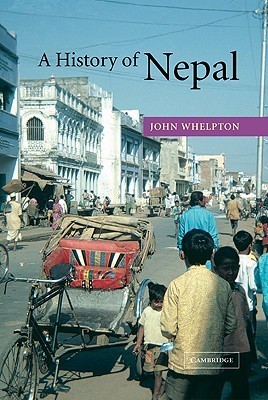
A History of Nepal
While John Whelpton's history of Nepal focuses on the period since the overthrow of the Rana family autocracy in 1950-51, the early chapters are devoted to the origins of the kingdom and the evolving relations of its diverse peoples. Whelpton portrays a country of extraordinary contrasts, whose history has been buffeted constantly by its neighbors, China and India. Economic and political turmoil over the last fifty years came to a climax with the massacre of the royal family in 2001, when the country erupted into civil war. This book is the most comprehensive and accessible English-language one-volume history of Nepal. John Whelpton, who works as a teacher in Hong Kong, is an historian and linguist. He has worked and traveled extensively in Nepal, and has written numerous articles and books on the subject. These include Nationalism & Ethnicity in a Hindu Kingdom: The Politics and Culture of Contemporary Nepal (Routledge, 1997), and Kings, Soldiers and Priests: Nepalese Politics and the Rise of Jang Bahadur Rana, 1830-1857 (South Asia Books, 1992).
- GenresHistoryTravelNonfiction
324 pages, Hardcover
First published January 1, 1990
Ratings & Reviews
Friends & Following
Create a free account to discover what your friends think of this book!
Community Reviews
Displaying 1 - 9 of 9 reviews

September 24, 2025
A few problems plague the writing of Nepali history. Firstly, the history of any kingdom is tied intimately to the caste system and unlike other dynasties, dynasties that ruled around here were eager to be tied to the Rajputs. This makes it difficult to trace the evolution of the dynastic spirit because all spirits essentially are swallowed by the Kshetriya identity. Perhaps I'm being too Aristotlean.
Another problem is that the transition from Monarchy to Democracy was abrupt enough to not need a corpus of political literature that legitimized the democratic process. As a consequence, each democratic mandate was at once an argument for or against the system itself in a way much more consequential than say, Nehru's term in office.
The historian thus has to be objective but not so objective that he forgets he is writing about a people's emotional experimentation with a system for which their affinity is very much in the surface. For example, a 1991 poll of the UML (Unified Marxist-Leninist) cadres showed that 20 percent of them believed the King was infact the incarnation of the Hindu God Vishnu.
Whelpton does a few things well. He is acutely aware of the subservience of Nepal's economic thinking to its political one and of the latter to its spiritual backbone. He thus analyses economic developments without considering what all institutional reforms were happening at the same time. He is only a bit less clueless than the politician who instituted such reforms. He has also done well what most Nepalis never do well - he does not think of Nepal as a unity. This automatically puts him leagues above authors who start from de jure assumptions that make absurd the political reactions to de facto conditions.
Whelpton doesn't analyze well the political motivations of individual actors. Why some leaders manage to override their opponents within the party, why the King waits idly at some times and not at other times - I'm no wiser of this than before I read the book.
All in all, I can find no fault in it which would make it a bad place from where to get a very reasonable and stolid picture of Nepal.
Another problem is that the transition from Monarchy to Democracy was abrupt enough to not need a corpus of political literature that legitimized the democratic process. As a consequence, each democratic mandate was at once an argument for or against the system itself in a way much more consequential than say, Nehru's term in office.
The historian thus has to be objective but not so objective that he forgets he is writing about a people's emotional experimentation with a system for which their affinity is very much in the surface. For example, a 1991 poll of the UML (Unified Marxist-Leninist) cadres showed that 20 percent of them believed the King was infact the incarnation of the Hindu God Vishnu.
Whelpton does a few things well. He is acutely aware of the subservience of Nepal's economic thinking to its political one and of the latter to its spiritual backbone. He thus analyses economic developments without considering what all institutional reforms were happening at the same time. He is only a bit less clueless than the politician who instituted such reforms. He has also done well what most Nepalis never do well - he does not think of Nepal as a unity. This automatically puts him leagues above authors who start from de jure assumptions that make absurd the political reactions to de facto conditions.
Whelpton doesn't analyze well the political motivations of individual actors. Why some leaders manage to override their opponents within the party, why the King waits idly at some times and not at other times - I'm no wiser of this than before I read the book.
All in all, I can find no fault in it which would make it a bad place from where to get a very reasonable and stolid picture of Nepal.

January 2, 2018
This is a surprisingly comprehensive and relatively balanced review of the history of Nepal over the last two and a half centuries. The author is able to provide a brief analysis of most events and aspects of the history without taking sides, even when discussing the foreign actors and influences. The result, however, is that a 240 page book is significantly lacking in detail or depth. While it is not the most exciting book I have ever read, and most everything that is covered in the book is discussed in more detail and with better insight in other material, it is a very good small package that provides some discussion about the entire history of Nepal.
June 20, 2015
Good quality history as is usual for the edition. I would probably find it more interesting if I was not familiar with Nepali history already. Book gives good overview of all important events, although focus is undoubtedly in modern post Rana period (after 1951). The book will give good basic understanding of current situation albeit some further study of post 2006 peace process would be needed. Generally recommend this book for people who want to get quickly acquainted with the basics, while further study of other sources would be needed to get a more complete picture.

September 7, 2020
Glad to learn so much about my own country from this book. I like that the book is presented with a neutral context.
September 30, 2025
Difficult to read
I found it quite hard to follow the time line of this book. Maybe Nepali history is more convoluted as a small country, but poor subtitles and minimal headings, plus excessive compilation of historical events rather than summary make this book better suited as a reference.
I found it quite hard to follow the time line of this book. Maybe Nepali history is more convoluted as a small country, but poor subtitles and minimal headings, plus excessive compilation of historical events rather than summary make this book better suited as a reference.
January 15, 2023
A good and well-researched book! While some facts may be incorrect or theorizing it gets the gist of what one wants from a book about Nepal. Definitely would recommend it to anyone who has a interest in history and is interested in Nepal as well!
July 15, 2026
As one of the proper accounts of the Modern History of Nepal, I loved the way it intersects different forms of development separately with the historical timeline. But having read contemporary books such as Kingdom lost, the details don't seem to be comprehensive enough. Yet a book to start with.

July 10, 2024
Glad to learn so much about my own country from this book. I like that the book is presented with a neutral context.

November 21, 2020
能让我看得昏昏欲睡的历史书真的是屈指可数,这算是其中一本。在不同历史年代的篇幅分配上又失衡到离谱。不服不行。
Displaying 1 - 9 of 9 reviews