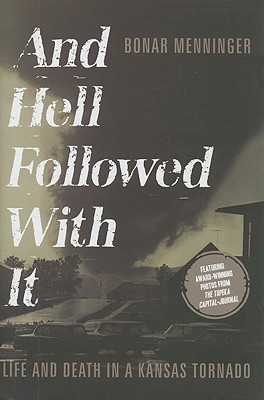
Colossal trees snap like matchsticks. A gigantic orange fireball explodes in the funnel's black core. Horses are sucked up and spit out alive by 200-mile-per-hour winds. These were just a few of the scenes that unfolded on June 8, 1966, when a massive EF-5 tornado cut a 22-mile swath across eastern Kansas and straight through Topeka Kansas's capital city. When it was over, 16 people were dead, more than 500 were injured, and property damage had reached $100 million, making the tornado the most destructive in U.S. history up to that time. That fateful day comes back to life in And Hell Followed With Life and Death in a Kansas Tornado. Author Bonar Menninger has interviewed dozens of survivors to construct a tightly woven narrative that conveys in gut-wrenching detail what it's like when nature careens out of control and ordinary people face extraordinary, life-threatening situations.
"If you're not under cover now, for God's sake, take cover!" -- then-rookie newscaster Bill Kurtis, broadcasting live during the incident on station WIBW-TV, to the viewers in Topeka, Kansas
In the realm of pop culture the U.S. state of Kansas and tornadoes are inextricably linked due to the everlasting popularity of L. Frank Baum's book The Wizard of Oz and its beloved film adaptation. In real life, however, the residents of 'The Sunflower State' routinely have actual cause for concern as their region is situated in the middle of 'Tornado Alley,' America's unofficial hot spot for twister activity. (Furthermore, the state ranks second in annual occurrences for these types of storms.)
Menninger's And Hell Followed With It (appropriating its title from the Bible's Revelation 6:8, when a pale horse - representing death - thundered down to Earth) details the events on the early evening of June 8, 1966 in Topeka, Kansas. This small capital city - population of 125,000 - in the state's northeastern corner was struck by a tornado that was later classified by meteorologists with the rare F-5 rating, meaning it involved 300 m.p.h. wind speeds, incredible types and amounts of structural damage, and the threat of serious bodily injury and/or death to any living creature in its vicinity.
Somewhat like a disaster movie, Menninger shadows various residents of the city - a popular disc jockey, a police officer, a college student, a telephone operator, and dozens more - as they go about an average day but are then suddenly confronted with the violent storm. (Since the weather service radar was then relatively new, the forecasting / predicting / warning for tornadoes was still in its infancy.) The tornado cut a 22-mile long path through the area to inflict complete devastation on housing developments, apartment complexes, and many businesses. Some of the locals who were WWII veterans likened the aftermath as similar to the bombed-out cities of England or Germany.
With a number of detailed, first-hand vignettes and a bit of interesting local history concerning their folklore (plus some excellent vintage photographs, courtesy of the city's newspaper) this was - at the risk of sounding ghoulish or disgusting - a sort of particularly exciting and suspenseful but yet also educational retelling of the horribly traumatic natural disaster. However, one of the primary reasons I read these types of books is that they often reassuringly demonstrate that disparate folks will band together and assist one another when faced with calamity. That happens here, plus there are couple of unique instances where divine intervention just may have been involved for some survivors.
I'm a serious storm freak, but I'm also a serious reader and writer, so I can't bring myself to recommend just any old book that comes along just because it's about extreme weather. But this book is definitely out toward the front of the pack among the many, many titles I've read about tornadoes. I can unequivocally recommend this one: exhaustively researched, written with the eye of a journalist and the soul of a caring interviewer, "Hell" takes the reader on a bullet train of a ride, speeding breathlessly toward the coming catastrophe. Then, when the storm inevitably touches down, Menninger draws out the pathos of regular people beset by sudden tragedy, as he reveals imminent peril to all the folks he so carefully introduced us to in the previous chapters. Though this book will easily satisfy storm freaks like me, it's also a good bet for history buffs and Kansas fans. I don,t buy many hardcovers anymore, but I'm glad I got this one that way, because it'll stay in my library forever, and I know I'll be reading it again. The book's website is also highly recommended, if only for the awesome photo progression and the chance to hear the haunting shriek of a real tornado siren: http://topekatornado.com/
This should be a book for all of those of us that live in tornado alley! An eye opener to the dangers of a F5 tornado and the damage it can cause! At first I thought the part with the history of the area and Kansas slowed down the book but later you will understand why it was needed in the book. Otherwise it was a good in depth story of those that lived and died in this tornado and why more weren't killed in it. Plus I liked the way the book is wound up in the end with the telling of the same people in the story years later and how it affected them personally. One even went through the Greensburg, Kansas F5 tornado in 2007 after having survived the Topeka, Kansas F5 tornado of 1966...they survived both! Some amazing stories and a good picture with words on the weird things tornados can do during damaging a town and what was found afterwards. There are some pictures of the damage included. All around best tornado book I've read so far!
I loved the way this book was written. The author broke the tornados path down into sections. Covering the destruction in one part of town, then jumping to the next. This kept it very easy to follow. Plus the book sticks to the subject, which to me is a big deal because I hate when I buy a book and it spends more time off the subject in the title. I wanted to read about the tornado and that's what I got. In a play by play fashion. Not to mention I'm a little more concerned about tornados now. Having lost a home to a hurricane, and another to a fire, I'm hoping I don't join the "tornado took my house" club too. Really good book. Never moving to Kansas.
Anyone who lived through the tornado, or knows anyone who was in the tornado, and would like a unique, detailed perspective of the night of June 8, 1966, should read this. Well-organized, but not detailed as an encyclopedia or documentary work, the tension of the event is well relayed and excellently transcribed.
Have to thank my mom, who was in Topeka during that night, returning from visiting her mother in Jefferson City, MO, and saw the tornado from the east Kansas Turnpike, for getting me this book from KTWU's pledge drive.
***Warning: Graphic material both of language and descriptive events. Not for those with light stomachs....***
Some months ago I had ended up visiting the Topeka public library just before going out on a double date with a fellow church member and a friend. Since she was from Topeka she ended up giving us a tour of the upper level of the library where a room was dedicated to the records and memories of those that had been a part of the 1966 tornado touchdown. With as limited time as we had I was able to note a bit of the information before seeing a book on the subject put in a spot of distinction. Knowing how much my sister enjoyed this type of reading I sent her a picture of the book itself before finding out later that she had already read it.
As for myself I knew nothing about the 1966 tornado and although I had been raised in the state since I was little had done no active pursuing in reading tornado survival books. For whatever reason, though, this book has summoned me and it was finally after a while that I got my hands on the copy while sitting down to read it.
The author does a wonderful job of putting together this book and all of its information in an easy-to-understand format while presenting it to the reader in as much of a chronological order as one can get to such a lengthy chaotic disaster. There are clearly some areas that when read after another don't seem to easily blend from one time sequence to another yet they can be overlooked after a while since the majority of the timing itself follows the track of this monster storm element, which helps the reader to follow along with the citizens of the city.
At the same time the reader is brought into the emotional core of what these people dealt with and struggled. Most first entries gave the reader with not only who we were going to be riding this part of the storm out with but also with enough past history that you knew who they were, what they had already lived with and what they were busy with at the minute before time. And then just as if you were within the same house or building you rode out the tornado with them - suffering, emotional flipped onto your back and quietly brought to see how they learned to overcome or deal with the aftereffects.
As a result of this strong ride and personal building format there is a raw deep emotional connection to be had between the past and the modern reader. Even though the storm is frightening and horrible there are times where you will laugh when you feel like you should be crying, there are times of hope and times of deep sorrow. At the same time you will be outraged, brought low and given hope if you are a follower of a higher power that divine intervention has its own place even in the darkest of darks.
And for those who like to have a bit of meat to the bone there are whole sections on the history of the tornado in forecasting and its weather organizations plus the science backing the storm itself. The latter does appear to repeat itself through the book as the reader continues to read but the scientific is gradually reblended back into the story that it doesn't take much away from the story itself. Otherwise you should be able to more or less skip these parts.
Finally there are over 10 black-and-white pictures from many sources that are tucked into the book for the reader. These range from pictures of the tornado, the destruction and damage, some of the people who will appear in the story and also for capturing others in the moment. The magnitude and weight of the pictures themselves combined with the chapter-headed detailed (detailed even to the size of the tornado and its color at the time) maps of particular hit zones will help the reader to feel the whole weight of this monstrous event. Otherwise if you really want to know this monster indirectly for what it was then you can find a short video of it on Youtube....
All in all this is one of the better catastrophe-type books that I have while I would highly recommend it to those who are interested in weather history, tornadoes and/or nature-based catastrophes. Again there are some descriptive and graphic moments that aren't for the queasy but otherwise it is a good book to read while getting you to think about what plans you may have if severe weather conditions may arise where you live, especially if you are in an area where these weather beasts are known to lurk.
Really enjoyed this book, and I'm not a nonfiction reader! I learned a lot about the Topeka tornado (I was 2 at the time) and currently living 35 miles from Topeka, I am familiar with much of the city. The insight and personal narrative of the storm victims kept me very interested the whole book. Well written, recommend!
Absolutely stellar book. I was genuinely upset to finish it and have no more pages to turn. Just regular folks met with a once-in-a-generation catastrophe and there the story unfolds and shocks and inspires. Menninger writes with a deft hand and sympathetic heart. Excellent. Read it soon!
Hell hath no fury... A killer tornado comes alive in Bonar Menninger’s comprehensive retelling of the twister that ravaged the Kansas capital of Topeka in 1966. And Hell Followed With It, Life and Death in a Kansas Tornado doesn’t miss a beat. From the thick air and eerie feelings some folks had early on the morning of the storm, to the devastating aftermath, Menninger deftly puts the reader in the path of the tornado through myriad accounts from terrorized Topekans.
Forget the lessons learned in Oz, many in Topeka in 1966 believed the town was protected from tornados by Burnett's Mound, an ancient Native American burial site. Some in Topeka, were guided by folklore that night thinking themselves immune, while others thought the town was being punished for building a water tower atop the sacred spot.
A family who chose not to head to the basement … students trapped at a music recital… travelers seeking shelter under a highway overpass… a woman carried hundreds of feet through the air following her anniversary dinner… babies, elderly, newlyweds and widows. Each story recounts terror, grief, loss and recovery. Menninger’s history as a reporter serves him well as he evokes personal and painful retellings from victims and their families. One of the most powerful moments for many in Topeka that night was the moment local news anchor Bill Kurtis, who later would gain prominence on the national news scene, sternly urged residents to take cover. Descriptions of wounds, injuries, death and destruction are accurate, even gory at times, contributing to the documentary feel of the book.
The twister’s technical side is well documented too, and we get a good glimpse of the early days of tornado prediction and warning systems. Due in large part to the damage and harm endured from the Topeka tornado, experts changed their policies on the safety of hiding out under highway overpasses (not a good idea), which corner of the basement is safest (not the Southwest, after all), and whether to open windows to reduce pressure (don’t).
Menninger’s reportage is enhanced by spectacular storm and damage photos from the Topeka Capital-Journal, providing a stunning first-hand glance at the fury of the storm. Even without them, however, we get the full picture through Menninger’s strong storytelling.
Menninger’s book recounts the 1966 Topeka tornado by weaving together several individual stories to describe the tragic event that affected so many people’s lives. This tornado, touching down on Burnett’s Mound, traveling through Topeka obliterated Washburn University. The story gives a play by play of each individual’s experience, divided by neighborhood by neighborhood approach. The author gives a personal approach to each individual’s story, giving information about an individual’s background, information about family members, and giving information about their careers. The author succeeds in using this technique, giving the reader the feeling that they know each individual on a personal level which adds suspense to the story when the reader realizes the tornado is coming right toward them. The individual stories go beyond just a few well-known names. Such as WIBW’s Bill Kurtis and his famous lines “For God Sakes Take Cover”, but recounts personal experiences from men, women, and children. This tragedy affected people in many different ways; some sought to bring awareness to others, others faced years of struggling with anxiety. Something that I found inspiring was how each person was able to pick themselves up after the event and hold their head high. Many were devastated but they were open minded to starting over and helping those around them. This book is a must read for anyone living in the Midwest, especially around Tornado Alley. Not only does this book knock some sense into those individuals who would rather stand outside and admire the view instead of seeking shelter but also brings awareness to the dangers that these natural disasters cause. So, next time you find yourself in a tornado watch, the sirens start going off….”FOR GOD SAKES, TAKE COVER!!!!”.
This entire review has been hidden because of spoilers.
The author starts this book with a look at tornadoes in general and the warning processes in existence prior to 1966. He starts his narrative with the tornado before it comes to Burnett's Mound. He follows different families and characters in their normal lives just before the tornado hits. He breaks the city of Topeka into sections and covers one section at a time as the tornado proceeds from southwest to northeast Topeka, right through the heart of the city. It's amazing that with siren warnings having just come into existence, that more than 16 lives weren't lost. Spotters, the National Weather Service, WREN radio and KIBW television all played intregal parts in the new warning system. Now living in Kansas and having experienced two myself, I know how important those warnings are and how important it is to have a plan if you hear those warnings. Some of our modern cable shows follow tornado hunters, but very rarely do they follow up on the injured or the dead. The types of injuries are unbelievable. Imagine that years after survival, you still have pieces of glass,wood, and tar being secreted from your skin. Everyone should read this book.
By far the best written and most level headed tornado history I've ever read. Just enough background history of Topeka and weather science to serve the story of the incident without bogging it down. The author also goes out of his way more than once to point out the dangers of sheltering under a bridge, no doubt afraid readers would pick up from survivor accounts that this is a safe place to shelter, when it is not. Well done, this is now the go to book in my severe weather history section.
Pretty awesome and terrifying portrait of the 1966 EF-5 tornado that plowed through Topeka, Kansas. The book is carefully composed with a timeline based off of the recollections of dozens of individuals present for the event. Hand drawn maps and set of relevant photos are excellent additions and I found myself referring to them often. A great read.
Possibly the best tornado book I've read. Menninger goes toe-to-toe with the monster from its inception just southwest of Topeka, Kansas on June 8, 1966, and stays with the storm following its path through downtown Topeka. Frequent, well-labeled maps and photos of places described help foster a better understanding of the life of this EF-5 behemoth.
Splendid overview of the notorious Topeka tornado of 1966. This was a massive and highly destructive F5 tornado; in the immortal cinematic masterpiece "Twister," a character refers to F5s as "the finger of God," and Topekans surely must have believed that God was giving them an upraised middle finger on the evening of June 8, 1966, as a twister half a mile across swept into southwest Topeka, cut through the middle of town, decimated Washburn University, flattened a chunk of downtown, and terrorized the working-class Oakland neighborhood before departing to the northeast and dissipating. (No cows go flying in this book, but a pony farm gets wiped out in one of the most horrific scenes.)
This is not a perfect book by any means. For one thing, it can get a bit repetitive: "[Name] was in [location]. Suddenly, [Second Person] ran in. '[Exclamation]!' they said. [Name] and [Second Person] ran to the [second location]. They heard [loud noise] and saw [something strange and random]. Then it was over. When they emerged, they saw [property damage]." But the author also delves into the history of tornado science and the development of the tornado warning system, which is really interesting, and nicely evokes the sheer power and terror of an event that they're still talking about in Topeka nearly 60 years after the fact. And Menninger has a good eye for detail, particularly when he's describing some of the tornado's more bizarre effects -- for example, empty, sealed soda bottles that the air pressure managed to empty, or the contents of a closed-up car found on a nearby lawn.
As an aside, some of the people Menninger interviewed for this book were family members of people I grew up with in Topeka, and there were a lot of other names I recognized as well (Topeka really isn't that big). I devoured it in a couple of days. Recommended for all weather geeks, even if you don't have any connection to Topeka or Kansas.
Interesting account of the Topeka EF-5 tornado of 1966, which ravaged the city. The author highlights behind the scenes events prior to this disaster to promote tornado awareness. Some say this is what encouraged others in the Midwest to promote early warning systems, such as the tornado (air raid) sirens that sound each Monday at noon. The myth of Burnett's Mound is revealed in part - let's just say it's still a legend. But the mound could not protect the city.
Eyewitness accounts retold through the author give a shocking and dramatic recollection from that simultaneously fateful and blessed day. Due to the timing of the arrival of the tornado, the warnings on the TV and radio and the efforts from locals, the loss of life could have been far worse.
I would dub this as a bit of a page turner, more so as you get further into the book - but the book doesn't just focus on the tornado itself, but a bit of the local history about the formation of Topeka, the inhabitants that settled there and how the city began to flourish.
Highly recommended reading for readers of local history and also recommended for those interested in disasters, disaster management. If anyone has read "Bloody Dawn", you'll find a very brief overlap in the history between Quantrill's raiders and the period of upheaval during the early part of the American civil war and Topeka's growth among all this turbulence.
As a Topekan for all 31 1/2 years I’ve been alive, I’ve always loved the weather and the day I found out that not only did an F5 beast carve a 22 mile path through the city but that it came up over Burnett’s Mound roughly 5 min from where I live was mind boggling.
Bonar’s book is amazing. While he details the path in a few different sections of the book (near the mound in one, then near Washburn the next, etc) he doesn’t get into so much detail that it’s hard to follow. He has so many eyewitnesses and dare I say victims whose stories are told and it’s easy to keep up with who is who and where they come from.
I recommend this book not only for those who live in and around Topeka and/or experienced the ‘66 tornado themselves but also those who love weather in general and are looking for a book that tells the story from start to finish of the dark side of nature and the community’s response. Well done.
A good account of the great Topeka tornado of 1966. I have heard talk of it, but this book really took me there. I, like many Kansans, tend to take a casual view of severe weather warnings. I have been lucky too many times. A recent experience with a tornado brought me to this book and gave me a more healthy respect for the power of nature. There is also a good section on the history of tornado forecasting.
As a storm spotter/chaser, this book truly hit home. I live in western Kansas and have seen my fair share of destructive tornados in my 30 years. My best friend’s mom was 6 years old and lived through the Topeka tornado. She says she will never forget it. This was an amazing book and I’m very glad I gave it a chance. I don’t normally read non-fiction books. Every page puts you right in the tornados path, as if you were actually there. If you have a chance to read this book, please do so!
This book chronicles the 1966 EF-5 tornado that leveled a good chunk of the town where I grew up. I knew most of the story already; partly because both of my parents lived through it, partly because it is local lore, and partly because the regional public television station did a nice documentary for the 40th anniversary. Anyway, the book is well organized, and it does a nice job of condensing all of his interviews and making a very readable story.
There is a lot of storm porn in here, and I recognized it for what it was, but that didn't make it any less interesting. Like, a gas station was hit, and it had a bunch of the old-timey glass soda bottles with the caps like beer bottles. The station was hit hard, but the soda bottles were there and un, but they were empty. And there was an aprtment building that was heavily damaged - basically the entire second floor was gone - but on a coffee table there were 2 martini glasses, each was full and garnished with an olive, and there was no debris.
This has been on my to read list for a while and I got it from the library then returned it. I have been enjoying Tornado books lately so I checked it out again but my library pile is already huge so I planned to return it again. Instead I forced myself to read it and I am so glad that I did. This book is an emotional read about the F5 tornado that sliced through Topeka in 1966. The stories from survivors are divided up into the different areas that was in the tornados path. As you read it was as if you were watching it happen through their eyes which made it very realistic. The author in a few chapters did include information about different topics that were important such as the history of Topeka and tornados to name a few. I understand why but I thought some of those took away from the book. Many who read these I think already know about how tornados are formed and the who F-scale but so it becomes tedious to read about them over and over in every book.
Remains the best that I've read in the genre of historic tornadic events. Admittedly, part of my praise is for the author's ability to capture so many things that were very similar to how life was when an outbreak of tornadoes struck near my home in the Twin Cities less than a year before: newer suburban sub-divisions spreading outward from brick and mortar centers, one-car families with stay-at-home moms, WWII vet dads, paper routes, radio, dinner time w/the tv on in the background (Lost in Space), party line telephones, kids scattered all over at friend's, parks, etc. Very atmospheric, in more ways than meteorologically.
It was very difficult to put this book down. I lived in Topeka in June of 1966, saw the horrible aftermath, and this book brought back so many memories. I knew all of the places in the book, knew of many of the people, and even knew two of the persons featured in the book personally. I have read many books on tornadoes, but none brings out the horror and wonder of nature's most violent creation as this book. The writing was magnificent. I felt I was there, with the people cowering in hallways, in basements and under bridges. It is an intense book. Not an easy read, but a must-read book. Thank you, Bonar Menninger!
The writing is workmanlike, the material is extremely exciting. I could read about strange tornado leftovers all day long (woman puts her wedding ring on a shelf to do dishes, after the storm the shelf and wall it hung from are gone but the ring is found on the kitchen floor)(a glass soda bottle, still capped, has only an inch of fluid left inside)(a tile roof is lifted off a building in one piece and then scattered). But I was sorry for the poor ponies!
Recommended for in-depth Topeka color and the storm progress play-by-play.
I picked this book knowing what had happened in June of "66 as my mother and her family were surivors of the storm, but the way the book was written made me almost imagine that I had been there. While some authors might have gotten bogged down into the little details of storm forecasting, the author kept it readable.
Great book, informed and well thought out and phrased.
This is a fascinating and meticulously researched account of a devastating tornado that destroyed much of Topeka KS back in 1966. Particularly helpful are the maps which precede each section so the reader knows where people were during their experience of the tornado. I found myself sitting up late reading just one more section, and then another and another.