Traces the archaeological and scientific studies surrounding the Egyptian oasis known as Dakhleh, citing evidence and historical findings that suggest the oasis may have given rise to the Egyptian civilization. 12,500 first printing.
Egypt has always fascinated me, from its Pharaohs to its drifting deserts. This book looks at the oasis history of the area, specifically the Dakhleh oasis, from its time before the sands took over to the present day. It’s a mix of history, archeological digs, and the discovery of just where the ancient Egyptian civilization really began.
Before the advent of homo sapiens, there was already human habitation in the oasis. At that time, it wasn’t a complete desert thanks to more rainfall, enough to cause occasional flooding. The ground soaked up the extra water, creating a huge aquifer which would sustain later villages. The book shows how archaeologists have uncovered the different groups of humans who arrived, lived, and eventually left Dakhleh. And while it was always assumed that the ancient Egyptians arose from the banks of the Nile river, enough evidence exists to show how the oasis people definitely influenced the foundations of that burgeoning empire. As the book continues, there are more archeological discoveries, including ancient Roman vestiges and an entire village.
Nothing brings home the ephemeral nature of the human enterprise better than finding a buried city. Nothing states with more surety that good times will be followed by bad, that the daily rituals we take for granted cannot last forever. Archeology underscores the frailty of the human project in the face of the ravages of time and the supremacy of nature.
Ultimately, this read warns us that nature will always triumph. Humans have basically emptied the aquifer and eventually the oasis will no longer be an oasis. The sands will come again, as they always do, and cover yet another form of civilization. It really absorbed me, even though I normally find archeology rather boring. By providing a chronological history of Dakhleh and of Egypt itself, I looked forward to learning about long-gone glassblowers, weavers, and potters. A very interesting book with a message about the handling of our environments.
(Q:where has my old copy gone? A: buried under the sands of time in a borrower's lair no doubt)
Dedication: for Catherine and Meghan who shared this journey, with love
Acknowledgements
It is Impossible to talk about the history of
civilisation without talking about water
SANDRA POSTEL 'Pillar of Sand' 1999
Prologue
Opening: Standing atop the 500-metre-high Libyan Plateau, a great limestone-capped prominence that shines white, pink or violet depending upon the angle of light and time of day, I peer over the edge of a dry ocean of sand, rippling with crests and troughs of golden, wave shaped dunes.
Page 17: Before the 1970s, despite the venerable history of Egyptology, no archaeologists had concentrated their efforts on the oases, opting instead to study the magnificent ruins that border the Nile. Eventually, however, a team of archaeologists focused their attention on Dakhleh and began to chart an unbroken 400,000 year pageant of human endeavour.
If you are prone to say something along these lines...
-did not finish. Too factual as it was an account of the actual archeological dig, a grain of sand at a time. First time ever i did not finish a book... :( tried twice to read it.
...then I would hazard a guess this is not the book for you. It IS a dig book, however the spin is slightly, as they say in the trade, 'out there'; read in superfluous conjecture.
Who would have imagined that an archaeological dig in southern Egypt could reveal such dramatic new data on the prehistory of humankind? Yet the evidence, literally dug up from beneath thousands of years of Sahara sands, established that habitation in this dry region goes back nearly half a million years. Excavations also revealed that the level of adaptability of the people to their arid environment reflected the rise and fall of empires of which little was known before.
The Dakhleh Oasis, a two thousand square kilometre area in Egypt's Western Desert comprises a patchwork of villages, palm groves and farmed fields. The casual visitor would find it difficult to imagine that this area of sand, rocks and lush green fields holds a unique historical record into our ancient past. Tracing the fascinating history of the Oasis and its surroundings, Thurston conveys the extraordinary story of this region and of the research project and its findings over the last 25 years. Presented in a conversational style, Thurston chronicles the discovery of the extraordinary treasures of this land based on two visits to the Dakhleh Oasis Research Project (DOP) and many discussions he had with project members over the years.
Initiated by two adventurous Canadians, fascinated by ancient Egypt, the project was launched in 1977 in collaboration with the ROM (Royal Ontario Museum in Toronto). Ever since, it has been expanding in size and scope, attracting an international team of experts. It is unique in its mandate and methodology. The mandate has been the study of human adaptability to a dryland ecozone and human activity's impact on it, from prehistory to today. It has required a team with very diverse scientific expertise. The research addresses archaeology, genetic makeup of early humans, ancient flora and fauna, land and water resource management, climate change and much more. This multidisciplinary approach allowed the team, over time, to map the history of the oasis, its peoples' living conditions and environment, identifying it as probably the world's oldest uninterruptedly lived-in location. Dakhleh was blessed above all else by the interminable availability of water from an underground aquifer, supplied by artesian wells. As long as the resources were used responsibly, Oasis dwellers benefited from fresh water irrespective of changing climatic conditions. Thurston reports on the earliest agricultural societies, their rise to becoming the breadbasket of Egypt followed by their fall when land and water resources were overexploited. A remarkable result, explains Thurston, has been the emerging understanding of the fundamental influence of climate change on human development and, in parallel the potentially devastating impact of human behaviour on fragile ecosystems.
His thoroughly researched study of the history of the Dakhleh Oasis is a treat for anybody interested in the history of human civilization and the interdependence of human development and fragile ecosystems. Thurston succeeds in presenting the reader with a fascinating and gripping story, "a microcosm of the human drama being played out on our planet". He argues convincingly that by understanding the past we can learn lessons for the present. "In essence, it's about water, its exploitation and conservation".
The book is so information rich that you want to go back to it, each time following a different theme or historical time frame. The chapters follow the historical chronology so that it is easy to select certain cultural periods. Unfortunately, for those interested in following a specific theme through time, the index will not help you much as it omits the all-important cross-references to topics and issues. The bibliography on the other hand is useful and leads to more specific readings.
A book that will appeal primarily to fans of ancient Egypt has natural limits on its readership. Island of the Blessed will lose even many of these through its opening sections, spending the first 140 pages in slightly dry accounting for the geography, prehistory and natural environment of the oasis before leaving prehistory with recognizable Old Kingdom settlement.
For all that, this is a book worth reading. The prose is workmanlike more than beautiful, but Thurston is a gracious guest who paints charming portraits of the daily lives of the archaeologists, scientists and specialists who make up the Dakleh Oasis Project (the 'DOP'), and seamlessly blends his several visits to the project over several decades of their work.
And the DOP is a fascinating project. Contrary to the historical independence of Egyptology, the project has integrated as wide a range of specialists as it can - not only archaeologists, but experts in hydrology, ancient flora and fauna, geography, and more to try to understand the story of the oasis through the millenia as a natural system. Like Easter Island or Iceland, the Oasis is a naturally isolated system that has attracted multiple waves of human settlement - some of whom found a stable way of life within its systems, while others introduced new technologies (irrigation, deep drilling) which led to rapid population booms and depletion of the slowly accumulated natural water reservoir and toxic accumulation of surface salt.
The analogy to larger human systems today is obvious, and Thurston not shy about drawing it in the closing chapters of the book.
Most attempted syntheses of such disparate themes aim for the great themes of history and draw from all over the world, to exciting but scattershot results. The focus on Dakleh makes this a quieter read, but perhaps one with higher potential to stick in one's memory.
Recommended to a patient reader with an interest in the interaction of human and natural systems across historical time.
"Ex Africa semper aliquid novi - There is always something new out of Africa." - Pliny the Elder
Egypt has ever been about the Nile. It's seasonal floods have carried rich silt along a narrow strip of arable land ribboning 4,000 miles through the desert, it's rhythm sustaining the life, culture and development of one of the world's most monumental civilizations.
But life did not begin with the Nile.
Deep in the Egyptian Sahara, 400 miles from the familiar epic sites of Cairo, Giza and the Pyramids lies the Dakhleh Oasis, a green island in a sea of sand, rock and parched wilderness - a place that has been revealed as an archaeological treasure trove, with an almost complete record of continuous human habitation dating back more than 400,000 years.
Island of the Blessed (entitled Secrets of the Sands in the U.S. - not nearly as evocative a title...) offers an intensely fascinating look at a unique archaeological site. The Dakhleh Oasis is not the proverbial pond with a smattering of palm trees, but rather a region that covers more than 600 square miles, providing life-giving water to a variety of plants, animals and people - stretching back more than 400,000 years in history. It is, quite literally, an island of life in the bleak wasteland of the Sahara.
Thurston draws on more than 30-years of archaeological studies and carefully takes the reader through the slowly uncovering history and significance of Dakhleh. Among the evidence uncovered by the archaeological teams working in Dakhleh is neolitihic stone tools and prehistoric encampments, new evidence of some of mankind's earliest agricultural activities, an exquisitely preserved Old Kingdom town, Roman aqueducts, countless mummies, a vast collection of papyrus records and the world's oldest bound books. One crucial theory now being examined is that Dakhleh was the crucible for Egyptian civilization, predating the Nile River habitations and provided a critical role in the ongoing development of Egyptian civilization and trade.
Thurston has created a solid, highly readable work that captures the unique setting and environment of Dakhleh, and offers up colorful and vivid glimpses of the sometimes obsessive characters of the archaeologists who are slowly bringing the past to light. In addition to the archaeological record, the long sequence of continuous human habitation within the isolated oasis environment permits archaeologists and climatologists to develop a one-of-a kind environment assessment, measuring the environmental impact and growth of human habitation within the isolation of the Dakhleh Oasis over an extended period of time. The research brings to light some of the detrimental impact that unchecked human growth and overly extensive agricultural practices can have on the water supply, a practice that may, in time, bring the Everlasting Oasis to an ignominious end.
For more on Dakhleh, check out The Dakhleh Oasis Project.
This book has archaeology, history, and the impact of man upon the environment. It tells the story of Dakhla, one of the five western desert oases of Egypt. The oasis has been inhabited since prehistoric times, and through archaeology you learn about the development of this area through history. You learn of it's impact on the Nile Valley civilization and vice versa. The author references ancient texts such as the "Autobiography of Harkhuf" and the "Autobiography of Weni" to tell the story of this oasis. The book ends with a discussion of the environmental impact on this oasis and the earth as a whole by man manipulating water resources, overuse of the land, etc. In this way it is a very timely book due to the current state of climate change and drought in many areas. I highly recommend this book.
I’m rereading this for the second time and I’m enjoying it as much as the first time around. It may not be for everyone, but I highly enjoy the prehistory and geography leading up to the historic settlement of the oasis. Everything is presented in a manner accessible to the layman and progresses at a natural pace. I know many find books based on archaeology to be dry but this is far from the driest I’ve read.
My only two issues are that I wish there were more pictures because that would help immensely in developing a mental image, and also that he mistakenly says that Cleopatra and Marc Antony had twin boy and girls and then a second daughter. They had a second, younger son, not a daughter.
This was the kind of book I was waiting to read. A good mixture of history, archaeology and present day concerns about our use of our resources. The style is very accessible and engaging without losing the critical edge of the science. Kudos.
I especially liked the perspective of a greater understanding of Egypt's place with its neighbors in Africa. This is a large picture with many moving parts.
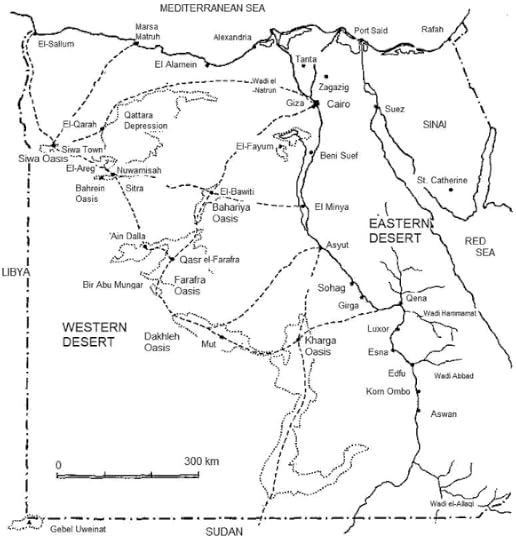
Two very small quibbles. Although there is a decent map at the beginning I didn't notice it until I was well into the text. Each time I was wondering where something was I kept going back to the table of contents but it wasn't there. I did find it eventually. Also, why not be consistent and just use ce and bce. Why confuse matters with bp or bc?
did not finish. Too factual as it was an account of the actual archeological dig, a grain of sand at a time. First time ever i did not finish a book... :( tried twice to read it.