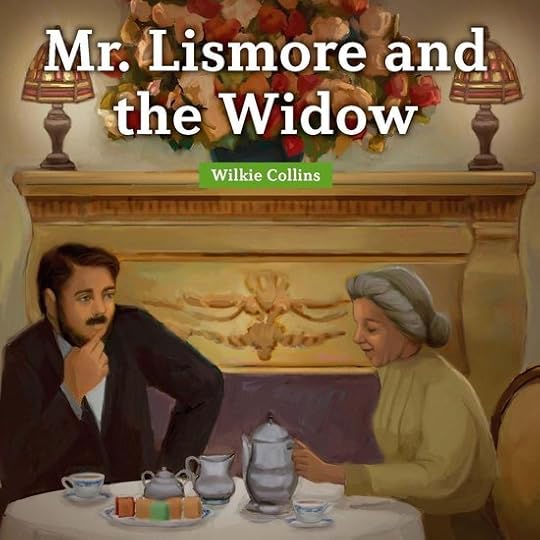
""Mr. Lismore and the Widow"" is a classic novel by Wilkie Collins, first published in 1888. The story follows the life of Mr. Lismore, a wealthy and successful businessman, who falls in love with a beautiful widow named Mrs. Farnaby. Despite their age difference and the disapproval of society, the two embark on a passionate romance. However, their happiness is threatened by a series of mysterious events that suggest Mrs. Farnaby may not be who she seems. As Mr. Lismore delves deeper into her past, he discovers a shocking secret that could destroy their relationship forever. With its complex characters and intricate plot, ""Mr. Lismore and the Widow"" is a gripping tale of love, betrayal, and redemption that will keep readers on the edge of their seats until the very end.The one security that he could offer was open, it must be owned, to serious objections on the score of risk. He wanted an advance of twenty thousand pounds, secured on a homeward-bound ship and cargo. But the vessel was not insured, and at that stormy season she was already more than a month overdue. Could grateful colleagues be blamed if they forgot their obligations when they were asked to offer pecuniary help to a merchant in this situation? Ernest returned to his office without money and without credit.This scarce antiquarian book is a facsimile reprint of the old original and may contain some imperfections such as library marks and notations. Because we believe this work is culturally important, we have made it available as part of our commitment for protecting, preserving, and promoting the world's literature in affordable, high quality, modern editions, that are true to their original work.
Wilkie Collins was an English novelist and playwright, best known for The Woman in White (1860), an early sensation novel, and The Moonstone (1868), a pioneering work of detective fiction. Born to landscape painter William Collins and Harriet Geddes, he spent part of his childhood in Italy and France, learning both languages. Initially working as a tea merchant, he later studied law, though he never practiced. His literary career began with Antonina (1850), and a meeting with Charles Dickens in 1851 proved pivotal. The two became close friends and collaborators, with Collins contributing to Dickens' journals and co-writing dramatic works. Collins' success peaked in the 1860s with novels that combined suspense with social critique, including No Name (1862), Armadale (1864), and The Moonstone, which established key elements of the modern detective story. His personal life was unconventional—he openly opposed marriage and lived with Caroline Graves and her daughter for much of his life, while also maintaining a separate relationship with Martha Rudd, with whom he had three children. Plagued by gout, Collins became addicted to laudanum, which affected both his health and later works. Despite declining quality in his writing, he remained a respected figure, mentoring younger authors and advocating for writers' rights. He died in 1889 and was buried in Kensal Green Cemetery. His legacy endures through his influential novels, which laid the groundwork for both sensation fiction and detective literature.
Opening lines: Late in the autumn, not many years since, a public meeting was held at the Mansion House, London, under the direction of the Lord Mayor.
The list of gentlemen invited to address the audience had been chosen with two objects in view. Speakers of celebrity, who would rouse public enthusiasm, were supported by speakers connected with commerce, who would be practically useful in explaining the purpose for which the meeting was convened. Money wisely spent in advertising had produced the customary result: every seat was occupied before the proceedings began.
Ernest Lismore is in financial difficulties. In return for a token marriage, he is offered help by the elderly Mrs. Callender whom he had saved from a fire some years earlier. Lismore eventually agrees and they live abroad as mother and son until he meets an attractive girl in an art gallery.
This short story was exciting with a great twist! I think Collins was one of the most creative writers of the Victorian era. He took the usual tropes and turned them on their heads.
Listened to the audiobook. The narrator sounds like Dame Judi Dench. Given that the writer is more popular for his gothic horror work, I was pleasantly surprised to be hooked to the end like it was a telenovela. I was gasping in reaction to the third character and amused that "I will be better in bed" meant something else.
Having only read Collins' novels in the past, this short story is somewhat suprising for its style. Although it continues to capture the socio-cultural norms in which he writes, this is lighter fare which cuts to the chase by developing the strange circumstances of love, shrouded in bizarre circumstances and personal choices. You ended up fully endeared to these characterns.
I have never read any Wilkie Collins, but after reading this short story he is definitely now an author I need to explore. I am genuinely so impressed.