

What do you think?
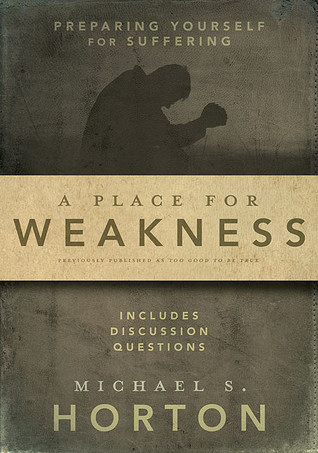
A Place for Weakness: Preparing Yourself for Suffering
In a world of hype, we may buy into the idea that, through Jesus, we’ll be healthier and wealthier as well as wiser. So what happens when we become ill, or depressed, or bankrupt? Did we do something wrong? Has God abandoned us? As a child, Michael Horton would run up the down escalator, trying to beat it to the top. As Christians, he notes, we sometimes seek God the same way, believing we can climb to him under our own steam. We can’t, which is why we are blessed that Jesus descends to us, especially during times of trial. In A Place for Weakness, formerly titled Too Good to Be True, Horton exposes the pop culture that sells Jesus like a product for health and happiness and reminds us that our lives often lead us on difficult routes we must follow by faith. This book offers a series of powerful readings that demonstrate how, through every type of earthly difficulty, our Father keeps his promises from Scripture and works all things together for our good.
208 pages, Paperback
First published May 1, 2006
About the author
Michael Scott Horton
236 books344 followersDr. Horton has taught apologetics and theology at Westminster Seminary California since 1998. In addition to his work at the Seminary, he is the president of White Horse Inn, for which he co-hosts the White Horse Inn, a nationally syndicated, weekly radio talk-show exploring issues of Reformation theology in American Christianity. He is also the editor-in-chief of Modern Reformation magazine. Before coming to WSC, Dr. Horton completed a research fellowship at Yale University Divinity School. Dr. Horton is the author/editor of more than twenty books, including a series of studies in Reformed dogmatics published by Westminster John Knox.
Ratings & Reviews
Friends & Following
Create a free account to discover what your friends think of this book!
Community Reviews
Displaying 1 - 30 of 37 reviews

April 30, 2011
This book flowed nicely starting when tragedy strikes and ends when God goes to a funeral which in translation means that the last enemy will be destroyed by death. "The Lord is a man of war, the Lord is his name" Exodus 15:3...our preparing for suffering is really a preparation for war of the spiritual kind. This book very nicely done makes you aware of the reality of suffering. What it is and what it is not. Faith always points to what Jesus has done not our own strength or own resources. God provides the resources, and the abilities, but in our flesh we can loose sight of who God is and loose reality at the same time.
You might ask who God is and how do I know who God is...by sound doctrine. Many today assume it is a distraction from the real life of of Christian discipleship but it is preparation for it. I just recently did a study on Isaiah (Bible Study Fellowship) and this really reasonated with me. Michael Horton does not pull any punches, sugar coats, or give you any promises. He presents Jesus. The Cross. The Character of God.
"They said to him, "We were not born of sexual immorality. We hae one Father-even God." Jesus said to them, "If God were your Father, you would love me, for I came from God and I am here...It is because you cannot bear to hear my word. You are of your father the devil, and you will is to do your father's desires." John 8:41-44
Page 166-Notice again the reference to God's word. This is the battleground of spiritual warfare. Preferring Satan's enticements to glory instead of God's word.
I very much enjoyed this book. It is grounded with truth that we need to know in preparation for tribulations. We can only act, if we know.
You might ask who God is and how do I know who God is...by sound doctrine. Many today assume it is a distraction from the real life of of Christian discipleship but it is preparation for it. I just recently did a study on Isaiah (Bible Study Fellowship) and this really reasonated with me. Michael Horton does not pull any punches, sugar coats, or give you any promises. He presents Jesus. The Cross. The Character of God.
"They said to him, "We were not born of sexual immorality. We hae one Father-even God." Jesus said to them, "If God were your Father, you would love me, for I came from God and I am here...It is because you cannot bear to hear my word. You are of your father the devil, and you will is to do your father's desires." John 8:41-44
Page 166-Notice again the reference to God's word. This is the battleground of spiritual warfare. Preferring Satan's enticements to glory instead of God's word.
I very much enjoyed this book. It is grounded with truth that we need to know in preparation for tribulations. We can only act, if we know.

February 27, 2021
A wonderful book to better understand God and ourselves
I find so much Biblical truth in the writings of Michael Horton. Our relationship with God often reverses the “normal” order of things and so it is with weakness. A wonderful theology of weakness that brings light to so many areas of our faith and lives. Very helpful. I may read it again next year.
I find so much Biblical truth in the writings of Michael Horton. Our relationship with God often reverses the “normal” order of things and so it is with weakness. A wonderful theology of weakness that brings light to so many areas of our faith and lives. Very helpful. I may read it again next year.

January 17, 2021
This is an amazing book. Highly recommended.

January 18, 2020
"...life is both a tragedy and a comedy, often at the same time."
"...being a theologian of the cross - which is the general vocation of every Christian - requires three things: oratio (prayer), meditatio (study), and tentatio (trials)."
"Sometimes we suffer for righteousness' sake, other times for our own folly, and quite often, simply as a result of belonging to a fallen creation in which suffering and death are inevitable."
"...America has increasingly preferred the religion James called 'healthy-mindedness,' which replaces sin with sadness as the real enemy of human nature."
"We become prisoners of our own felt needs, which were inculcated in us in the first place by the very marketplace that promises a 'fix.'"
"Just where the highest and holiest victim of truly undeserved suffering cries out, 'My God, my God, why have you abandoned me?' victory over sin and death is taking place. This is the foolishness and weakness that trump the wisdom and power of the ages!"
"The theology of glory sees God everywhere, in glory and in power, and presumes to ascend self-confidently to God by means of experience, rational speculation, and merit. It is the religion of the natural man or woman. By contrast, the theology of the cross sees God only where God has revealed himself, particularly in the weakness and mercy of the suffering. Only when we learn to despair of ourselves, to suffer our own nakedness in God's holy presence, to renounce our righteousness and listen only to God's Word, are we enabled to recognize God as our Savoir rather than our just judge and holy enemy. We rise up to God in pride, while God descends to us in humility. We look for God in powerful places; in health, wealth, and happiness; in perfect families and prosperous nations, but God is truly to be found in the weak things of the world."
"In Christ - that is, under his guardianship - we are assured that God, not Satan, is king; life, not death, has the last word..."
"...as horrible as our own circumstances may be, they are secondary to our salvation and God's glory."
"[our theology is] what we believe about God and his revealed purposes in history..."
"We need more than chicken soup for our souls; we need to be transferred from the domain of sin and death into the kingdom of God's Son."
"[pragmatism] - truth is whatever works best for the greatest number of people..."
"...we never really encounter God - a person distinct from us - but only our personal, national, or cultural ideas of 'god.'"
"We know that we have drilled into reality when its gushing intensity throws us off balance."
"There is no theology-free experience. It is all interpreted, and the question is whether there is something outside our experience to critique it, to let it know whether it got things right."
"Following our experience means we are always prisoners of what we already believe. If we simply let our heart be our guide, we'll never be challenged, corrected, surprised, or changed in a more liberating direction."
"...reality is not the projection of our own heads or hearts, but exists apart from us."
"...deism (God as involved)...pantheism (God as indistinguishable from creation)..."
"While God's revealed designs are often made contingent on the actions of his covenant partners, God's secret plans are already settled, long before we arrived on the scene."
"God's knowledge has already accounted for all obstacles in the way of our salvation, and his power will conquer them."
"...we tend to measure God and his purposes by what we calculate as most beneficial for us."
"...he is weaving together our miseries in this fallen world - even those miseries we bring on ourselves - into the tapestry of grace for his glory."
"Just because we can diagnose mental illness according to purely physical symptoms and treatments does not mean that the demonic 'powers and principalities in heavenly realms' are not ALSO taking advantage of our physical weakness in order to undermine our confidence in God's gracious promise."
"We build suitable projections of gods who will not threaten us, gods who are too far away to cause any harm, or, if they are friendly and useful enough, gods who are close at hand, gods who do not judge."
"News of God's majesty, power, glory, holiness, and justice only comforts those who are not guilty."
"For a revelation of God's saving will, more than the visible realm of nature is needed."
"Human curiosity....will leave no secret to God that it will not search out and unravel."
"...[we are] catechized by the world to believe that tragedies have no clear origin...and therefore no clear hope of being part of a master plan."
"We do not need to add to the insult of tragedy the injury of expecting people to discern something that might make the event more rational or acceptable."
"Comforted by the cross, let us turn away from the theologies of glory we find all around us: in the signs and wonders so many demand; in the clamor for success, numbers, and popularity in this world; in the speculative, mystical, and subjectivist trends of our time; and in the triumphalism that so marks the contemporary church."
"...it assumes a view of divine action that eliminates or trivializes the actions of human beings, weather patterns, and other created factors that have their own prescribed freedom under God."
"...a lot of the adversities we face in this life are simply part of the web of ordinary causes and effects in the world."
"...in the middle of the crisis, the big thing on my mind was what my father was going through, not how I could turn it into my own learning experience."
"...the attempt to know more than God has actually revealed is characteristic of superstition and magic rather than of Christian piety."
"We have to avoid confusing God's gracious care for the world in all of its rebellion with his plan of redeeming a people for himself in Christ."
"...we must not limit our pursuit of truth, goodness, and beauty merely to the pages of Scripture. The reality of God's common grace means we are free to pursue - and indeed expected to pursue - truth, goodness, and beauty wherever God's Spirit has scattered it, even in secular sources."
"...allows us to participate in secular culture, to enjoy relationships with unbelievers, and to work beside them in common vocations and toward common goals without always having to justify such cooperation and common life in terms of ministry and outreach."
"Whenever we come upon these matters in secular writers, let that admirable light of truth shining in them teach us that the mind of man, though fallen and perverted from its wholeness, is nevertheless clothed and ornamented with God's excellent gifts." -Calvin
"The Mosaic theocracy was limited to the old covenant and is no longer the blueprint at a time when there is no chosen nation. The law of God written upon the conscience of every person allows for a marvelous diversity in constitutions, forms of government, and laws, all of which are in their own times and places acceptable as long as they preserve the equity that must be the goal and rule and limit of all laws."
"[God's providence is]...the determinative principal of all things, even though sometimes it works through an intermediary, sometimes without an intermediary, sometimes contrary to every intermediary."
"It must be said that this is exactly the sort of platitudinous moralism one often finds in some Christian circles these days. But it is as old as the Garden of Eden. We dress ourselves in fig leaves, believing that our shame is covered by the shelter of our own righteousness. Platitudes for better living are offered instead of promises of God's unmerited favor, and Job's response is understandably as sarcastic toward his counselors as it is reverent and trusting toward God:
'Though he slay me, I will hope in him;'..."
"What happens here and now is not the whole story."
"This historical event may not fix our marriages, our relationships, or our messed up lives the way we would like, or in the timing we would like, but it saves us from the wrath of God to come and gives us new life, hope, and wisdom for our existence here and now, guaranteeing the end of pain at last."
"It is this fading age, with its false promises and money-back guarantees, makeovers, petty lust, and perpetual amusements that is in fact the 'opiate of the masses,' not biblical faith."
"...we also become so vitally connected to him by the mysterious work of the Spirit that his very life becomes the source of transformation of our own lives."
"...all believers are already definitively changed once and for all, incapable of returning to spiritual death."
"Life in Christ by the power of the Spirit is not something to be attained by us but something that has already been given to us, and this we are to recognize as already having been given to us because of our union with Christ."
"What we need most in times of spiritual and physical trials are not more imperatives (our plans for our victory), but to be reminded again of the triumphant indicatives (God's plan for victory, achieved for us in Christ)."
"Sin is much more complicated...being likened here to a spider's web that is woven not just by each of us but by all of us collectively. Thus, we are all simultaneously sinners and sinned-against, perpetrators and victims."
"Ironically, although sentimentalism seems like the opposite of stocisim, they share some intriguing parallels. They both seem intent on avoiding the messiness of life - particularly, the tragic aspect...[either] to abandon negative emotions by banishing all emotions...[or] admitting only the good emotions."
"Eschatological is just a fancy term for the in-breaking of the last day, the future heavenly reality anticipated in flashes here and there even in this present age of sin and death."
"...being a theologian of the cross - which is the general vocation of every Christian - requires three things: oratio (prayer), meditatio (study), and tentatio (trials)."
"Sometimes we suffer for righteousness' sake, other times for our own folly, and quite often, simply as a result of belonging to a fallen creation in which suffering and death are inevitable."
"...America has increasingly preferred the religion James called 'healthy-mindedness,' which replaces sin with sadness as the real enemy of human nature."
"We become prisoners of our own felt needs, which were inculcated in us in the first place by the very marketplace that promises a 'fix.'"
"Just where the highest and holiest victim of truly undeserved suffering cries out, 'My God, my God, why have you abandoned me?' victory over sin and death is taking place. This is the foolishness and weakness that trump the wisdom and power of the ages!"
"The theology of glory sees God everywhere, in glory and in power, and presumes to ascend self-confidently to God by means of experience, rational speculation, and merit. It is the religion of the natural man or woman. By contrast, the theology of the cross sees God only where God has revealed himself, particularly in the weakness and mercy of the suffering. Only when we learn to despair of ourselves, to suffer our own nakedness in God's holy presence, to renounce our righteousness and listen only to God's Word, are we enabled to recognize God as our Savoir rather than our just judge and holy enemy. We rise up to God in pride, while God descends to us in humility. We look for God in powerful places; in health, wealth, and happiness; in perfect families and prosperous nations, but God is truly to be found in the weak things of the world."
"In Christ - that is, under his guardianship - we are assured that God, not Satan, is king; life, not death, has the last word..."
"...as horrible as our own circumstances may be, they are secondary to our salvation and God's glory."
"[our theology is] what we believe about God and his revealed purposes in history..."
"We need more than chicken soup for our souls; we need to be transferred from the domain of sin and death into the kingdom of God's Son."
"[pragmatism] - truth is whatever works best for the greatest number of people..."
"...we never really encounter God - a person distinct from us - but only our personal, national, or cultural ideas of 'god.'"
"We know that we have drilled into reality when its gushing intensity throws us off balance."
"There is no theology-free experience. It is all interpreted, and the question is whether there is something outside our experience to critique it, to let it know whether it got things right."
"Following our experience means we are always prisoners of what we already believe. If we simply let our heart be our guide, we'll never be challenged, corrected, surprised, or changed in a more liberating direction."
"...reality is not the projection of our own heads or hearts, but exists apart from us."
"...deism (God as involved)...pantheism (God as indistinguishable from creation)..."
"While God's revealed designs are often made contingent on the actions of his covenant partners, God's secret plans are already settled, long before we arrived on the scene."
"God's knowledge has already accounted for all obstacles in the way of our salvation, and his power will conquer them."
"...we tend to measure God and his purposes by what we calculate as most beneficial for us."
"...he is weaving together our miseries in this fallen world - even those miseries we bring on ourselves - into the tapestry of grace for his glory."
"Just because we can diagnose mental illness according to purely physical symptoms and treatments does not mean that the demonic 'powers and principalities in heavenly realms' are not ALSO taking advantage of our physical weakness in order to undermine our confidence in God's gracious promise."
"We build suitable projections of gods who will not threaten us, gods who are too far away to cause any harm, or, if they are friendly and useful enough, gods who are close at hand, gods who do not judge."
"News of God's majesty, power, glory, holiness, and justice only comforts those who are not guilty."
"For a revelation of God's saving will, more than the visible realm of nature is needed."
"Human curiosity....will leave no secret to God that it will not search out and unravel."
"...[we are] catechized by the world to believe that tragedies have no clear origin...and therefore no clear hope of being part of a master plan."
"We do not need to add to the insult of tragedy the injury of expecting people to discern something that might make the event more rational or acceptable."
"Comforted by the cross, let us turn away from the theologies of glory we find all around us: in the signs and wonders so many demand; in the clamor for success, numbers, and popularity in this world; in the speculative, mystical, and subjectivist trends of our time; and in the triumphalism that so marks the contemporary church."
"...it assumes a view of divine action that eliminates or trivializes the actions of human beings, weather patterns, and other created factors that have their own prescribed freedom under God."
"...a lot of the adversities we face in this life are simply part of the web of ordinary causes and effects in the world."
"...in the middle of the crisis, the big thing on my mind was what my father was going through, not how I could turn it into my own learning experience."
"...the attempt to know more than God has actually revealed is characteristic of superstition and magic rather than of Christian piety."
"We have to avoid confusing God's gracious care for the world in all of its rebellion with his plan of redeeming a people for himself in Christ."
"...we must not limit our pursuit of truth, goodness, and beauty merely to the pages of Scripture. The reality of God's common grace means we are free to pursue - and indeed expected to pursue - truth, goodness, and beauty wherever God's Spirit has scattered it, even in secular sources."
"...allows us to participate in secular culture, to enjoy relationships with unbelievers, and to work beside them in common vocations and toward common goals without always having to justify such cooperation and common life in terms of ministry and outreach."
"Whenever we come upon these matters in secular writers, let that admirable light of truth shining in them teach us that the mind of man, though fallen and perverted from its wholeness, is nevertheless clothed and ornamented with God's excellent gifts." -Calvin
"The Mosaic theocracy was limited to the old covenant and is no longer the blueprint at a time when there is no chosen nation. The law of God written upon the conscience of every person allows for a marvelous diversity in constitutions, forms of government, and laws, all of which are in their own times and places acceptable as long as they preserve the equity that must be the goal and rule and limit of all laws."
"[God's providence is]...the determinative principal of all things, even though sometimes it works through an intermediary, sometimes without an intermediary, sometimes contrary to every intermediary."
"It must be said that this is exactly the sort of platitudinous moralism one often finds in some Christian circles these days. But it is as old as the Garden of Eden. We dress ourselves in fig leaves, believing that our shame is covered by the shelter of our own righteousness. Platitudes for better living are offered instead of promises of God's unmerited favor, and Job's response is understandably as sarcastic toward his counselors as it is reverent and trusting toward God:
'Though he slay me, I will hope in him;'..."
"What happens here and now is not the whole story."
"This historical event may not fix our marriages, our relationships, or our messed up lives the way we would like, or in the timing we would like, but it saves us from the wrath of God to come and gives us new life, hope, and wisdom for our existence here and now, guaranteeing the end of pain at last."
"It is this fading age, with its false promises and money-back guarantees, makeovers, petty lust, and perpetual amusements that is in fact the 'opiate of the masses,' not biblical faith."
"...we also become so vitally connected to him by the mysterious work of the Spirit that his very life becomes the source of transformation of our own lives."
"...all believers are already definitively changed once and for all, incapable of returning to spiritual death."
"Life in Christ by the power of the Spirit is not something to be attained by us but something that has already been given to us, and this we are to recognize as already having been given to us because of our union with Christ."
"What we need most in times of spiritual and physical trials are not more imperatives (our plans for our victory), but to be reminded again of the triumphant indicatives (God's plan for victory, achieved for us in Christ)."
"Sin is much more complicated...being likened here to a spider's web that is woven not just by each of us but by all of us collectively. Thus, we are all simultaneously sinners and sinned-against, perpetrators and victims."
"Ironically, although sentimentalism seems like the opposite of stocisim, they share some intriguing parallels. They both seem intent on avoiding the messiness of life - particularly, the tragic aspect...[either] to abandon negative emotions by banishing all emotions...[or] admitting only the good emotions."
"Eschatological is just a fancy term for the in-breaking of the last day, the future heavenly reality anticipated in flashes here and there even in this present age of sin and death."

April 1, 2012
Excellent book on the theology of suffering.

February 1, 2016
Incredibly complete ressource!

May 14, 2024
The title of this extremely practical and solidly biblical book is somewhat ominous. First printed in 2006 with the title “Too Good to be True,” the author shares some of his family’s stories along with other experiences in making the case that sadness and loss are not only possible but are guaranteed in the life of the believer. The first six chapters focus on the “God of the Cross,” while the last four are offered under the heading “God of the Empty Tomb.” The following are brief overviews of each of the ten chapters.
Part One: God of the Cross
When Tragedy Strikes
After describing some of the challenges faced by the author’s own family, he notes that even though these experiences do not make us experts on the topic, we do have the Scriptures that enable us to interpret the events in a godly and productive way. Horton notes that these experiences can bring us closer to God, as did Jacob’s “limping to Zion” after encountering God.
Good News for Losers
Both Nietzsche and Ted Turner described Christianity as “a religion for losers,” and the author agrees. This powerful chapter includes quotes from the Psalms along with diverse authors including William James, Joni Eareckson Tada, C.S. Lewis, and Karl Barth. Horton challenges the approach of celebration the loved one’s life exclusively at funerals, since death was and is not how things were to be at creation. Even so, in sharing excerpts from the Book of Common Prayer, he emphasizes that “suffering is the way to ultimate glory, not a resignation to meaningless tragedy” (p. 35).
Suffering on Purpose
I loved the title of this chapter! The author makes the case for the distinction between “the theology of glory” and “the theology of the cross.” God is to be found in the weak things of the world, as demonstrated in the words of Paul in 1 Corinthians 1:18-29. It was when Christ was most humiliated that God was most pleased (Isaiah 53:10-11). In recalling a sermon on Jonah by James Montgomery Boice, Horton writes “God’s grace is not a way of going around trials…but a way going through them” (p. 47).
Is Your God Big Enough?
Recalling a book by J.B. Phillips, “Your God is Too Small,” the author challenges the combination of experience-centeredness (religion as therapy) and sentimental pictures of God. Indeed, God is most present when He seems most absent. God is self-sufficient, unchangeable, all power and knowledge over every circumstance, and is everywhere. A weak God is in direct conflict with Scripture. Horton challenges us in writing “We must eliminate both the idea of a loving but weak God and the idea of a strong but graceless God” (p. 67).
Is Anybody Up There?
Scripture is rich with examples of what medieval theologians described as “Deus absconditus” (the hidden God), both in the Psalms as well as in the prophets (e.g., Isaiah and Jeremiah). Challenging the words of both Nietzsche and Freud in promoting the death, or at least, unnecessary presence of God, Horton provides this insight on the topic: “… if God’s presence in saving mercy is so powerful in the weakness of the cross, so active in the very moment it looks as if there is nobody up there, surely we can trust God to be most present in our own lives when everything within us would convince us that he is the least present: when we are suffering” (p. 88).
If We Only Knew Why God Made It Happen.
This extraordinary chapter is a deep dive into the story of Job. Of course, the most significant point of the book is that Job never learns why he suffered, nor does God give him the answer that was so assiduously and wrongly suggested by his well-meaning friends. In discussing providence and the cross, Horton notes that “Just as in the cross God’s power is hidden in weakness and his wisdom in folly, the world cannot see God’s power and wisdom in the circumstances of the world” (p. 110).
Part Two: God of the Empty Tomb
Out of the Whirlwind
Spending more time on Job’s well-intentioned friends, the author reminds that Job was seeking “a good attorney” (which prefigures Christ as our mediator). We are in no better position on our own to take God to court, and it is safe (and necessary) to look to God, “for he intercepts Satan’s designs and fashions even sin and evil into messengers of grace …our trials will never be incorporated into canonical Scripture, but they too participate in this cosmic assize” as God redeems us (p. 134).
A New Creation
This new creation is contrasted with competing philosophies like nihilism (which the author suggests is rampant even today). Describing the new Adam Christ as addressing the results of the first Adam as our federal head, Horton emphasizes the two realities for the believer – already (Romans 6) and not yet (Romans 7). He demonstrates how the voice and mood of the original language emphasize the unique nature of the believer’s position in Christ. This powerful chapter closes in presenting the rich legacy of the Christian in Romans 8, looking to Christ and our hope of glory. When Luther was asked what he would do if he knew Jesus was returning tomorrow, he responded, “I’d plant a tree,” implying he would continue his calling (p. 157).
The True Nature of Spiritual Warfare
There truly are two kingdoms in conflict in our world; the author challenges the concept of cosmological dualism, as if Satan and God were two equal and opposing forces. Scripture challenges this throughout its pages. The authority to bind and loose (Matthew 12:28-29) is present whenever the gospel is preached. Focusing practically on the powerful words of Ephesians 6 (in Isaiah 59, the armor is worn by Yahweh himself), the reader is challenged to “fight as those who belong to the Warrior God, who has already conquered with his own right arm” (p. 178).
When God Goes to a Funeral
This closing chapter builds on the story of the raising of Lazarus (John 11) to confront the often banal and euphemistic approaches to the loss of loved ones, noting that Jesus demonstrated his “anguish of soul in the presence of sin’s most gruesome banner: death” (p. 187). According to the author, neither stoicism nor sentimentalism approach death accurately. Before the Fall, death was not meant to be. Death is still an enemy, but it is the “last enemy,” and has been defeated by Christ. The sting of death has been removed, and Horton closes this powerful chapter in suggesting that, in the greater exodus, all Christians can sing the song of Moses from Exodus 15:1-3.
To drive home the practical application of these 10 exceptional chapters, each is provided with questions for discussion and reflection. Horton provides us with an excellent resource to “prepare for suffering.”
Part One: God of the Cross
When Tragedy Strikes
After describing some of the challenges faced by the author’s own family, he notes that even though these experiences do not make us experts on the topic, we do have the Scriptures that enable us to interpret the events in a godly and productive way. Horton notes that these experiences can bring us closer to God, as did Jacob’s “limping to Zion” after encountering God.
Good News for Losers
Both Nietzsche and Ted Turner described Christianity as “a religion for losers,” and the author agrees. This powerful chapter includes quotes from the Psalms along with diverse authors including William James, Joni Eareckson Tada, C.S. Lewis, and Karl Barth. Horton challenges the approach of celebration the loved one’s life exclusively at funerals, since death was and is not how things were to be at creation. Even so, in sharing excerpts from the Book of Common Prayer, he emphasizes that “suffering is the way to ultimate glory, not a resignation to meaningless tragedy” (p. 35).
Suffering on Purpose
I loved the title of this chapter! The author makes the case for the distinction between “the theology of glory” and “the theology of the cross.” God is to be found in the weak things of the world, as demonstrated in the words of Paul in 1 Corinthians 1:18-29. It was when Christ was most humiliated that God was most pleased (Isaiah 53:10-11). In recalling a sermon on Jonah by James Montgomery Boice, Horton writes “God’s grace is not a way of going around trials…but a way going through them” (p. 47).
Is Your God Big Enough?
Recalling a book by J.B. Phillips, “Your God is Too Small,” the author challenges the combination of experience-centeredness (religion as therapy) and sentimental pictures of God. Indeed, God is most present when He seems most absent. God is self-sufficient, unchangeable, all power and knowledge over every circumstance, and is everywhere. A weak God is in direct conflict with Scripture. Horton challenges us in writing “We must eliminate both the idea of a loving but weak God and the idea of a strong but graceless God” (p. 67).
Is Anybody Up There?
Scripture is rich with examples of what medieval theologians described as “Deus absconditus” (the hidden God), both in the Psalms as well as in the prophets (e.g., Isaiah and Jeremiah). Challenging the words of both Nietzsche and Freud in promoting the death, or at least, unnecessary presence of God, Horton provides this insight on the topic: “… if God’s presence in saving mercy is so powerful in the weakness of the cross, so active in the very moment it looks as if there is nobody up there, surely we can trust God to be most present in our own lives when everything within us would convince us that he is the least present: when we are suffering” (p. 88).
If We Only Knew Why God Made It Happen.
This extraordinary chapter is a deep dive into the story of Job. Of course, the most significant point of the book is that Job never learns why he suffered, nor does God give him the answer that was so assiduously and wrongly suggested by his well-meaning friends. In discussing providence and the cross, Horton notes that “Just as in the cross God’s power is hidden in weakness and his wisdom in folly, the world cannot see God’s power and wisdom in the circumstances of the world” (p. 110).
Part Two: God of the Empty Tomb
Out of the Whirlwind
Spending more time on Job’s well-intentioned friends, the author reminds that Job was seeking “a good attorney” (which prefigures Christ as our mediator). We are in no better position on our own to take God to court, and it is safe (and necessary) to look to God, “for he intercepts Satan’s designs and fashions even sin and evil into messengers of grace …our trials will never be incorporated into canonical Scripture, but they too participate in this cosmic assize” as God redeems us (p. 134).
A New Creation
This new creation is contrasted with competing philosophies like nihilism (which the author suggests is rampant even today). Describing the new Adam Christ as addressing the results of the first Adam as our federal head, Horton emphasizes the two realities for the believer – already (Romans 6) and not yet (Romans 7). He demonstrates how the voice and mood of the original language emphasize the unique nature of the believer’s position in Christ. This powerful chapter closes in presenting the rich legacy of the Christian in Romans 8, looking to Christ and our hope of glory. When Luther was asked what he would do if he knew Jesus was returning tomorrow, he responded, “I’d plant a tree,” implying he would continue his calling (p. 157).
The True Nature of Spiritual Warfare
There truly are two kingdoms in conflict in our world; the author challenges the concept of cosmological dualism, as if Satan and God were two equal and opposing forces. Scripture challenges this throughout its pages. The authority to bind and loose (Matthew 12:28-29) is present whenever the gospel is preached. Focusing practically on the powerful words of Ephesians 6 (in Isaiah 59, the armor is worn by Yahweh himself), the reader is challenged to “fight as those who belong to the Warrior God, who has already conquered with his own right arm” (p. 178).
When God Goes to a Funeral
This closing chapter builds on the story of the raising of Lazarus (John 11) to confront the often banal and euphemistic approaches to the loss of loved ones, noting that Jesus demonstrated his “anguish of soul in the presence of sin’s most gruesome banner: death” (p. 187). According to the author, neither stoicism nor sentimentalism approach death accurately. Before the Fall, death was not meant to be. Death is still an enemy, but it is the “last enemy,” and has been defeated by Christ. The sting of death has been removed, and Horton closes this powerful chapter in suggesting that, in the greater exodus, all Christians can sing the song of Moses from Exodus 15:1-3.
To drive home the practical application of these 10 exceptional chapters, each is provided with questions for discussion and reflection. Horton provides us with an excellent resource to “prepare for suffering.”

July 2, 2020
Excellent book. Horton does not shy away from confronting prevailing false American church ideals of "victorious Christian living" by highlighting that God most often chooses to work through weakness and lowliness. He also does a masterful job of using personal stories of tragedy in conjunction with scripture to highlight the tragic realities of living. If we live long enough we will suffer greatly. This is truth. But how we anchor ourselves in Christ in our suffering and what we learn about Him through scripture with a focus on the gospel will ground is our ultimate comfort in life and death. Theologically this book is rich with a Christ-centered focus, practically is helps anyone going through suffering, preparing for future suffering, or comforting those who are currently suffering (so, basically it's for everyone).

April 6, 2020
"The good news that we proclaim is true, not because it works for people in that pragmatic, utilitarian way, but because nearly two thousand years ago, outside of the center city of Jerusalem, the Son of God was crucified for our sins and was raised for our justification. This historical event may not fix our marriages, our relationships, or our messed-up lives the way we would like, but it saves us from the wrath of God to come and gives us new life, hope, and wisdom for our existence here and now, guaranteeing the end of pain at last."
An encouraging read. A worthwhile read. A much needed read. Take heart, Christian, Jesus has overcome the world. 💜
An encouraging read. A worthwhile read. A much needed read. Take heart, Christian, Jesus has overcome the world. 💜

May 11, 2025
A Place for Weakness , or Too Good to be True, is a very brief volume that shows a different side of Horton. Usually he does more of a devotional commentary but here offers personal reflection. Using examples from his own life, he remind us that weakness is prevalent in this life. And that suffering, though we don’t see it does have a purpose. Unfortunately, we live in a world where we are told that if you have enough faith, God will answer. Or you need to be pragmatic, rather Horton tells us to appreciate God‘s ordinary and secondary means it is quite eschatological. Presents the Gospel clearly and reminds us that death does not win.
May 11, 2020
An honest look at biblical suffering and our need to one, be prepared for it and two, see it through gospel lens. I did find the second half of the book easier to read, although I’m not sure why exactly. I would recommend this book to another Christian looking to read on this theme.

August 19, 2018
Just reading the final chapter is worth the price of the book.

May 7, 2019
Such a wonderful read. Currently at the top of my favorites list. It was a very timely read. Enjoyed it immensely!

November 4, 2013
2Good2BTrue?
I'm thinking that this book should be required reading for:
1. Pastors
2. Lay people
3. Anyone who is considering, or has responded to, the call to follow Christ
When I'm out and about, or even just flipping through the channels on TV, I am often confronted by statements that Christianity will "fix" your life. I admit that Jesus has fixed some parts of my life and that my life is definitely better with him than without him. However, we should never tell others, nor should we expect, that accepting the call to follow Jesus will exempt us from pain or trials; grief or temptation. Neither does it carry a promise to make us healthy, wealthy, and wise. "It isn't a technique for our personal therapy."
What Jesus does promise is that we will have trouble and that we will be participants with him in his suffering . So, unless you are some kind of sick person, this doesn't sound too exciting. Why then, would anyone choose to become a Christian?
Horton correctly instructs us that, "The good news that we proclaim is true, not because it works for people in that pragmatic, utilitarian way, but because nearly two thousand years ago, outside of the center city of Jerusalem, the Son of God was crucified for our sins and was raised for our justification. This historical event may not fix our marriages, our relationships, or our messed-up lives the way we would like, but it saves us from the wrath of God to come and gives us new life, hope, and wisdom for our existence here and now, guaranteeing the end of pain at last."
If you've been disappointed with your life (or with God) because things aren't going the way you were promised, this book should be a source of great joy. Horton makes a clear distinction between what God has promised and what (well-meaning, but wrong) people have assumed to promise on his behalf. Hope in God's promises is not misplaced and will never disappoint.
Horton has done a good thing for us all in writing this book.
I'm thinking that this book should be required reading for:
1. Pastors
2. Lay people
3. Anyone who is considering, or has responded to, the call to follow Christ
When I'm out and about, or even just flipping through the channels on TV, I am often confronted by statements that Christianity will "fix" your life. I admit that Jesus has fixed some parts of my life and that my life is definitely better with him than without him. However, we should never tell others, nor should we expect, that accepting the call to follow Jesus will exempt us from pain or trials; grief or temptation. Neither does it carry a promise to make us healthy, wealthy, and wise. "It isn't a technique for our personal therapy."
What Jesus does promise is that we will have trouble and that we will be participants with him in his suffering . So, unless you are some kind of sick person, this doesn't sound too exciting. Why then, would anyone choose to become a Christian?
Horton correctly instructs us that, "The good news that we proclaim is true, not because it works for people in that pragmatic, utilitarian way, but because nearly two thousand years ago, outside of the center city of Jerusalem, the Son of God was crucified for our sins and was raised for our justification. This historical event may not fix our marriages, our relationships, or our messed-up lives the way we would like, but it saves us from the wrath of God to come and gives us new life, hope, and wisdom for our existence here and now, guaranteeing the end of pain at last."
If you've been disappointed with your life (or with God) because things aren't going the way you were promised, this book should be a source of great joy. Horton makes a clear distinction between what God has promised and what (well-meaning, but wrong) people have assumed to promise on his behalf. Hope in God's promises is not misplaced and will never disappoint.
Horton has done a good thing for us all in writing this book.

April 30, 2022
It’s easy to take Scripture and interpret it to say what feels good. That if we believe a particular way, life will go the way we want it to. It’s often preached from the pulpit in this manner.
Michael Horton challenges his readers to take a real look at God’s Word, to lay our presuppositions down and really listen. He’s challenged me through many of his books to be a student of God’s Word rather a mere reader so l can say l have. It’s not always pretty nor what l want to hear yet it’s never ceased to be what l needed to hear.
I have yet to read a book of Horton’s without finishing it and learning that God offers me more. More than simplistic answers. He encourages me to look beyond the easy answers l sometimes have preferred to hold on to in the past because it was what everyone around me wanted me to believe.
Michael Horton has taught me to drink Many of Michael Horton’s books have given me a deeper understanding of an aspect of my faith that, while it may not be new to me, is often a concept l need to re-examine as a result of poor theology l’ve carried around for a long time.
The first book l read was one he edited called “Lordship Salvation”. This book challenged me to look at a topic l was confident l understood well. This book led me to re-examine my belief system in this regard and l began to read and learn a great deal from Horton’s books.
Michael Horton challenges his readers to take a real look at God’s Word, to lay our presuppositions down and really listen. He’s challenged me through many of his books to be a student of God’s Word rather a mere reader so l can say l have. It’s not always pretty nor what l want to hear yet it’s never ceased to be what l needed to hear.
I have yet to read a book of Horton’s without finishing it and learning that God offers me more. More than simplistic answers. He encourages me to look beyond the easy answers l sometimes have preferred to hold on to in the past because it was what everyone around me wanted me to believe.
Michael Horton has taught me to drink Many of Michael Horton’s books have given me a deeper understanding of an aspect of my faith that, while it may not be new to me, is often a concept l need to re-examine as a result of poor theology l’ve carried around for a long time.
The first book l read was one he edited called “Lordship Salvation”. This book challenged me to look at a topic l was confident l understood well. This book led me to re-examine my belief system in this regard and l began to read and learn a great deal from Horton’s books.

September 27, 2013
For a small little book you wouldn't think that the message inside would be so powerful, but as the saying goes, "Don't under estimate small packages".
It is truly one of the most doctrinally correct books concerning the gospel of Jesus Christ that I have ever read. And easy to read too. I read it last year, but recently began reading it again.
I liked how he contrasted the theologies of glory, a rags-to- riches kind of glory, that is, one starts from nothing and makes something of himself, to the theology of the cross, which is "a different account of reality; it moves from riches to rags. The one who already had everything voluntarily, freely, without any obligation or external constraint, gave it up in order to live for others. There is a power here that makes the fallen "will power" petty and trivial by comparison."
His book will lead you through many of life's trials and tragedies, and as he does you will find your faith being rekindled in the hope of everlasting life through Jesus Christ our Lord.
It is truly one of the most doctrinally correct books concerning the gospel of Jesus Christ that I have ever read. And easy to read too. I read it last year, but recently began reading it again.
I liked how he contrasted the theologies of glory, a rags-to- riches kind of glory, that is, one starts from nothing and makes something of himself, to the theology of the cross, which is "a different account of reality; it moves from riches to rags. The one who already had everything voluntarily, freely, without any obligation or external constraint, gave it up in order to live for others. There is a power here that makes the fallen "will power" petty and trivial by comparison."
His book will lead you through many of life's trials and tragedies, and as he does you will find your faith being rekindled in the hope of everlasting life through Jesus Christ our Lord.

May 1, 2014
This was an excellent book about human suffering. While personal suffering may not be necessary to developing an accurate doctrine of suffering in the Christian life, it was very helpful that the author was able to express empathy and compassion for those who are experiencing suffering because his own life has not been without its challenges. I found that I was very much able to relate to the author as he described the sufferings in his own life and how he and his wife responded to them.
But the author didn’t limit himself to personal anecdotes; there was also a good biblical study of suffering. His treatment of the book of Job was wonderful and left me much more impressed with Job’s faith than I was before reading the book. It was also interesting how he balanced God’s immanence and transcendence in the things that happen in our lives.
This book was an excellent read and I recommend it to anyone who is interested in how to deal with suffering from a Christian perspective.
But the author didn’t limit himself to personal anecdotes; there was also a good biblical study of suffering. His treatment of the book of Job was wonderful and left me much more impressed with Job’s faith than I was before reading the book. It was also interesting how he balanced God’s immanence and transcendence in the things that happen in our lives.
This book was an excellent read and I recommend it to anyone who is interested in how to deal with suffering from a Christian perspective.

April 19, 2016
Written with great tenderness & much empathy, Dr. Horton's words are soothing & they are honest!
There was no masking the dark side of evil & suffering we endure here in this life. No making light of the painful trials we encounter, sometimes one upon another & yet another that threaten to drain us of our very last drop of faith or so it would seem.
Through scripture & his own personal afflictions Dr. Horton skillfully applies the balm of Christ to all our woundedness as well as the mental/spiritual/emotional struggles resulting from the mysteries within suffering itself.
Yes there will always be many questions ...but the answer remains the same, Christ is sufficient! He's accomplishing things beyond our capacity to understand, He's greater than our suffering & understands all our limitations. Thank God for this most precious truth! He never leaves us or forsakes us!
There was no masking the dark side of evil & suffering we endure here in this life. No making light of the painful trials we encounter, sometimes one upon another & yet another that threaten to drain us of our very last drop of faith or so it would seem.
Through scripture & his own personal afflictions Dr. Horton skillfully applies the balm of Christ to all our woundedness as well as the mental/spiritual/emotional struggles resulting from the mysteries within suffering itself.
Yes there will always be many questions ...but the answer remains the same, Christ is sufficient! He's accomplishing things beyond our capacity to understand, He's greater than our suffering & understands all our limitations. Thank God for this most precious truth! He never leaves us or forsakes us!

February 3, 2016
Michael Horton brings a thoughtful and personal perspective to the Christian who endures - or who will endure - suffering. Pain and loss, in and of themselves, are simply crushing. But Horton puts the problem of pain into into the context of the Gospel where, even it it rarely makes sense, it is redeemed. He reminds the reader that "Christianity is not true because it works. In many cases, it does not work. That is to say, it does not solve all the problems we think it should solve. It isn’t a technique for our personal therapy, but the truth that God has overcome sin and death in the cross and resurrection of Christ."
"A Place for Weakness" is full of helpful insights, and I recommend it to anyone who's looking to expand their understanding of and preparation for suffering.
"A Place for Weakness" is full of helpful insights, and I recommend it to anyone who's looking to expand their understanding of and preparation for suffering.
August 28, 2015
Horton brings the comfort of knowing the Christian's place with God is settled once and for all by the life, death, burial, and resurrection of Jesus Christ in history and relays how we can rest in this truth when life and experience seems to deny any chance of hope. This book is deeply pastoral and unrelenting in its full picture of reality. The "victorious Christian life" is refuted; the theology of glory that all of us possess is eclipsed by the theology of the cross; and the Pharisee is brought to the feet of a God who will overcome in spite of our efforts to box him in.
I highly suggest spending time with this and letting its words sink deep.
I highly suggest spending time with this and letting its words sink deep.
July 5, 2023
I have never been disappointed by any of Michael Horton's books. He has a gift for taking what are often complex topics and giving some sense to his reader. Showing them a side of life realistically yet not without hope. a great read for anyone struggling with the question of "Why". Anyone in search of understanding why life is often so hard and needing to gain a grasp of purpose won't finish this book without gaining some perspective on these often confusing concepts.

March 25, 2008
Horton is very thought provoking in his analysis of American culture. He encourages the reader to take solace in Christ's work on the cross & the hope we already have in him. He does not encourage Christians to remove themselves from the world. Rather, he encourages them to put their hope in what is yet to come.
March 8, 2015
This book on suffering is absolutely solid theologically, just what you'd expect from Dr Horton. It is a great counter balance to the way that both culture and very often theologically flawed "Christian" culture often deals with this subject. The harsh reality of suffering and death are not dodged but met with the great assurances of the gospel and the hope of the resurrection.

January 30, 2020
An exploration of suffering and death through a Reformed theological lens. Horton’s deep scholarship shines through, but does not overshadow the keen pastoral insights he brings to the table. I found the last few chapters especially powerful as he brought the hope of the gospel to the fore through examinations of the resurrection of Lazarus and Ephesians’ armor of God.

January 7, 2011
Horton provides a systematic approach to the issue of suffering. He writes sympathetically as one who has endured various kinds of trials. Highlights the success of the gospel and the triumph of Christ and points to the day when all things will be made right. Very helpful book.

July 13, 2013
Excellent insight on Christian suffering. He's able to clearly point out all of the problems with pop psychology. There is a small section where he goes overboard on philosophy, but it doesn't affect the rest of the book.

May 10, 2014
Great discussion of a biblical view of weakness and suffering over against the prevalent Christian heresy that says the good Christian will have a triumphant life. Full of good exegesis and moving real life story.

June 23, 2008
don't let the small size fool you (186 pages or so). this contains some awesome nuggets. i'm barely halfway through the book but i already highly recommend it.

November 8, 2012
Fabulous. In my opinion, this is a must-read for every Christian.

May 13, 2013
In a world that celebrates victories and triumphs, what place do Christians have to tell of weakness and valleys? Horton does wonders in helping us sort through such chapters.
Displaying 1 - 30 of 37 reviews